If I test channels one by one, I can get the wrong answer. For omnichannel personalization, I need to test the journey - not just email, SMS, push, or web in isolation.
In plain terms, the article says this: I should set 1 hypothesis, 1 primary business metric, and 1 control plan across the whole journey. Then I should randomize users once, keep groups fixed, run the test through the full journey window, and judge results on incremental revenue, conversion, retention, or LTV - not just opens or clicks.
If I want the short version, here it is:
- Test the full customer journey, not single messages
- Pick holdouts up front - either universal or channel-level
- Change 1 variable class at a time - channel execution or journey orchestration
- Keep control and treatment separated across all channels
- Run long enough to cover the full journey
- Report lift in business terms, such as revenue per user, AOV, ROI, or iROAS
- Check guardrails like unsubscribe rate, bounce rate, and later-stage conversion before rollout
A few points matter most:
- A universal holdout shows total lift, but some users get no personalized marketing during the test
- A channel-level holdout is easier to run, but other channels can fill the gap and blur the result
- If I test subject lines, timing, and channel order all at once, I will not know what caused the change
- If I stop early because a metric looks good, I can call a winner before the journey is done
- If 50% of teams keep no central test record, documenting setup and results with top A/B testing tools is a basic control step
| Area | What I should do | What to avoid |
|---|---|---|
| Test design | Measure the whole journey | Reading 1 touchpoint as the answer |
| Metrics | Start with conversion, revenue, retention, or LTV | Leading with CTR or open rate |
| Holdouts | Use 1 control rule across channels | Separate holdouts inside each tool |
| Variants | Test 1 variable class at a time | Mixing message changes with journey changes |
| Timing | Run through the full journey window | Calling early winners |
| Rollout | Validate by segment, region, and device | Sending the winner live everywhere at once |
Bottom line: if I want a clean read on omnichannel personalization, I need to test the sequence people experience, protect the split across every channel, and judge success by incremental business impact.
From A/B Testing to A/B Personalization
sbb-itb-5174ba0
Set up the experiment: hypotheses, metrics, and holdouts
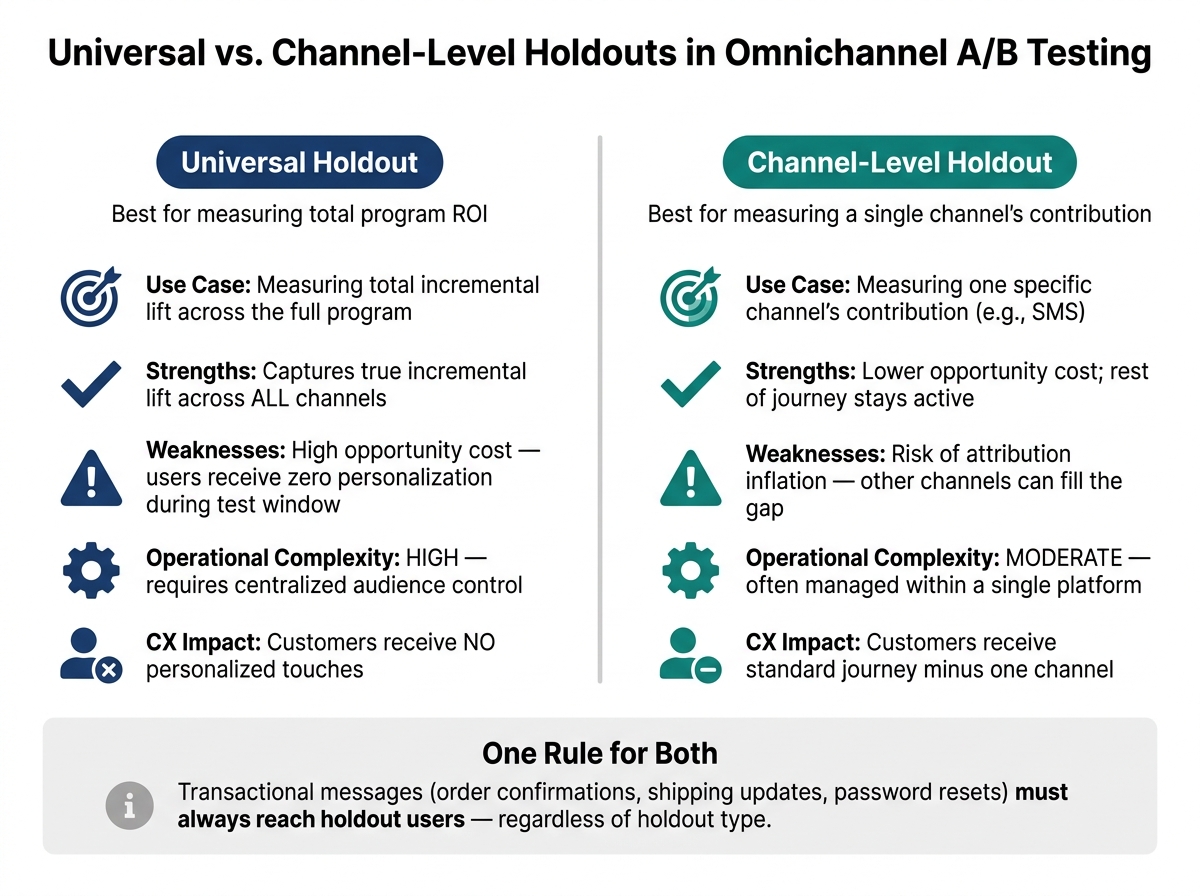
Universal vs. Channel-Level Holdouts in Omnichannel A/B Testing
Write hypotheses tied to journey outcomes
Start with the journey stage, not the channel metric.
A good omnichannel hypothesis ties directly to what the customer is trying to do at that point in the journey. Use an If/Then/Because structure: if you personalize the journey stage, then a business metric like conversion or LTV should improve because of a clear behavior change. If the "because" is weak or missing, the test is not ready.
Pick the primary metric based on the journey stage. Then add a guardrail metric like unsubscribe rate or bounce rate so you can spot experience damage early. Define the metric first, then choose the holdout that can measure it cleanly.
Choose between universal and channel-level holdouts
Choose the holdout type first. That choice shapes how you read the test.
A universal holdout measures total incremental lift across the full program. The tradeoff is simple: opportunity cost is high because those users get no personalized touches during the test window.
A channel-level holdout removes users from only one channel, such as SMS, while the rest of the journey continues as usual. It carries less risk and is easier to run, but results can look better than they are if other channels fill the gap and take credit for conversions the withheld channel might have driven.
| Feature | Universal Holdout | Channel-Level Holdout |
|---|---|---|
| Use Case | Measuring total program ROI | Measuring a specific channel's contribution |
| Strengths | Captures true incremental lift across all channels | Lower opportunity cost; the rest of the journey stays active |
| Weaknesses | High opportunity cost; users receive no personalization | Risk of attribution inflation from other channels |
| Operational Complexity | High - requires centralized audience control | Moderate - often managed within a single platform |
| CX Impact | Customers receive no personalized touches | Customers receive a standard journey minus one channel |
Transactional messages still need to go to holdout users. Order confirmations, shipping updates, and password resets are operational, not marketing.
The next step is audience randomization and timing rules so the journey stays intact.
Define channel-level variants without changing too many variables at once
The most common mistake in omnichannel testing is changing too many things at once.
If you change the subject line, CTA, creative, send time, and channel sequence in the same test, you will not know what caused the result. It muddies the readout fast.
Keep the test focused on one variable class at a time:
- Channel-level execution
- Journey-level orchestration
Do not test both in the same sequence.
| Test Type | What You're Testing | Primary Success Metric |
|---|---|---|
| Channel-Level | Subject lines, CTA colors, creative, send time | Open rate, CTR, channel-specific conversion rate |
| Journey-Level | Channel mix, touchpoint order, delays between touches | Purchase conversion rate, revenue per user ($), repeat purchase rate |
If you're testing a change to the channel mix, don't test a new subject line in that same sequence. The result gets hard to interpret, and mixed messaging may show up in guardrail metrics before it shows up in the primary metric.
That separation keeps the setup clean before you move into audience splits and orchestration. Once the hypothesis, metric, and holdout are set, use randomized splits and orchestration rules to launch the test.
Run the test: audience splits, timing, and orchestration rules
Build randomized audience splits that avoid contamination
Once the holdout is set, protect that split across every touchpoint. The main risk in omnichannel testing is contamination: the same customer lands in control in one channel and treatment in another. When that happens, you can't trust the readout.
Assign users to a group before any personalization logic or message delivery starts. One customer should follow one journey, not two. Control and treatment groups must stay mutually exclusive across email, SMS, push, web, and paid media for the full test window. For paid media with tight targeting, user-level holdout tests can be a clean way to compare exposed users with a control group [4]. If user-level tracking is hard because of privacy limits or anonymous traffic, geo matched-market testing is a practical fallback. In that setup, you pair regions with similar past performance as treatment and control groups [4].
Define lifecycle segments before launch, then keep them fixed for the length of the test.
Run tests for full journey windows, not early winners
After the split is locked, timing decides whether the journey stays intact. Do not stop the test before the full journey window closes. Set sample size and duration up front using your MDE. If lift comes in below that threshold, the test is underpowered.
Spacing between messages matters too. If email, SMS, and push all hit the same user in a tight window, you add noise and muddy attribution. Build frequency caps and wait windows into your orchestration rules so channels don't stack on the same user. Keep the touchpoint sequence the same for everyone in the segment [2].
| Timing Approach | Risk | Recommended Practice |
|---|---|---|
| Short window | False positives; journey incomplete | Use only for high-traffic, single-step tests |
| Separate holdouts in each platform | Contamination across channels | Use one control assignment across all channels, not separate holdouts inside each platform |
Use top analytics tools that support centralized control groups and cross-channel delivery
This only works when one orchestration layer enforces the rules across channels. Use a single orchestration layer to keep audience assignments aligned across CRM, email, SMS, push, web, and paid media. The key point is simple: one control assignment across all channels, not separate holdouts inside each platform.
Read results correctly across channels and journeys
Compare channel metrics with business metrics
Once the journey window closes, read the outcome at the same level you tested: the full customer journey. Channel metrics tell you how people reacted in the moment. Business metrics tell you whether the test changed the outcome that matters.
In omnichannel tests, one channel can look strong while the full path underperforms later. A high open rate or click-through rate may look good on its own, but that does not mean the sequence drove conversion. Judge the whole sequence, not one touchpoint.
| Metric Type | Examples | What It Tells You | Where It Can Mislead |
|---|---|---|---|
| Channel-level | Open rate, CTR, response rate | Immediate reaction to a message | High engagement doesn't guarantee conversion |
| Journey/business-level | Revenue per user, ROI, conversion rate, AOV, LTV | Business impact of the experiment | Slower to reach significance; harder to attribute |
When you're reporting to finance or operations, start with revenue or a revenue proxy like AOV. Don't lead with CTR or open-rate gains. Those numbers can help explain what happened, but they should not carry the story.
Keep guardrail metrics in view too, so improving one touchpoint doesn't hurt another part of the journey.
Use the holdout to check whether engagement turned into incremental business impact.
Use holdouts and incrementality methods to measure true lift
Compare treatment and holdout outcomes at the journey level or channel level, based on how the test was built. The gap in business outcomes is your incremental lift - the impact caused by the test.
If you want a deeper read, compare actual results with a forecast built from past performance, alongside a matched control group. That helps separate lift from normal variation [3].
The rule here is simple: judge success on incremental revenue and downstream behavior, not engagement spikes. If open rate goes up but revenue per user or retention does not move, that is not a win.
Before rollout, check whether lift holds by device or region. Break out results by device and region first, because aggregate lift can hide drag in specific segments [1][6].
Scale winning tests without damaging journey flow
A winning test is not ready for rollout the moment you see lift. First, make sure it holds up by segment and clears your guardrails. Treat rollout as a controlled extension of the test, not a handoff. The same cross-channel logic used in the test needs to stay in place during rollout.
Validate, document, and roll out changes across all affected channels
Before rollout, check the segments most likely to behave differently at scale. Break results out by audience sub-groups, and if a variant shows unusually large lift, rerun it before expanding.
After segment checks, review guardrail metrics like unsubscribe rates, bounce rates, and downstream conversion using analytics tools for business. The goal is simple: confirm the new rule does not hurt another part of the journey while helping this one. Then document the test setup, results, and learnings in a central repository. Only 50% of experimentation teams maintain one [5], so this is a practical control that helps protect later journey decisions. Roll out only after the result holds through one full business cycle.
Once the change clears validation, report it in business terms. Use iROAS to show incremental revenue caused by the change, not just revenue attributed to it.
FAQs
How do I choose between a universal and channel-level holdout?
Choose a universal holdout if your goal is one clean control group across the full customer journey. It gives you the clearest read on true incremental lift and avoids cross-channel interference.
Choose a channel-level holdout if you need to measure the impact of one specific channel while everything else stays the same.
In either setup, keep your audience splits consistent. Also reduce control-group exposure in other channels as much as possible, since bleed-through can muddy the results.
How long should an omnichannel A/B test run?
Run the test until it hits statistical significance based on a set duration and sample size - not early signals. A common rule is at least 7 days so you smooth out day-to-day traffic and behavior swings. If you still have not reached significance, extend the test by another week.
Set the timing around your minimum detectable effect (MDE) too. Don’t stop because an early trend looks promising. Short-term swings can point you in the wrong direction.
What metrics should I use to judge omnichannel lift?
Use conversion rate as the main KPI. It should match the goal of that stage in the journey.
Then add a small set of support metrics to show why performance is moving:
- CTR
- Bounce rate
- Session duration
- Engagement depth
- Micro-conversions
For financial impact, track revenue per user, AOV, and CPA. For longer-term impact, look at retention and CLV.
One more thing matters: don’t just look at top-line movement. Confirm incremental lift with holdout or control groups.