Affiliate tracking software helps you monitor clicks, conversions, payouts, and commissions efficiently. With the affiliate industry projected to hit $27.78 billion by 2027, choosing the right tool is critical for success. This article compares five popular platforms: Everflow, Post Affiliate Pro, Tapfiliate, Rewardful, and AnyTrack, focusing on their features, pricing, and best use cases. Here's a quick summary:
- Everflow: Ideal for enterprises managing high traffic. Offers advanced analytics, first-party tracking, and fraud detection. Starting at $750/month.
- Post Affiliate Pro: Flexible for various business models, with features for multi-level marketing and robust fraud prevention. Starts at $89/month.
- Tapfiliate: Best for e-commerce and SaaS, with user-friendly setup and unlimited affiliates. Pricing starts at $89/month.
- Rewardful: Tailored for SaaS and subscription businesses using Stripe, with automated commission tracking. Starts at $49/month.
- AnyTrack: Focuses on multi-channel attribution and data orchestration, perfect for marketers managing multiple networks. Plans start at $100/month.
Quick Comparison
| Tool | Starting Price | Best For | Key Features | Integration Count |
|---|---|---|---|---|
| Everflow | $750/month | High-volume enterprises | Advanced analytics, fraud detection | High (ads, CRMs) |
| Post Affiliate Pro | $89/month | Multi-model businesses | MLM tools, fraud prevention | 220+ integrations |
| Tapfiliate | $89/month | E-commerce/SaaS | Unlimited affiliates, ease of use | 30+ integrations |
| Rewardful | $49/month | SaaS/Stripe users | Recurring commissions, no-code setup | Stripe-focused |
| AnyTrack | $100/month | Multi-network marketers | Unified attribution, server tracking | 300+ integrations |
Each tool caters to different business needs, so evaluate your goals, budget, and technical requirements to find the best fit.
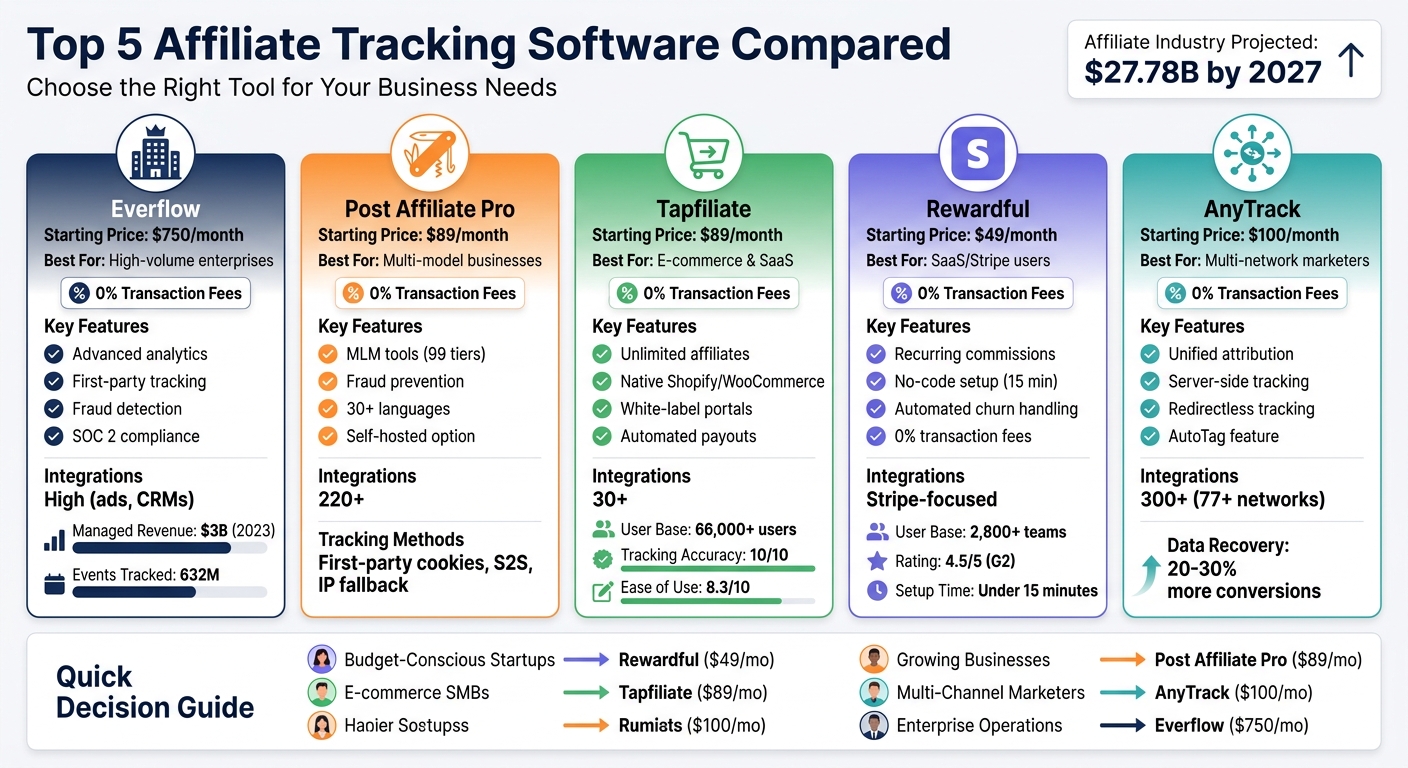
Affiliate Tracking Software Comparison: Features, Pricing & Best Use Cases
Top 6 Affiliate Marketing Tools 2025 (Full Comparison)
sbb-itb-5174ba0
Everflow
Everflow caters to high-volume operations, making it a strong contender for enterprise networks and multi-client agencies. In 2023 alone, the platform managed $3 billion in revenue and tracked 632 million events - a testament to its scalability and reliability [8]. By relying on first-party tracking instead of cookies, it sidesteps growing browser restrictions. It also supports QR codes for offline campaigns and view-through attribution for impressions, ensuring comprehensive data capture [7].
One standout feature is Dimensional Analytics, which provides real-time performance insights segmented by placement, city, and device [8]. Josh Littler, CEO of Digital Mojito Limited, praised the platform:
Their intuitive interface and real-time data analytics empower me to make well-informed decisions for maximizing ROI [8].
Everflow integrates seamlessly with major e-commerce platforms like Shopify, BigCommerce, WooCommerce, and ClickFunnels, while also offering attribution for social media campaigns on Google, Facebook, and TikTok [6].
Another highlight is the Partner Marketplace, which connects brands with vetted affiliates across industries like finance, e-commerce, and lead generation [8][10]. To combat digital ad fraud - projected to result in $172 billion in losses by 2028 - Everflow includes built-in fraud detection tools. For example, Unlock Finance reported saving $100,000 by using Everflow's rule-based payouts to block fraudulent conversions, while also achieving 740% more verified leads [9]. These features make Everflow a powerful tool for enterprises, despite its higher price point.
Pricing starts at $750 per month, with a six-month minimum commitment and an onboarding fee [5][6]. For high-volume users, costs can exceed $5,000 monthly as operations scale [4]. Smaller teams should note that the technical setup often requires developer assistance and several weeks of training, which might make it less suitable for smaller-scale operations [4].
Pros and Cons
| Strengths | Limitations |
|---|---|
| Real-time analytics with placement-level insights [8] | High starting cost ($750+ per month) [5] |
| First-party tracking avoids cookie restrictions [7] | Steep learning curve; may require developer support [4] |
| Built-in fraud detection and SOC 2 compliance [6][4] | Costs increase significantly with volume [4] |
| Integrations with Shopify, TikTok, Meta, and Google Ads [6][7] | Too advanced for small or low-traffic programs [4] |
| Partner Marketplace for affiliate connections [8][10] | Hidden settings can be overwhelming for new users [4] |
Post Affiliate Pro
Post Affiliate Pro strikes a balance between flexibility and control, offering advanced features without the complexity of enterprise-level solutions. Similar to Everflow, it tackles modern tracking challenges, but its standout strength lies in its ability to adapt to diverse business models. With over 220 integrations - including Shopify, WooCommerce, Magento, and BigCommerce - it seamlessly connects with major e-commerce platforms. For those seeking complete control, a self-hosted version is also available [11][12].
The platform employs a robust tracking system that covers all bases. It uses first-party cookies, third-party cookies, and HTML5 local storage to store visitor IDs. If these methods fail, it falls back on IP address and User Agent combinations. Additionally, server-to-server (S2S) tracking ensures conversions are tracked even if users clear their cache or block cookies. This is especially crucial for subscription-based businesses, where lifetime commissions tie customer IDs to affiliates [13].
Beyond tracking, Post Affiliate Pro offers tools tailored for structured marketing strategies. For instance, the Forced Matrix feature limits the number of sub-affiliates per member, making it ideal for multi-level marketing setups. The platform also supports commission structures with up to 99 tiers, recurring commissions for SaaS models, and performance-based rewards [11].
Other key features include automated mass payments, which streamline affiliate payouts, and robust fraud prevention measures. The system can detect duplicate commissions from the same order ID, flag suspicious IP addresses, and block bot traffic automatically. For those focused on SEO, the platform supports direct links and mod rewrite options, removing affiliate parameters from URLs to create cleaner, more trustworthy links [13].
Features vs. Pricing
| Plan | Monthly Cost | Annual Cost | Tracking Requests | Best For |
|---|---|---|---|---|
| Starter | $89 | $79/month | 10,000 | Small programs testing affiliate marketing |
| Pro | $139 | $129/month | 1,000,000 | Growing businesses with established traffic |
| Ultimate | $269 | $249/month | 6,000,000 | High-volume operations needing MLM features |
| Network | $649 | $599/month | 20,000,000 | Agencies managing multiple client programs |
The Pro plan, priced at $129/month (billed annually), is a great fit for mid-sized businesses. It includes access to all 220+ integrations, unlimited affiliates, and advanced reporting [11]. For agencies overseeing multiple client accounts, the Network plan is the better choice. It offers features like multiple merchant accounts and audit logs, designed for multi-client operations [11][12].
For businesses needing extra tracking capacity, additional requests cost $1 per 10,000 on the Pro plan, while the cost drops to $0.40 per 10,000 on the Ultimate tier. High-traffic sites should carefully estimate their needs to manage costs effectively [11]. All plans come with a 30-day free trial and full setup assistance, which helps ease the learning curve of this feature-rich platform [11].
Tapfiliate
Tapfiliate is a versatile option tailored for e-commerce brands looking for a reliable tracking solution that balances functionality with accessibility. With over 66,000 users and a strong 8.1/10 rating, it stands out for its perfect 10/10 tracking accuracy [16]. One of its standout features is the unlimited affiliate policy across all plans - there are no additional fees per affiliate, making it an appealing choice for brands aiming to scale without extra costs.
Setting up Tapfiliate takes around 30–60 minutes for first-time users. While this setup time is longer than some basic tools, it’s still more straightforward than many enterprise-level platforms [15]. For Shopify and WooCommerce merchants, native integrations mean they can get started without needing a developer. However, users will need to manually configure tracking snippets and event triggers. With an ease of use rating of 8.3/10, the platform strikes a good balance between simplicity and effectiveness [16].
The pricing starts with the Essential plan at $89/month, which includes up to 20,000 clicks and 2,000 conversions [16][18]. If you exceed these limits, additional fees apply - $1.50 per 1,000 extra clicks and $15 per 1,000 extra conversions [19]. The Pro plan, priced at $149/month, introduces extra features like white-label portals, automated payouts via Trolley, and a higher monthly click cap of 100,000 [16][18].
"We went through many affiliate platforms and they were all either complicated, out-of-date or expensive... Tapfiliate is so easy to use that it almost makes me cry."
– Henri Liljeroos, CEO & Co-founder, Campwire [20]
Tapfiliate supports over 30 direct integrations, including Stripe, PayPal, and BigCommerce, making it suitable for a wide range of business models, from SaaS to subscription services and dropshipping [14][15]. In 2026, the platform introduced a Spanish-language advertiser portal, broadening its usability for international users [14]. One case study reported an impressive 108.71% growth in conversions within just eight weeks of implementation [20].
Integration Options vs. Performance
| Metric | Tapfiliate | Post Affiliate Pro | Rewardful |
|---|---|---|---|
| Starting Price | $89/mo | $129/mo | $49/mo |
| Ease of Use Rating | 8.3/10 | 7.8/10 | 8.8/10 |
| Shopify/WooCommerce | Native Integration | Supported | Stripe-focused |
| Affiliate Limit | Unlimited | Varies by plan | Varies by plan |
| Setup Time | 30–60 mins | High (Steep curve) | Low (Simple) |
| Customer Base | 66,000+ users | Not disclosed | Not disclosed |
| Direct Integrations | 30+ | 220+ | Limited (Stripe-centric) |
This comparison highlights Tapfiliate’s strengths in the mid-tier market, particularly for businesses prioritizing ease of use and scalability.
However, there are some limitations to keep in mind. For instance, Tapfiliate’s WooCommerce integration may face issues with custom checkout pages, which could be a challenge for stores with highly tailored setups [17]. Additionally, the Essential plan does not include automated payouts, requiring users to either upgrade to the Pro plan or manually handle payments through Trolley [17][19]. For businesses with more complex needs, Tapfiliate offers an Enterprise tier with custom pricing, which supports multi-account management [16].
These factors make it clear that while Tapfiliate is a strong contender for many e-commerce brands, it’s essential to evaluate its features against your specific business needs and technical requirements.
Rewardful
Rewardful is tailored specifically for SaaS and subscription businesses using Stripe or Paddle. Trusted by over 2,800 teams and boasting a 4.5/5 rating on G2, this platform is designed to work without requiring developer assistance [22]. Its two-way sync with Stripe integrates directly with your billing system, allowing setup in under 15 minutes [23]. Rewardful automatically tracks recurring commissions, handling upgrades, downgrades, cancellations, prorations, and refunds seamlessly. Unlike tools built for broader affiliate networks, it’s optimized for businesses relying on subscription-based revenue, ensuring accurate tracking of recurring commissions.
Pricing begins at $49/month for up to $7,500 in monthly affiliate revenue. For businesses handling higher volumes, the Growth plan is $99/month, and the Enterprise plan is $149/month [23]. Unlike competitors like PartnerStack, which charge transaction fees ranging from 3–15% on top of subscription costs, Rewardful keeps it simple with 0% transaction fees across all plans. This makes it an appealing option for businesses scaling their affiliate programs.
Rewardful also simplifies operations by automatically stopping commissions in Stripe when a customer cancels, eliminating the need for manual adjustments [22]. It supports both link-based tracking and coupon code attribution, making it ideal for influencers on platforms where clickable links aren’t always feasible. Additionally, it streamlines affiliate payments by supporting PayPal and Wise for mass payouts [23].
"What I love about Rewardful is how easily it integrates with Stripe. All I have to do is pass the affiliate's ID to Stripe Checkout, and Rewardful magically handles the rest for us."
– Danny Postma, Founder, HeadshotPro [22]
The platform’s effectiveness is backed by real-world examples. Aragon.ai, for instance, generated over 50% of its revenue through affiliates within just a few months of launching its program, eventually scaling to 2,000 affiliates and driving $1 million in revenue [22]. Similarly, Podia doubled its affiliate revenue within four to five months after switching from Impact to Rewardful in 2025 [24]. Uplisting, another loyal user, attributed approximately $700,000 in total sales to its affiliate program over four years [23].
Use Case Comparison
The table below highlights key features of Rewardful and their advantages for SaaS and subscription-based businesses.
| Feature | Rewardful Starter ($49/mo) | Benefit for SaaS/Subscription Businesses |
|---|---|---|
| Stripe Integration | Native, one-click | Syncs automatically with billing events for accurate tracking |
| Churn Handling | Automated | Stops commissions immediately when a customer cancels |
| Plan Changes | Automated | Adjusts commissions in real time for upgrades and downgrades |
| Transaction Fees | 0% | Keeps costs predictable without a "success tax" on high revenue |
| Revenue Cap | $7,500/mo | Affordable entry point for startups to test affiliate programs |
| Payouts | PayPal/Wise Mass Pay | Saves time by simplifying affiliate payments |
One limitation of the Starter plan is its $7,500/month revenue cap. If your affiliate program exceeds this threshold, you’ll need to upgrade to the Growth plan, which increases costs as your program scales. While Rewardful offers a free 14-day trial, it does not include a free-forever plan, which may be a drawback for businesses seeking a no-cost entry option.
AnyTrack
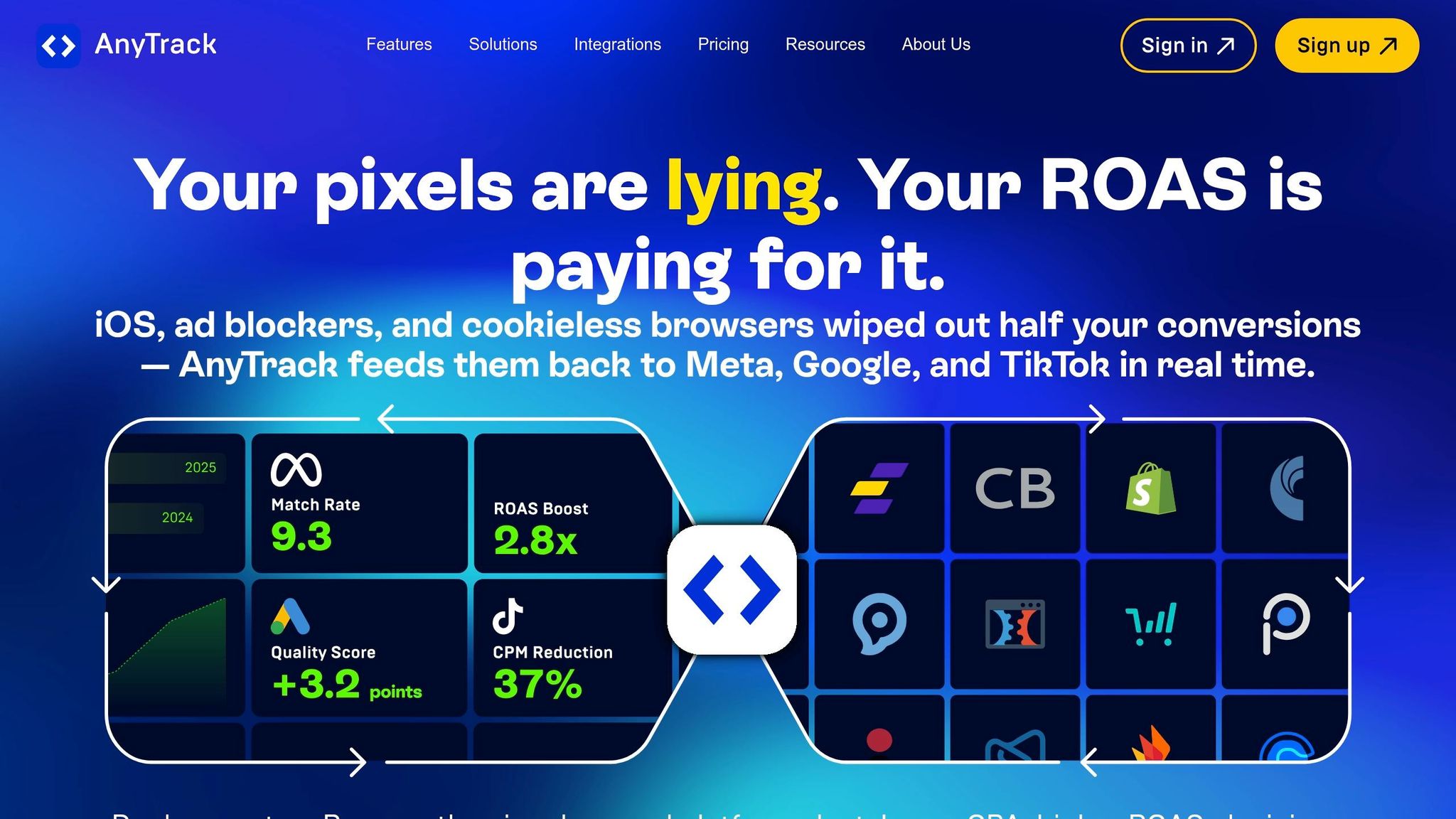
AnyTrack stands out among affiliate tracking tools by prioritizing data orchestration rather than just tracking conversions. It doesn’t just log clicks and sales - it collects signals from various sources, enriches them with over 30 data points, and sends this information to platforms like Facebook, Google, and TikTok in real time [25][28]. This makes it a go-to choice for affiliate marketers managing multi-channel campaigns who need precise attribution across different platforms.
One of its defining features is Redirectless Tracking. Unlike traditional trackers, AnyTrack’s tag handles onsite tracking and link tagging without being part of the redirect process. This avoids the risk of ad platforms flagging your links as "cloakers" [26][28]. With its AutoTag feature, AnyTrack scans pages for affiliate links and automatically appends a unique click_id, eliminating the need to manually create tracking links [27][28]. This approach caters perfectly to the evolving demands of data-driven affiliate marketing. For those looking to integrate these insights into a broader customer journey, marketing analytics tools can provide deeper behavioral tracking.
Another standout feature is its server-side tracking, which recaptures 20–30% of conversions typically lost to ad blockers and iOS privacy restrictions. For example, in an eCommerce case study, AnyTrack helped resolve data discrepancies across Meta, Taboola, Google, and TikTok [25][29]. Over a three-year span, eCommerce marketer Tsuf Peterson used AnyTrack to address overlapping data for a Shopify brand. By leveraging AnyTrack as a "single source of truth", the brand bypassed Meta’s pixel restrictions through custom conversions, ensuring accurate purchase tracking [25].
"Before discovering AnyTrack... we were dealing with overlapping data and misreporting across all of our channels - Meta, Taboola, Google, and TikTok with every channel over-reporting and claiming credit for the same purchases."
– Tsuf Peterson, eCommerce Marketer [25]
Pricing and Integrations
AnyTrack offers three pricing tiers:
- Starter Plan: $100/month (100,000 sessions, 1 website, all major ad integrations)
- Personal Plan: $150/month (500,000 sessions, 3 websites, GA4 integration)
- Advance Plan: $300/month (3,000,000 sessions, 10 websites, unlimited CAPI integrations)
All plans include a 14-day free trial. The platform supports over 300 integrations and works with 77+ affiliate networks, including ShareASale, CJ, Impact, and ClickBank [27][28][29].
Attribution Accuracy vs. Integration Count
The table below highlights how AnyTrack’s capabilities stack up against traditional affiliate trackers, particularly in terms of attribution and integration.
| Capability | Traditional Affiliate Trackers | AnyTrack |
|---|---|---|
| Setup Complexity | One tracking link per offer per source | One postback URL per network covers all offers |
| Link Management | Manual redirect links | Original affiliate links, auto-tagged |
| Ad Platform Integration | Manual CSV exports or none | Direct Conversion API (Google, Meta, TikTok) |
| Data Recovery Rate | Vulnerable to ad blockers and iOS 14+ | Recovers 20-30% of hidden conversions [25][29] |
| Audience Building | Not available | Custom and lookalike audiences from conversion data |
| Attribution Method | Last-click within the tracker | Cross-channel with first-party data |
| Integration Count | Limited to affiliate networks | 300+ marketing stack integrations [28][29] |
These features underline AnyTrack’s ability to simplify complex tracking processes while improving data accuracy and integration across platforms.
Comparison Summary
Choosing the right affiliate tracking software depends on your business size, technical requirements, and growth plans. For small businesses with tighter budgets, Rewardful ($49/month) and Tapfiliate ($74/month) provide affordable entry points and easy setups [30][12]. Medium-sized businesses might find Post Affiliate Pro ($97/month) or Tapfiliate better suited, as they offer advanced features and scalable pricing [12]. For enterprise-level operations, Everflow (custom pricing) or Post Affiliate Pro's self-hosted option ensures robust data control and flexibility [12][1]. These distinctions are especially important as tracking technologies evolve.
The affiliate tracking landscape has seen rapid changes. By 2026, 85% of affiliate platforms are expected to use AI-driven tracking technologies, a jump from 60% in 2022 [21]. Server-side tracking is now the go-to method for bypassing third-party cookie limitations, and around 30% of programs have adopted blockchain-based tracking for greater transparency [21]. These advancements are vital, considering that 90% of affiliate programs fail within their first year due to conversion tracking issues [30].
Here’s a quick overview of the key features and pricing for popular affiliate tracking tools:
| Tool | Starting Price | Best For | Key Strength | Integration Count |
|---|---|---|---|---|
| Everflow | Custom pricing | Enterprise multi-channel campaigns | Unified tracking across Google, Meta, TikTok [2][21] | High (ads, CRMs, carts) |
| Post Affiliate Pro | $97/month | Global teams & networks | 30+ languages, 200+ integrations [1][3][12] | 200+ [3] |
| Tapfiliate | $74/month | E-commerce & SaaS SMBs | Shopify/Stripe quick setup [3][21] | 30+ [3] |
| Rewardful | $49/month | Stripe-based SaaS | 15-minute no-code setup [21] | Focused (Stripe, Paddle) |
| AnyTrack | $50–$200/month | Multi-network consolidation | Unified dashboard for 50+ affiliate networks with GA4 sync [31] | 50+ networks [31] |
Notably, all these tools come with 0% transaction fees on their monthly subscription plans [30]. To ensure a good fit, take advantage of each platform's 14-day free trial and test tracking accuracy with real-world traffic. If you’re looking for broader analytics solutions beyond attribution, the Marketing Analytics Tools Directory is a great resource for additional options to track campaign performance and audience insights.
FAQs
Do I need server-side tracking now that cookies are being blocked?
Server-side tracking is gaining importance as browsers block more cookies and privacy regulations grow stricter. Unlike client-side tracking, which relies on the user's browser, server-side tracking processes data directly on the server. This method ensures more accurate attribution and insights, even when cookies are unavailable.
By handling data on the server, this approach helps marketers maintain reliable analytics while staying aligned with evolving privacy standards. It's a smart way to track conversions and user behavior effectively, offering a solution that adapts to the changing digital landscape.
How do I estimate my monthly tracking volume before choosing a plan?
To figure out your monthly tracking volume, take a close look at your traffic sources, click counts, and conversion rates to calculate the total activity. Don’t forget to factor in things like projected growth, complex commission setups, or high transaction volumes, as these can influence which plan works best for you. By analyzing this data, you'll be able to pick a plan that fits your needs without overspending or hitting capacity limits.
What’s the easiest way to prevent affiliate fraud without hurting legit partners?
To tackle affiliate fraud without harming relationships with legitimate partners, a multi-layered strategy is essential. Start by thoroughly vetting affiliates during the registration process to ensure they meet your standards. Regularly monitor their activity to spot any unusual patterns or red flags. Dive into detailed reports to identify suspicious behavior before payouts are made. By combining proactive monitoring with careful vetting, you can protect your program’s integrity while maintaining trust with genuine affiliates.