AI attribution is changing how marketers evaluate campaign success. Here's what you need to know:
- Last-click attribution is outdated: 73% of companies still use it, but it ignores early touchpoints in the customer journey.
- Privacy changes are reshaping tracking: With third-party cookies disappearing and iOS privacy updates, trackable sessions have dropped by 40–60%.
- AI fills the gaps: Using probabilistic models, AI achieves 83–91% accuracy even with limited data.
- Real-time insights: Tools now update as often as every six hours, allowing marketers to adjust campaigns instantly.
- Predictive analytics: AI forecasts future outcomes, helping allocate budgets more effectively and boosting ROI.
To succeed, marketers need clean data, robust systems, and tools that align with their goals. By combining AI-driven insights with first-party data, businesses can improve conversion rates, reduce costs, and stay competitive in 2026.
1. Predictive Analytics and Forecasting
Core Mechanism
Predictive analytics takes attribution a step further by focusing on forecasting future outcomes rather than just analyzing past events. Machine learning models use historical data to predict future scenarios. These systems rely on algorithms like logistic regression, random forests, neural networks, Markov Chains, and Shapley Value to analyze massive datasets using website analytics tools. Metrics such as dwell time, engagement patterns, and behavioral signals are examined to predict user intent even before a conversion happens.
These models assign confidence scores by analyzing behavioral, contextual, and channel-specific data. Unlike traditional "yes/no" attribution, they assess both "propensity" (users likely to convert regardless) and "incrementality" (users influenced by an ad to take action). This ensures that marketing budgets are spent in ways that drive measurable impact. Beyond forecasting, this approach reshapes how value is assigned throughout the marketing funnel.
Advantages over Traditional Models
Predictive models offer a fresh perspective compared to traditional attribution methods. While traditional models rely on static, backward-looking rules that often overemphasize the last touchpoint, predictive models evaluate the entire customer journey dynamically.
"AI marketing analytics applies artificial intelligence - specifically machine learning algorithms - to marketing data to uncover patterns, predict outcomes, and prescribe optimal actions that human analysts would miss or take weeks to discover"
The benefits are evident in practice. For example, Hydrant, a hydration supplement brand, used predictive churn modeling to assign risk scores based on customer purchase frequency and service interactions. This resulted in a 2.6x boost in conversion rates for retention campaigns and a 3.1x increase in average revenue per customer. Similarly, a retail client employing Keen's Bayesian modeling, which analyzed $7 billion in sales data, was able to reallocate budgets based on predicted performance, achieving a 49% increase in profit ROI. While these results are impressive, implementing predictive analytics comes with its own challenges.
Key Challenges
Predictive analytics isn't a simple plug-and-play solution. For reliable results, models typically need at least 200+ conversions per month. Poor data quality is another major issue - errors like inconsistent UTM tags (e.g., "facebook" vs. "Facebook_Ads") or CRM data with duplicates and missing information can skew outputs. Additionally, privacy regulations and the decline of third-party cookies have cut trackable user sessions by 20–50%, making it harder to create complete customer profiles.
Another challenge is identity fragmentation. Modern customers interact across multiple devices and browsers, but without identity resolution, these interactions appear as separate, anonymous visits. To overcome these obstacles, companies need to invest in robust data infrastructure for 3–6 months before deploying advanced models. Poor data quality is a leading cause of failure for 60% of AI projects. A good starting point is predictive lead scoring, which typically delivers fast ROI (within 3–6 months) by helping sales teams prioritize high-potential leads.
2026 ROI Impact
By 2026, 74% of B2B marketing teams are expected to use AI marketing analytics to stay competitive. The benefits are clear: companies adopting predictive marketing analytics report 32% better lead quality and 27% faster sales cycles. On average, organizations leveraging AI marketing analytics experience 23% higher productivity and a 19% improvement in marketing ROI within the first year. Those using AI-powered predictive models for real-time decisions see 20% higher conversion rates and 15% lower customer acquisition costs.
Salesforce's Einstein AI exemplifies these results. Businesses using its predictive lead scoring, which evaluates thousands of data points such as website activity and email engagement, have seen a 30% boost in conversion rates and a 25% reduction in sales cycle length. The predictive analytics market itself is forecasted to grow from $14.5 billion to $67.86 billion by 2032, showing that this isn't just a passing trend - it's becoming a cornerstone of marketing strategy.
sbb-itb-5174ba0
2. Real-Time Processing and Automation
Core Mechanism
Predictive analytics may help forecast future trends, but real-time processing is what allows for immediate adjustments in campaigns. Real-time AI attribution takes a stream-based approach, processing event data as it happens instead of relying on batch reporting. Modern platforms pull live data from CRMs, ad servers, and social media APIs, processing it within seconds. Using tools like neural networks, Bayesian models, and Markov Chains, these systems dynamically measure the contribution of each touchpoint. Unlike older models that update data weekly or monthly, platforms like Google Ads and GA4 now refresh their Data-Driven Attribution (DDA) every six hours.
These AI systems don’t just process data quickly - they also monitor for issues like tracking errors, click fraud, or sudden performance changes. This helps address problems before they escalate and drain budgets. Instead of relying on fixed attribution windows (e.g., 7 or 28 days), these platforms adapt timing based on user behavior. For example, fast-purchase items might have a 3–5 day window, while high-consideration products could extend up to 60 days. This flexibility ensures credit is assigned based on actual user actions, not arbitrary rules. By speeding up insights, real-time processing also paves the way for automated decision-making.
Advantages over Traditional Models
Real-time processing gives marketers the ability to adjust strategies on the fly. Traditional last-click attribution often overemphasizes bottom-funnel touchpoints, but real-time AI eliminates this bias. Marketers can reallocate budgets mid-campaign based on current performance instead of waiting for outdated reports.
"This isn't just speed for speed's sake; it narrows the gap between consumer behavior and strategic response. In competitive markets, that delta time between insight and action determines campaign ROI." – Rahul Sachdeva
This rapid feedback loop also transforms creative testing. High-performing ad variations can be identified in minutes, turning A/B testing into a continuous process rather than a weeks-long ordeal. Additionally, AI models operating within data clean rooms can boost attribution accuracy by up to 40% by combining platform data with first-party CRM information, all while staying privacy-compliant.
Key Challenges
Implementing real-time systems requires a robust infrastructure that many mid-sized companies may lack. The need for rapid data processing and anomaly detection introduces technical demands that differ from traditional batch-based models. Data hygiene is another critical factor - something as small as inconsistent UTM tags (e.g., "facebook" versus "Facebook_Ads") can disrupt attribution models.
Privacy regulations like GDPR and iOS updates have further complicated tracking, reducing the number of trackable user sessions by 20% to 50%, depending on the region. To counteract this, platforms now rely on probabilistic methods to fill data gaps, offering a "statistical truth" when direct tracking isn't possible. Server-side tracking has become a preferred method, bypassing browser-based cookie restrictions by capturing data directly from servers. However, businesses should expect a 90–120 day setup period before these systems generate reliable insights for significant budget decisions.
Pricing Considerations
The benefits of real-time AI attribution are available at a range of price points, making them accessible to businesses of all sizes. Entry-level tools like Benly start at $99 per month, while mid-market solutions such as Cometly cost around $400. Enterprise platforms like Northbeam are priced at $1,000 or more.
3. Advanced Machine Learning Models for Attribution
Core Mechanism
Advanced machine learning (ML) models take attribution to the next level by integrating complex, dynamic data in real time. Techniques like Markov Chains and Shapley Value algorithms are used to measure how each interaction contributes to a customer’s decision to convert. Meanwhile, neural networks and Bayesian models handle vast amounts of data to assign credit based on actual user behavior instead of pre-set percentages.
One standout feature is identity resolution. This process consolidates fragmented identifiers into a single, unified "Golden Record" using both exact and statistical matching. When direct tracking is hindered by cookie restrictions, these models employ probabilistic inference to estimate conversions from untracked users by analyzing contextual patterns. This is especially critical as browsers like Safari now limit cookie lifespans to just one day in many cases.
Some systems are even leveraging reinforcement learning, often referred to as Agentic AI. These advanced models don’t just analyze performance - they actively make decisions, such as reallocating budgets or generating personalized offers, all aimed at increasing conversion rates in real time. This proactive approach marks a dramatic improvement in attribution compared to older methods.
Advantages over Traditional Models
Traditional attribution methods are more backward-looking, functioning like a report card that summarizes past performance. In contrast, advanced ML models act like a GPS, predicting conversion probabilities and suggesting the best next steps. These systems adapt attribution windows based on the product type, such as 3-5 days for quick purchases or up to 60 days for items requiring more consideration.
Another major advantage is the ability to separate causation from correlation. For instance, just because a click happens before a sale doesn’t mean it caused the sale. Advanced models combine attribution with incrementality testing to ensure that credited channels are driving actual revenue growth, not just claiming credit for sales that would have happened organically. By operating in data clean rooms, AI models can improve attribution accuracy by up to 40% compared to traditional methods. These capabilities go beyond measurement, actively enhancing campaign performance along the way.
Key Challenges
While these models are powerful, they come with their own set of challenges. They require large volumes of conversion data - typically at least 200 conversions per month - to generate reliable insights. Without this, the results can be skewed by statistical noise.
Privacy regulations like GDPR and CCPA further complicate matters by restricting the data that can be used for training these systems. Despite these hurdles, adoption is growing. By early 2026, 73% of organizations were still using last-click attribution as their main model, but that number is steadily declining as businesses shift toward ML-based approaches.
2026 ROI Impact
For businesses using these advanced algorithms, the payoff can be dramatic. Attribution tools typically cost between 1% and 5% of a brand’s total ad spend, but the ability to optimize campaigns in real time delivers significant returns. Companies report faster adjustments, reducing wasted ad spend and improving conversion rates.
"Attribution in 2026 isn't about finding the channel that converts - it's about understanding the network of influence." – Sushil Goel, LayerFive
To maximize the value of AI-driven attribution, businesses should validate insights with quarterly incremental lift tests to ensure credited channels are genuinely driving new revenue. Additionally, prioritizing first-party data from CRM systems or customer data platforms is crucial. This approach remains resilient as third-party cookies continue to be phased out.
Digital Marketing Attribution in 2026: Challenges and Solutions
Pros and Cons
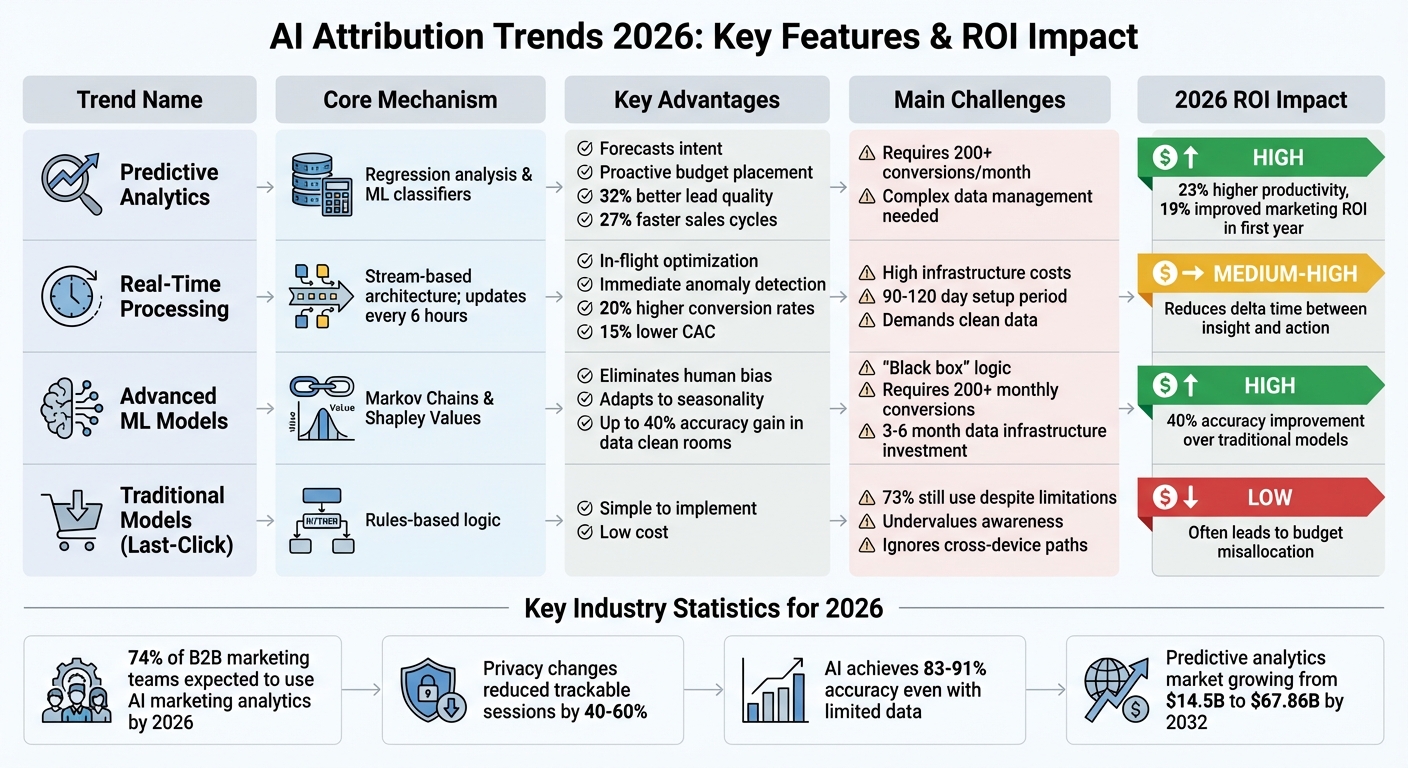
AI Attribution Trends 2026: Comparison of Predictive Analytics, Real-Time Processing, and Advanced ML Models
Here’s a breakdown of the trade-offs for each AI attribution trend mentioned earlier. Each trend offers distinct strengths and hurdles based on the methods they employ.
Predictive analytics uses forecasting to predict outcomes and adjust budgets based on expected value. This allows for proactive optimization of your channel mix. The downside? It demands a large volume of data and sophisticated management systems to ensure predictions are reliable. On the upside, the return on investment (ROI) can be impressive - you can avoid wasting your budget by reallocating spending based on forecasted results.
Real-time processing eliminates delays between data collection and action. With this approach, you can tweak budgets and identify high-performing creatives in minutes rather than days. However, it comes with steep infrastructure costs and relies heavily on clean, high-quality data. Even so, the ability to seize marginal return opportunities during live campaigns provides immediate benefits.
Advanced machine learning models get rid of the biases often found in traditional rules-based systems. Methods like Markov Chains and Shapley Value algorithms distribute credit based on actual user behavior. That said, these models can feel like "black boxes" and need at least 200 monthly conversions to produce reliable insights. When implemented effectively - particularly in data clean rooms - they can boost attribution accuracy by as much as 40%.
| Trend | Core Mechanism | Advantages over Traditional Models | Key Challenges | 2026 ROI Impact |
|---|---|---|---|---|
| Predictive Analytics | Regression analysis and ML classifiers | Forecasts intent; proactive budget placement | Requires high data volume and complex data management | High: Optimizes spend based on future value |
| Real-Time Processing | Stream-based architecture and live APIs | In-flight optimization; immediate anomaly detection | High infrastructure costs; demands clean data | Medium-High: Reduces "delta time" between insight and action |
| Advanced ML Models | Markov Chains and Shapley Values | Eliminates human bias; adapts to seasonality | "Black box" logic; requires high data volume and complex data management | High: Up to 40% accuracy gain in clean rooms |
| Traditional Models | Rules-based logic | Simple to implement; low cost | Undervalues awareness; ignores cross-device paths | Low: Often leads to budget misallocation |
Traditional models still serve a purpose for businesses with tighter budgets or straightforward customer journeys. They’re easy to set up and require minimal technical know-how. However, as William Flaiz points out, these models often undervalue upper-funnel activities like awareness and consideration, which can result in underfunding those crucial areas. In fact, about 73% of companies still using last-click attribution are missing out on significant optimization opportunities.
This analysis highlights how businesses can use directories to identify the best analytics tools for business to find the most suitable AI attribution solutions for their needs.
How Directories Help You Find AI Attribution Tools
By 2026, marketing stacks are expected to include 10–20+ platforms, each with its own tracking methods. This makes evaluating AI attribution tools on your own a daunting task.
The Marketing Analytics Tools Directory simplifies this process by organizing tools into specialized resource hubs. For instance, the "AI For Businesses" section focuses on automation and decision-making, while the "PPC Marketing Hub" zeroes in on ROI optimization. This structured approach builds on advanced analytics and real-time insights, making it easier to pinpoint the right solution.
Each tool profile highlights essential features like multi-touch attribution and real-time reporting filters, helping you refine your search based on specific needs. The directory also includes a "Related Tools" section, which allows you to compare similar platforms side-by-side. For example, you can view real-time social analytics tools alongside commerce analytics and unified marketing automation solutions.
The directory further organizes tools into a clear taxonomy, dividing them into categories like "Marketing Analytics Tools", "Attribution Analytics Tools", and "Marketing Performance Tools". This system helps you quickly find tools tailored to your business model - whether you're focused on Shopify-based eCommerce, B2B strategies, or enterprise omnichannel operations.
Beyond just tool listings, the directory offers educational content to deepen your understanding of advanced attribution trends. Through its Knowledge Hub and blog, topics like "Machine Learning for CLV in Subscription Models" and "Real-Time Personalization" are explored. This ensures you grasp not only what tools are available but also why certain features are important.
Sushil Goel, CEO of LayerFive, explains:
"Attribution accuracy is now a data architecture problem, not a reporting problem"
The directory helps marketers tackle key challenges like identity resolution, server-side tracking, and incrementality testing. By streamlining the selection process, it equips you to make the most of AI-driven attribution insights discussed earlier.
Conclusion
By 2026, AI attribution will go beyond simply analyzing past actions - it will actively predict and guide immediate decisions. This evolution from descriptive to prescriptive intelligence is set to redefine marketing, shifting its role from a cost center to a revenue driver. With Google Chrome phasing out third-party cookies - impacting over 60% of global browser traffic - marketers will increasingly rely on first-party data and AI-driven conversion models.
This shift demands a balanced approach, blending tactical execution with strategic planning. For a well-rounded strategy, consider combining multi-touch attribution with media mix modeling. Advanced identity resolution, which boasts accuracy rates 2–5 times higher than standard methods, provides the strong foundation AI agents need to function effectively and autonomously.
To make the most of this transformation, start with the basics. Standardize your UTM parameters, implement server-side tracking, and connect your CRM to ad platforms to minimize bias in your data. Instead of overhauling your budget all at once, try reallocating 10–15% based on initial AI-driven insights, and validate these changes with quarterly incrementality tests.
Choose tools that align with your business size and budget. Options range from $99/month tools like Benly to enterprise platforms starting at $1,000/month. Just ensure your chosen platform supports enough conversion volume to deliver actionable insights.
The future will favor marketers who can turn AI-generated probabilities into actionable human insights. Focus on metrics that matter, like attributed revenue and Customer Lifetime Value, rather than superficial ones. And remember, while attribution software can identify issues, the real challenge lies in fostering the discipline to act on these insights.
FAQs
Do I have enough conversions for AI attribution to work?
AI attribution models thrive when they have plenty of data to work with, especially for mapping out complex customer journeys across various channels. To get reliable, statistically sound insights, you’ll typically need hundreds or even thousands of conversions within a given period. If your conversion numbers are on the lower side, the results might not be as dependable. However, as your data pool grows, the models can deliver more accurate results. Take a close look at your current data volume to see if it aligns with these recommendations.
How can I improve attribution without third-party cookies?
To navigate attribution challenges without third-party cookies, consider using AI-powered techniques like probabilistic models and machine learning. These advanced methods can predict customer interactions across various channels, even in the absence of cookies, improving the precision of your measurement efforts. Additionally, cookieless strategies like smart link attribution and privacy-preserving AI models offer a broader view of conversions while respecting user privacy. Together, these approaches allow for accurate, data-driven attribution in a privacy-focused landscape.
What’s the safest way to shift budget using AI insights?
The smartest way to adjust budgets with confidence is by utilizing real-time AI attribution models. These models dig deep into customer journey data, simulate different budget scenarios, and suggest precise adjustments to help you maximize ROI - all while maintaining compliance and accuracy.
To make the most of this approach, rely on tools that offer continuous updates and actionable insights. This ensures you're always equipped to make informed decisions and adapt quickly to changing conditions.