Ever wonder how e-commerce sites know exactly what you want? Recommendation engines do the heavy lifting, analyzing customer behavior with analytics tools to suggest relevant products. These tools can increase sales, improve customer loyalty, and drive long-term business growth. Here's a quick rundown of the top 5 tools for e-commerce recommendation engines:
- Amazon Personalize: Offers pre-built machine learning models, real-time suggestions, and seamless AWS integration. Pricing starts with a free tier, then pay-as-you-go.
- Google Recommendation AI: Uses advanced AI to predict user intent. Ideal for businesses using Google Cloud, with pricing based on API usage.
- Dynamic Yield: Focuses on advanced personalization with deep learning. Best for large enterprises, starting at $35,000 annually.
- Bloomreach Discovery: Tailored for enterprise retailers, it leverages AI to boost conversions. Pricing is custom, starting around $2,000 monthly.
- Recombee: Developer-friendly with hybrid AI, flexible APIs, and a freemium model. Paid plans start at $99/month.
Quick Comparison
| Tool | Best For | Integration | Scalability | Starting Cost |
|---|---|---|---|---|
| Amazon Personalize | AWS users, real-time data | AWS ecosystem, APIs | Enterprise-ready | Free tier + usage |
| Google Recommendation AI | Google Cloud users | Google Cloud API | Global scale | $600 free credits |
| Dynamic Yield | Large enterprises | Shopify, Magento, APIs | Handles millions of SKUs | $35,000/year |
| Bloomreach Discovery | Enterprise retailers | Shopify, Salesforce, APIs | Enterprise-level | $2,000/month |
| Recombee | Developers, small biz | APIs, SDKs in 10+ languages | Handles large catalogs | $99/month |
Each tool has its strengths depending on your business size, budget, and technical setup. Dive into the full article to find the best fit for your needs.
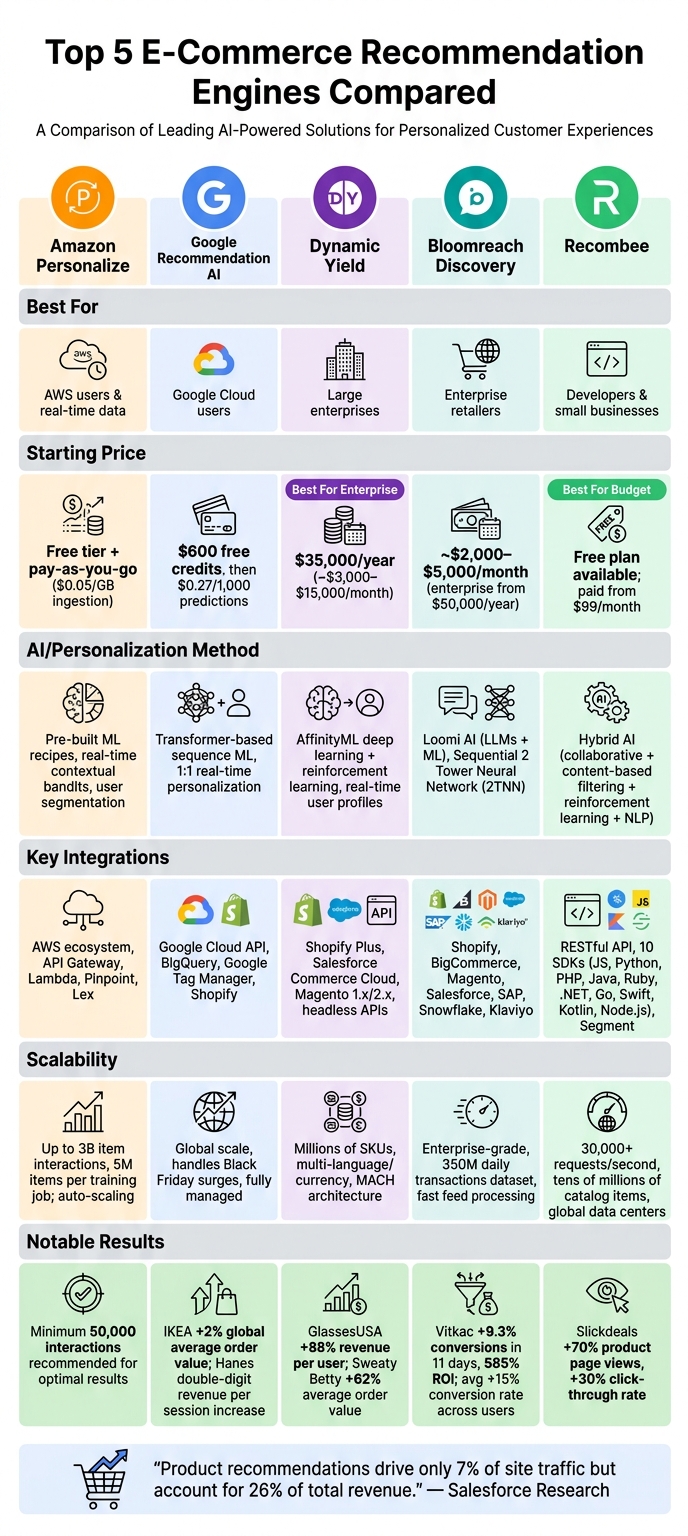
Top 5 E-Commerce Recommendation Engines Compared
How to add 'Recommendations' to an e-commerce site
sbb-itb-5174ba0
1. Amazon Personalize
Amazon Personalize is a managed machine learning (ML) service from AWS designed to deliver personalized product recommendations. Built on the same technology that powers Amazon.com’s recommendations, it is accessible to businesses through a pay-as-you-go API.
Personalization Capabilities
Amazon Personalize offers pre-configured ML models, referred to as e-commerce recipes, which eliminate the need for businesses to build models from scratch. These recipes cater to common retail scenarios:
| Use Case | Recipe | Key Requirement |
|---|---|---|
| Recommended for you | aws-ecomm-recommended-for-you |
User ID; uses real-time data |
| Frequently bought together | aws-ecomm-frequently-bought-together |
Item ID; based on purchase data |
| Customers who viewed X also viewed | aws-ecomm-customers-who-viewed-x-also-viewed |
Item ID; excludes purchased items |
| Best sellers | aws-ecomm-popular-items-by-purchases |
Minimum 1,000 purchase events |
| Most viewed | aws-ecomm-popular-items-by-views |
Minimum 1,000 view events |
In addition to product recommendations, the service can suggest actions like loyalty program sign-ups and automatically segment users by their preferences, such as brand or category affinity [7][6]. Recommendations are updated in real-time as users interact with the platform, eliminating the need for nightly updates [8].
Amazon Personalize integrates seamlessly with existing e-commerce platforms and website analytics tools, ensuring these features can be implemented directly into user-facing experiences.
Integration with E-Commerce Platforms
Integration is straightforward through AWS services like API Gateway and Lambda. Amazon Amplify tracks clickstream events (e.g., ProductViewed), which feed into the recommendation engine [9]. The same system can support multiple channels, including websites, mobile apps, email campaigns (via Amazon Pinpoint), and chatbots (via Amazon Lex) [9].
It also works with third-party tools like Amplitude for behavior tracking, Braze for personalized messaging, and Optimizely for A/B testing [7].
Scalability for Large Datasets
Amazon Personalize is built to handle high volumes of data and traffic. It can process up to 3 billion item interactions and 5 million items in a single training job [10]. Auto-scaling ensures the system adjusts to traffic demands, avoiding resource waste during slower periods and maintaining performance during spikes [11]. Models are retrained automatically every seven days to keep recommendations current [11].
While the minimum requirement is 1,000 item interactions and 25 unique users (with at least two interactions each), AWS recommends starting with at least 50,000 interactions from over 1,000 users for optimal results [5].
Pricing
Amazon Personalize operates on a pay-as-you-go pricing model, with no upfront costs. New users can take advantage of a free tier for the first two months, which includes 20 GB of data processing, 100 training hours, and up to 180,000 real-time recommendation requests per month [6][7].
After the free tier, the pricing structure is as follows:
| Component | Price |
|---|---|
| Data ingestion | $0.05 per GB |
| Training (v2 recipes) | $0.002 per 1,000 interactions |
| Real-time inference (v2 recipes) | $0.15 per 1,000 requests |
| Batch inference (first 20M requests) | $0.067 per 1,000 requests |
| Training (custom solutions) | $0.24 per training hour |
For custom campaigns or domain recommenders, enabling item metadata in responses incurs an additional cost of $0.0167 per 1,000 requests or $0.10 per hour [6]. For non-real-time scenarios like email personalization, batch recommendations offer a more budget-friendly alternative.
2. Google Recommendation AI
Google Recommendation AI, part of Vertex AI Search for commerce, simplifies the process of training, preprocessing, and scaling machine learning models [16]. Using advanced sequence-based machine learning powered by transformers, it predicts user intent in real time [16].
Personalization Capabilities
This tool offers five tailored model types, each designed to enhance specific stages of the shopping journey:
| Model Type | Best Placement | Optimization Goal |
|---|---|---|
| Recommended for You | Home page / Category pages | Click-through rate (CTR) |
| Others You May Like | Product detail / Add-to-cart pages | Click-through rate (CTR) |
| Frequently Bought Together | Shopping cart / Registry pages | Revenue per session |
| Buy it Again | Recurring purchases / Any page | N/A |
| On-sale | Personalized promotions | Click-through rate (CTR) |
The platform can manage multiple recommendation panels on a single page, ensuring maximum user engagement. Businesses can also set merchandising rules directly from the console - allowing them to prioritize certain products, filter by availability, or diversify the displayed items.
Real-world success stories highlight its impact: IKEA Retail (Ingka Group) achieved a 2% boost in global average order value, while Hanes Australasia experienced a significant double-digit increase in revenue per session [12].
Integration with E-Commerce Platforms
For Shopify users, integration is seamless through the Google & YouTube sales channel, while Magento 2 requires manual API setup [14][15]. Shopify stores also come pre-enabled with Universal Commerce Protocol (UCP), which supports advanced features like agentic checkout [14]. Beyond websites, recommendations can be extended to mobile apps, email campaigns, in-store kiosks, and call centers. Supported data ingestion tools include Google Tag Manager, JavaScript pixels, BigQuery, and Google Analytics [16].
Scalability for Large Datasets
This fully managed service scales effortlessly to handle sudden traffic surges, such as those during Black Friday [12]. There’s no need for manual infrastructure provisioning or load balancing. Data ingestion from BigQuery or Cloud Storage is free, making it easy to import large historical datasets for model training [13]. Additionally, models can auto-tune every three months, ensuring recommendations stay relevant as user behavior and product offerings change.
Pricing
New users receive $600 in free credits, valid for six months - enough to train a model and conduct a two-week A/B test [13]. Afterward, pricing is tiered based on monthly prediction volume:
| Monthly Prediction Volume | Price per 1,000 Predictions |
|---|---|
| Up to 20,000,000 | $0.27 |
| Next 280,000,000 | $0.18 |
| Over 300,000,000 | $0.10 |
Training and tuning are billed at $2.50 per node per hour [13]. To manage costs, businesses can pause or delete inactive models. Importing product catalog data and tracking user events is free, helping keep baseline expenses manageable.
Up next, we’ll explore another leading solution with its own set of features.
3. Dynamic Yield
Dynamic Yield is a personalization platform designed for retailers who need advanced recommendation tools. It has earned the title of Leader in the Gartner Magic Quadrant for Personalization Engines for eight consecutive years (2019–2026) [17].
Personalization Capabilities
Dynamic Yield employs deep learning and reinforcement learning to anticipate shopper preferences from their very first session [17]. Its AffinityML engine creates real-time user profiles by analyzing browsing behavior, purchase history, CRM data, and loyalty program information [18]. The Algorithm Studio allows businesses to merge Dynamic Yield's AI with their own custom logic. For instance:
- GlassesUSA reported an 88% increase in average revenue per user.
- Sweaty Betty achieved a 62% boost in average order value [17][18].
Sephora's Managing Director, Alexis Horowitz-Burdick, highlighted the platform's impact:
"Personalization is at the core of our eCommerce strategy and partnering with Dynamic Yield allows us to craft truly customized shopping experiences across all touchpoints." [17]
These features make Dynamic Yield a strong choice for businesses aiming to deliver tailored shopping experiences.
Integration with E-Commerce Platforms
Dynamic Yield integrates smoothly with a variety of e-commerce systems. It is CMS-agnostic and supports platforms like:
- Shopify Plus (via an app)
- Salesforce Commerce Cloud SFRA (with a cartridge)
- Magento 1.x/2.x (extensions)
It also works with headless setups, such as Shopify Hydrogen 2, through a server-side API [19][21][22][23][24]. However, Shopify Plus users may need additional developer resources for complete API integration.
Scalability for Large Datasets
Built on MACH principles (Microservices, API-first, Cloud-native, Headless), Dynamic Yield is designed to handle high traffic and large datasets. It can process millions of product SKUs across multiple languages and currencies, making it a reliable solution for global retailers with extensive catalogs. Its fast feed processing ensures recommendations remain up-to-date, even with frequent product data changes throughout the day [17].
Pricing
Dynamic Yield's pricing starts at around $35,000 per year, with monthly costs ranging from $3,000 to over $15,000. Large enterprise contracts typically begin at $50,000 annually. While there is no setup fee, implementation can take three to six months and requires dedicated technical resources. This makes it a better fit for businesses generating over $10 million in annual revenue [19][20].
4. Bloomreach Discovery
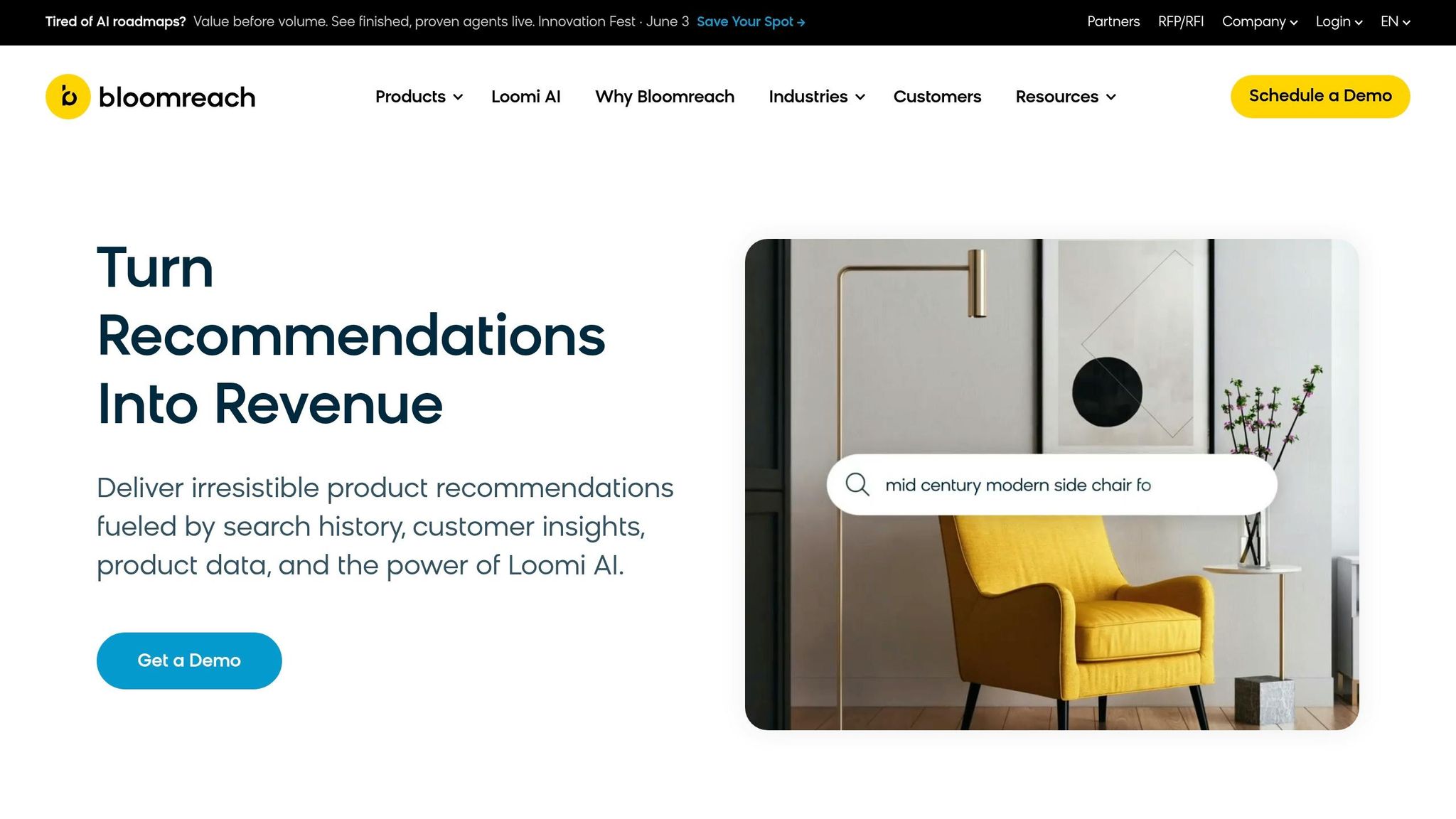
Bloomreach Discovery stands out as a powerful recommendation engine tailored for modern retailers. Geared toward mid-market and enterprise-level businesses, this platform is powered by Loomi AI, a core engine that utilizes advanced LLMs and machine learning. With access to 350 million daily transactions - the largest e-commerce dataset outside of Amazon [30] - it ensures precise personalization, even for stores without prior data.
Personalization Capabilities
Loomi AI creates dynamic, real-time affinity profiles by analyzing a shopper's browsing patterns, search history, and product preferences, such as brand, size, and price [28][29]. These profiles adapt instantly as customers interact with the store. Merchandisers can also fine-tune the experience by applying business rules through an easy-to-use drag-and-drop interface. This allows them to highlight high-margin products or private labels while still letting the AI do the heavy lifting [25][26].
The outcomes speak for themselves. For example, luxury retailer Vitkac saw a 9.3% boost in conversions within 11 days and a 23.2% increase over five months, resulting in a 585% ROI [29]. Across its user base, Bloomreach reports an average 15% improvement in conversion rates and a 25% increase in revenue per visitor (RPV) [25].
"Our reengagement journey used to speak broadly to customers without taking their unique needs into account. Now, we can personalize them, reaching every single person on the right channel with the right message." - Victoria Pinion, Assistant CRM Manager [25]
These personalization tools are designed to work seamlessly with various e-commerce platforms.
Integration with E-Commerce Platforms
Bloomreach Discovery offers flexible integration options, making it compatible with platforms like Shopify, Shopify Plus, BigCommerce, Magento, Salesforce Commerce Cloud, and SAP Commerce [27][31]. It also connects with tools such as Snowflake, Segment, Klaviyo, and Attentive [27]. While basic recommendation widgets can be set up via a no-code dashboard, more advanced configurations and data syncing require API work [28][27]. The implementation of the Autonomous Search module typically takes about six weeks, with noticeable business results often appearing in under four weeks [27].
Scalability for Large Datasets
The platform is designed to handle enterprise-scale catalogs with lightning-fast response times, even during high-demand events like Black Friday [30]. Using a Sequential 2 Tower Neural Network (2TNN) - a system akin to transformer architectures - it predicts shopper intent over extended browsing sessions [32]. In one case, a month-long A/B test with the "Personalized for You" widget led to a 26% increase in conversions and a 35% jump in revenue, projecting an additional $1.5 million in annual U.S. revenue [32].
Pricing
Bloomreach Discovery follows a custom pricing model that factors in the size of the product catalog, customer volume, and event activity [27]. For mid-market businesses, costs are estimated to range from $2,000 to $5,000 per month, while enterprise deployments start at around $50,000 annually [31][30]. Every plan includes Loomi AI at no extra cost [27]. Full enterprise implementation can take up to four months and often requires dedicated developer resources [30].
5. Recombee
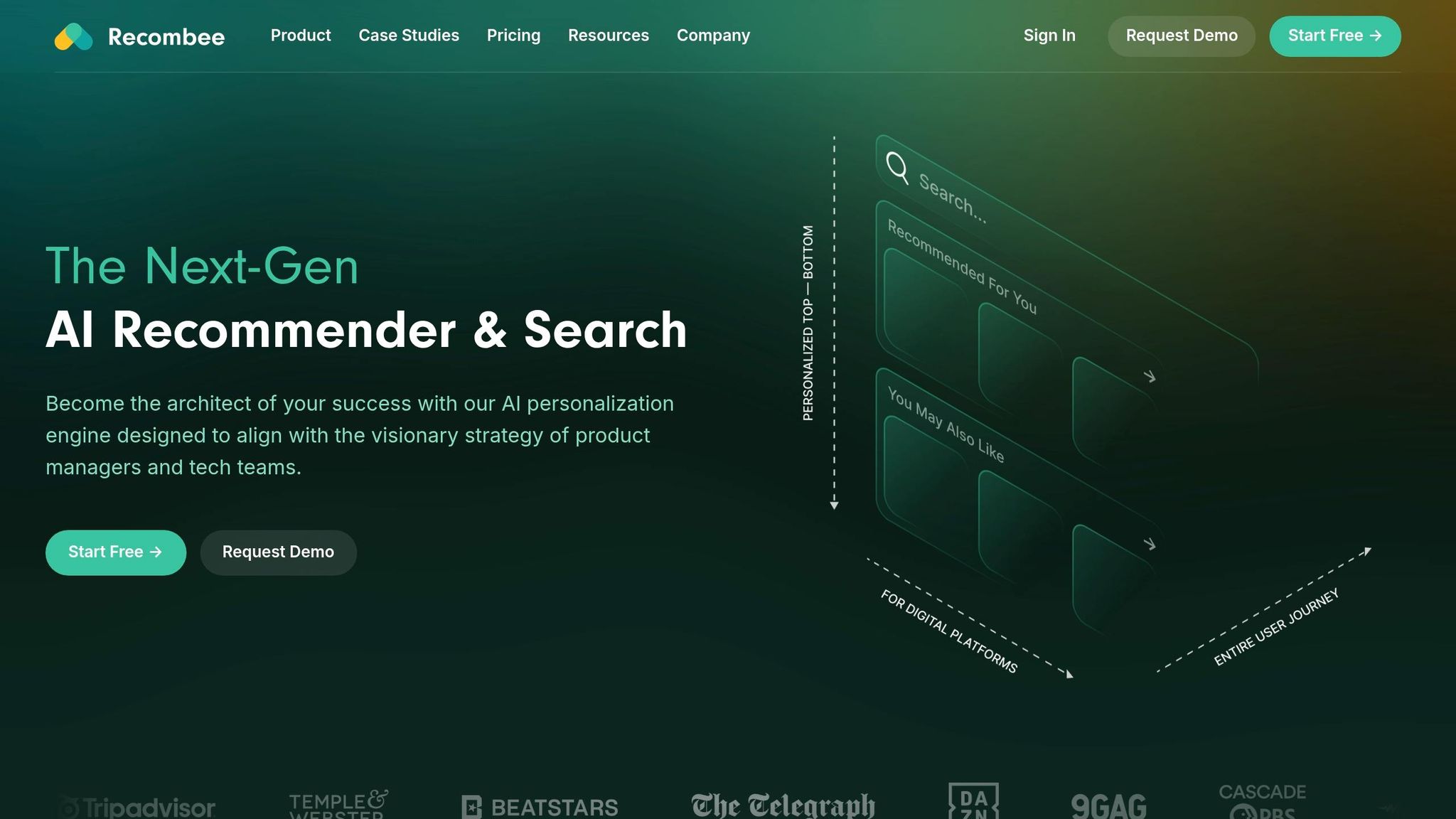
Recombee stands out as a developer-focused recommendation engine, trusted by businesses to deliver over a billion daily recommendations across products, videos, and articles [33].
Personalization Capabilities
Recombee uses a hybrid AI approach that combines collaborative filtering, content-based filtering, and reinforcement learning. This blend helps refine recommendations by factoring in user feedback [35][36]. To go a step further, it incorporates image processing and natural language processing (NLP) to analyze product photos and text. This is particularly useful when behavioral data is limited, as it ensures better matches.
A key feature is its Next Basket Prediction, which uses deep neural networks to predict what a shopper might add to their cart based on past behavior [36][37]. Developers also benefit from Recombee's Recommendation Query Language (ReQL), which allows for custom filters and boosters to align recommendations with specific business goals. For added convenience, the AI-powered ReQL Assistant simplifies the process of setting up complex rules [33].
Recombee’s capabilities have proven effective in real-world applications. For instance, Slickdeals saw a 70%+ boost in product detail page views and a 30%+ increase in click-through rates to affiliate links after implementing Recombee recommendations on their homepage [37].
"The Recombee team is a great partner in helping solve our unique use cases, and we look forward to continue working with them." - Daniel Uhm, Product Manager, Slickdeals [37]
These personalization tools are versatile and can be integrated in various ways to suit different business needs.
Integration with E-Commerce Platforms
Recombee provides a range of integration options, including no-code widgets (via a visual editor), customizable widget SDKs, and a RESTful API. The API is supported by 10 SDKs in languages like JavaScript, Python, PHP, Java, Ruby, .NET, Go, Swift, Kotlin, and Node.js [38][40]. It also connects with top analytics tools like Segment CDP and Keboola, and features Shoptet GTM integration [34][38].
The integration process generally involves four steps: sending user interaction data, syncing the item catalog, displaying recommendations, and enabling personalized search. Additionally, Catalog Feeds ensure that product data - such as titles, descriptions, and prices - is updated in real time [38].
Scalability for Large Datasets
Built for scale, Recombee’s infrastructure can handle over 30,000 recommendation requests per second and supports catalogs with tens of millions of items [33][39]. Its network of global data centers ensures low latency for users worldwide. For businesses with massive traffic, the Platinum plan offers tailored solutions to handle billions of monthly requests, along with R&D support for managing high-traffic spikes. The Item Segmentation feature further enhances scalability by organizing large catalogs into groups based on attributes like brand or category, ensuring recommendations remain relevant even with extensive inventories.
Pricing
Recombee offers flexible, usage-based pricing and a 30-day unlimited free trial [35].
| Plan | Monthly Price | Interactions/Requests | Active Users | Catalog Items |
|---|---|---|---|---|
| Free | $0 | < 100,000 | < 20,000 | < 20,000 |
| Standard | $99 | 100,000 | 20,000 | 20,000 |
| Plus | $899 | 2,000,000 | 400,000 | 400,000 |
| Pro | $1,499 | 5,000,000 | 1,000,000 | 1,000,000 |
| Premium | $2,499 | ≥ 10,000,000 | ≥ 2,000,000 | ≥ 2,000,000 |
| Platinum | Custom | Billions | Custom | Custom |
The free plan is an excellent starting point for smaller businesses, as it includes both personalized search and product recommendations. As needs grow, businesses can easily transition to higher-tier plans.
Comparison Table
Choosing the best recommendation engine means finding a tool that fits your business size, technical setup, and budget. Here's a breakdown of how the top five options stack up across essential criteria:
| Tool | Personalization Capabilities | Platform Integration | Scalability | Pricing Model |
|---|---|---|---|---|
| Amazon Personalize | Real-time machine learning, contextual bandits, user segmentation [1] | Seamlessly integrates with AWS ecosystem, API-based [1] | Auto-scaling, built for enterprise needs [1] | Usage-based pricing [1] |
| Google Recommendation AI | 1:1 real-time personalization, session context (e.g., device, location, weather) [41] | Google Cloud API, supports data streaming [41] | High scalability, ideal for global catalogs [41] | API usage-based [41] |
| Dynamic Yield | AffinityML, deep learning, omnichannel targeting [2] | Works with major platforms like Shopify and Magento; custom API requires complex setup [43] | Handles enterprise-level demands, supports millions of SKUs [2] | Custom pricing, often $50,000+/year [2] |
| Bloomreach Discovery | AI-driven search relevance, merchandising controls [3] | Integrates with enterprise-level stacks; requires specialized expertise [3] | Optimized for content-heavy, enterprise-grade sites [3] | Custom pricing for enterprise clients [3] |
| Recombee | Hybrid AI, handles cold starts, customizable scenarios via ReQL [1][42] | Simple API/SDK integration, supports 10 SDKs [1] | Scales effectively for large catalogs [4] | Freemium model; paid plans up to $2,499/month [42] |
This comparison showcases the tools' strengths, helping you match them to your business requirements.
For businesses already leveraging AWS or Google Cloud, Amazon Personalize and Google Recommendation AI offer seamless integration, simplifying data workflows [1][41]. On the other hand, Dynamic Yield and Bloomreach Discovery cater to enterprise-level teams with the resources to handle more complex implementation processes and higher costs [3][43].
If you're a developer or a smaller business looking for flexibility, Recombee is a great choice. Its freemium pricing and easy-to-use API allow you to experiment without a significant upfront investment [1].
All five tools provide real-time processing, though Bloomreach has limitations in that area. Standard A/B testing is included across the board, but Dynamic Yield stands out with its advanced testing features. Meanwhile, Amazon Personalize, Google Recommendation AI, Dynamic Yield, and Recombee excel at offering bundling and upselling capabilities compared to Bloomreach [3][42].
"Product recommendations drive only 7% of site traffic but account for 26% of total revenue." - Salesforce Research [41]
The right recommendation engine doesn't just enhance the shopping experience - it directly impacts revenue. Matching a tool's capabilities with your technical setup and business goals is key to maximizing your ROI.
Conclusion
When selecting a recommendation engine, consider factors like your budget, technology stack, and business scale. For small businesses or developers, Recombee offers a freemium option and paid plans starting at $99/month, making it a practical choice for tighter budgets [1]. If you're already using AWS, Amazon Personalize is ideal for handling large-scale operations with reliable performance [1]. For enterprise-level needs, Dynamic Yield and Bloomreach Discovery provide advanced features and omnichannel personalization capabilities [3]. Meanwhile, Google Recommendation AI delivers a quick-to-deploy API, particularly cost-effective for catalogs with fewer than 500,000 monthly requests [41]. The best choice depends on how well the tool aligns with your data and operational requirements.
One critical factor to keep in mind: the quality of your product data often outweighs the complexity of the algorithm itself.
"Recommendations are only as good as your product information. Clean, structured data makes a bigger difference than sophisticated algorithms." - MindStudio [41]
Strong, well-organized product data is the foundation for any recommendation engine's success. To make an informed decision, consider trialing two solutions simultaneously. This approach allows you to compare how easily they integrate with your systems and how well their features meet your needs. Testing these tools in a live environment will give you a clearer picture of their performance. Additionally, consider using complementary analytics tools to gain deeper insights. For resources like A/B testing platforms, audience insights tools, or campaign tracking solutions, check out the Marketing Analytics Tools Directory to explore and compare your options.
FAQs
What data do I need to start a recommendation engine?
To create a recommendation engine for e-commerce, you’ll need two key data sources: product data (like descriptions, categories, and attributes) and customer interaction data (such as browsing behavior, purchase history, and preferences). When this data is well-organized and labeled, it allows for methods like collaborative filtering or content-based filtering. These techniques help the engine identify patterns and provide tailored suggestions, enhancing the shopping experience while increasing sales by anticipating what customers might want next.
Which tool is easiest to integrate with Shopify or Magento?
The Shopify Connector extension by Webkul is a straightforward tool designed for seamless integration with Shopify or Magento. It streamlines the process of syncing products, orders, and categories, making store management much simpler without needing extensive technical expertise. While Magento provides more advanced AI-driven tools, these typically involve more complicated configurations. For those seeking an easy-to-use solution, the Shopify Connector extension stands out as a top choice.
How do I measure ROI from product recommendations?
To figure out the ROI from product recommendations, focus on tracking the revenue directly linked to those recommendations over a specific time frame. The formula to calculate this is: (Revenue – Expenses) / Expenses x 100%. Pay close attention to the incremental revenue - the extra income generated - compared to the costs of implementing the recommendation system.
Many tools come with built-in dashboards that make this tracking process easier. Regularly reviewing these metrics is key to assessing how well your recommendation engine is performing and finding ways to improve its ROI.