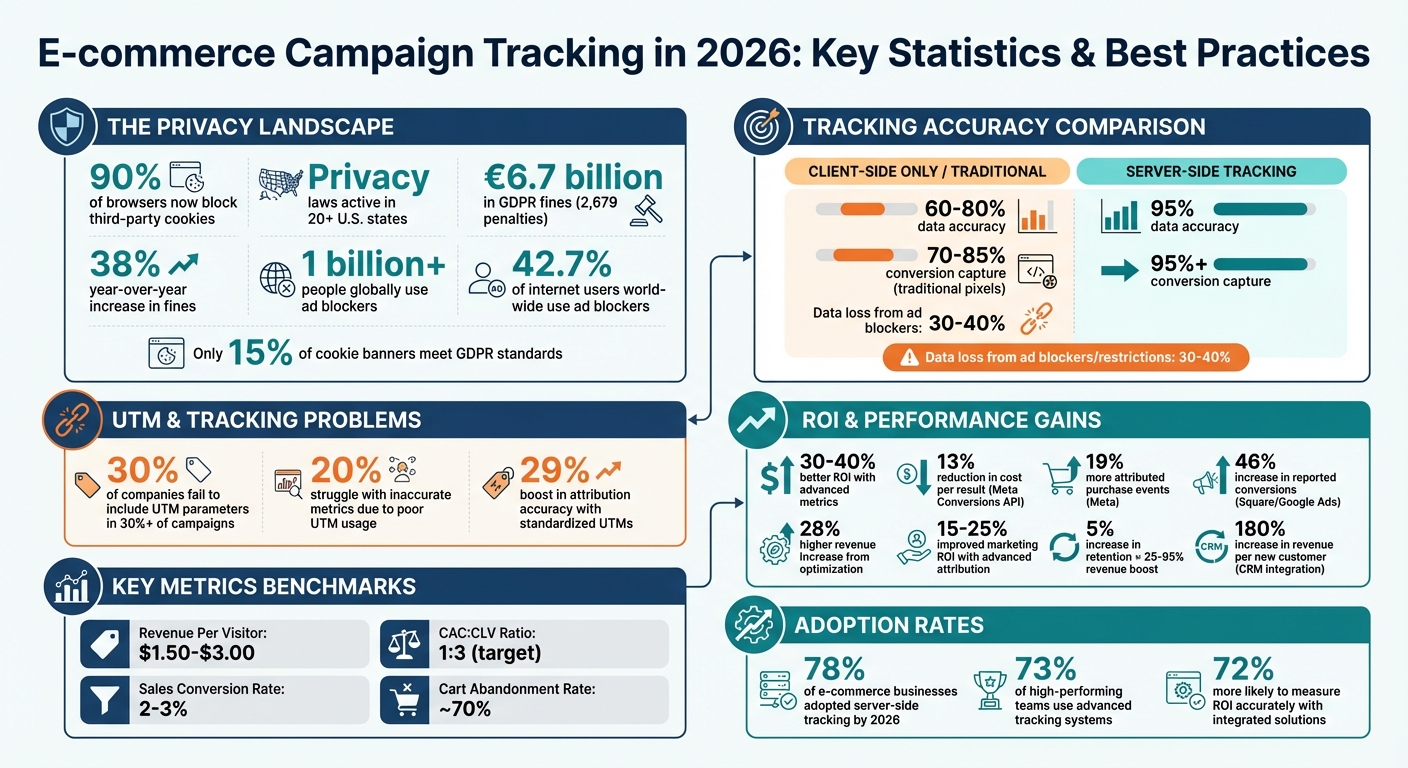
Campaign tracking in 2026 is all about precision, privacy, and profitability. With 90% of browsers blocking third-party cookies and privacy laws tightening across 20 U.S. states, traditional tracking methods are no longer enough. Businesses must focus on advanced techniques like server-side tracking, first-party data collection, and consent-led measurement to maintain accurate attribution and ROI.
Key insights include:
- Server-side tracking improves data accuracy to over 95%, bypassing ad blockers and browser restrictions.
- First-party data is critical as third-party cookies become obsolete. Use tools like Meta’s Conversions API and Google Tag Manager to manage this effectively.
- UTM standardization prevents fragmented data. Consistent naming conventions and compare campaign tracking tools and centralized systems boost attribution accuracy by 29%.
- Privacy compliance is non-negotiable. Tools like Google Consent Mode v2 and Consent Management Platforms ensure campaigns respect user privacy while recovering lost conversion data.
- Data-driven analysis leads to smarter decisions, with businesses reporting 30–40% better ROI when relying on advanced metrics like Revenue Per Visitor (RPV) and Customer Lifetime Value (CLV).
Modern e-commerce tracking isn't just about gathering more data - it’s about gathering the right data in a privacy-conscious way. By focusing on these strategies, businesses can ensure better campaign performance even in a cookie-less world.
E-commerce Campaign Tracking Statistics 2026: Privacy, Performance & ROI
3 Secrets to Ecommerce Google Ads Success in 2026
sbb-itb-5174ba0
Creating Consistent Campaign Tracking Processes
Inconsistent tracking can wreak havoc on your data. When team members use different methods to tag campaigns, your analytics become fragmented and unreliable. For instance, GA4 treats "Facebook", "facebook", and "fb" as separate traffic sources, splitting your ROI data into multiple entries. Shockingly, 30% of companies fail to include UTM parameters in over 30% of their campaigns, and 20% struggle with inaccurate metrics due to poor UTM usage. The solution? Establish clear, standardized processes for everyone to follow to ensure data quality KPIs.
"A documented naming convention is the single source of truth for your marketing team. It eliminates guesswork and ensures that every team member... tags URLs uniformly." - David Pombar, Digital Marketer
Setting Up UTM Parameters
Start by adopting a consistent naming convention. Define precise values for each UTM parameter:
utm_source: Indicates where traffic originates (e.g.,googleornewsletter).utm_medium: Describes how traffic arrives (e.g.,cpcoremail).utm_campaign: Identifies the specific promotion (e.g.,spring_sale_2026).
Stick to lowercase letters and use hyphens or underscores to separate words. Teams that enforce these standards report a 29% boost in campaign attribution accuracy.
To streamline this process, use automated UTM builders with dropdown menus for pre-approved values. On paid platforms, take advantage of dynamic parameters, such as Google Ads' {campaignid} or Meta's {{campaign.name}}, to auto-fill values and minimize errors. Avoid tagging internal links with UTMs, as this can overwrite the original traffic source and skew your attribution data. Finally, centralize your tracking efforts to maintain consistency across all campaigns.
Using Centralized Tracking Systems
A centralized system acts as your single source of truth for campaign tracking. Maintain a master registry that logs each URL's parameters, owner, launch date, and approval status. This prevents duplicate campaign names and ensures that teams across regions follow the same standards.
Incorporate data validation tools, such as dropdown menus, to enforce the use of pre-approved utm_source and utm_medium values. Conduct monthly audits to identify and correct naming inconsistencies. Review your GA4 data for duplicate source/medium entries caused by typos or case sensitivity, and watch for unusual spikes in "Direct" or "Unassigned" traffic - these often signal missing or incorrect UTMs.
Adopting New Tracking Technologies
As privacy regulations tighten and third-party cookies fade out, e-commerce businesses are being pushed to rethink how they track user behavior with website analytics tools. With traditional browser-based tracking losing 30–40% of conversion data due to ad blockers and browser restrictions, the need for a new approach is clear. By 2026, over 1 billion people globally are expected to use ad blockers, making client-side tracking methods increasingly unreliable. The answer lies in server-side tracking and building a robust first-party data infrastructure - two essential tools for modern e-commerce tracking.
Server-Side Tracking Solutions
Server-side tracking shifts data collection from the user's browser to a cloud server under your control. This method processes and forwards data to vendors through a custom subdomain (e.g., track.yourstore.com), bypassing ad blockers by appearing as a first-party request.
The benefits are striking. Meta reports that advertisers using the Conversions API experience a 13% reduction in cost per result and 19% more attributed purchase events. Similarly, Square documented a 46% increase in reported conversions from Google Ads after adopting server-side tracking. Danish online supermarket Nemlig also saw a 7% improvement in page load speeds by moving tracking scripts to a server-side Google Tag Manager container.
"Server-side tracking is not just for privacy compliance - it is a data quality issue. When 30–40% of conversions go unreported, your marketing attribution is inaccurate, your ROAS calculations are wrong, and you cannot optimize spend effectively." – Leonhard Baumann, Web Analytics Consultant
To get started, set up a custom tracking subdomain with SSL to ensure cookies are recognized as first-party. Meta's Conversions API is a good first step, as it often provides immediate returns by improving event match quality. For businesses running both browser and server tracking, ensure consistency by using the same event_id or transaction_id values across both systems to avoid double-counting conversions. For many, managed services like Stape or TAGGRS (with plans starting at $19–$90/month) offer a practical alternative to self-hosting on Google Cloud.
First-Party Data Collection
First-party data - information collected directly from your customers - has become a dependable resource as browsers clamp down on external trackers. For example, Safari's Intelligent Tracking Prevention limits JavaScript-set cookies to just seven days, but first-party cookies set via server-side HTTP headers can last anywhere from three months to two years. This extended lifespan significantly improves attribution and campaign tracking accuracy.
To maximize first-party data, capture key signals like purchases and sign-ups at the cart level. Store UTM parameters, click IDs (such as fbclid or gclid), and referral details in cart attributes or order notes to maintain attribution even after sessions expire. Always ensure user consent and anonymize personal data using SHA-256 hashing before sharing it with advertising platforms.
Building a first-party data infrastructure provides both control and compliance. By 2026, roughly 78% of e-commerce businesses had adopted server-side tracking. Those using it report achieving 95% data accuracy, compared to just 60–80% for client-side-only setups. Owning your data pipeline also allows you to enhance events with internal attributes like loyalty tiers or lifetime value before sending them to ad platforms, enabling smarter, more effective ad optimization.
Improving Campaign Performance with Data Analysis
Using top analytics tools to analyze tracking data can lead to smarter decisions and boost ROI by 30–40%. E-commerce businesses that rely on data see a 28% higher revenue increase from optimization efforts and 35% greater customer retention. The key lies in how you audit, measure, and interpret your campaign data. This approach builds on the robust tracking systems and server-side solutions mentioned earlier, forming a solid foundation for campaign optimization.
Regular Campaign Data Audits
Regular audits are essential to avoid costly tracking errors. Issues like broken pixels, inconsistent UTM parameters, and bot traffic can distort your data, leading to poor decisions. Businesses using advanced attribution models can improve marketing ROI by 15–25% compared to those relying on single-touch models. However, this only works if the data is accurate.
Audits should be conducted at three levels:
- Weekly operational reviews to identify underperforming ads.
- Monthly tracking checks to ensure UTM consistency and filter out bot traffic.
- Quarterly strategic assessments to analyze lifetime value trends and confirm privacy compliance.
Set up dashboards to flag metrics that deviate more than 15% from a seven-day average for immediate attention. To measure success accurately, calculate true profit by subtracting discount costs, ad spend, creative expenses, and operational overhead from revenue - not just top-line figures.
"Revenue is the most dangerous metric when measured alone - always calculate true profit by subtracting discount cost, ad spend, and operational expenses before declaring a campaign successful." – Growth Suite
Key Metrics for E-commerce Campaigns
Focus on metrics that directly impact revenue. Revenue Per Visitor (RPV), which combines conversion rate and average order value, is a crucial indicator. By 2026, benchmarks for RPV range between $1.50 and $3.00, depending on the industry.
Other key metrics include:
- Sales Conversion Rate: Typically 2–3% across most sectors, with fashion and beauty often performing slightly better.
- Customer Acquisition Cost (CAC) vs. Customer Lifetime Value (CLV): Aim for a 1:3 ratio, meaning every dollar spent acquiring a customer should return three dollars over their lifetime.
- Average Order Value (AOV): A primary lever for increasing revenue without raising traffic costs.
- Shopping Cart Abandonment Rate: With rates often near 70%, even small improvements can significantly impact revenue.
For example, reallocating budgets to focus on top-performing campaigns can lead to noticeable increases in conversions.
Cohort Analysis for Customer Retention
Cohort analysis takes these metrics further by grouping customers based on shared characteristics, such as their first purchase date, and tracking their behavior over time. This method uncovers patterns that can drive long-term profitability. A 5% increase in customer retention can boost revenue by 25% to 95%.
To get started, track acquisition cohorts by grouping customers based on when they signed up or made their first purchase (e.g., "January 2026 buyers"). Compare retention curves to identify which time periods or campaigns brought in the highest-quality customers. For instance, holiday cohorts often show a 55% higher lifetime value than those acquired mid-year.
You can also segment behavioral cohorts - such as customers who used a specific discount code or purchased a particular product first - to see which actions are linked to repeat purchases.
In early 2026, Jin Grey, CEO of Jin Grey SEO Books, shared an example of a beauty brand client that reduced its "repeat visitor lag time" from 16 days to 11 days. By adjusting the timing of post-purchase emails to align with this 11-day period, the brand achieved a 22% increase in repeat sales without additional advertising costs. For most direct-to-consumer brands, conducting cohort analysis monthly strikes the right balance between identifying trends and avoiding unnecessary noise.
Using Marketing Analytics Tools for Campaign Tracking
Tracking tools play a crucial role in managing multi-channel campaigns effectively, especially in e-commerce. They help businesses improve attribution and maximize ROI. With 73% of high-performing marketing teams using advanced tracking systems, the divide between data-driven companies and those relying on guesswork is growing. The challenge lies in choosing tools that can unify data, offer actionable insights, and integrate smoothly with existing systems.
Features of the Marketing Analytics Tools Directory
When assessing analytics tools, focus on features that address real tracking challenges. For starters, data unification is essential. Your tool should seamlessly connect platforms like Shopify, email services, Meta Ads, and your CRM into a single, comprehensive view - no manual CSV exports required. Another critical feature is multi-touch attribution, which credits all touchpoints in a customer’s journey, offering a more accurate picture of the channels driving conversions.
In 2026, AI-powered insights have become a standard feature. These tools don’t just present raw data - they suggest actions, such as "launch a win-back flow for this segment".
"If operating your analytics tool requires a data engineer, it functions more as a data warehouse than a true analytics solution".
Additionally, natural language queries are now common. For example, you can simply ask, “What was my ROAS on TikTok yesterday?” without needing to write SQL.
The Marketing Analytics Tools Directory (https://topanalyticstools.com) categorizes tools by their primary functions - like attribution, retention analytics, and business intelligence - making it easier to compare options based on your needs and budget. For smaller brands, tools like Lifetimely offer cohort analysis starting at $34/month. On the other hand, enterprise-level tools such as Northbeam cater to brands spending $50,000+ monthly on paid media, with pricing starting at $1,000+.
These features ensure a smoother integration with your existing systems, allowing for a more streamlined data workflow.
Connecting Analytics Tools with Your Systems
The real value of an analytics tool lies in its ability to integrate with your existing operational systems, providing a complete view of campaign performance. Integration is critical - it determines whether your tool becomes a reliable source of truth or just another isolated data silo. Most modern tools offer native integrations (e.g., Shopify to BigQuery), ETL platforms like Fivetran or Airbyte, or direct tracking code installation in your site’s header. A key aspect of integration is linking campaign IDs and UTM parameters to checkout data, enabling you to trace revenue back to specific ads.
A great example of this in action comes from the DTC supplement brand Fatty15, which adopted advanced analytics tools in 2025 to unify its data. By doing so, the brand uncovered sleeper channels delivering up to 1,647.68% ROAS. Armed with this insight, they confidently doubled their marketing budget the following year while maintaining positive cash flow. Their success lay in connecting store data, web analytics, and marketing platforms into one cohesive dashboard.
Server-side tracking remains a crucial component. Using Google Analytics 4’s recommended events - like add_to_cart and purchase - ensures accurate e-commerce reporting across all integrated tools. Linking your analytics platform to your CRM is equally important, as it allows you to track campaigns that generate the highest lifetime value, not just the most clicks. Brands that sync campaign data with customer records have reported a 180% increase in revenue per new customer by identifying high-value lead sources.
Privacy-Compliant Tracking Methods
Privacy laws are reshaping how e-commerce campaigns track user behavior. By the end of 2025, GDPR fines had reached a staggering €6.7 billion, spread across 2,679 penalties, with a 38% year-over-year increase in fines. For businesses, the challenge lies in balancing compliance with effective tracking to maintain campaign performance. While the stakes are high, compliant and accurate tracking methods are still achievable.
Server-Side Tracking: A Game-Changer
Server-side tracking has become a cornerstone of privacy-compliant strategies. Unlike traditional browser pixels, which ad blockers can intercept, server-side tracking sends conversion data directly to platforms like Meta and Google. This approach captures over 95% of conversions, compared to the 70–85% range typically seen with client-side tracking. To stay compliant, always hash sensitive data like emails and phone numbers using SHA-256 before sharing.
Google Consent Mode v2: A Must for EU Advertisers
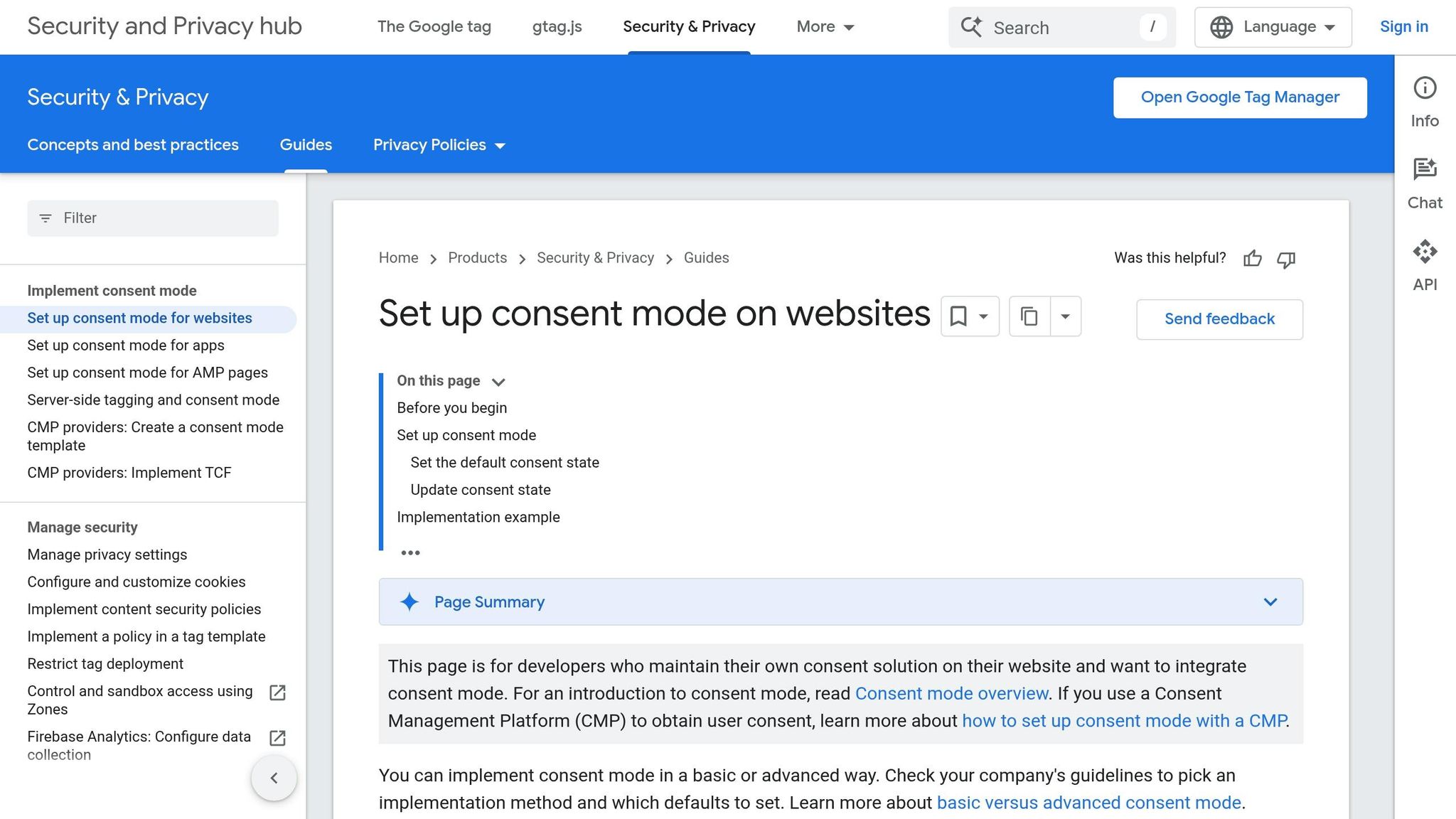
For businesses targeting users in the European Economic Area, Google Consent Mode v2 is now mandatory. This system adapts tracking behavior based on user consent. Even when users decline tracking, "cookieless pings" are sent, enabling Google to use machine learning for behavioral modeling. This method helps recover 70–80% of lost conversion data, bridging the gap left by consent refusals.
Consent Management and Legal Compliance
Using a Consent Management Platform (CMP) is no longer optional for most e-commerce businesses. However, research shows that only 15% of cookie banners currently meet GDPR standards. When the UK's Information Commissioner's Office enforced stricter compliance measures, many businesses saw a sharp drop in tracked traffic. This highlights the trade-offs required to meet legal obligations.
To configure a CMP correctly, tracking should be set to "denied" by default until explicit consent is granted. Avoid using deceptive tactics, like making the "Reject All" button less visible than "Accept All", as these "dark patterns" can result in hefty fines. Tools like Cookiebot and OneTrust offer solutions tailored to different budgets and compliance needs.
"Your analytics data is wrong - and cookie consent is the reason. Marketing teams lose anywhere from 30% to 70% of their tracking data overnight after implementing consent banners incorrectly." - Lukas Reinhardt, Marketing Analytics Specialist
Geo-targeting can help manage compliance across regions. For instance, show GDPR-compliant banners to EU visitors while using less intrusive CCPA notices for US-based users. In California, tracking is allowed by default as long as you provide a clear "Do Not Sell or Share My Personal Information" option.
Anonymized Data Reporting: Privacy Without Compromise
Anonymized reporting offers a way to gather campaign insights without storing personal data. By analyzing group behavior, businesses can still gain actionable insights - like identifying that 8% of users who clicked on Ad A made a purchase within 30 days.
Hash-based tracking is another privacy-conscious method. This approach uses daily rotating salts with SHA-256 or SipHash to create temporary, site-specific identifiers. These hashes help deduplicate visitors within a single day while avoiding cross-site or long-term tracking.
"Calling hash-based tracking 'fingerprinting' is like calling a Post-it note a surveillance system. They're fundamentally different things with fundamentally different privacy properties".
Avoid browser fingerprinting altogether. This invasive technique collects over 100 device signals to create permanent user IDs, drawing intense scrutiny from regulators and carrying significant legal risks. With 42.7% of internet users worldwide using ad blockers by 2025, relying on such methods can lead to massive data gaps.
For a privacy-first approach, consider analytics tools like Plausible and Fathom. These platforms provide GDPR-compliant analytics without features like session replays or individual event tracking. They’re also lightweight, adding less than 5 KB to your page load - far less than the 200–300 KB typical of traditional tracking stacks.
Conclusion: Key Takeaways for 2026
The landscape of e-commerce campaign tracking in 2026 demands a move toward privacy-focused and precise tracking systems. Server-side tracking has become a game changer, capturing more than 95% of conversions - far surpassing the 70–85% range achieved by older browser pixels. With 90% of browsers now blocking third-party cookies by default, businesses must lean into first-party data strategies to avoid losing critical insights.
To ensure clean and actionable data, adopting strict UTM naming conventions is a must. Poorly managed UTMs can lead to fragmented data and skewed ROI calculations. Companies that use integrated tracking solutions are 72% more likely to measure ROI accurately across multiple channels. Additionally, implementing proper campaign tracking strategies can result in a 30–40% improvement in returns compared to relying on basic metrics. These best practices build on the integrated tracking methods discussed earlier.
"Most ecommerce brands don't have a data problem. They have a decision problem." - Sushil Goel, CEO, LayerFive
Alongside effective tracking, ensuring compliance with privacy regulations remains critical. Tools like Google Consent Mode v2 offer a way to balance compliance with data accuracy, allowing for modeled reporting even when users opt out of tracking. This ensures businesses can still gain insights into user behavior without breaching privacy guidelines.
Finally, the shift from focusing on activity metrics to prioritizing revenue intelligence has become a clear marker of success. For instance, Billy Footwear achieved a staggering 72% revenue growth in February 2026 with only a 7% increase in ad spend. By prioritizing contribution margins and true profitability over vanity metrics, businesses can unlock sustainable growth and long-term success.
FAQs
What’s the simplest way to start server-side tracking?
The simplest way to start with server-side tracking is by using a hybrid approach. This method moves data collection from the browser to your server, which then sends it to analytics platforms. Tools such as Google Tag Manager (GTM) paired with a cloud server or managed solutions make this process much more straightforward.
To get started, you'll need to:
- Set up a cloud server for handling data.
- Configure your website to send event data to your server.
- Ensure the data is securely forwarded to platforms like Google Analytics or Meta.
This approach keeps things efficient while improving control over your tracking setup.
How do I prevent UTM mistakes across my whole team?
To minimize errors with UTMs, focus on creating clear and consistent tagging practices. Use standardized naming conventions for parameters such as utm_source, utm_medium, and utm_campaign - for instance, stick to lowercase letters and use hyphens instead of spaces. Tools like Google Tag Manager can help automate UTM creation, reducing the chance of mistakes. Make sure to document these standards in a shared platform so your team can easily access and follow them. This approach ensures your campaign tracking remains accurate and dependable.
How can I track conversions while staying privacy-compliant?
To monitor conversions effectively in 2026 while prioritizing privacy, consider using server-side tracking methods like the Conversions API. This approach helps you navigate cookie restrictions and ad blockers. Pair it with privacy-focused strategies, including first-party data collection, consent management, and cookieless tracking solutions. Tools such as Google Tag Manager with consent mode and enhanced conversions can also help you stay compliant with regulations like GDPR and CCPA while preserving reliable campaign performance data.