Customer Data Platforms (CDPs) are transforming financial services by integrating data from multiple sources like CRMs, website analytics tools, and mobile apps to create unified customer profiles. These profiles enable real-time personalization, better fraud detection, and improved compliance. Financial institutions use CDPs to address key challenges like data silos, customer retention, and regulatory risks while enhancing customer experiences across channels.
Key Use Cases:
- Customer Segmentation: Create real-time, 360-degree customer views for targeted marketing and compliance.
- Fraud Detection: Identify suspicious activity by consolidating data across devices and channels.
- Personalized Marketing: Deliver tailored offers using unified customer profiles.
- Single Customer View: Integrate data from multiple systems to ensure consistency.
- Risk Assessment: Use real-time data to make informed lending decisions.
- Omnichannel Journeys: Provide consistent experiences across digital and offline channels.
- Cross-Selling & Upselling: Identify product opportunities based on customer behavior.
- Cross-Device Tracking: Track user activity across devices for seamless experiences.
- Next Best Offer: Use AI to recommend the most relevant products or services.
- Call Center Integration: Equip agents with unified customer data for personalized interactions.
- Customer Acquisition: Optimize campaigns by excluding existing customers and targeting high-value prospects.
- Suppression Campaigns: Avoid unnecessary ad spend by excluding current customers.
- Retargeting Campaigns: Re-engage potential customers with personalized follow-ups.
- Referral Campaigns: Track and optimize referral programs with unified data.
- AI-Powered Analytics: Predict customer behavior and manage risks with advanced models.
CDPs streamline operations, improve customer satisfaction, and help financial institutions adapt quickly to a data-driven world. Whether it's reducing fraud, enhancing marketing, or simplifying compliance, CDPs are a critical tool for success in the financial sector.
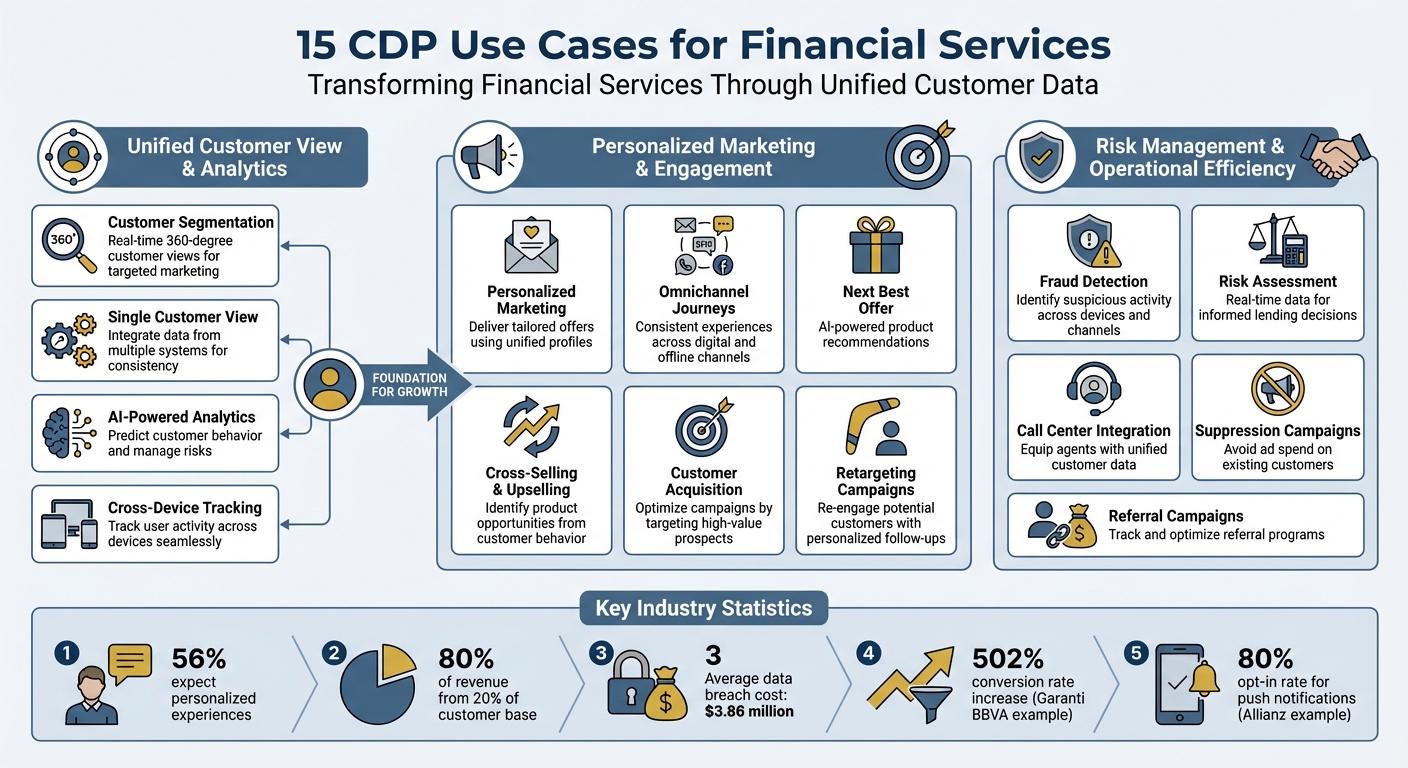
15 CDP Use Cases for Financial Services: Key Applications and Benefits
1. Customer Segmentation
Data Unification and Integration Capabilities
CDPs (Customer Data Platforms) are designed to consolidate customer data from various sources - like CRM systems, transaction logs, mobile apps, websites, and branch visits - into a single, unified profile. By using unique identifiers such as email addresses or CRM IDs, businesses can maintain a 360-degree, real-time view of each customer as new data continues to flow in.
One of the biggest challenges for financial institutions is managing data stored across outdated systems, where accounts for investments, credit, and insurance often remain siloed. Modern CDPs tackle this issue by connecting these fragmented systems through APIs or direct warehouse integrations. Importantly, they preserve the original structure of the data for future use. This unified approach provides a solid foundation for generating actionable insights on the spot.
Real-Time Analytics and Decision-Making
Real-time segmentation allows businesses to respond instantly to customer behavior. For example, if a user visits a life insurance page on a website, a CDP can immediately trigger follow-up actions tailored to that interest. This capability also extends to identifying potential churn. Sudden drops in app usage or transaction activity can be flagged, enabling businesses to send personalized retention offers without delay.
"CDP-driven AI helps ID at-risk customers and engage them with personalized retention offers. A bank can analyze customer interactions, transactional data, and app usage to spot churn signals." - Janet Jaiswal, Global VP of Marketing, Blueshift
Real-world examples highlight the impact of this approach. Etiqa Insurance personalized homepage banners for different audience segments, boosting their conversion rate to 4.74%, more than double their average of 2.17%. Similarly, Garanti BBVA achieved a staggering 502% increase in conversion rates through CDP-powered segmentation.
Support for Compliance and Risk Management
Beyond segmentation, CDPs enhance compliance and risk management efforts. Composable CDPs, in particular, help financial institutions adhere to strict regulatory standards by inheriting existing access controls. This ensures that marketers can create audience segments while the system automatically filters out sensitive data - such as age or gender - to remain compliant with regulations.
"A composable CDP makes it easy to leverage the power of built-in governance in Snowflake to manage how all data can be used; this therefore enables marketers to act freely, because they know the data they have access to is permitted by their company." - Eddie Drake, Author, Snowflake
This functionality is especially useful for building suppression segments. By excluding current customers or high-risk prospects from paid media campaigns, companies can avoid unnecessary ad spend and steer clear of compliance risks.
Enhancement of Customer Experience and Engagement
Advanced segmentation techniques leverage AI to predict traits like churn likelihood or discount sensitivity. These predictive insights enable businesses to model the next best action, ensuring that customers receive the right message through their preferred channel at the ideal time. For instance, Allianz achieved an 80% opt-in rate for mobile app push notifications by creating precise AI-driven segments.
Segmentation strategies can range from basic demographic or location-based methods to more sophisticated AI-driven models, even extending to household-level analyses. This level of refinement not only supports personalized engagement but also highlights the broader advantages of a unified CDP strategy. With this flexibility, businesses can proactively identify high-value customers at risk of leaving and target them with tailored retention offers - keeping them engaged and loyal before competitors can step in.
sbb-itb-5174ba0
2. Fraud Detection
Data Unification and Integration Capabilities
CDPs (Customer Data Platforms) bring fragmented data together - whether it's from CRM systems, transactional databases, web tracking, or mobile apps - into a single, unified customer profile often referred to as a "golden record". This consolidated view is key to identifying inconsistencies that could indicate fraudulent activity. For instance, a login from a mobile device in one location combined with an in-person branch visit in another can raise red flags. By connecting data from various devices and linking identifiers to previously anonymous behaviors, CDPs can map out customer journeys and detect potential identity theft.
A common challenge for financial institutions is integrating modern data tools with outdated banking infrastructure. Advanced CDPs tackle this by offering real-time server-to-server integration with encrypted identifiers. This ensures that sensitive personal information remains secure while still being accessible for immediate fraud risk evaluations. This unified approach not only enhances data security but also enables top analytics tools to intercept fraudulent activities as they happen.
Real-Time Analytics and Decision-Making
The unified data foundation provided by CDPs enables real-time analytics, which are critical for fraud prevention. These platforms continuously update customer profiles across both digital and offline channels, ensuring that risk assessments are always based on the most current data. When unusual behavior, like a suspicious purchase or login from an unrecognized device, is detected, AI-powered systems can immediately trigger multi-factor authentication or alert security teams.
The financial implications of these capabilities are significant, especially for high-value accounts where real-time monitoring is essential. Modern composable CDPs, which can be deployed within 1–4 months, allow institutions to implement fraud detection measures much faster compared to the 6–12 months typically required by traditional systems. This speed empowers organizations to respond to threats more effectively.
Support for Compliance and Risk Management
Composable CDPs help mitigate compliance risks by working directly within a company’s existing data cloud, such as Snowflake. This ensures that sensitive financial data remains within a governed environment. They also inherit global data access controls from the central data warehouse, automatically filtering out protected information to meet regulatory requirements. Furthermore, detailed audit trails of data access are provided, supporting key compliance measures like Anti-Money Laundering (AML) and Know Your Customer (KYC) protocols.
"A composable CDP governs data and can limit the marketers' access to the data they're allowed to use, reducing compliance risk while enabling marketers to move faster and more confidently with their trusted data." - Snowflake
With a zero-copy architecture, CDPs can analyze and segment data without physically moving it. This not only meets data residency requirements but also reduces the security risks associated with storing sensitive financial information in external systems. This approach ensures that organizations can maintain compliance while safeguarding their data.
3. Personalized Marketing
Data Unification and Integration Capabilities
Customer Data Platforms (CDPs) bring together data from a variety of customer interactions - like CRM systems, mobile apps, website visits, call centers, and even older banking platforms - into one unified profile. This consolidated view uses identity resolution to create a "golden record" for each customer. Modern composable CDPs take this a step further by working directly within existing data warehouses. This means marketing teams can access and use customer data without moving it out of its secure, governed environment. The result? Reduced compliance risks and the elimination of data silos, which have traditionally made cohesive marketing efforts difficult.
With unified profiles, marketers gain a complete picture of the customer relationship across different product lines - whether it’s loans, credit cards, investments, or insurance. This approach even allows for personalized experiences for anonymous visitors before they’ve shared their contact information. Considering that 56% of customers now expect tailored experiences, this capability is no longer just nice to have - it’s essential.
Real-Time Analytics and Decision-Making
Real-time analytics change the game by identifying customer behaviors as they happen and triggering immediate, personalized responses. For instance, if someone browses a mortgage page or abandons an application, the CDP can send a targeted message right away. AI-powered decisioning engines then step in, analyzing the unified data to predict the "Next Best Action" or "Next Best Offer" - automatically delivering the most relevant product or message at that exact moment.
Take Chime, for example. In August 2023, this financial technology company used a composable CDP to sync its Snowflake AI Data Cloud with paid media platforms. The result? A 20% improvement in performance marketing match rates and the ability to launch new campaigns across all channels in just 20 minutes. Ramp, a finance automation platform, saw similar success in December 2022 by implementing a unified data strategy with a composable CDP. Personalized campaigns from this approach contributed to 25% of its total sales pipeline. These examples highlight how real-time responses not only capture immediate customer actions but also lead to more meaningful interactions.
Enhancement of Customer Experience and Engagement
Using CDPs for personalized marketing creates smooth, omnichannel experiences that drive both engagement and conversions. For example, Etiqa Insurance used the Insider One CDP to customize homepage banners based on individual user behavior. The result? A conversion rate of 4.74%, which is more than double their sitewide average of 2.17%. Allianz also achieved impressive results, securing an 80% opt-in rate for mobile app push notifications through real-time server-to-server integration and AI-driven segmentation.
"Insider One gives us the unified customer view we were searching for. The platform offers real-time server-to-server integration and an encrypted identification approach, which gives us the security and freedom to create precise AI-powered segments."
- Marketing and Service Design Group Head, Allianz
CDPs also enable dynamic app experiences by tailoring features like bill payment tools or loan calculators based on individual usage patterns. This level of personalization is particularly valuable in financial services, where 80% of revenue often comes from just 20% of the customer base. By delivering consistent, tailored experiences across platforms like web, mobile apps, email, SMS, and even WhatsApp, financial institutions can deepen customer relationships and achieve measurable business outcomes.
4. Building a Single Customer View
Data Unification and Integration Capabilities
A single customer view (SCV) brings together data from various sources - CRM systems, websites, mobile apps, branch visits, call centers, and even third-party inputs - into a unified profile using a process called identity resolution. This process connects scattered data points by matching unique identifiers like CRM IDs, email addresses, or contact numbers, creating what’s often referred to as a "golden record".
What makes this approach effective is its ability to work with existing data structures, ensuring accuracy without creating new silos. Flexible APIs enable connections to over 100 tools, from email marketing platforms to analytics software, keeping profiles updated in real time without duplicating data. As a result, customer profiles continuously evolve, capturing both online and offline interactions.
Here’s a real-world example: In December 2022, Ramp, a finance automation platform, adopted the Snowflake AI Data Cloud and implemented a composable CDP (Customer Data Platform) for its marketing efforts. This move not only cut Ramp’s data platform expenses by 20% but also sped up data transformation by 33%. Unified customer profiles contributed to 25% of Ramp’s total sales pipeline. Beyond marketing benefits, the updated profiles also supported compliance efforts.
Support for Compliance and Risk Management
An accurate SCV plays a critical role in regulatory reporting and risk management. By creating golden records - free of inconsistencies - financial institutions ensure that their risk assessments and compliance reports are built on reliable data. Composable CDPs enhance compliance by managing data within the organization’s existing systems, avoiding the need to copy sensitive information into external platforms that could create additional risks.
A unified profile also enables institutions to implement global data access controls and filters based on sensitive information like age, gender, and consent status. This comprehensive view improves risk management by linking customer accounts across multiple products - like loans, insurance, and investments - allowing real-time calculations of key metrics such as profitability, loan-to-value ratios, and default risks. With this insight, institutions can automate tasks like EMI reminders and personalized follow-ups, helping reduce defaults and strengthen overall portfolio performance.
5. Risk Assessment and Lending Decisions
Real-Time Analytics and Decision-Making
The way financial institutions assess creditworthiness has been transformed by real-time data processing. With Customer Data Platforms (CDPs), banks can analyze live behavioral data alongside traditional credit scores to offer personalized, pre-approved credit card or mortgage options. Imagine a customer exploring a mortgage calculator or browsing loan products - CDPs can instantly generate tailored offers or follow-ups, simplifying the application process and enhancing user experience.
One major challenge for lenders is abandoned loan applications, which can lead to significant revenue losses. CDPs address this by detecting incomplete applications in real time and triggering automated follow-ups. Additionally, AI-powered tools can send reminders for EMI payments based on customer behavior patterns, helping to reduce default risks and maintain healthier loan portfolios. These real-time insights not only improve operational efficiency but also strengthen compliance and risk management efforts.
Support for Compliance and Risk Management
CDPs go beyond analytics by bolstering risk management and compliance measures. By connecting various data sources - such as loan accounts, insurance policies, investments, and payment histories - CDPs create a unified risk profile that reflects a customer's total credit exposure across all products. This holistic view enables more precise risk assessments while adhering to regulations that protect sensitive data, like age and gender. Composable CDPs integrate seamlessly with existing data warehouses, ensuring sensitive information stays secure and is excluded from lending models to meet fair lending standards.
Compliance reporting is another area where CDPs shine. They automate the documentation of data lineage and maintain detailed audit trails, simplifying regulatory requirements for KYC (Know Your Customer) and AML (Anti-Money Laundering) processes. Centralized consent management ensures customer data is used only within approved boundaries, reinforcing trust and regulatory compliance. Success stories highlight how unified customer profiles not only reduce data platform costs but also boost sales pipelines.
Traditional risk models often rely on static credit bureau data, but CDPs enhance these assessments by incorporating real-time behavioral signals, such as website interactions and mobile app usage. This dynamic combination helps identify anomalies and suspicious activities that static data might overlook. It also improves predictions for customer churn, product purchase likelihood, and borrower risk. By integrating risk assessment with compliance reporting, CDPs play a pivotal role in creating a consistent and reliable customer view across various financial functions.
6. Omnichannel Customer Journeys
Data Unification and Integration Capabilities
Customer Data Platforms (CDPs) eliminate data silos by pulling information from every interaction - whether it’s through mobile apps, branch visits, call centers, or tools like mortgage calculators. Using unique identifiers such as email addresses, CRM IDs, or phone numbers, identity resolution stitches these interactions together into a single, cohesive customer profile. Composable CDPs take this a step further by connecting both legacy and modern systems directly to data warehouses like Snowflake, cutting down on data duplication.
The impact of these integrations is clear: companies have reported a 20% boost in marketing match rates and significantly quicker campaign rollouts. This unified approach sets the stage for creating seamless, cross-channel customer experiences.
Real-Time Analytics and Decision-Making
Real-time triggers enable businesses to act instantly based on customer behavior. For instance, if a high-value prospect revisits a product page, that information can be relayed immediately to a call center agent, ensuring a timely follow-up. AI-powered tools analyze customer actions and recommend the next-best steps across platforms like WhatsApp, SMS, email, or app notifications.
Marketers can also use journey orchestration tools to design detailed, multi-channel workflows with simple drag-and-drop interfaces. Imagine this: a customer abandons their online credit card application. Within minutes, they receive a personalized SMS reminder, followed by a call from an agent who already knows exactly what product they were exploring. This level of coordination creates a seamless blend of physical and digital interactions - what some call a "phygital" experience. Such real-time responsiveness is crucial for delivering smooth, omnichannel journeys.
Improving Customer Experience and Engagement
With a unified customer view in place, personalized interactions across channels become more impactful. Tailored content - like differentiating between college savings plans and retirement planning - ensures every interaction feels relevant, which strengthens loyalty and boosts revenue. Apps, for example, can dynamically adjust their navigation or homepage based on a user’s habits, such as prioritizing bill payments or showcasing loan calculators.
This level of customization matters. Over half of customers - 56% - expect personalized experiences from their financial service providers, and a staggering 80% of revenue in the industry typically comes from just 20% of the customer base. Financial institutions that have embraced omnichannel journey orchestration are seeing measurable gains in customer lifetime value and return on investment, proving that unified data and automated processes are key to building lasting customer relationships.
Customer Data Platform Adoption in Banking and Finance: The Do’s, Don’ts, and Must-Know Strategies
7. Cross-Selling and Upselling
CDPs (Customer Data Platforms) play a key role in boosting cross-selling and upselling efforts by pinpointing opportunities based on unified customer profiles and identifying gaps in product usage.
Data Unification and Integration Capabilities
CDPs eliminate data silos by combining information from multiple sources - online banking, mobile apps, branch visits, and even third-party services - into a consolidated "Single Customer View" or "Golden Record". This comprehensive profile helps banks spot areas where customers might not be utilizing certain products. For instance, a customer with a checking account but no investment or credit card products represents a potential opportunity.
Transaction data becomes a goldmine in this context. By analyzing spending habits and transaction history, CDPs can uncover unmet needs and deliver personalized offers. For example, a customer who frequently makes high-value purchases might be a perfect candidate for a premium rewards card, while someone with recurring business-related expenses could benefit from a small business loan. Life-stage modeling adds another layer of precision by grouping customers into categories like students, young professionals, or families. This allows banks to align product recommendations with life events - think mortgages for families or retirement accounts for mid-career professionals. These insights set the foundation for real-time analytics to deliver timely and relevant product suggestions.
Real-Time Analytics and Decision-Making
Timing is everything, and CDPs use real-time analytics to identify the perfect moment for making an offer. For example, if a customer repeatedly browses a specific loan product or spends extra time exploring investment options, the CDP can flag this behavior and immediately deliver a tailored offer. AI-powered "Next Best Offer" systems analyze these behavioral cues alongside historical data to determine which product has the highest likelihood of acceptance.
Picture this: a customer with a basic savings account starts researching mortgage rates or investment portfolios. A CDP can instantly trigger a personalized communication showcasing these products. Banks using this approach have reported significant increases in product adoption rates by engaging customers precisely when their interest peaks.
Enhancement of Customer Experience and Engagement
By shifting from one-size-fits-all promotions to personalized, needs-driven recommendations, banks can make cross-selling feel helpful rather than pushy. For instance, if a CDP detects a family saving for college or an individual nearing retirement, it can trigger outreach that directly addresses their specific needs. Personalized offers displayed in secure "My Account" sections can also leverage recent transaction data to suggest products that align with the customer’s current situation.
Financial institutions adopting CDP-driven strategies have seen measurable gains in customer lifetime value. The ability to deliver timely, relevant product recommendations not only enhances customer satisfaction but also strengthens financial relationships. Instead of bombarding customers with irrelevant promotions, this targeted approach ensures that offers are meaningful and aligned with their financial goals.
8. Cross-Device Data Tracking
Banking customers often switch between devices - like smartphones and desktops - creating a fragmented journey without proper cross-device tracking.
Data Unification and Integration Capabilities
Customer Data Platforms (CDPs) address this issue through identity resolution. By assigning unique IDs, CDPs integrate customer behaviors across channels, devices, and systems into one continuous profile. This process consolidates interactions from mobile, desktop, and even offline channels, creating a unified view.
Take Chime, for example. In August 2023, this financial technology company implemented a composable CDP architecture using Snowflake and Hightouch. This setup unified customer data across devices, enabling them to sync audiences automatically with paid media platforms for retargeting and suppression. The results? A 20% improvement in performance marketing match rates and the ability to launch campaigns across all channels in just 20 minutes. This highlights how cross-device integration can directly impact audience targeting.
CDPs also track anonymous visitors by monitoring browsing behavior and later merging profiles when users identify themselves. This enables brands to personalize experiences right from the first interaction, potentially lowering acquisition costs.
Real-Time Analytics and Decision-Making
The power of cross-device tracking grows when paired with real-time updates. As customers engage with your brand - whether through a website, mobile app, or offline branch - their profiles are updated instantly. This ensures every interaction reflects their most recent behavior.
Allianz, a global leader in financial services, adopted Insider One's CDP to unify data from its extensive network of branches and agencies. By using mobile app push notifications based on these unified profiles, Allianz achieved an 80% opt-in rate and measurable ROI within days. Their Marketing and Service Design Group Head shared:
"Insider One gives us the unified customer view we were searching for. The platform offers real-time server-to-server integration and an encrypted identification approach, which gives us the security and freedom to create precise AI-powered segments".
Real-time data also allows financial marketers to tailor interactions to a user’s preferred device. For example, if a customer researches investment options on their desktop but completes transactions on their phone, offers can be customized for the device most likely to drive conversions. This dynamic tracking integrates seamlessly with strict security measures.
Support for Compliance and Risk Management
Cross-device tracking not only enhances marketing but also plays a critical role in compliance and risk management. By centralizing data in a controlled environment, CDPs enforce strict access controls and reduce regulatory risks. When customers update privacy preferences or opt out of communications, these changes are applied across all devices consistently.
The stakes are high - financial services report an average data breach cost of $3.86 million. CDPs ensure privacy preferences are unified, maintaining compliance across all touchpoints.
Unified data also enhances risk profiling. For instance, in December 2022, Ramp, a finance automation platform, transitioned to an AI Data Cloud and composable CDP for A/B testing and experimentation. This move cut data platform costs by 20%, sped up data transformation by 33%, and drove personalization efforts that contributed to 25% of their sales pipeline.
Enhancement of Customer Experience and Engagement
Unified multi-device data also transforms the customer experience. By eliminating fragmented interactions, cross-device tracking ensures a seamless journey. For example, if a customer starts researching a personal loan on their phone during a commute and switches to their laptop later, the CDP ensures continuity, so they don’t have to start over.
Etiqa Insurance leveraged a CDP to personalize homepage banners based on cross-device behavioral data. This approach boosted their conversion rate to 4.74%, significantly higher than their sitewide average of 2.17%. Personalization like this is critical, especially since 56% of customers expect tailored experiences during financial interactions.
Cross-device tracking shows how CDPs unify data to deliver efficient, secure, and personalized financial services.
9. Next Best Offer Recommendations
Next Best Offer (NBO) recommendations take product targeting to the next level by combining historical data with real-time insights. This approach addresses a common issue in financial services: mismatched offers that fail to meet customer needs. By analyzing past buying patterns and current behaviors, NBO uses AI to pinpoint the most suitable product or service for each individual.
Data Unification and Integration Capabilities
For NBO strategies to work effectively, a comprehensive view of the customer is essential. Customer Data Platforms (CDPs) bring together information from loans, insurance, investments, and payments to create this unified profile. These platforms integrate first-party behavior, CRM data, transaction records, and third-party inputs using unique identifiers, resulting in a complete 360-degree customer profile.
Composable CDPs are particularly powerful because they connect directly to data warehouses like Snowflake. This setup allows marketers to access detailed data - such as account hierarchies and transactional categories - without moving it outside secure systems. The outcome is a unified and persistent database that AI models can use to predict the most relevant offers.
Real-Time Analytics and Decision-Making
Real-time analytics add another layer of precision to NBO strategies. By using instant triggers, these systems can respond to customer actions as they happen. For example, a CDP might send targeted messages based on a user visiting a specific mortgage page or abandoning a loan application. AI decision engines then combine this real-time activity with historical data to calculate the "Next Best Action" - whether it's recommending a credit card upgrade or a debt consolidation loan.
A great example of this in action comes from Ramp, a finance automation platform. In December 2022, Ramp adopted a composable CDP strategy to drive its marketing and A/B testing efforts. By leveraging real-time data, the company triggered personalized emails and Slack notifications, which contributed to 25% of its total sales pipeline. This kind of immediate, data-driven personalization creates a seamless customer experience.
Improvement of Customer Experience and Engagement
NBO recommendations shift marketing from generic to highly personalized. By responding to signals like life events or intent-based behaviors, banks and insurers can build trust through relevant outreach. For instance, a CDP might identify a family saving for college and suggest a 529 plan, or recognize a retiree revisiting their financial strategy and recommend tailored investment options.
Advanced systems also predict the best delivery channel for each recommendation, whether it's SMS, WhatsApp, or email, based on user preferences. Integration with call centers ensures that agents can follow up quickly when a lead revisits a product page. Additionally, CDPs enable personalized offers within authenticated banking portals, such as "My Account" sections, displaying recommendations based on the customer’s likelihood to act.
71% of customers expect personalized experiences from brands, and companies using real-time segmentation report 40% higher revenue compared to those relying on traditional batch-processing methods.
10. Call Center Integration
Call centers play a crucial role in financial services but often operate separately from digital channels. Customer Data Platforms (CDPs) help close this gap by enabling a two-way data exchange between online customer behavior and phone interactions. By extending a unified customer view to call centers, businesses can strengthen their omnichannel approach, connecting digital activity with personalized service. For instance, if a high-value prospect revisits a mortgage rates page, the system can instantly notify an agent, allowing for a well-informed outbound call with full context.
Data Unification and Integration Capabilities
A unified customer profile is the cornerstone of effective call center integration. CDPs gather and merge data from various sources - like core banking systems, mobile apps, CRM platforms, and website activity - into a single, persistent database. This consolidated view equips agents with critical insights, such as recent loan applications, pending account updates, and engagement history, before they even answer a call. High-value customers can also be prioritized by routing their calls directly to senior relationship managers. This unified profile ensures agents deliver personalized and informed service throughout the customer journey.
Real-Time Analytics and Decision-Making
Real-time analytics revolutionize how agents handle live conversations. For example, if a customer calls about a credit card, the CDP can instantly suggest the "Next Best Offer" based on their recent browsing history and transaction patterns. This kind of integration has proven impactful, contributing 25% to Ramp's sales pipeline. Additionally, the system allows call center inputs to update digital profiles in real time, triggering personalized follow-ups like tailored emails or suppressing irrelevant ads.
Improving Customer Experience and Engagement
By leveraging real-time insights, this integration ensures every interaction is enriched with context from both digital and voice channels. It eliminates data silos that often frustrate customers. For example, if someone abandons an online loan application, the agent following up can immediately identify where they left off and address the issue. This seamless channel integration fosters trust and reduces friction. In August 2023, fintech company Chime used a composable CDP to sync audience data from their data cloud to operational platforms. This improved match rates by 20% and enabled marketers to launch new campaigns across all channels in just 20 minutes.
11. Customer Acquisition Campaigns
CDPs simplify the process of acquiring new customers by bringing together scattered data into a single, unified profile. This allows for more precise targeting and smarter budget allocation. Using these consolidated customer profiles, banks and fintech companies can zero in on high-value prospects while avoiding unnecessary spending on current customers.
Data Unification and Integration Capabilities
At the heart of successful customer acquisition is identity resolution. CDPs combine data from various sources - like email addresses and CRM IDs - to create a detailed profile for each prospect. This unified view powers lookalike modeling, where AI identifies potential high-value prospects by analyzing the traits of a company's most profitable customers. Additionally, CDPs can integrate real-time CRM data to exclude existing customers from acquisition campaigns, ensuring budgets are directed toward genuine prospects and boosting return on ad spend.
Real-Time Analytics and Decision-Making
Real-time analytics provide the ability to identify and segment high-value audiences quickly. Propensity models, which predict the likelihood of conversion, play a key role here. For example, in August 2023, fintech company Chime used a composable CDP to sync audiences from Snowflake to paid media platforms. This improved their performance marketing match rates by 20% and allowed campaigns to launch across all channels within just 20 minutes. Similarly, in December 2022, Ramp, a finance automation platform, adopted a composable CDP to enable real-time personalization and A/B testing. This contributed 25% to their overall sales pipeline.
Support for Compliance and Risk Management
Compliance is non-negotiable in financial services, especially during customer acquisition. Composable CDPs help maintain compliance by keeping sensitive data within an organization’s existing data warehouse rather than transferring it to third-party systems. This minimizes the risk of breaches, which can cost an average of $3.86 million per incident. They also enforce strict governance over protected-class data - like age and gender - ensuring marketers only access information they are authorized to use.
"A composable CDP makes it easy to leverage the power of built-in governance in Snowflake to manage how all data can be used; this therefore enables marketers to act freely, because they know the data they have access to is permitted by their company".
These platforms also handle consent management and maintain audit trails, helping businesses stay compliant while protecting sensitive data. This strong governance framework not only safeguards information but also supports more secure and effective customer engagement.
Improving Customer Experience and Engagement
CDPs take customer acquisition to the next level by personalizing experiences - even for anonymous users. By analyzing real-time session behavior, they can adjust homepage content, product recommendations, and messaging to suit individual visitors. For example, when prospects abandon an application, automated retargeting kicks in. US Polo Assn. leveraged likelihood-to-purchase algorithms for ad targeting, which led to a 311% increase in conversion rates and a 58% drop in customer acquisition costs.
Additionally, CDPs can notify call center agents when high-value leads are browsing a website, enabling timely and relevant outreach. By seamlessly combining digital interactions with personal touchpoints, these platforms create a smooth acquisition journey that builds trust from the very start.
12. Suppression Campaigns
Suppression campaigns are a smart way for financial institutions to avoid wasting money on marketing to their existing customers. While acquisition campaigns focus on attracting new prospects, suppression campaigns ensure that current customers don't get targeted unnecessarily. By using a CDP (Customer Data Platform) to identify active account holders and exclude them from acquisition ads, institutions can focus their budgets on reaching new prospects, which directly boosts their return on ad spend (ROAS). This precise targeting not only cuts down on unnecessary spending but also aligns with compliance and risk measures discussed in later sections.
Data Unification and Integration Capabilities
CDPs bring together scattered data from CRM systems, transactional databases, and website tracking to create a complete profile of existing customers. By integrating first-party data with ad platforms through conversion APIs or webhooks, businesses can automatically exclude current customers from acquisition campaigns. This prevents customers from receiving redundant or irrelevant offers. Additionally, unified data ensures suppression works seamlessly across channels. For instance, if a customer unsubscribes from an email list, that information is synced across SMS, paid social, and other platforms.
Real-Time Analytics and Decision-Making
Real-time analytics play a key role in suppression campaigns by allowing financial institutions to act the moment a prospect becomes a customer. This ensures new customers are immediately removed from acquisition campaigns. Decision engines compare third-party prospect lists with first-party data to avoid spending on existing customers or high-risk individuals. For example, in August 2023, Chime used real-time triggers in its composable CDP to quickly exclude newly converted customers from paid acquisition audiences as soon as their accounts were activated. This approach improved targeting accuracy and reduced wasted ad spend. Real-time triggers also help regulate outreach frequency, pausing communications with customers who have recently been contacted or are overwhelmed with messages - an approach that supports long-term loyalty during critical service moments.
Support for Compliance and Risk Management
Suppression campaigns aren't just about saving money - they're also vital for compliance. CDPs centralize consent management across various channels, ensuring suppression lists reflect the latest opt-out statuses in line with GDPR requirements. Composable CDPs, for instance, include built-in governance filters to manage sensitive data like age or gender, ensuring marketers only access authorized information.
"A composable CDP makes it easy to leverage the power of built-in governance in Snowflake to manage how all data can be used; this therefore enables marketers to act freely, because they know the data they have access to is permitted by their company."
- Eddie Drake, Author, Snowflake
CDPs also document data lineage, giving compliance teams the transparency they need to verify that sensitive information isn’t misused. By syncing unsubscribe events through webhooks, CDPs prevent accidental communication with customers who have opted out, avoiding compliance gaps caused by outdated systems. This level of precision not only strengthens compliance efforts but also ensures resources are directed toward reaching new prospects effectively.
13. Retargeting Campaigns
Retargeting campaigns are all about reconnecting with potential customers at the right moment in their financial journey. These campaigns are especially useful for reaching out to individuals who showed interest but didn't follow through - like abandoning a loan application or browsing mortgage rates without applying. A Customer Data Platform (CDP) simplifies this process by tracking behaviors across devices and channels, then sending personalized follow-ups at just the right time. For example, if someone starts a credit card application but doesn’t complete it, the system can automatically send an email offering an account-opening bonus or fee waiver as an incentive.
Data Unification and Integration Capabilities
CDPs create what’s known as a "golden record" - a single, accurate profile of each customer that combines behavioral data, CRM information, and third-party inputs. This unified view connects anonymous online actions, like using a mortgage calculator, with identifiable details such as email addresses or phone numbers. A great example of this in action is Chime, which improved its match rates by 20% through better data integration, showing how crucial streamlined data can be for retargeting success. Additionally, CRM data helps avoid targeting existing customers unnecessarily, ensuring marketing dollars focus on genuine prospects.
Real-Time Analytics and Decision-Making
With this unified data, CDPs enable quick detection of high-intent behaviors. Real-time marketing analytics tools can pick up on these signals as they happen, allowing for immediate action. For instance, if someone abandons a loan application or repeatedly visits a specific insurance product page, the CDP can trigger a follow-up email or adjust the website's messaging during their next visit. Timing is everything here: 56% of customers expect personalized experiences, and delays could mean losing them. Real-time data also powers "Next Best Action" models, which determine the most effective message or channel based on recent interactions, keeping retargeting efforts timely and relevant.
These real-time capabilities not only capture customer intent but also make interactions smoother and more effective.
Improving Customer Experience and Engagement
Retargeting through a CDP isn’t just about conversions - it’s also about creating a better overall experience. Instead of bombarding users with generic ads, the platform delivers messages that align with individual needs, like saving for college or refinancing a mortgage. By pre-filling forms and offering tailored deals on preferred devices, CDPs reduce friction and increase conversions. For example, Garanti BBVA saw a 502% boost in conversions by using this approach. Additionally, focusing on the most valuable 20% of prospects - who often generate 80% of revenue - helps financial institutions engage effectively while keeping marketing costs in check.
14. Referral Campaigns
CDPs don't just refine segmentation, fraud detection, and personalized marketing - they also transform referral campaigns. By ensuring every referral is tracked and optimized, CDPs empower banks to tap into their most loyal customers' networks. These platforms connect referral activity directly to complete customer profiles, eliminating the need for outdated spreadsheets or disconnected tools. By integrating data from banking systems, CRMs, and risk engines, CDPs track every referred account's full lifecycle. This seamless approach prevents duplicate referrals, ensures proper attribution, and highlights the most loyal customers - often the 20% responsible for 80% of revenue.
Data Unification and Integration Capabilities
CDPs excel at linking referral data with transactional milestones, enabling precise attribution and fraud detection. This holistic view allows banks to pinpoint high-value customers who've recently hit significant milestones, like completing a loan application or reaching a savings goal. These moments make them ideal candidates for referral invitations. Adding referral fields to application forms ensures accurate tracking right from the start, while cross-checking new accounts against established patterns helps detect fraud and verify identities before rewards are issued.
Real-Time Analytics and Decision-Making
With unified referral data, real-time analytics let banks act on referral opportunities instantly. For example, a positive customer interaction - like a high-value deposit or a successful support call - can immediately trigger a referral invitation. CDPs analyze behavioral patterns to identify customers most likely to share, ensuring referral offers are sent at the perfect moment. Once the referred friend completes required actions, such as meeting a deposit threshold or passing identity verification, the system automatically confirms eligibility and issues rewards without delay.
Support for Compliance and Risk Management
Real-time data flow is critical for meeting strict regulatory requirements. CDPs maintain detailed audit trails and manage consent across all channels, ensuring referral campaigns comply with frameworks like GDPR, PSD2, and CCPA. These platforms also support KYC (Know Your Customer) and AML (Anti-Money Laundering) protocols by tying every referral reward to a verified identity. Automated consent management ensures communications only reach customers who have opted in, reducing compliance risks.
Improving Customer Experience and Engagement
Tailored incentives based on customer tier and financial behavior can significantly improve engagement. For instance, a wealth management client might receive a higher APY offer for a savings account, while a retail banking customer might benefit from a fee waiver. Real-time updates keep both the referrer and the referee informed about reward status, building trust and strengthening engagement. Banks leveraging CDP-powered referral programs often see higher conversion rates and deeper customer loyalty. Transparent tracking and prompt rewards create a positive experience that inspires ongoing advocacy.
15. AI-Powered Predictive Analytics
CDPs with AI-powered predictive analytics are changing the way financial institutions predict customer behavior and manage risks. By analyzing unified customer data, AI can forecast actions like the likelihood of a purchase, responsiveness to discounts, or engagement on specific channels. This proactive approach enables banks to meet customers at key moments in their financial journey, moving beyond reactive strategies. Let’s dive into how unified data fuels these advanced predictive models.
Data Unification and Integration Capabilities
For AI predictive models to deliver accurate insights, they need access to unified data. CDPs bring together information from transaction histories, online interactions, loan applications, and customer service records into one cohesive view. This integration allows AI to uncover patterns that siloed systems would miss. For example, predictive segmentation can group customers based on their likelihood to purchase, engage, or churn, helping banks create targeted strategies for each segment.
Institutions using composable CDP architectures gain an added advantage. Sensitive data stays within their secure, governed infrastructure rather than being copied to external systems, reducing the risk of breaches while ensuring the high-quality data AI models require.
Real-Time Analytics and Decision-Making
Real-time analytics let banks act on AI predictions immediately. For instance, if a customer applies for a loan online, AI can instantly recommend tailored financial advice or personalized product offers. Real-time triggers also track behavioral patterns, delivering messages at moments when engagement is most likely.
Predictive risk modeling plays a crucial role here too. It identifies customers at risk of defaulting on loans or discontinuing services, enabling automated reminders or support calls to address issues early. Since 80% of financial services revenue typically comes from just 20% of customers, managing churn effectively is vital for stability.
Support for Compliance and Risk Management
AI-powered analytics go beyond personalization - they also bolster compliance and risk management. Composable CDPs include governance tools that restrict access to sensitive data like age or gender, ensuring compliance with regulations. Automated reporting tracks customer data and consent across all interactions, simplifying adherence to frameworks like GDPR.
Additionally, predictive analytics can identify abandoned applications and link customer accounts across various products via identity resolution. This holistic view aids fraud detection and strengthens risk assessments. Considering the average cost of a data breach in the financial sector is $3.86 million, these tools provide a critical layer of protection.
Enhancement of Customer Experience and Engagement
Modern banking customers demand personalized experiences - 56% expect tailored interactions - and AI delivers on this expectation while maintaining data privacy. Generative AI creates customized text and visuals that align with individual preferences, while predictive models guide customers toward their next best action based on their financial needs.
This level of personalization transforms customer relationships from purely transactional to advisory, fostering trust and loyalty through meaningful, tailored interactions.
Conclusion
Customer Data Platforms (CDPs) bring together scattered data from banking systems, CRMs, mobile apps, and physical branches. This unified view helps financial institutions deliver tailored customer experiences while improving fraud detection and risk management - especially important given that businesses lose an average of 5% of their gross annual revenue to fraud.
The 15 use cases discussed demonstrate how CDPs reshape financial services by eliminating data silos, enabling predictive analytics, and simplifying risk management. With these tools, institutions can seamlessly connect digital and in-person touchpoints, implement personalized recommendations to boost customer lifetime value, and automate compliance reporting to meet regulations like GDPR and CCPA.
"The future of the BFSI industry is undeniably data-driven."
– Elina Safargulova, Brand & Marketing Lead, Meiro
This reliance on data allows financial institutions to make quicker, more informed decisions, enhancing both customer satisfaction and operational performance.
Before adopting a CDP, it’s essential to assess your organization’s needs, data infrastructure, and compliance requirements. The Marketing Analytics Tools Directory offers a resource to compare CDP options based on features like security, integration capabilities, real-time analytics, and enterprise-grade reporting. Whether your priority is fraud prevention, personalized marketing, or unified customer insights, this directory can help you find a solution that aligns with your goals.
To get started, focus on straightforward, impactful use cases like recovering abandoned applications or creating personalized onboarding experiences. These quick wins build momentum and confidence, paving the way for more advanced implementations. A well-integrated CDP can drive customer satisfaction, streamline operations, and increase revenue in today’s competitive financial landscape.
FAQs
What’s the difference between a CDP and a CRM in banking?
A Customer Data Platform (CDP) pulls together customer data from various sources to form a single, detailed profile for each individual. This unified view allows businesses to deliver personalized experiences, create targeted segments, and engage with customers in real time by analyzing their behavior across multiple channels.
On the other hand, a Customer Relationship Management (CRM) system is designed to manage customer interactions, track relationship history, and streamline sales or service processes. Unlike a CDP, a CRM doesn’t consolidate data from different sources or offer in-depth insights into customer behavior patterns.
How does a CDP stay compliant with GDPR/CCPA and consent rules?
A Customer Data Platform (CDP) helps businesses stay compliant with GDPR, CCPA, and consent regulations by promoting a robust culture of data privacy, creating a well-defined data governance structure, and using technology built for secure data processing and consent management. These steps protect customer data while ensuring adherence to legal requirements.
Which 1–2 CDP use cases should a bank start with for quick ROI?
Banks should start by focusing on customer segmentation and data unification. These approaches deliver fast and measurable returns by allowing for more precise marketing efforts and creating personalized experiences for customers. This not only enhances operational efficiency but also boosts customer engagement.