Want to get more out of your ad budget? Start using Customer Lifetime Value (CLV) and top analytics tools for business. Instead of treating all customers the same, CLV helps you focus on the ones who bring long-term revenue. This approach can transform your ad strategy by:
- Maximizing ROI: Spend more on high-value customers and less on one-time buyers.
- Better Targeting: Use CLV-based segments to create lookalike audiences on platforms like Facebook and Google.
- Smarter Budgeting: Align ad spend with a CLV-to-CAC ratio (e.g., 3:1) for sustainable growth.
- Personalized Ads: Tailor ads and offers to match the behavior of each customer segment. This process is often streamlined using real-time marketing analytics to capture shifting behaviors instantly.
The Solution to Attribution: Using Real-Time CLV to Optimize Ad Buying
sbb-itb-5174ba0
Step 1: Calculate Customer Lifetime Value Predictions
Predicting Customer Lifetime Value (CLV) accurately hinges on using data-driven methods to estimate future revenue from customers. The better your data, the more precise your predictions - and the smarter your ad spend will be.
Key Data Points for CLV Calculation
At the heart of any CLV model are three main variables: Average Purchase Value, Purchase Frequency, and Customer Lifespan. To refine these basics, you can incorporate RFM metrics - Recency, Frequency, and Monetary Value - to pinpoint your most valuable customers.
For example, compare a customer who makes three purchases in a month with an average order value of $150 to another who made a single $50 purchase six months ago. Clearly, their potential value to your business is vastly different.
But revenue alone doesn’t tell the full story. To calculate a profit-based CLV, you need to account for profit margins, cost of goods sold (COGS), and operational expenses. For instance, while a $500 order might seem impressive, if the profit margin is only 15%, the actual profit is just $75.
As Harvard Business School Professor Sunil Gupta points out, "20% of your customers account for 200% of your profits... this calculation works when you realize that many of your customers are unprofitable".
Behavioral signals also play a significant role. Metrics like how often customers return to your website, open your emails, or browse your products can help identify those likely to become long-term, high-value customers. Additionally, tracking how customers were acquired - whether through organic search, paid ads, or email campaigns - can highlight which channels bring in loyal, profitable buyers. For example, noting whether a customer is "New-to-Brand" gives insight into their potential lifetime value and helps guide better budget allocation.
With these metrics in place, top analytics tools for predictive modeling can take your CLV forecasts to the next level, offering a more dynamic and detailed view of customer behavior.
Using Predictive Analytics for CLV
Predictive analytics leverages individual engagement patterns to provide a clearer picture of future customer value. This approach is especially useful for industries like e-commerce or retail, where customer relationships often lack formal contracts.
For these businesses, models like BTYD (Buy ‘Til You Die), including BG/NBD and Gamma-Gamma, are effective for analyzing customer behavior. Additionally, machine learning techniques such as Random Forest, Gradient Boosting, and Neural Networks can capture complex, non-linear trends to refine your predictions.
Lastly, applying a discount rate - typically around 1% monthly - when calculating the net present value (NPV) of future cash flows ensures your CLV estimates remain grounded. After all, a dollar earned three years from now doesn’t hold the same value as a dollar earned today. This adjustment prevents overestimating customer value, which can lead to overspending on acquisition efforts.
With these advanced predictions in hand, you’ll be well-positioned to segment your customers based on their CLV and make more informed decisions.
Step 2: Segment Customers by Predicted CLV
Once you've calculated Customer Lifetime Value (CLV), the next step is to break your audience into actionable groups. This segmentation helps you fine-tune your marketing strategies and focus your ad spend where it will deliver the most impact. As Don Peppers and Martha Rogers aptly said, "Some customers are more equal than others".
High-CLV, Mid-CLV, and Low-CLV Segments
The easiest method is percentile-based segmentation. For instance, you might classify the top 20% of customers by predicted CLV as high-value. If you want more detail, try decile-based segmentation, which splits your customers into ten groups. Here, the top two deciles (01 and 02) represent high-value customers, deciles 03–09 cover mid-value customers, and decile 10 includes low-value ones.
Another option is setting dollar-based thresholds. For example:
- High-CLV: Predicted to spend $3,000+ in the next 12 months
- Mid-CLV: Predicted to spend $500–$3,000
- Low-CLV: Predicted to spend less than $500
A more advanced approach is the four-quadrant model, which evaluates revenue against costs:
- High-Value: High revenue, low cost - your ideal customers.
- Revenue Potential: High revenue but high cost - consider subscription models to reduce acquisition costs.
- Growth Potential: Low revenue, low cost - these customers could grow with the right offers.
- Low-Value: Low revenue, high cost - these are the least profitable to target.
These frameworks make it easier to prioritize resources effectively.
Using Segmentation to Prioritize Marketing Efforts
Segmentation isn't just about categorizing customers; it's about taking action. For your High-CLV segment, invest in premium ad placements, higher bids, and personalized perks like exclusive offers or VIP events. These customers are also ideal for creating lookalike audiences on platforms like Facebook. For example, The Motley Fool used AI predictions to target high-CLV lookalikes, cutting lead acquisition costs by 34% and attracting customers with a 9% higher lifetime value compared to non-AI audiences.
For the Mid-CLV segment, focus on nurturing strategies. Use targeted campaigns, bundle deals, or upsell opportunities to encourage these customers to move into the high-value tier. Many of these customers have "Growth Potential" and just need the right push to become loyal advocates.
As for the Low-CLV segment, limit ad spend and focus on cost-effective channels like email or automated campaigns. While they may not generate significant revenue, acquiring them at a low cost can still be worthwhile.
This laser-focused approach ensures you're not overspending on customers who won't deliver meaningful returns. Considering that retaining an existing customer costs 5 to 7 times less than acquiring a new one, and boosting retention by just 5% can increase profits by 25% to 95%, segmentation becomes a powerful tool to optimize your marketing efforts.
Step 3: Adjust Bids and Budgets Based on CLV Scores
Once you've segmented your audience, the next step is to fine-tune your bid strategies based on each segment's predicted customer lifetime value (CLV). Focus your budget on high-performing segments while setting aside 10–20% of your funds for testing new strategies.
A useful benchmark for spending is the CLV-to-CAC ratio. Ideally, this should be 3:1 - meaning every dollar spent acquiring a customer should yield $3.00 in lifetime value. However, in highly competitive industries, you may need to settle for a lower ratio, such as 1.5:1, to remain competitive. Anything below that risks cutting into profitability. Advanced audience segmentation can also boost your Return on Ad Spend (ROAS) by as much as 30%.
Dynamic Bid Adjustments for High-CLV Customers
To maximize returns, value-based bidding (VBB) can be a game-changer. Platforms like Google Ads use AI to adjust bids in real time, targeting customers predicted to deliver higher lifetime value rather than just focusing on conversion volume. Features like "Target ROAS" or "Maximize Conversion Value" automatically adjust bids for your most valuable customer segments, requiring minimal manual input.
A great example of this is Citibanamex, Mexico's second-largest bank. They adopted value-based bidding to optimize their credit card acquisition campaigns. By prioritizing potential customer value over raw conversions, they increased credit card bookings by 27% while cutting the cost per booked card by 7%. Karla Guerrero, Online Acquisition Manager at Citibanamex, shared:
"Google AI helped us detect patterns quickly, catch users with potential to convert, and increase our sales by optimizing towards value."
To make the most of this strategy, avoid setting manual CPC limits and let the algorithm bid freely for high-value customers. Additionally, ensure your budgets can accommodate spikes in demand for these high-value opportunities. Regularly uploading conversion and value data - ideally daily - keeps predictive models accurate and effective.
Reducing Spend on Low-CLV Audiences
While boosting bids for high-value customers is crucial, cutting back on low-value audiences is just as important. For segments in the "Low-Value" category (high cost, low revenue), consider capping bids or excluding them entirely from acquisition campaigns. This frees up resources to invest in "Growth Potential" segments - customers who could become loyal with the right incentives.
One practical approach is using "burn pixels", which are tracking codes that remove users from retargeting campaigns once they convert. This avoids wasting money on customers who have already made a purchase. Some brands even exclude their highest-value customers from retargeting, as these individuals often convert on their own.
For example, The Motley Fool leveraged Twilio Segment's predictive AI to identify high-LTV audiences on Facebook. By concentrating their ad spend on these segments, they reduced lead acquisition costs by 34% and attracted customers with a 9% higher lifetime value compared to standard targeting. This highlights how aligning bids with predicted customer value not only saves money but also attracts better-quality customers.
Step 4: Personalize Ad Creatives for CLV Segments
The next step is to craft ad creatives tailored to each CLV (Customer Lifetime Value) segment. By focusing your messaging on the specific motivations and behaviors of each group, you can make your ad spend work harder and connect with your audience in a meaningful way.
Customizing Messaging for High-CLV Customers
For your most valuable customers, the high-CLV "Champions", steer clear of aggressive discounts. Instead, focus on strategies like upselling premium products, offering exclusive early access to launches, and encouraging reviews or referrals. These approaches not only strengthen their loyalty but also enhance their lifetime value.
For mid-CLV customers, often labeled "Potential Loyalists", personalized product recommendations are key. Use their browsing history to guide your suggestions, and invite them to join loyalty programs to encourage repeat purchases.
It’s also important to align your ad creatives with these customers' preferences. For instance, if your data shows that high-CLV customers often start with a particular "gateway" product, make that product the star of your acquisition ads. Similarly, if these customers are more active on Instagram or prefer mobile over desktop, shift your creative resources and budget accordingly to meet them where they are.
Scaling Personalization with marketing analytics tools
Once your messaging is customized, automation tools can help you scale this personalization across multiple campaigns and platforms. Without automation, managing personalized ads for different segments can quickly become a logistical nightmare. Tools like Twilio Segment, for example, let you create "Predictive Audiences" (like 'high LTV' or 'ready to buy') and sync them directly with platforms like Google Ads and Facebook.
Bloomreach Engagement takes it a step further by building CLV-based cohorts that refresh in real time. These cohorts are automatically pushed to your ad platforms, ensuring your campaigns always target the most relevant segments. A great example of this in action is O2 Slovakia, which used Bloomreach Engagement to create smarter lookalike audiences for Facebook and Google campaigns. This approach helped them reduce cost per page visit by 60% and cut conversion costs by up to 37%.
According to Bloomreach:
"Informing lookalike audiences with similar data has yielded our clients up to +151% revenues and -38% cost-per-acquisition (CPA) for lookalike campaigns".
Other tools, like Graphite Note, allow agencies to build predictive models without needing coding expertise. Meanwhile, the Comarch Loyalty Marketing Platform uses AI to segment customers by predicted value and churn risk, enabling highly personalized customer experiences [37,38]. By automating audience syncing, you can keep your ad platforms updated with the latest CLV scores, scaling your efforts without the need for constant manual updates.
Step 5: Measure ROAS and Refine Models Continuously
Once you've implemented customer segmentation and dynamic bidding strategies, the next step is to monitor your Return on Ad Spend (ROAS) and adjust your models regularly. This ensures your campaigns stay aligned with Customer Lifetime Value (CLV) predictions. As customer behavior shifts over time, continuous measurement and refinement are essential for staying ahead.
Key Metrics to Monitor for Success
Traditional ROAS often focuses only on the revenue from the first conversion, usually within the first 1–3 months. To get a more accurate picture, switch to LTV-based ROAS, which factors in the predicted lifetime value divided by your Cost Per Acquisition (CPA). This approach provides a clearer sense of your marketing's effectiveness over the entire customer relationship.
Keep a close eye on your CLV-to-CPA ratio. A good rule of thumb is a ratio of 3:1, while top-tier businesses hit 4:1. If your ratio falls to 1:1, you're likely losing money after accounting for costs like shipping, taxes, and goods sold. On the other hand, ratios above 5:1 might suggest you're not spending enough on acquiring new customers, potentially leaving growth opportunities on the table.
For high-CLV customers, a lower initial ROAS (around 1.5×) can be acceptable because their long-term value justifies the upfront expense. However, low-CLV customer segments need a higher immediate ROAS (3× or more) to remain profitable.
Another critical metric is the CAC payback period, which measures how long it takes for a customer to generate enough revenue to cover their acquisition cost. If this period becomes too lengthy, consider strategies like upselling to boost the average order value or refining your audience targeting to lower CPAs. Additionally, track retention and churn rates for each customer segment. It’s worth noting that acquiring a new customer can cost 5 to 25 times more than retaining an existing one.
Use these insights to fine-tune your CLV models for better accuracy and performance.
Refining CLV Models with Feedback Loops
Customer behaviors are constantly changing - whether due to seasonal trends, economic factors, or new product launches - which can cause your CLV predictions to drift over time. To address this, implement closed-loop learning. This involves comparing your predicted customer value to the actual revenue generated and retraining your models to close any gaps. With clean identity and event data, automated CLV models can reach around 90% prediction accuracy.
Set up automated pipelines for monthly or quarterly retraining, or trigger updates when performance metrics fall below specific thresholds. Use automated alerts for error metrics like Mean Absolute Error (MAE) to ensure your models stay accurate. These refinements directly improve bidding strategies and budget allocation in your campaigns. According to The Pedowitz Group, automated CLV forecasting can increase revenue impact by 25%.
Before scaling CLV-driven ad spend across all campaigns, run A/B tests comparing traditional target CPAs with those derived from eCLV (expected CLV). Assess which method delivers CPAs closest to predicted targets while achieving higher overall ROAS. Additionally, use real-time data - such as browsing behavior, purchases, and customer support interactions - to update CLV scores immediately, ensuring your marketing strategies reflect the latest customer activity.
"Closed-Loop Learning: Compare predicted vs. realized value and retrain to improve accuracy." - The Pedowitz Group
Incorporate churn probability into your models to avoid overestimating the value of customers who may soon disengage. AI-powered tools can also drastically reduce the time needed for CLV model maintenance - from 20–30 hours to just 1–3 hours - making continuous refinement much more manageable.
Key Metrics Table for CLV-Optimized Ad Spend
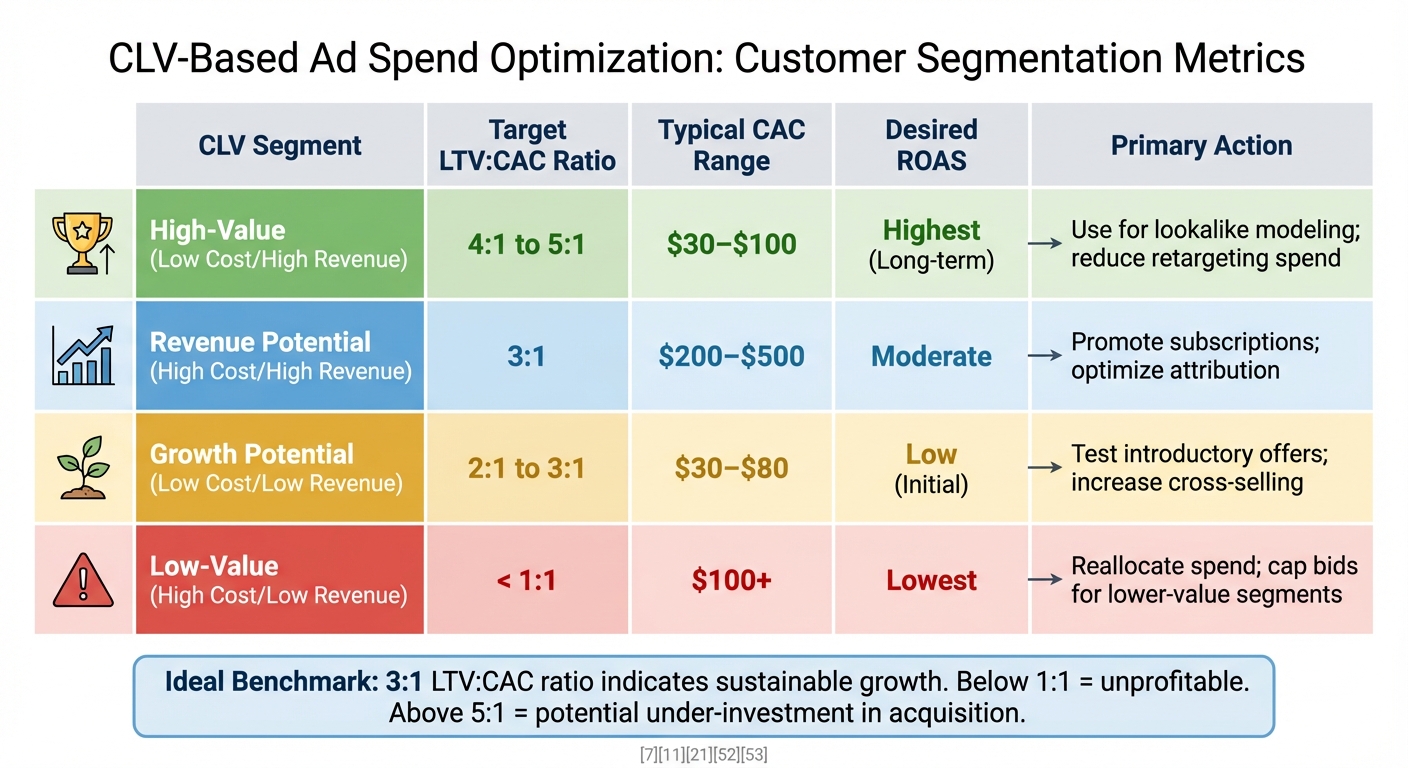
Customer Lifetime Value Segments: Target Metrics and Ad Spend Strategy
This table breaks down the essential metrics for aligning your ad spending with customer lifetime value (CLV) segmentation. By focusing on these metrics, you can evaluate how effectively your ad strategy supports your business goals.
| CLV Segment | Target LTV:CAC Ratio | Typical CAC Range | Desired ROAS | Retention Priority | Primary Action |
|---|---|---|---|---|---|
| High-Value (Low Cost/High Revenue) | 4:1 to 5:1 | $30–$100 | Highest (Long-term) | Maintain organically | Use for lookalike modeling; reduce retargeting spend |
| Revenue Potential (High Cost/High Revenue) | 3:1 | $200–$500 | Moderate | High | Promote subscriptions; optimize attribution |
| Growth Potential (Low Cost/Low Revenue) | 2:1 to 3:1 | $30–$80 | Low (Initial) | Moderate | Test introductory offers; increase cross-selling |
| Low-Value (High Cost/Low Revenue) | < 1:1 | $100+ | Lowest | Low | Reallocate spend; cap bids for lower-value segments |
These metrics provide a framework for smarter budget allocation, ensuring your ad spend aligns with the predicted value of each customer segment. For instance, a 3:1 LTV:CAC ratio is a solid indicator of sustainable growth. However, if your ratio drops below 1:1, it means you're spending more to acquire customers than they bring in after accounting for operational costs. On the flip side, ratios above 5:1 could suggest you're under-investing in acquisition.
In competitive markets, businesses may need to accept a lower ratio, such as 1.5:1, to maintain market share. However, for those prioritizing profitability, targeting a 4:1 ratio strikes a better balance.
"A 4:1 LTV:CAC ratio with 8-12 month payback typically indicates optimal balance between growth and cash efficiency." - AdBid
Aiming for a 6–12 month payback period is ideal, with anything under 6 months being exceptional. Additionally, boosting retention by just 5% can lead to a profit increase of 25% to 95%, making retention as important as acquisition when assessing your CLV-focused campaigns. Regularly tracking these metrics ensures your ad strategy remains adaptable and effective based on evolving CLV insights.
Conclusion
Predicting Customer Lifetime Value (CLV) leads to smarter ad spending by focusing on long-term profitability. It’s about investing in customers who are likely to deliver consistent returns. Take HelloFresh and The Motley Fool, for example - they used CLV predictions to boost their return on ad spend (ROAS) while cutting acquisition costs significantly.
These examples highlight a major shift in strategy: moving from cost-based to value-based optimization. By prioritizing high-value conversions, ad platforms can better align with your business goals. Segmenting audiences based on predicted CLV and adjusting bids ensures you’re not wasting money on low-value leads. Instead, your budget is allocated where it has the most impact.
That said, as consumer behavior and market conditions change, your models need to evolve too. Regularly monitoring metrics like Mean Average Percentage Error helps you spot prediction issues early. By feeding updated data into your models, you can refine their accuracy and keep your predictions sharp.
"By integrating predictive modeling into our marketing efforts, we are able to put our customers first and understand their needs on a deeper level. This isn't just about immediate gains; it's about creating long lasting relationships with customers." – Annie Meininghaus, SVP of Product, HelloFresh
This quote underscores the importance of aligning ad spend with CLV for sustainable growth. It’s not just about short-term wins - it’s about building relationships that last.
FAQs
How can predicting Customer Lifetime Value (CLV) improve ad spend efficiency?
Predicting Customer Lifetime Value (CLV) gives businesses a clear edge when deciding how to allocate their advertising budgets. By pinpointing high-value customers - those who are likely to generate the most revenue over time - marketers can concentrate their resources on acquiring and keeping these profitable individuals. This approach not only minimizes wasted spending on less valuable audiences but also maximizes returns.
CLV predictions also enhance audience segmentation. With this insight, businesses can create personalized offers and messages that truly connect with their most important customers. The result? Higher conversion rates and stronger customer loyalty. On top of that, understanding which campaigns and channels bring in high-value customers allows companies to fine-tune their marketing strategies for better efficiency and profitability. Using CLV as a guide ensures a data-driven, focused approach to advertising that supports long-term revenue growth.
What metrics are essential for predicting Customer Lifetime Value (CLV)?
To predict Customer Lifetime Value (CLV), businesses rely on three main types of data:
- Transactional data: This includes a customer’s purchase history, focusing on recency (how long it’s been since their last purchase), frequency (how often they buy), and monetary value (how much they typically spend).
- Demographic data: Information such as age, gender, income, and location helps businesses group customers into segments for more targeted strategies.
- Behavioral data: This tracks customer actions like browsing patterns, interactions on websites, and responses to marketing campaigns.
By diving into these data points, companies can pinpoint their most valuable customers, fine-tune marketing efforts, and make smarter decisions about where to allocate their advertising budgets.
How can businesses use CLV predictions to optimize their advertising budgets?
Businesses can use customer lifetime value (CLV) predictions to make more informed decisions about their advertising spend. By pinpointing high-value customers, companies can channel more resources into acquiring and retaining these profitable groups. For example, they might increase ad bids targeted at high-CLV customers or prioritize campaigns that yield the highest returns.
CLV insights also allow businesses to fine-tune their marketing strategies by shifting budgets toward the channels and tactics that bring in and keep valuable customers. This approach not only lowers acquisition costs but also boosts overall ROI, ensuring advertising dollars are spent wisely to support long-term growth.