Dynamic budget allocation is a game-changer for marketing teams looking to maximize ROI and reduce wasted spending. Unlike fixed budgets that rely on outdated assumptions, dynamic allocation uses real-time data to shift funds toward high-performing channels and away from underperforming ones. This approach can increase ROI by up to 25% and help marketers outperform competitors by the same margin.
Key takeaways:
- Real-time data enables faster decisions, reducing analysis time from 12–18 hours to just 2–3 hours.
- Companies using dynamic allocation see 48% exceed internal KPIs, compared to 33% with static budgets.
- Flexible reallocation prevents overspending on saturated channels and ensures funds flow to the highest ROI opportunities.
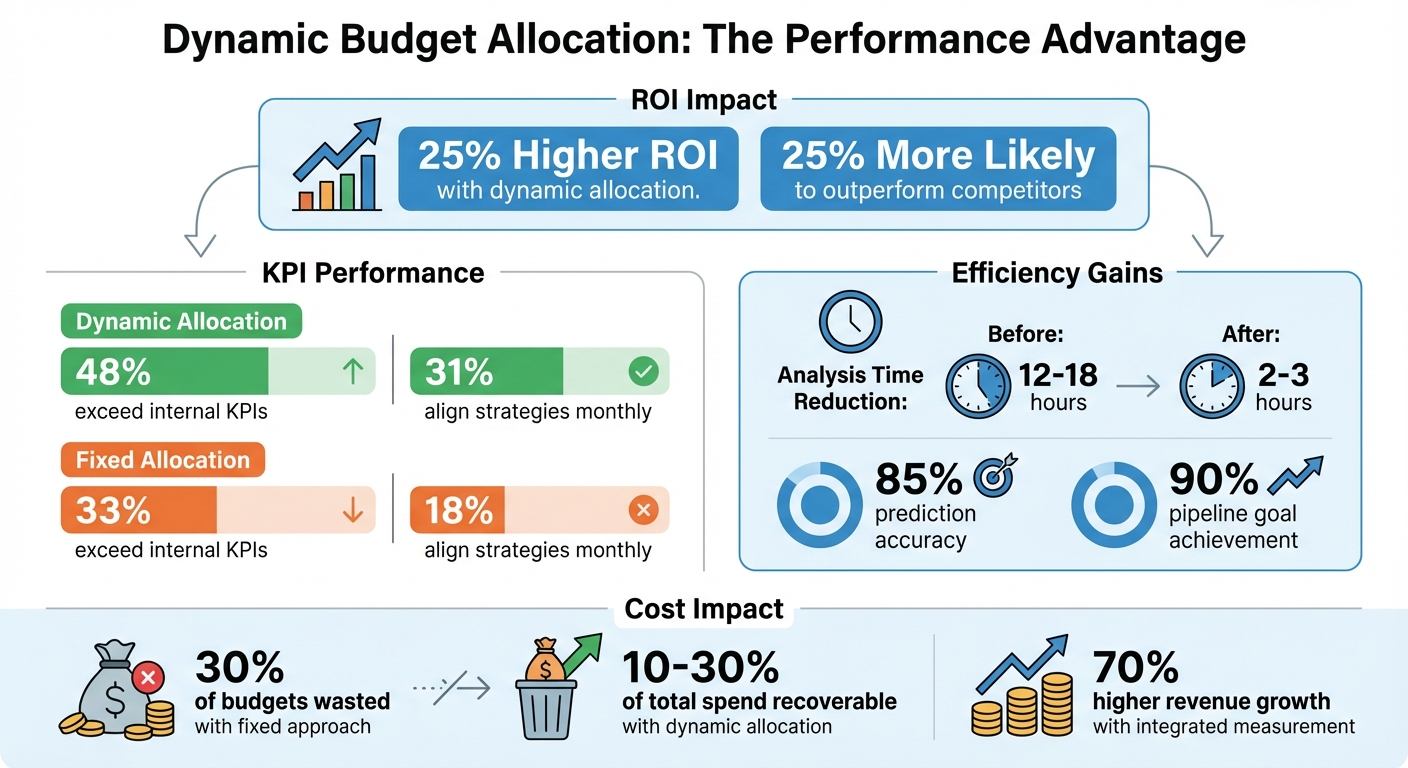
Dynamic vs Fixed Budget Allocation: Performance Comparison
Active your MMM: Optimize budget with dynamic spend & forecast checks | Modern Analytics Ep. 7
Problems with Fixed Budget Allocation
Fixed budgeting might seem convenient, but it often falls short in today’s fast-paced marketing landscape. Many organizations rely on the assumption that last year’s strategies will deliver the same results, adjusting budgets incrementally without re-evaluating their effectiveness. This "set it and forget it" mindset can lead to inefficiencies that hurt ROI and highlight the need for a more flexible, performance-driven approach to budget allocation.
Cannot Respond to Market Changes
The digital advertising world moves fast - sometimes by the hour. Fixed budgets, however, lack the flexibility to adapt to sudden shifts. For instance, if a competitor rolls out a major campaign or consumer interest spikes unexpectedly, teams using fixed budgets often can't act quickly enough. This issue is worsened by organizational silos, where funds are locked into specific categories like search, social, or display. These rigid divisions make it nearly impossible to reallocate resources in real time to seize new opportunities.
Spending Too Much or Too Little on Channels
Fixed budgets fail to account for diminishing returns. Once a channel reaches saturation, additional spending can lead to a steep drop in ROI - for example, falling from $3.50 to $1.80 per dollar spent - yet fixed budgets force continued investment regardless of performance. On the flip side, strict spending caps can prevent marketers from scaling high-performing campaigns, leaving potential profits on the table.
Another issue is that fixed budgets often overvalue "last-click" channels that close sales while underfunding awareness-driven efforts. This imbalance is compounded by platform-reported data, which can overlook 30% to 60% of marketing impact due to privacy restrictions. These missteps result in misallocated resources and wasted spending.
Lower ROI and Wasted Resources
The financial cost of fixed budgeting is hard to ignore. Studies show that nearly 30% of budgets are wasted when using a fixed approach. Additionally, lengthy manual analyses - taking up to 12–18 hours - often yield outdated insights, further dragging down ROI. In contrast, marketers who adopt flexible budgeting see better results: they’re 25% more likely to outperform competitors and 48% exceed internal KPIs, compared to just 33% of those sticking to fixed strategies.
Core Principles of Dynamic Budget Allocation
Dynamic budget allocation is built on three main principles, shifting decisions away from guesswork to real-time, performance-based strategies.
Real-Time Performance Tracking
Gone are the days of relying on delayed reports to make adjustments. With real-time tracking, marketers can spot trends or identify underperforming areas before resources are wasted. This method uses advanced modeling techniques, like multi-armed bandits, to strike a balance between exploring new opportunities and scaling successful ones.
Marketers who adjust their digital budgets weekly - or even more frequently - report 25% stronger performance compared to their competitors. Among these marketers, 48% say they exceeded their internal KPIs, while only 33% of those using slower, manual processes could say the same. AI-powered tracking tools make this possible by cutting analysis time from 12–18 hours down to just 2–3 hours, while achieving 85% prediction accuracy and hitting 90% of pipeline goals. This kind of instant feedback enables swift, data-driven resource adjustments.
Flexible Resource Reallocation
Traditional budgets often trap funds in rigid categories like search, social, or display, making it difficult to adapt when new opportunities emerge. Flexible reallocation breaks down these silos, focusing instead on forward-looking ROI potential. This allows resources to flow freely across channels based on real-time performance rather than outdated plans.
One example of this approach comes from a European retailer that shifted from managing 200 broad regional cells to 2.4 million micro-cells, each containing household socio-demographic and purchase data. By reallocating its advertising budget to this hyper-targeted level, the company boosted its target-group match by 150% and slashed leaflet distribution costs by 30%.
Prioritize Highest-Return Opportunities
Building on the flexibility of reallocation, the focus shifts to maximizing marginal ROI - the return on the next dollar spent. Unlike average ROI, marginal ROI helps prevent overspending on channels that have already reached diminishing returns. This strategy ensures that funds are directed to the most impactful opportunities.
Interestingly, only 17% of budget-agile marketers use uncapped budgets. However, those who do apply them strategically, targeting channels that consistently meet finance-approved ROI thresholds. AI systems enhance this process with scenario modeling, comparing multiple allocation strategies to identify the one most likely to succeed. These systems don’t just predict outcomes - they recommend specific actions, such as, “Shift $5,000 from Search to Social now”. This prescriptive guidance ensures that every dollar works harder and smarter.
sbb-itb-5174ba0
How to Implement Dynamic Budget Allocation
If fixed budgets feel restrictive, dynamic allocation offers a practical way to adapt and improve outcomes. By shifting from static to flexible budgets, businesses can see up to a 25% boost in ROI. Achieving this involves three key steps: unifying your data, adopting agile budget reviews, and incorporating analytics tools.
Create a Unified Data System
Start by auditing past campaigns to establish benchmarks like ROAS (Return on Ad Spend) and CAC (Customer Acquisition Cost) for future planning.
One common hurdle in this process is dealing with organizational silos. When teams - such as those handling search, social, and display - work independently and use inconsistent metrics or naming conventions, it becomes tough to compare performance across channels. Take Orangetheory, for example. In 2024, the fitness franchise tackled this issue by adopting the Switchboard data integration platform. This move automated data normalization and real-time reporting, cutting their analytics development time by 60% and eliminating the need for additional hires.
"Agility often starts with breaking down silos... marketers have to lean into an agile mindset to shift budgets to the biggest opportunities."
– Marie Gulin-Merle, Global VP of Ads Marketing, Google
To set the foundation for effective dynamic allocation, establish consistent naming conventions across platforms. Pair this with multi-touch attribution (MTA) to better understand the entire customer journey, rather than relying solely on last-click data. A unified data system enables quicker and more informed budget adjustments.
Review Budgets Monthly or Quarterly
The traditional approach of setting annual budgets and forgetting about them is no longer effective. Instead, embrace agile review cycles. For instance, set performance triggers - like reallocating funds if ROAS drops below a 4:1 ratio. Regularly compare actual spending against planned allocations to catch overspending or underspending early. Use clear criteria, such as discontinuing campaigns that fail to hit 70–90% of their CAC goals within 30 days, to make quick decisions.
A good rule of thumb is the 80/20 principle: allocate 80% of your budget to proven channels and 20% to testing new opportunities. Once these review cycles are in place, automation can help streamline the process, saving time and reducing errors.
Use Marketing Analytics Tools
Manually reallocating budgets is time-consuming and prone to mistakes. Tools powered by AI can speed up this process by condensing tasks like analysis, forecasting, and planning into three streamlined phases: simulation, prediction, and recommendation. This approach reduces the time required from 12–18 hours to just 2–3 hours.
For example, DoorDash uses an algorithmic budget allocation system that continuously monitors real-time performance data across more than 15 marketing channels. This system optimizes customer acquisition costs without the need for manual adjustments.
To make the transition smoother, consider tools from resources like the Marketing Analytics Tools Directory. Look for features like predictive scenario modeling, which allows you to simulate potential outcomes and assess confidence levels for different budget strategies. Before fully automating your budget shifts, ensure the tools meet high standards - such as 85% prediction accuracy and a 90% probability of meeting goals. Set guardrails, like minimum and maximum spend limits for each channel, to avoid over-investing in any single area. Start with an "Assist" mode, where the tool provides annotated recommendations, and gradually move to an "Execute" mode that automates adjustments within your defined parameters. Monitor the need for human intervention; if it's below 5%, your system is likely ready for more autonomy.
Benefits of Dynamic Budget Allocation
Dynamic budget allocation offers a smarter way to boost ROI, adapt to market changes, and make spending more efficient. According to research, 31% of agile marketers align their strategies monthly, compared to just 18% of non-agile marketers. This highlights how frequent planning and adaptability can lead to better outcomes. Let’s dive into how this approach improves ROI, speeds up market responsiveness, and reduces waste.
Higher ROI Through Data-Driven Decisions
Dynamic allocation thrives on real-time data, replacing guesswork with precise decision-making. With AI-driven tools reaching a 95% confidence level in decisions and 85% accuracy in budget impact predictions, marketers can minimize costly errors and maximize returns.
Take Brill Media in 2024, for example. CEO Robert Brill used Reddit and AI research to test ad language, dynamically reallocating budgets to high-performing ads. The result? Their cost per lead dropped from $114 to $27, a 76% reduction. Similarly, Affinity Law shifted from broad national campaigns to localized search ads targeting phrases like "Toronto pedestrian accident lawyer." This pivot to high-intent keywords increased their conversion rate by 35% and cut their cost per lead by 20%. These examples show how data-driven decisions can transform marketing outcomes.
Faster Response to Market Changes
Dynamic allocation isn’t just about better returns - it’s also about speed. Markets change constantly, with auction costs, competitor strategies, and consumer behaviors evolving daily. Instead of waiting for quarterly reviews, dynamic budgeting lets you pivot within hours or days.
Philips demonstrated this in 2025 by combining a data management platform with AI across 79 markets. Using real-time data, they continuously refined their content, leading to a 635% increase in newsletter signups from a slide-in CTA and a 16% boost in product views. This kind of rapid optimization simply isn’t possible with slower, traditional planning cycles.
Less Waste and Better Spending
Quick adjustments don’t just help you seize opportunities - they also prevent waste. Dynamic budgeting tackles two key inefficiencies: saturation waste (where extra spending delivers diminishing returns) and underinvestment (missing out on high-ROI opportunities). Marketers who use integrated measurement and standardized KPIs see up to 70% higher revenue growth compared to their peers, largely by addressing these blind spots.
In fact, tackling inefficiencies can recover 10%–30% of total spend. AI tools help by spotting creative fatigue and audience saturation faster than manual reviews, allowing teams to reallocate funds before they’re wasted. Instead of relying on historical averages, dynamic budgeting focuses on the "next dollar" impact, ensuring funds flow to the most effective touchpoints. This approach breaks down channel silos, preventing resources from being trapped in underperforming areas. It’s a smarter way to make every dollar count.
Conclusion and Next Steps
Dynamic budget allocation isn't just a buzzword - it’s a smarter way to achieve higher ROI, respond quickly to market changes, and make every dollar count. By moving away from rigid quarterly plans and embracing real-time, data-driven strategies, businesses can adapt swiftly to shifting market dynamics and optimize their spending.
To get started, lay down a strong foundation. Take a close look at your current data sources and ensure they’re aligned and consistent. Use tools like Marketing Mix Modeling to establish performance baselines, pinpoint where diminishing returns begin, and set clear objectives. It's also important to define guardrails, such as minimum and maximum spend thresholds for each channel, to keep automated systems on track. Begin with controlled pilot programs - run them for 8–12 weeks in a specific market. This approach lets you test and refine your strategy before rolling it out on a larger scale.
The tools you choose can make all the difference. Marketers who adjust budgets weekly or even more frequently are 25% more likely to outperform competitors. Plus, leveraging AI tools can drastically cut down analysis time, giving your team more bandwidth for strategic planning. Start with platforms that offer an "assist mode", where AI provides recommendations, but your team retains final decision-making authority. Over time, you can transition to full automation as you build confidence in the system.
Ready to take the leap? The Marketing Analytics Tools Directory is a great resource to help you find the right solutions for your business. Whether you’re looking for unified data platforms, AI-driven forecasting tools, or cross-channel allocation systems, this directory can guide you toward the tools that fit your unique needs.
FAQs
How can dynamic budget allocation help improve ROI compared to fixed budgets?
Dynamic budget allocation helps boost ROI by enabling marketers to adjust spending in real time based on performance metrics and shifting market trends. Unlike fixed budgets, which often rely on outdated predictions, this flexible approach ensures resources flow toward the most effective channels and strategies, maximizing efficiency.
This method uses data-driven insights and advanced technologies like AI and machine learning to fine-tune spending across campaigns. By reallocating funds to seize new opportunities or cut back on areas that aren't performing well, businesses can stay agile and improve overall returns. Fixed budgets, in contrast, lack this adaptability, making it harder to keep up with changing market conditions or campaign results.
What are the best tools for implementing dynamic budget allocation?
Dynamic budget allocation becomes much more manageable with the help of advanced tools powered by AI and machine learning. These technologies work behind the scenes to analyze campaign performance, track market trends, and align with business objectives, making real-time adjustments that aim to get the most out of every dollar spent.
There are platforms available that use predictive modeling and automation to simplify budget management. For instance, some tools offer AI-driven recommendations to distribute budgets effectively across multiple channels, while others handle daily adjustments automatically, ensuring funds are concentrated on the campaigns delivering the best results. This not only minimizes manual effort but also improves overall efficiency.
By tapping into real-time analytics and smart automation, businesses can fine-tune their budget strategies and make sure their marketing investments deliver the highest possible returns.
How can companies break down silos to create more flexible budgets?
To create budgets that can adapt more easily, companies should focus on breaking down silos within their organization. Encouraging closer collaboration between teams - especially marketing and finance - can lead to smarter resource allocation and greater returns on investment.
Using advanced analytics tools like AI and machine learning can be a game-changer. These tools offer real-time insights and predictive data, helping businesses spot high-impact opportunities for investment. On top of that, scenario planning allows companies to simulate different outcomes before making changes, reducing uncertainty and giving decision-makers more confidence in their choices.
By combining cross-team collaboration, data-driven tools, and agile planning approaches, businesses can stay responsive to shifting market conditions and internal priorities. This creates a budgeting process that’s not only more dynamic but also far more effective.