Subscription businesses thrive when they understand Customer Lifetime Value (CLV). Machine learning (ML) models are transforming how companies predict CLV by delivering faster, more accurate insights compared to older methods. Here's what you need to know:
- Why CLV Matters: CLV helps businesses decide how much to spend on acquiring and retaining customers using analytics tools for business.
- Traditional vs. ML Methods: Traditional models rely on basic purchase data and take 12–24 months for accuracy. ML models can predict CLV in just 30–60 days using diverse data like browsing history, email engagement, and customer support interactions.
- ML Techniques: Gradient Boosted Trees, Collaborative Filtering, and Deep Learning are key methods used to predict CLV, personalize experiences, and reduce churn.
- Business Impact: Companies like Netflix, Dropbox, and HelloFresh use ML to improve retention, optimize marketing spend, and increase revenue.
Key takeaway: Machine learning is reshaping how subscription businesses calculate and act on CLV, helping them focus resources on high-value customers and long-term growth.
Forecasting Customer Lifetime Value (CLTV) for Marketing Campaigns under Uncertainty with PySTAN
sbb-itb-5174ba0
Machine Learning Techniques for CLV Prediction
Subscription-based businesses use three main machine learning methods to forecast customer lifetime value (CLV): gradient boosted trees for uncovering complex patterns, collaborative filtering for tailored recommendations, and deep learning for analyzing large, intricate datasets. These methods help predict customer churn, personalize user experiences, and draw insights from diverse data. Let’s break down how each approach works, along with real-world examples of their effectiveness.
Gradient Boosted Trees and Survival Analysis
Gradient boosted trees (GBT) algorithms, like XGBoost and CatBoost, excel at identifying non-linear relationships in data that simpler models might overlook. These models work by sequentially training decision trees, each one correcting the errors of the previous. For instance, in September 2023, Expedia Group implemented a CatBoost-powered CLV system that processes over 200 features - such as booking platform, brand, and email engagement - for hundreds of millions of users. By segmenting customers into 30 behavioral and geographical groups and updating the model daily, Expedia significantly improved its ability to distinguish high-value customers from low-value ones, surpassing older CLV benchmarks.
"The main idea behind ensemble learning is that multiple weak learners are trained, and their predictions are combined before further training more weak learners." - Blue Orange Digital
Survival analysis complements GBT by estimating how long a customer will remain active - a key metric for subscription businesses where churn directly affects revenue. Unlike one-size-fits-all approaches, survival models like Kaplan-Meier and Cox Proportional-Hazards predict individual churn timelines. For example, Expedia uses percentile clipping to handle outliers, while a comparative study revealed that a Random Forest model achieved a Mean Absolute Error (MAE) of $912, outperforming the probabilistic BG/NBD model's MAE of $954. By pinpointing when customers are likely to leave, survival analysis helps businesses allocate retention resources more effectively, boosting profitability.
Collaborative Filtering for Subscription Models
Collaborative filtering (CF) takes a different route, focusing on personalization to enhance CLV. It works by grouping users with similar preferences and recommending content to keep them engaged. Companies like Netflix and Facebook have successfully scaled CF to handle billions of users and interactions.
CF relies on a user-item matrix, where rows represent users and columns represent items (like movies or products). Two common approaches are user-to-user recommendations, which suggest items based on the preferences of similar users, and item-to-item recommendations, which highlight content similar to what a user has already enjoyed. Techniques like Singular Value Decomposition (SVD) uncover hidden "latent features" that improve prediction accuracy. By reducing decision fatigue and delivering personalized suggestions, CF helps subscription businesses improve retention and maximize customer lifetime value.
Deep Learning for CLV Forecasting
Deep learning adds another layer of capability, especially for handling massive, high-dimensional datasets. These models can analyze complex inputs like web activity, social media engagement metrics, and customer support interactions to identify patterns that simpler models might miss. A 2022 study in the UK analyzed 541,000 e-commerce transactions using K-Means clustering, showing that behavior-based segmentation can significantly increase repeat purchases.
A common approach involves a two-stage pipeline: first, classify the likelihood of a customer renewing their subscription, and then predict the monetary value of that renewal. This strategy ensures computational resources are focused where they matter most. Algorithms like XGBoost, designed for parallel processing, can evaluate hundreds of millions of users daily. Unlike older methods, these models handle non-linear relationships effectively and are more resilient to missing data - a critical advantage in the diverse datasets typical of subscription businesses. By revealing hidden behavioral trends, deep learning enables businesses to make timely, personalized CLV predictions, supporting smarter retention and acquisition strategies.
Case Studies: Machine Learning for Subscription CLV
These examples highlight how companies use machine learning (ML) to refine customer lifetime value (CLV) in subscription-based models.
Netflix: Personalization and Retention Powered by AI
Netflix boasts a subscriber retention rate of over 90%, thanks to its extensive use of machine learning across its platform. The company’s recommendation system evaluates real-time actions - like pauses, skips, and inactivity - to identify users at risk of canceling. It then personalizes content to re-engage them. Features like "Trending Now" and "Because You Watched" are tailored for each viewer, driving 75–80% of all content watched. This approach saves Netflix an estimated $1 billion annually in retention costs. On average, a Netflix subscriber stays for 25 months, with a lifetime value of $291.25.
"Netflix estimates that their recommendation system saves them $1 billion per year in customer retention."
– Ben, Head of Data Strategy
Netflix has also pioneered dynamic thumbnail personalization. Using convolutional neural networks and Esthetic Visual Analysis, it selects thumbnails that resonate with individual viewers. For example, action fans see dynamic scenes, while rom-com enthusiasts get romantic imagery. This strategy impacts 82% of browsing time. Netflix's data pipeline, Keystone, processes over 700 billion messages daily. Beyond this, the company uses ML to predict content success before production, achieving a 70% renewal rate - double the average for traditional networks. Techniques like Markov chains and causal inference help quantify the impact of retention and acquisition efforts.
Switching from streaming to cloud storage, Dropbox offers another compelling example of ML-driven growth.
Dropbox: AI-Optimized Referrals and Retention
Faced with acquisition costs of $300 per user compared to annual revenue of $99, Dropbox shifted from paid advertising to a referral program. This program rewarded both the inviter and the invitee with extra storage space, a low-cost incentive that dramatically increased user engagement. The result? A staggering 3,900% growth within 15 months, with user numbers jumping from 100,000 to 4 million. At its peak, referrals accounted for 35% of daily signups.
Dropbox uses the eXpected Revenue (XR) metric, powered by Gradient Boosted Trees in TensorFlow, to forecast the two-year value of trial users within days of onboarding. These predictions are accurate within 5% of actual revenue.
"With machine learning we can now draw accurate conclusions from A/B experiments in a matter of days instead of months - meaning we can run more experiments every year."
– Michael G. Wilson, Dropbox
In addition, Dropbox revamped its billing system by replacing 14 years of static rules with a gradient boosted ranking model. This new system predicts the best time to retry failed credit card charges based on user behavior and geography, reducing involuntary churn. The "Predict Service" further improved efficiency, cutting prediction latency to under 300 milliseconds for 99% of requests.
In the food subscription space, HelloFresh demonstrates how predictive modeling can transform marketing efforts.
HelloFresh: Predictive Models for Smarter Marketing
HelloFresh created Morpheus, a system powered by 1,360 CatBoost gradient boosting models trained on segmented customer data. Instead of traditional CLV metrics, it focuses on Customer Campaign Value (CCV), which measures profits generated between key customer events like activation and reactivation. This enables more precise marketing budget allocation.
"Morpheus is a giant leap forward compared to our previous approach, which adopted a cohort perspective... to forecast the future average order rate."
– Luca Fiaschi, Chief Data & AI Officer, HelloFresh
In February 2024, HelloFresh adopted a target Return on Ad Spend (tROAS) strategy for search advertising. By combining forecasted CLV data with Google's bidding algorithms, the company shifted its focus from maximizing conversions to prioritizing long-term value. This resulted in a 14% increase in ROAS and significantly lowered acquisition costs.
"By integrating predictive modeling into our marketing efforts, we are able to put our customers first and understand their needs on a deeper level. This isn't just about immediate gains; it's about creating long-lasting relationships with customers."
– Annie Meininghaus, SVP of Product, HelloFresh
HelloFresh also introduced the Deep Propensity Score (DPS) model in September 2023 to predict order frequency over 2–3 week periods. Using BERT for recipe title embeddings and SWIN for image embeddings, it calculates the similarity between past orders and upcoming menus. Alongside this, a LightGBM-based Pause Model predicts with 90% accuracy whether a customer will become inactive for four weeks, triggering tailored retention campaigns. Insights from SHAP analysis revealed that U.S. customers respond more to visuals, while U.K. customers prioritize recipe titles. These findings help refine personalization strategies for different markets.
Comparing Machine Learning Models for CLV
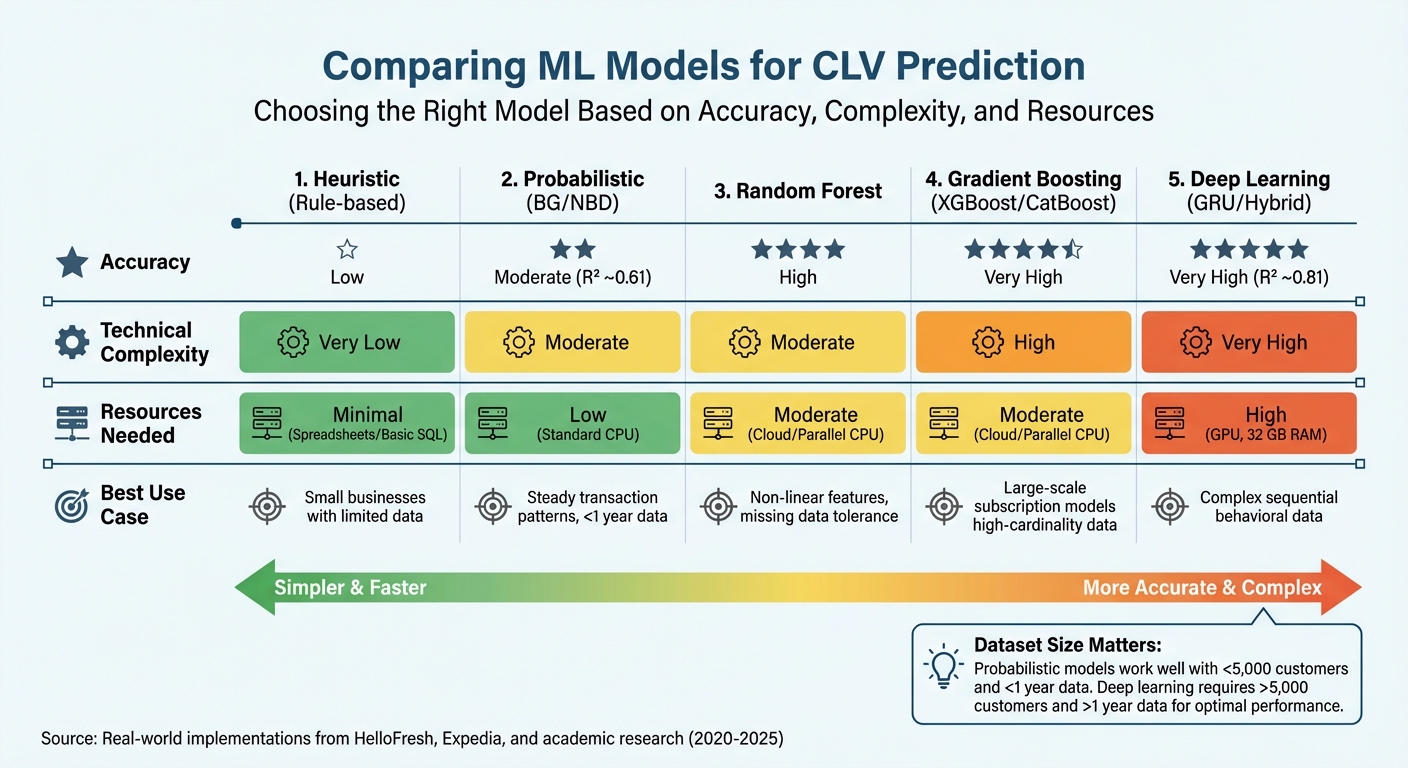
Machine Learning Models for CLV Prediction: Performance and Resource Comparison
Selecting the right machine learning model for Customer Lifetime Value (CLV) prediction depends on factors like dataset size, available resources, and business objectives. Here's a breakdown of some widely used models and their applications:
Gradient Boosted Trees, such as XGBoost and CatBoost, are known for delivering top-notch accuracy in subscription-based businesses with large and varied datasets. For example, in December 2020, HelloFresh utilized 1,360 CatBoost models through their Morpheus system. This innovation replaced traditional cohort-based forecasting with individualized weekly predictions. Under the leadership of Chief Data & AI Officer Luca Fiaschi, the system analyzed hundreds of features - including meal swaps and zip code-based household value estimates - to fine-tune marketing budgets across Finance, Marketing, and Product teams.
Deep Learning models shine when dealing with sequential behavioral data and additional contextual details like demographics or website analytics tools. A noteworthy instance: In October 2025, researchers MD AL Rafi and I K M Saameen Yassar developed a hybrid deep learning framework using stacked GRUs on the Olist Brazilian E-Commerce dataset. Powered by an NVIDIA GeForce RTX 2080 Ti GPU with 32 GB of RAM, their model achieved an R² of 0.81 and reduced the Mean Absolute Error to 24.1, outperforming the BG/NBD baseline's 32.4. With approximately 150,000 trainable parameters, this approach significantly improved the precision of marketing budget allocation.
For businesses with smaller datasets or simpler transaction patterns, probabilistic models like BG/NBD are a practical choice. These models rely solely on Recency, Frequency, and Monetary (RFM) data and can be implemented using Python libraries like lifetimes. They are particularly effective for datasets covering less than a year or involving fewer than 5,000 customers. On the other hand, deep learning models typically require more extensive datasets - spanning over a year and involving more than 5,000 customers - to outperform these simpler statistical approaches.
Model Performance and Results Comparison
| Model Type | Accuracy | Technical Complexity | Resources Needed | Best Use Case |
|---|---|---|---|---|
| Heuristic (Rule-based) | Low | Very Low | Minimal (Spreadsheets/Basic SQL) | Small businesses with limited data |
| Probabilistic (BG/NBD) | Moderate (R² ~0.61) | Moderate | Low (Standard CPU) | Steady transaction patterns, <1 year data |
| Random Forest | High | Moderate | Moderate (Cloud/Parallel CPU) | Non-linear features, missing data tolerance |
| Gradient Boosting (XGBoost/CatBoost) | Very High | High | Moderate (Cloud/Parallel CPU) | Large-scale subscription models with high-cardinality data |
| Deep Learning (GRU/Hybrid) | Very High (R² ~0.81) | Very High | High (GPU, 32 GB RAM) | Complex sequential behavioral data |
These comparisons, backed by real-world implementations, help subscription-based businesses make informed decisions about the most suitable model for their needs. For instance, Expedia Group's experiences further highlight the practical differences in performance across these models.
Best Practices from Case Studies
Case studies offer a practical lens into how machine learning (ML) techniques for customer lifetime value (CLV) prediction can improve customer retention and yield a better return on investment (ROI).
Churn Prevention and Personalization Strategies
Preventing churn effectively requires combining behavioral insights with multi-channel strategies. Netflix, for instance, uses neural networks to analyze user behavior, such as viewing habits and interface interactions. This allows them to identify subscribers likely to cancel and proactively recommend content to re-engage them. The takeaway? Retention isn’t just about offering discounts - it’s about delivering tailored value before customers even consider leaving.
Take the example of LES MILLS+. In late 2023, they tackled a 7.7% year-over-year decline in home fitness demand by launching a churn prevention initiative. Using a machine learning model to flag at-risk customers, they integrated the insights with Customer.io for targeted multi-channel messaging. The results were impressive: 53% of predicted churners stayed, and 80% of those identified as at-risk switched to annual memberships. This saved the company hundreds of thousands in ad costs.
Centralized data access also plays a crucial role. HelloFresh’s Morpheus system exemplifies this by storing CLV predictions in a database that teams can query with simple SQL commands. This accessibility empowers Finance, Marketing, and Product teams to make data-driven decisions without needing advanced technical expertise.
Another key principle is weighing retention efforts against profitability. Databricks emphasizes:
"The cost of avoiding churn whether through promotions, discounts or other incentives should never exceed the residual value we might hope to preserve".
This means calculating the remaining CLV of at-risk customers before offering costly incentives, ensuring that retention strategies protect profits rather than erode them. These methods demonstrate how targeted retention can deliver substantial financial benefits, as explored further in the ROI analysis below.
ROI of Machine Learning in CLV Prediction
When done right, machine learning applied to CLV prediction can yield significant financial rewards.
Consider Readly, a European digital subscription leader. Between 2023 and 2024, they transitioned from a growth-centric approach to a profitability-driven one, leveraging predictive LTV models with Solita’s help. The results were striking: a 40-60% boost in channel profitability and a marked improvement in their LTV/CAC ratio within six months. Their CMO, Marie-Sophie von Bibra, highlighted the transformation:
"Predictive LTV has totally changed how we can predict, plan and evaluate the individual channel strategies and our marketing strategy as a whole... it has been a game changer".
In financial services, a Fortune 500 bank used six years of transactional data to forecast individual customer revenue. Their ML solution delivered a 33% improvement in Return on Marketing Investment (ROMI) and a 50% increase in operational efficiency by identifying which new customers would become high-value clients within a year.
Scalability is another critical factor for ROI. Managing large-scale ML models ensures consistent performance even as customer behaviors evolve. For example, HelloFresh runs 1,360 CatBoost models, using MLOps platforms to prevent "model drift." This infrastructure supports daily scoring of millions of customers with high accuracy across segments. The financial logic is clear: eCommerce companies typically spend six times more acquiring new customers than retaining existing ones, making strategies like second-purchase optimization essential for profitability.
Conclusion
Machine learning has reshaped how subscription businesses approach customer lifetime value (CLV) predictions. By moving from broad, cohort-based methods to detailed, customer-level forecasts, companies can break free from generic strategies. As Luca Fiaschi, CDAO at HelloFresh, explains:
"Individualized predictions can bring us beyond digital product optimization strategies formed for the average, enabling custom and personalized communication with high-value customers".
The results speak for themselves. Case studies reveal that personalized CLV analysis leads to 30-50% better retention rates and 25-40% growth in expansion revenue per customer in SaaS and subscription models. These metrics highlight the difference between thriving and merely surviving in today’s market.
To achieve these outcomes, businesses must focus on three crucial elements: granular segmentation, multi-stage modeling, and continuous monitoring. These strategies unlock the full potential of CLV optimization and provide a strategic edge in an increasingly competitive subscription landscape.
Fortunately, the tools and infrastructure needed for this transformation are more accessible than ever. Platforms like the Marketing Analytics Tools Directory offer a centralized resource for comparing machine learning solutions, predictive analytics tools, and customer data platforms tailored to subscription models. With 90% of companies planning to invest in AI-powered CLV solutions by 2027 and the global CLV market projected to hit $5.6 billion by 2025, adopting these technologies is no longer optional - it’s essential for staying ahead.
The tools are available, the ROI is clear, and the time to act is now.
FAQs
What data do I need to predict CLV in a subscription business?
To forecast Customer Lifetime Value (CLV) in a subscription-based business, having access to detailed customer data is essential. The core inputs include:
- Customer IDs: To track individual customers.
- Transaction timestamps: To understand when purchases occur.
- Order types: To differentiate between product or service categories.
- Monetary values: To measure the financial impact of each transaction.
- Purchase frequency: To gauge how often customers buy.
Adding layers of data, like demographic details, engagement metrics, and behavioral trends, can refine predictions. Using machine learning models, businesses can analyze historical patterns to estimate future customer value. This insight is critical for fine-tuning marketing efforts and retention strategies.
How do I choose between BG/NBD, gradient boosting, and deep learning for CLV?
Choosing the right approach - BG/NBD, gradient boosting, or deep learning - depends on your goals and the complexity of your data.
- BG/NBD is a solid choice for predicting purchase frequency when you have historical transaction data. It's straightforward and works well for simpler datasets.
- Gradient boosting shines when working with structured data that includes multiple features. It delivers higher accuracy and is great for tasks requiring detailed feature analysis.
- Deep learning is ideal for large, complex datasets, especially when dealing with sequential or unstructured data like text, images, or time-series information.
For simpler datasets, BG/NBD might be all you need. But if your data is more detailed or complex, gradient boosting or deep learning could offer better results.
How can I use CLV predictions without overspending on retention incentives?
Predicting Customer Lifetime Value (CLV) can help you zero in on your most valuable customers and direct your marketing efforts where they matter most. By using predictive analytics, you can identify high-value customers and allocate more resources to them while scaling back on those with lower potential.
Machine learning models play a key role here, offering insights into future customer behavior. This allows you to craft personalized retention strategies that focus on keeping your top customers engaged - without overspending on less profitable ones. The result? A more efficient and effective marketing budget.