Psychographics go beyond demographics - they explain why customers make decisions, revealing values, motivations, and behaviors. For marketers, this means creating campaigns that connect on a deeper level. Here's a quick look at five tools designed to help analyze psychographic data effectively:
- GWI: Global survey data from 3 billion people across 53 markets. Ideal for building detailed audience profiles.
- Resonate: Focuses on U.S. consumers with 15,000+ attributes, including motivations and behavioral predictions.
- Brandwatch: Monitors 100+ million sources for real-time sentiment and trend analysis.
- Toluna: Combines surveys with AI-driven synthetic personas for rapid concept testing and audience insights.
- Synthesio: Social listening paired with Ipsos research standards to analyze global consumer behavior.
These tools help marketers target audiences more precisely by blending psychographic, demographic, and behavioral data. Whether you're planning a global campaign or analyzing niche U.S. markets, choosing the right tool depends on your goals, budget, and data needs.
Quick Comparison
| Tool | Data Source | Focus | Features | Pricing |
|---|---|---|---|---|
| GWI | Global surveys (3B+ users) | 53 markets | Lifestyle insights, audience profiles | ~$1,500/user/year |
| Resonate | AI + U.S. consumer data | U.S. only | 15,000+ attributes, predictive models | Custom |
| Brandwatch | Social media/web sources | Global | Real-time sentiment, trend tracking | $6K–$15K/month |
| Toluna | Surveys + synthetic personas | Global | Rapid testing, consumer panels | Custom |
| Synthesio | Social listening (Ipsos-backed) | Global | Consumer behavior analysis | Custom |
Each platform offers unique strengths. For global insights, GWI is a strong choice, while Resonate excels in U.S.-specific segmentation. Social listening tools like Brandwatch and Synthesio provide real-time sentiment, and Toluna is great for testing ideas quickly. Choose based on your campaign's scope and audience needs.
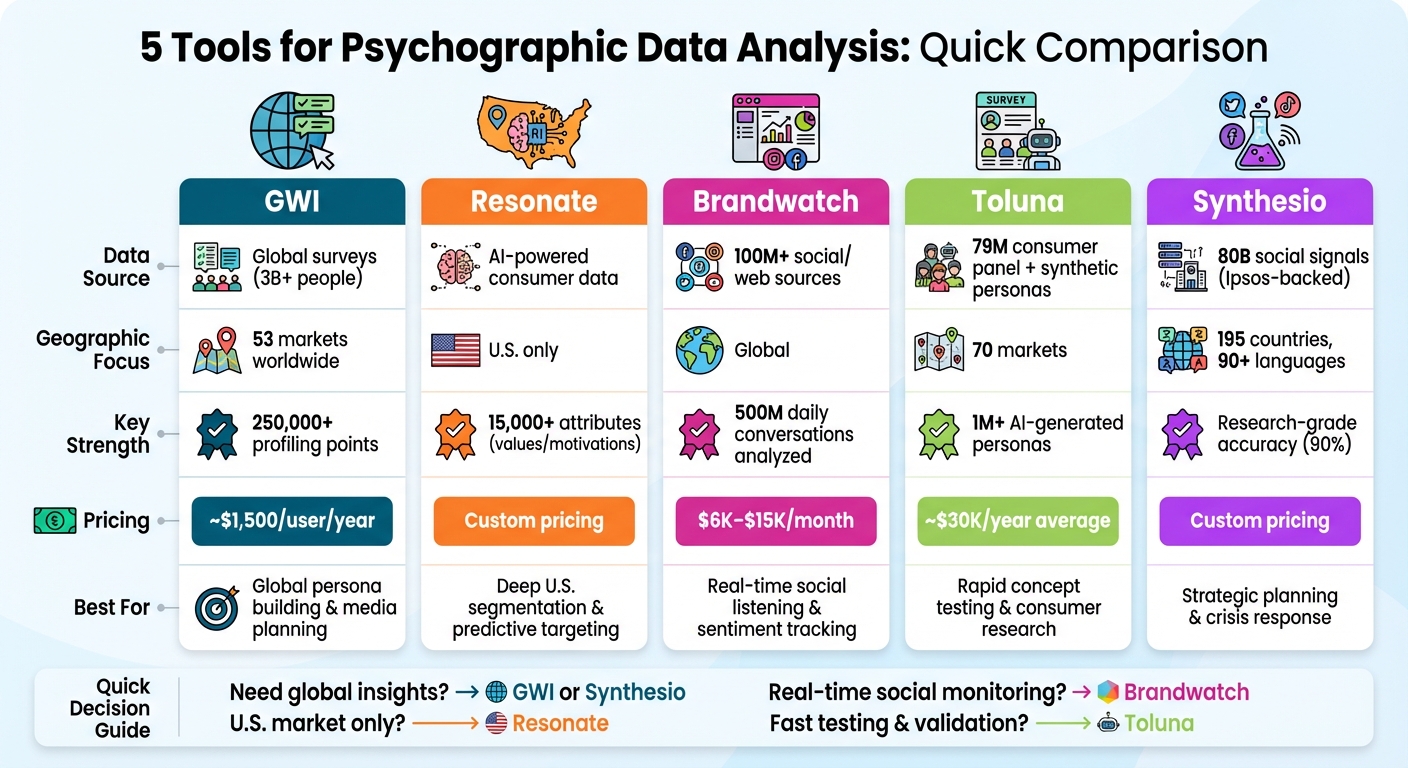
Comparison of 5 Psychographic Data Analysis Tools for Marketers
The Complete Guide to Psychographic Segmentation Systems for Retail
GWI
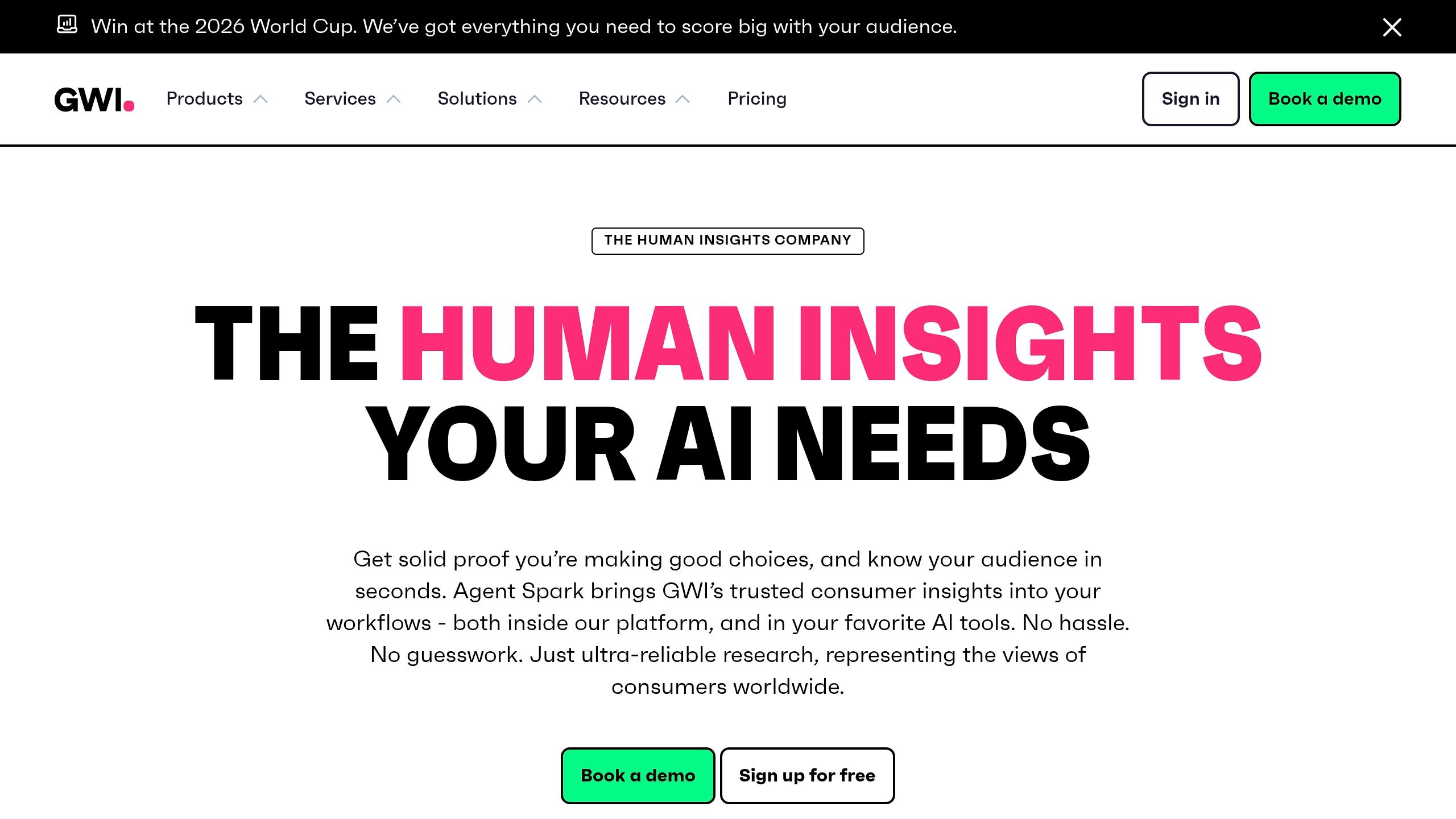
GWI is a Human Insights platform designed to uncover the motivations and lifestyles shaping consumer choices. By conducting over 2 million interviews annually across 50+ global markets and processing 35 billion data points, GWI captures insights from more than 2.5 billion internet users. This expansive reach ensures marketers can access verified survey data instead of relying on less reliable web-scraped information.
At the heart of GWI's platform is Agent Spark, an AI-driven insights tool that answers plain-English questions with data grounded in real human surveys. For example, you can ask, "What influences brand loyalty among Gen Z gamers?" and receive instant, data-supported insights. Other tools, like GWI Canvas for turning data into presentation-ready slides and Instant Charts for creating sharable visualizations from text queries, make the platform user-friendly and efficient.
Key Features
GWI offers over 250,000 profiling points that cover interests, attitudes, purchasing behaviors, and media habits, enabling marketers to create highly detailed audience segments. With 40,000+ attributes available, the platform allows for precise audience profiling. Its GWI Core survey tracks 4,000+ brands across 47 markets, and features like AND/OR/NOT logic let users refine their audience segmentation with pinpoint accuracy.
To keep insights up-to-date, GWI refreshes its data four times a year, ensuring marketers can react to changing market conditions. Beyond general consumer data, the platform offers specialized datasets like GWI USA (focused on 240 million US users), GWI Work (targeting B2B buyers in 10 markets), GWI Gaming (covering gamers in 15 markets), GWI Sports (focused on over 1 billion sports fans), and GWI Kids (providing insights on children aged 8–15). Additionally, its recontact methodology enables brands to align custom research with GWI Core data for deeper, long-term insights.
Use Cases
GWI is a go-to tool for building and analyzing detailed audience profiles for global marketing campaigns. It helps with strategic planning by segmenting consumers based on their lifestyles and values, supports media planning by aligning messaging with specific audience mindsets, and informs product development by uncovering the emotional triggers behind buying decisions.
One standout example is the agency Passion Digital, which used GWI to profile "ultra high earners" for its client, The Thinking Traveller. By leveraging psychographic and demographic insights, they developed a targeted contact strategy that led to a 300% boost in organic visibility and over $200,000 in free media coverage. Passion Digital shared:
"When it comes to our client's audiences, GWI is perfect for helping us think outside the box. You can't lose."
Pricing
GWI offers customized pricing based on factors like business requirements, market focus, and research scope. While a "Sign up for free" option provides limited access, full functionality requires scheduling a demo to receive a personalized quote.
Resonate
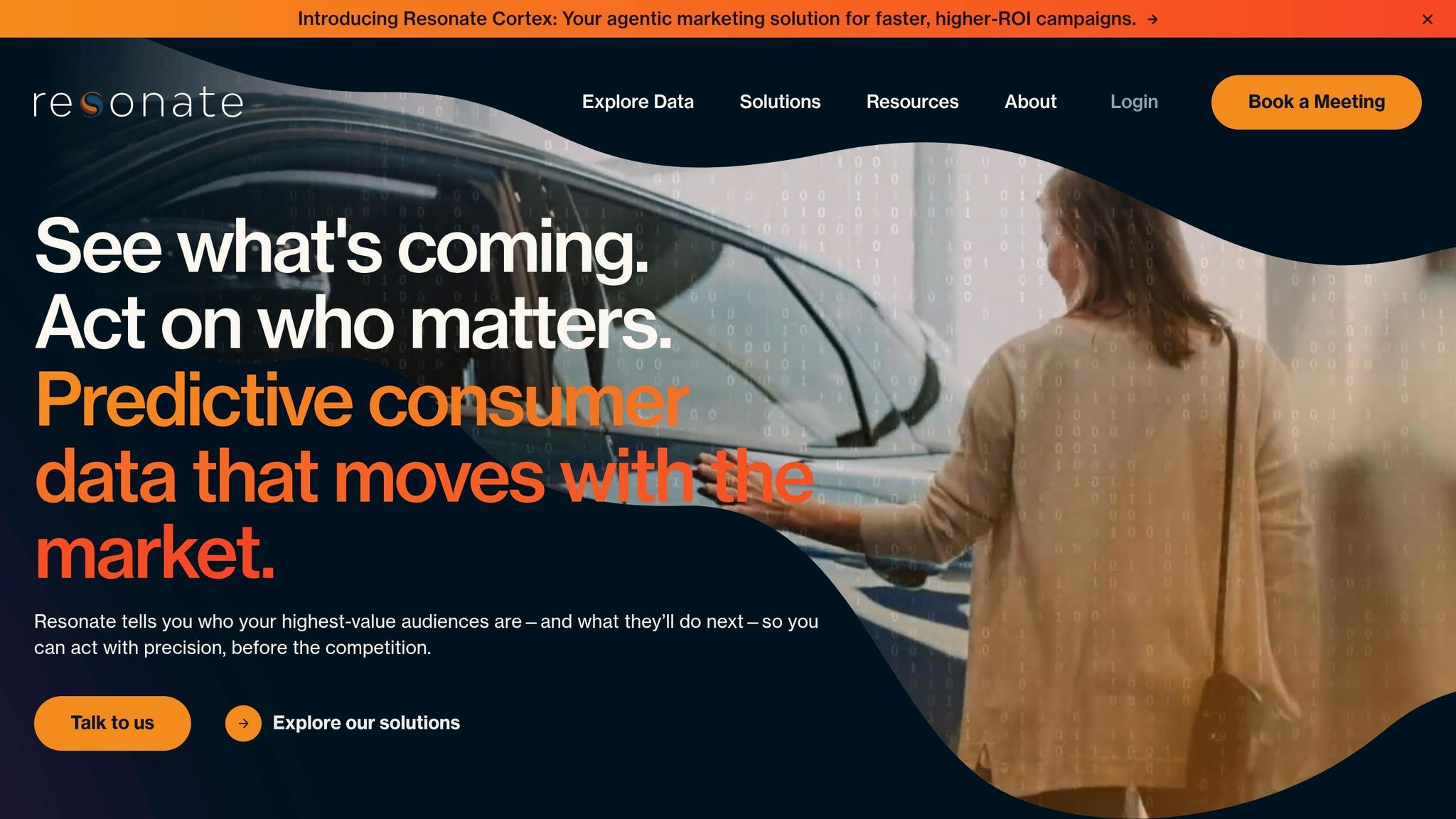
Resonate is an AI-driven platform tailored for analyzing U.S. consumer psychographics. With a database of 250 million U.S. consumer profiles linked to over 1 billion device IDs through its multi-ID identity graph, Resonate processes an impressive 30 billion daily consumer observations via its proprietary rAI engine.
This platform, like others in its category, combines in-depth data insights with actionable intelligence, enabling marketers to fine-tune their campaigns with precision.
Key Features
Resonate’s Elements dataset includes over 15,000 attributes, such as 2,200 psychographic markers, 5,500 behavioral signals, 2,500 media patterns, and 2,200 intent indicators. These attributes allow businesses to forecast purchases over 30-, 90-, or 365-day windows. Unlike basic demographic data, these psychographic markers delve into personal values like "Devotion to God/faith", "Social/professional status", and "Caring for nature", giving marketers a clearer picture of what drives consumer decisions.
The Resonate Ignite Platform acts as a centralized hub for marketers. It provides tools to build audiences, uncover insights, and directly activate campaigns on major DSPs and digital channels - no intermediaries required. Features like persona replication and micro-segmentation enhance existing audience segments with deeper psychographic insights. Additionally, the platform’s AI-powered predictive models can be developed in days, and over 1,000 pre-built intent and lifestyle-based audience segments are ready for immediate use.
These capabilities make it easier for marketers to turn data into highly targeted campaigns.
Use Cases
Resonate is particularly suited for U.S.-based companies that need detailed audience insights and predictive planning for their campaigns. Marketers often use the platform to enrich their first-party CRM data by integrating it into the Ignite platform. This process fills in gaps with psychographic and behavioral insights, offering a comprehensive view of their audience. The platform supports industries ranging from consumer packaged goods and financial services to retail, healthcare, and political advocacy.
Here’s what industry leaders have to say about Resonate:
"Resonate is the best tool we use. It has replaced three other tools"
- Chief Strategy Officer, Grey New York.
"What we share from Resonate either validates what advertisers know about their audiences or opens their eyes to things they didn't know"
- Chief Marketing Officer, Star Tribune.
These endorsements highlight how Resonate helps marketers uncover the "why" behind consumer behavior, reinforcing the importance of advanced psychographic profiling.
Pricing
Resonate offers custom enterprise-level pricing tailored to business needs and usage. Flexible plans are available for insights, targeting, and data enrichment, with optional add-ons like managed media and analytics services for an additional fee. Businesses can request a personalized quote by scheduling a meeting, demo, or data discovery call with the Resonate team.
Brandwatch
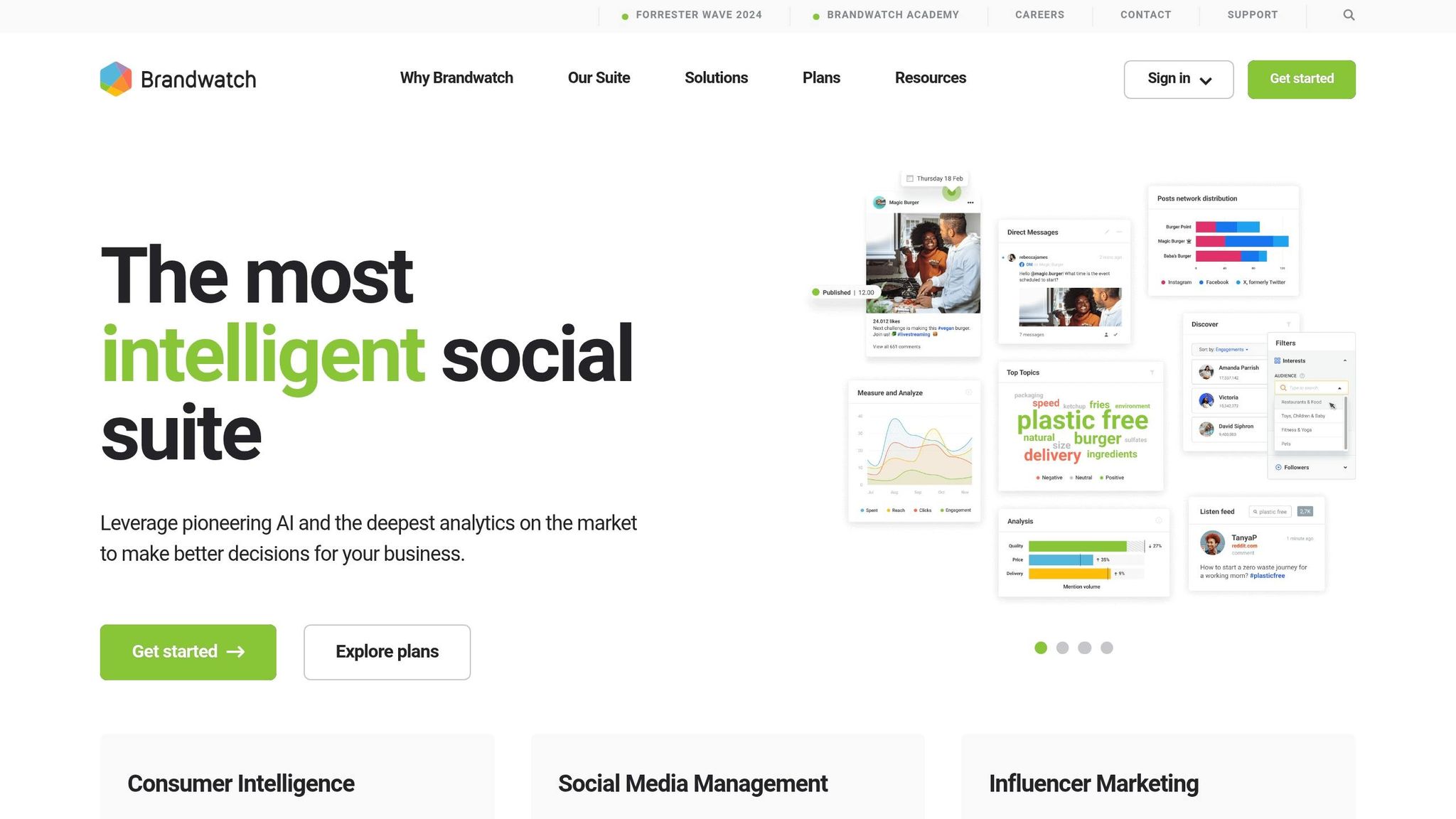
Brandwatch is a social listening platform that monitors over 100 million sources and analyzes 500 million conversations daily. It boasts a historical archive of 1.4 trillion posts dating back to 2008. The platform’s psychographic insights are powered by advanced AI technologies, including Blue Silk AI, Iris AI Assistant, and BrightView machine learning classifiers.
What sets Brandwatch apart is its ability to dig deeper than basic metrics. Using Social Panels, it segments audiences into specific personas, uncovering consumer intents and key life moments. The Iris AI Assistant automatically identifies data spikes, helping users understand the reasons behind shifts in consumer sentiment. Additionally, Brandwatch excels in sentiment and emotion analysis, leveraging deep learning and natural language processing to classify conversations as positive, neutral, or negative. It also identifies six emotions: anger, disgust, fear, joy, surprise, and sadness.
"My favourite thing about Brandwatch is the ability to really customize the data. We're able to customize what we're looking for and the audiences we're speaking to."
- Jaya Deshpande, Principal Social Analyst, BBC
The platform also offers Visual Listening, which detects brand logos and objects in images across 187 languages. Like other tools in this space, Brandwatch uses AI to uncover the "why" behind consumer behavior, providing a comprehensive suite of features.
Key Features
Brandwatch offers real-time monitoring with advanced Boolean search capabilities, enabling users to refine queries and focus on niche audience segments. It allows marketers to upload first-party data for analysis alongside online conversations, creating a fuller picture of customer sentiment. The Benchmark tool lets users compare brand performance and consumer perception directly. Recent updates include Bluesky integration (added in May 2025) and enhanced TikTok listening, enabling brands to track public mentions and video content.
The platform also stands out for its customer support, with a team of over 400 Customer Success experts spread across 17 global offices. These experts assist in tailored onboarding and custom dashboard setups.
"What differentiates Brandwatch? The ability to put the customer at the heart is a big one."
- Adam Mills, Brand Strategy and Planning Insights Manager, British Telecom
Brandwatch has earned high marks in user evaluations, scoring 89% for its advanced filtering and visualizations. It also boasts a 99% customer satisfaction score. Recognized as a "Leader" in Forrester Wave's Social Listening Platforms reports, it has garnered more than 300 five-star reviews on G2.
Use Cases
Brandwatch’s AI-driven insights empower marketers to make strategic decisions by uncovering psychographic data. The platform is widely used by Social Media Managers, Marketing Analysts, PR Specialists, and UX teams. About 35% of its users are enterprise teams, and 62% of marketers rely on social listening tools like Brandwatch as a core data source.
Agencies and enterprises use the platform to track emerging topics and trending hashtags in real time, enabling them to create timely, relevant content. Its unified social suite allows teams to move seamlessly from discovering audience insights to launching targeted campaigns. Real-time alerts also help brands stay ahead of potential reputation issues.
"Brandwatch always gets you to the insight faster."
- Tara Clark, BBC
Pricing
Brandwatch operates on a custom enterprise pricing model. It offers tailored plans for its Consumer Intelligence, Social Media Management, and Influencer Marketing solutions. While specific pricing details aren’t publicly available, prospective users can book a meeting or request a demo for a personalized quote.
sbb-itb-5174ba0
Toluna
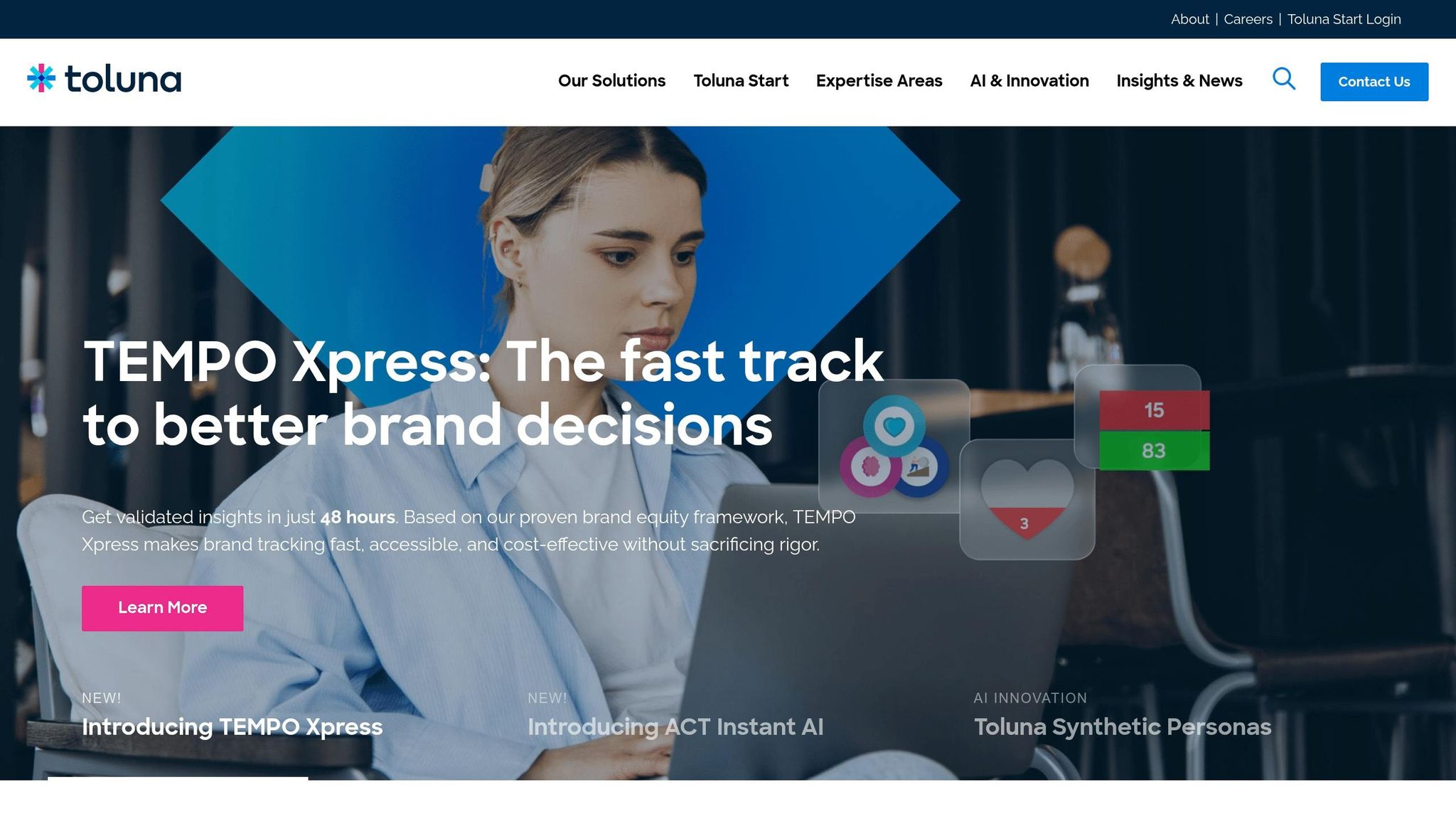
Toluna combines traditional survey techniques with AI-driven tools to advance psychographic analysis. With a global panel of over 79 million members spanning 70 markets, it provides marketers with direct access to diverse consumer segments. A standout feature is Toluna's use of synthetic personas - over 1 million AI-generated profiles designed to mimic real human behavior, complete with unique personalities and life stories.
HarmonAIze Personas leverage anonymized first-party data to reflect realistic consumption patterns and emotional reactions, moving beyond standard statistical averages. This blend of synthetic personas and traditional survey methods strengthens Toluna's capabilities in psychographic profiling. Frédéric-Charles Petit, Toluna’s CEO, explains:
"Our synthetic personas are not simply data points - they reason, express emotion, and have distinct perspectives. By integrating them with our Claims solution, we are giving brands a powerful tool to simulate and predict real consumer behavior with unmatched speed."
Toluna’s AI-powered tools, such as SmartCloud for sentiment analysis and QProbe for real-time clarifications, enhance insights by up to 80%. Meanwhile, QSphere ensures data accuracy through AI-driven fraud detection.
For quick research, Toluna offers ACT Instant AI, which delivers ad testing results 120 times faster than traditional methods, and TEMPO Xpress, which provides brand tracking insights within 48 hours. Additionally, the platform includes automated MaxDiff exercises to identify which product claims or taglines resonate most with specific audiences.
Key Features
Toluna’s all-in-one platform supports the entire research process, from survey creation and audience targeting to real-time analysis and reporting. The Toluna Start platform lets users weight data, create sub-populations, and apply filters for significance testing across various segments. Researchers can access over 225 norms across multiple countries and categories for concept and pack testing.
The platform’s ability to merge quantitative and qualitative research in a single workflow is a major advantage. Users can pair structured surveys with qualitative insights, then use AI-generated summaries to pinpoint key themes for presentations. A side-by-side comparison tool also allows teams to evaluate multiple concepts or ads simultaneously, speeding up decision-making.
"While MetrixLab – Toluna comes with tools, what I appreciate is that they are market researchers at heart: they will always adjust and customize depending on the brief, which is very much needed given that one size does not fit all."
- Vito Petrosino, Senior Director Confectionary Europe, Strategy, Insights & Analytics, Mondelez
With over 25 years of experience, Toluna operates in 70+ countries through 40 offices. Its "AI Everywhere" strategy seamlessly integrates synthetic data and human expertise into the platform for automated analysis.
Use Cases
Toluna is well-suited for concept testing, ad pre-testing, pack evaluations, brand tracking, and shopper insights. When speed-to-market is critical, marketing teams rely on the platform for rapid, iterative testing. Its synthetic personas are particularly useful for studying niche or hard-to-reach consumer groups that traditional sampling methods might miss.
Social Media Managers and Marketing Analysts use Toluna’s multi-market tools to test campaigns across different regions simultaneously. For example, the ASICS Marketing Intelligence Team shared:
"Toluna-MetrixLab's solution to brand tracking is flexible and modular, allowing us and our teams to match the approach with our activities throughout the year".
Toluna caters to businesses of all sizes with flexible service models, ranging from self-service DIY research on Toluna Start to full-service expert consultancy. Companies can test ideas using synthetic data first, then scale up to human panel testing once concepts are validated.
Pricing
Toluna operates on a credit-based system with pricing tailored to individual business needs. The average annual contract value is approximately $30,000, with users often negotiating savings of around $14,000 through bundling and other strategies. Credits remain valid for 24 months, offering flexibility to carry over unused credits beyond a one-year contract.
The platform offers three service levels: self-service DIY research, automated solutions, and full-service consultancy. Businesses can often secure better pricing by committing to multi-year contracts or finalizing agreements at the end of a quarter. For a customized quote, potential users are encouraged to schedule a demo or contact the sales team.
Synthesio
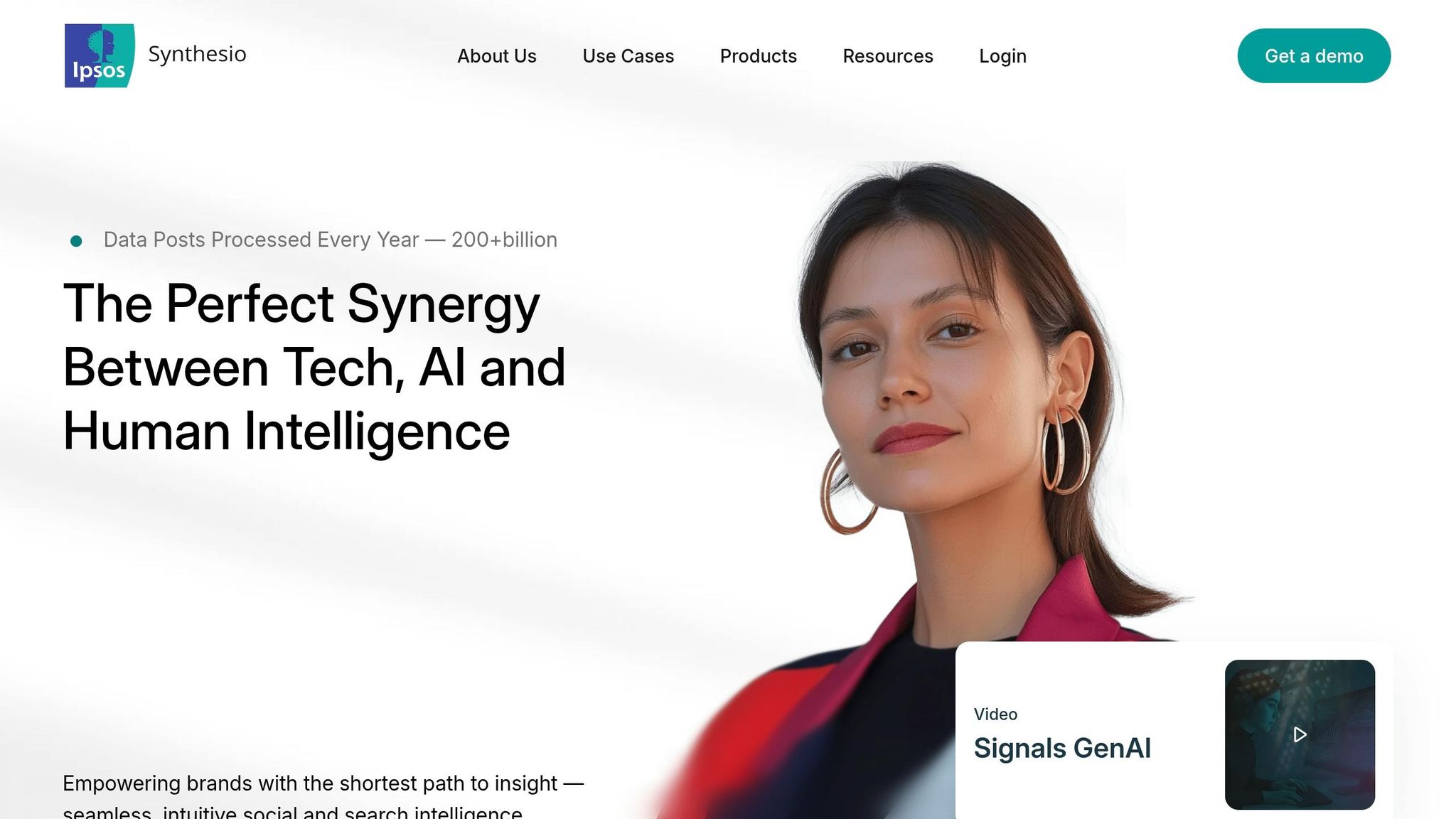
Synthesio pairs AI-driven social listening with Ipsos's rigorous research standards to deliver insights into consumer attitudes and behaviors. As part of Ipsos, Synthesio processes over 80 billion social signals annually from more than 800 million sources in 90+ languages across 195 countries. This comprehensive data includes social media activity, search intelligence, and over 2,000 ecommerce review sources, providing marketers with a detailed understanding of consumer motivations.
At the heart of Synthesio is its Signals GenAI engine, which can distill millions of consumer signals into actionable insights in less than a minute. This is achieved using a library of over 40 prebuilt, validated prompts. Andrea Hiranaka, Global Implementation Manager at Ipsos, describes the platform's approach:
"Synthesio's offering captures what consumers say, do, and think online – while again applying market research rigor and processes – to offer the most complete picture of that digital consumer."
The platform's Profiler tool uncovers online behavior patterns, highlighting the interests and preferences that define audience interactions with brands. It can compare target audiences with reference groups to identify unique traits and unmet needs. Additionally, the Topic Modeling feature groups conversations into consumer-driven themes, while Semantic and Vision AI analyze sentiment and decode visual content by recognizing logos, objects, and scenes.
Key Features
Synthesio integrates Ipsos's research frameworks directly into its algorithms, maintaining a 90% accuracy rate. This allows the platform to detect statistically significant changes in conversations, helping marketers identify trends early. Through Topic Modeling, Synthesio measures market impact, while Vision AI examines how brands and products are depicted in visual content.
The Profiler tool goes beyond traditional demographics, diving into consumer motivations and attitudes. Marketers can also combine internal data, like customer surveys and emails, with social trends to align internal insights with broader market patterns. This approach reduces bias and ensures precise, validated results.
Thierry Lalande, CEO of Ipsos Synthesio, emphasizes the platform's user-friendly design:
"With Quick Search, we're making social intelligence radically more accessible... you can now get instant, dependable headlines on any topic and share them instantly with your stakeholders."
By incorporating Ipsos's expertise and attention to cultural nuances, Synthesio ensures its insights are both fast and research-grade.
Use Cases
Synthesio is a powerful tool for strategic planning and audience analysis. Its Profiler tool helps marketers uncover "white spaces" - hidden opportunities and unmet needs that inform product development. L'Oréal's Global Social Insights & AI Director shared:
"Synthesio has been crucial when it came to product development to be able to size at the earliest stage of new customers' expectations."
The platform also refines messaging for specific subgroups by analyzing how different communities engage with shared topics. During times of rapid market change or crises, teams use Signals GenAI to quickly summarize shifts in consumer sentiment and adjust campaigns as needed.
Brands like Nestlé have integrated Synthesio into their innovation processes. According to Nestlé's Global Social Intelligence Development Lead:
"Synthesio AI-powered capabilities helped us to integrate social data into the innovation process and enhanced our trend analysis processes."
For short-term needs, Synthesio offers On-Demand Activation, which provides temporary access to Signals GenAI and expert reporting. This is ideal for testing new markets or validating campaign ideas without committing to long-term subscriptions.
Pricing
Synthesio offers flexible pricing to cater to different marketing needs. Options include:
- DIY Platform Access: A SaaS license with full access to social and search intelligence tools, customizable dashboards, and GenAI capabilities.
- Platform Access + Service: Combines software access with expert consultation for advanced setup, sourcing, and reporting.
- On-Demand Activation: Two-month access to Signals GenAI and expert-led reporting for specific projects, without requiring a subscription.
Pricing is customized based on factors like region, language, and team size. Interested teams can request a demo to receive a tailored quote that aligns with their goals and requirements.
Comparison Table
Comparison Dimensions
Choosing the right tool often depends on factors like geographic coverage, data depth, and budget. For global campaigns, GWI provides survey data representing over 3 billion people across 53 markets, priced at approximately $1,500 per user annually. This makes it a strong choice for mid-sized teams needing worldwide insights. On the other hand, Resonate focuses solely on the U.S., offering over 15,000 attributes to analyze 250 million consumer profiles, with its AI predicting psychological drivers like devotion to religion or peer recognition.
Brandwatch excels in social data collection, pulling from over 100 million online sources and maintaining a database of 1.7 trillion historical conversations dating back to 2010. With the ability to process over 500 million new public posts daily, it’s ideal for tracking real-time sentiment and managing PR crises. Toluna and Synthesio provide flexible, project-specific pricing, with their unique strengths lying in consumer panels and social listening, respectively.
Each tool’s data source plays a critical role in its effectiveness. As Jodie C., a GWI reviewer, shared:
"GWI shines with its extensive and in-depth consumer data, offering a truly global perspective that's invaluable for understanding diverse audiences".
Similarly, Bianca Cristina O., a Brandwatch reviewer, remarked:
"The Brandwatch Consumer Intelligence platform is very comprehensive... ideal for various contexts, being both powerful and versatile".
For a well-rounded approach, combining survey-based tools like GWI with social listening platforms like Brandwatch can help cross-check consumer behavior. This strategy reduces biases and highlights gaps between what people say and what they do. The market for such tools is projected to grow from $8.2 billion in 2025 to $34 billion by 2035, with a 15.3% compound annual growth rate.
Here’s a quick summary of the tools:
| Tool | Primary Data Source | Geographic Focus | Psychographic Depth | Pricing | Best For |
|---|---|---|---|---|---|
| GWI | Global consumer surveys (3B+ people) | 53 markets worldwide | Attitudinal & behavioral insights | ~$1,500/user/year | Global persona building & media planning |
| Resonate | AI-powered data infrastructure | U.S. only | 15,000+ attributes (values/motivations) | Custom pricing | Deep U.S. segmentation & predictive targeting |
| Brandwatch | Social web sources (100M+ sources) | Global | Real-time sentiment & trend tracking | $6,000–$15,000/month | Social listening & competitor benchmarking |
| Toluna | Consumer panels & surveys | Global | Specifications not provided | Custom pricing | Interactive consumer research |
| Synthesio | Social listening data | Global | Specifications not provided | Custom pricing | Strategic planning & crisis response |
Conclusion
This overview of five psychographic analysis tools showcases their distinct strengths for various marketing objectives. Selecting the right tool depends on factors like geographic reach, analytical capabilities, and budget. For instance, GWI is ideal for global campaigns with its survey-driven insights, while Resonate shines in delivering detailed U.S.-specific segmentation.
Budget plays a significant role in the decision-making process. GWI, for example, starts at approximately $1,500 per user annually, but costs for other platforms can vary depending on the scale and scope of your needs.
The depth of analysis is just as important as geographic coverage. Combining methods like survey panels, social listening, and AI-driven predictions can help create more precise consumer profiles. Regular updates to psychographic data - at least annually - are essential, as consumer motivations and values shift over time.
The predictive analytics market is booming, expected to grow from $7.2 billion in 2020 to $21.5 billion by 2025. Notably, 75% of marketers are already leveraging AI-powered tools to enhance campaign performance. Companies using these platforms often report a 25% boost in sales and a 30% drop in customer acquisition costs.
To get started, identify whether your campaigns require global coverage, U.S.-specific insights, or real-time data, and ensure the tool aligns with your budget and integrates seamlessly with your existing CRM or advertising platforms. Each tool in this list serves a unique purpose - choosing the right one comes down to aligning your marketing goals with the platform's strengths. Use these insights to make an informed decision and drive better campaign outcomes.
FAQs
What’s the difference between psychographics and demographics?
Demographics deal with visible characteristics like age, gender, income, education level, and geographic location. They provide a straightforward snapshot of an audience. Psychographics, however, dig deeper into the emotional and psychological side, focusing on factors like interests, values, attitudes, motivations, and lifestyles. These details help marketers grasp the why behind consumer choices, making it easier to create messaging that feels more personal and resonates on a deeper level.
Which tool is best for U.S.-only targeting vs global campaigns?
SparkToro works exceptionally well for campaigns focused exclusively on the U.S., as it provides detailed insights into audience behaviors and demographics specific to this region. This makes it a great choice for targeting localized audiences. However, if you're running global campaigns, you might want to explore tools that offer broader international data and deeper psychographic insights to better understand worldwide audiences.
How do I combine survey data and social listening insights?
To bring together survey data and social listening insights effectively, merge these tools to confirm assumptions and gain a clearer understanding of what drives consumer behavior. Social listening offers a window into real-time trends and psychographic details, while surveys deliver structured, measurable data. By combining these approaches, you can spot new trends, analyze behaviors, and build precise audience segments. This blend of qualitative and quantitative insights allows for sharper, more focused marketing strategies.