Real-time big data is changing marketing forever. Instead of waiting days for campaign results, marketers now improve marketing decisions instantly, improving performance and cutting costs. Here are five ways real-time data is being used to drive results:
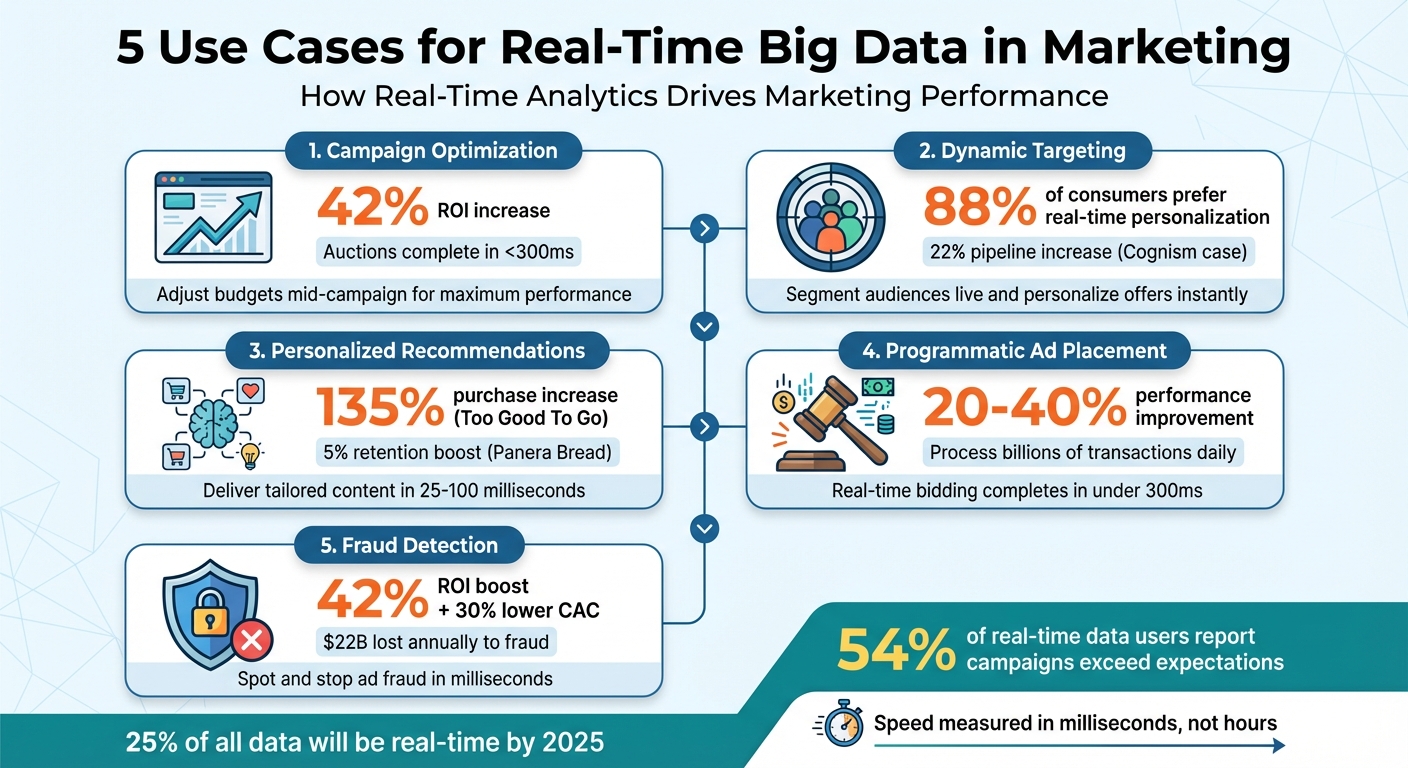
- Campaign Optimization: Adjust budgets and strategies mid-campaign to boost ROI by up to 42%.
- Dynamic Targeting: Segment audiences live and personalize offers in the moment, increasing conversions by 88%.
- Personalized Recommendations: Deliver tailored content instantly, driving higher engagement and sales.
- Programmatic Ad Placement: Use real-time bidding to secure ad placements in under 300 milliseconds.
- Fraud Detection: Spot and stop ad fraud immediately, saving billions in wasted spend.
These strategies not only improve efficiency but also deliver better results for businesses that act fast. The key? Investing in systems that process data in milliseconds and integrate seamlessly with existing tools. Real-time analytics is no longer optional - it’s the future of marketing. Using the top tools for real-time marketing analytics can help you implement these strategies effectively.
Real-Time Big Data Marketing Impact: 5 Key Use Cases with ROI Statistics
1. Campaign Performance Optimization and Budget Allocation
Real-Time Data Processing Capabilities
Real-time big data has revolutionized how marketers optimize campaigns and allocate budgets. By using an event-driven architecture, real-time analytics processes campaign data in milliseconds, capturing every interaction as it happens. This allows marketers to quickly pinpoint which creatives are performing well and which segments are falling short, enabling immediate adjustments.
The move from batch processing to continuous streaming has completely changed budget management. Instead of waiting for post-campaign reports, marketing teams can now monitor performance and make real-time changes while campaigns are still running. For instance, real-time bidding auctions are completed in under 300 milliseconds, giving marketers the ability to seize high-performing opportunities before they vanish. This quick feedback loop leads to better ROI and more efficient testing processes.
Impact on Marketing ROI and Efficiency
Real-time analytics doesn’t just speed things up - it delivers results. Marketers leveraging real-time data have seen a 42% boost in ROI while also cutting costs and shortening A/B testing cycles.
"Real-time analytics isn't just about speed; it's about making smarter, more informed decisions that drive results." - Jessica Graeser, VP of Marketing, NinjaCat
A great example of this is browse abandonment emails. These emails, triggered immediately after someone abandons their cart, achieve a 0.96% conversion rate - an impressive 9.6 times higher than typical email campaigns. This highlights how acting on fresh data can make a measurable impact.
Ease of Integration with Marketing Platforms
Modern real-time analytics platforms are designed to integrate seamlessly with existing marketing tools. This means teams can create a unified data view without overhauling their tech stack. Automated integrations ensure data flows smoothly between tracking tools, analytics tools for business, and marketing automation platforms. Visual dashboards make it easy to spot budget overspends or performance dips at a glance.
However, successful integration requires careful planning. Start by defining clear KPIs - like conversion rates or engagement metrics - before implementing real-time tracking. This ensures the data being processed aligns with your business goals. Additionally, set thresholds for metrics like cost per acquisition or click-through rates, but avoid overreacting to fluctuations. Over-correcting too soon can disrupt platform algorithms and hurt performance.
Scalability for High-Volume Data Streams
As data volumes continue to grow, marketing infrastructure must scale to keep up. Tools like Apache Kafka, Apache Spark, and Flink are capable of processing millions of events per second, meeting the demands of a world where over 25% of all data will be real-time by 2025. Automated alert systems further enhance efficiency by notifying teams when metrics hit predefined thresholds, allowing for rapid responses without constant monitoring.
That said, balancing speed and stability is key. Campaigns need time to exit the "learning phase" before making major adjustments to creatives or budgets. Interestingly, 54% of marketers who rely on real-time data report that their campaigns outperform expectations. This underscores the value of staying agile while maintaining a strategic approach.
sbb-itb-5174ba0
Season 1: Episode #7 | The Art of Marketing Analytics: A Deep Dive
2. Dynamic Audience Segmentation and Targeting
Real-time audience segmentation is changing the game for marketers, allowing them to adjust targeting instantly based on live data.
Real-Time Data Processing Capabilities
Thanks to top website analytics tools, marketers no longer have to rely solely on historical reports. Platforms like Apache Kafka process customer actions - clicks, scrolls, searches, and even location data - as they happen. This enables in-session personalization, where website content, offers, or product recommendations adapt on the spot to a visitor's behavior.
For instance, if a customer completes a purchase, real-time systems can immediately notify ad platforms to stop showing related ads. This not only reduces wasted ad spend but also avoids annoying the customer. Similarly, Customer Data Platforms (CDPs) integrate live event data with segment identifiers, enabling marketing tools to send personalized messages within seconds.
Impact on Marketing ROI and Efficiency
Personalization in real time has a clear impact on consumer behavior. In fact, 88% of consumers are more likely to purchase when brands personalize their experience in real time. In 2021, global retail personalization efforts led to a 16% boost in conversions.
A great example of this is Druva’s SDR Manager EMEA, Antony Arcan, who used Cognism’s enrichment API within Salesforce to process leads from webinars and events in real time. By enriching incoming data instantly, his team achieved a 22% increase in their quarterly pipeline, marking their best "marketing closed-won" results for the year. This demonstrates how actionable, up-to-the-minute segmentation can directly drive measurable business outcomes.
Scalability for High-Volume Data Streams
Real-time segmentation requires infrastructure that can handle large volumes of customer interactions without breaking a sweat. Services like AWS and Azure automatically scale processing power during high-traffic events, such as flash sales or product launches. Meanwhile, tools like Apache Storm and Hadoop manage massive, unstructured datasets to deliver instant targeting decisions.
Modern composable data stacks make it easier to integrate real-time capabilities into existing systems without needing to rebuild everything from scratch. This shift from batch processing to streaming eliminates delays that once took hours or even days to update segments.
"When it comes to personalization, speed is no longer an advantage - it's a requirement." - Megan DeGruttola, Twilio Segment
With 97% of brands planning to increase AI budgets to support real-time data activation, scalable segmentation is quickly becoming a must-have for staying competitive in today’s fast-paced markets.
3. Personalized Product Recommendations and Content Delivery
Real-time big data is revolutionizing how personalized experiences are delivered. As shoppers browse websites, streaming data captures their interactions and adjusts product recommendations or content instantly. This process, often taking just 25 to 100 milliseconds, ensures that what appears next aligns perfectly with what the visitor is most likely to want. These in-the-moment adjustments build on earlier dynamic segmentation strategies, making sure recommendations and messages hit at just the right time.
Real-Time Data Processing Capabilities
Recommendation engines are designed to act on the spot. For instance, when a user engages with a specific feature or reaches a milestone, the system can trigger an upgrade prompt or a tailored notification at the exact moment it’s most relevant. This kind of responsiveness ties real-time recommendations to broader marketing goals, creating a seamless strategy.
AI-driven systems take this a step further by predicting what a customer might do next, rather than simply reacting to past behavior. This allows brands to deliver content that feels intuitive and timely. Dynamic content blocks also adapt in real time, changing elements like names, locations, or product visuals as customers move through their journey.
Impact on Marketing ROI and Efficiency
Personalized, real-time experiences have a strong influence on consumer behavior. Studies show that up to 88% of consumers respond positively to these tailored interactions, with 35% significantly more likely to make a purchase. Take Panera Bread, for example. In April 2024, during a major menu overhaul, they introduced an AI-powered decision engine. By offering over 4,000 personalized combinations through email, apps, and websites, they achieved a 5% increase in retention, doubled loyalty offer redemptions, and boosted conversions - all while saving 50 hours of manual effort.
Another standout example is Too Good To Go, which used real-time alerts to notify users when "Surprise Bags" became available nearby. This approach led to a 135% jump in purchases linked to CRM efforts and doubled conversion rates. Similarly, Grubhub’s "Taste of 2020" campaign utilized 32 custom data points to create personalized summaries for 30 million diners. The result? A 100% increase in social media mentions and an 18% boost in word-of-mouth referrals.
Scalability for High-Volume Data Streams
Personalization at scale requires robust systems. Modern composable data architectures allow brands to process millions of interactions in real time by layering real-time capabilities over existing data warehouses. This eliminates the delays common with batch processing, enabling instant activation of customer data across web, mobile, CRM, and email channels - all without needing a complete tech overhaul.
However, there’s a gap between aspiration and execution. While 80% of companies want to implement real-time actions, only 22% manage to do so effectively. When done right, though, these campaigns can deliver up to 10× higher ROI compared to traditional batch methods.
"They undercut the customer relationship, revealing to people that your brand doesn't know them as well as they'd thought." - Kevin Wang, Chief Product Officer, Braze
Accuracy is just as critical as speed. Real-time systems must ensure customer profiles are continuously updated to avoid irrelevant or outdated recommendations. This highlights the power of real-time data: it enables brands to engage proactively with customers, delivering precisely timed and personalized interactions that drive tangible results.
4. Real-Time Bidding and Programmatic Ad Placement
Marketers now rely on split-second decision-making for programmatic ad placement, thanks to real-time bidding (RTB). This process transforms digital advertising into lightning-fast auctions, where each ad impression is evaluated and sold in under 300 milliseconds.
Real-Time Data Processing Capabilities
RTB demands precise and rapid coordination. When a bid request is triggered, multiple systems spring into action. The ad exchange handles the auction in just 3–7 milliseconds, the demand-side platform (DSP) evaluates the opportunity and selects the best creatives within 10–25 milliseconds, and the data management platform retrieves user profiles in 5–15 milliseconds. To stay ahead, industry leaders are pushing for latency under 100 milliseconds.
Take The Trade Desk, for example. As of January 2026, it processes billions of transactions daily using Aerospike's real-time data platform. During each auction, the platform analyzes user profiles from terabytes of data in just 5–10 milliseconds, enabling precise audience targeting on a global scale. Similarly, Reddit uses Apache Druid to manage tens of gigabytes of event data per hour. This setup allows advertisers to query hundreds of billions of events spanning six months, making real-time adjustments to their campaigns.
"By using Apache Druid and Imply, we can ingest multiple events straight from Kafka and our data lake, ensuring advertisers have the information they need for successful campaigns in real-time."
- Shariq Rizvi, Ads Monetization EVP, Reddit
Impact on Marketing ROI and Efficiency
Real-time optimization has a major impact on campaign performance, improving results by 20–40% compared to delayed reporting. This immediacy helps marketers identify and address underperforming placements or fraudulent traffic before budgets are wasted. Each year, approximately $22 billion is lost in the open web programmatic market due to inefficiencies like these.
For instance, Ibotta, a rewards platform, adopted a "data river" architecture using Apache Druid to detect ad fraud in seconds. By combining third-party vendor data with internal event logs, their teams gained access to real-time dashboards that flagged and stopped fraudulent bidding activity before it drained their budgets.
"We found Druid and Imply to be clearly the most robust solution... supporting rapid incident response, building trust with our end users and partners through proactive fraud prevention."
- Jaylyn Stoesz, Data Engineer, Ibotta
Despite the advantages of real-time systems, many marketers still rely on delayed reporting - 46% review performance weekly, while 25% do so monthly. These delays can lead to overspending. Real-time tools, on the other hand, allow for quick budget shifts to high-performing creatives and segments, ensuring resources are allocated efficiently within hours rather than days.
Scalability for High-Volume Data Streams
RTB systems operate on a massive scale, processing billions of events each day while maintaining sub-second response times for thousands of simultaneous queries. To manage such enormous data volumes, platforms use elastic architectures that incorporate pre-aggregation and compression techniques. This approach allows them to handle petabyte-scale data without compromising speed or cost-effectiveness. The ability to scale seamlessly ensures that real-time data continues to drive marketing success at all levels.
5. Fraud Detection and Campaign Integrity Monitoring
Ad fraud costs marketers billions, making real-time detection an absolute necessity. Unlike older systems that struggle to keep up, real-time fraud detection can spot suspicious patterns in milliseconds.
Real-Time Data Processing Capabilities
Modern fraud detection relies on real-time data ingestion, where information is instantly searchable upon entry. This is crucial in environments like real-time bidding, where auctions wrap up in under 300 milliseconds. For instance, click fraud can be flagged immediately when systems notice three or more clicks on the same URL within ten seconds during a single session.
In 2022, Ibotta, a cashback rewards platform catering to 120 million shoppers, revamped its fraud detection system with Apache Druid. This upgrade enabled real-time analytics by integrating third-party vendor data with internal events, achieving sub-second query responses. This allowed Ibotta to block fraudulent activity instantly.
"We found Druid and Imply to be clearly the most robust solution... supporting rapid incident response, building trust with our end users and partners through proactive fraud prevention." - Jaylyn Stoesz, Data Engineer, Ibotta
Impact on Marketing ROI and Efficiency
Real-time fraud detection doesn’t just prevent losses - it maximizes marketing efficiency. Businesses leveraging these systems report a 42% boost in marketing ROI and a 30% drop in customer acquisition costs. By instantly blocking fraudulent actors, marketers can redirect budgets from bot traffic to legitimate audience segments.
Reddit showcases this on a massive scale, processing tens of gigabytes of advertising data per hour using Apache Druid. This system monitors advertiser spending and user engagement across billions of events, enabling Reddit to quickly detect and address fraudulent patterns.
"By using Apache Druid and Imply, we can ingest multiple events straight from Kafka and our data lake, ensuring advertisers have the information they need for successful campaigns in real-time." - Shariq Rizvi, Ads Monetization EVP, Reddit
This level of proactive fraud detection ensures both campaign integrity and advertiser trust.
Scalability for High-Volume Data Streams
Fraud detection systems must handle the immense data streams generated by growing programmatic ad volumes without compromising speed. Modern real-time databases can manage billions - or even trillions - of rows while delivering sub-second query responses for thousands of simultaneous queries. Distributed architectures, which separate compute from storage, allow these systems to scale almost infinitely.
The $30 billion global AdTech industry depends on reacting to streaming data in milliseconds. To keep up with this demand, platforms use pre-aggregation and data summarization techniques. These approaches reduce storage needs while preserving the detailed insights necessary to spot fraud, ensuring that even as campaign volumes skyrocket, systems maintain both performance and accuracy.
Conclusion
When you look at the five key use cases, one thing becomes obvious: acting on data instantly is a game-changer for growth. Real-time big data analytics has shifted from being a luxury to a necessity for modern marketers. Why? Because these capabilities deliver measurable performance boosts. With 88% of consumers preferring personalized, real-time experiences, the real question is - how fast can you implement these tools?
In today’s fast-paced world, success is measured in milliseconds, not hours. Industry experts emphasize that speed is everything. Real-time systems that provide insights in a fraction of a second allow for instant budget adjustments, tailored user experiences, and on-the-spot fraud detection. This evolution replaces outdated reporting cycles with agile strategies that connect every customer interaction to meaningful outcomes.
While setting up the right infrastructure may seem overwhelming, the path forward is straightforward. Start by determining your top priority: is it enhancing customer-facing personalization or streamlining operational efficiency? Make sure the platform you choose delivers true real-time capabilities - measured in milliseconds - and can unify data across silos for a complete view of your customer interactions. By 2025, over 25% of all global data will be generated in real time, making this shift unavoidable for businesses aiming to stay competitive.
Selecting the right analytics platform requires careful consideration of factors like speed, scalability, and how well it integrates with your existing systems. To help with this, the Marketing Analytics Tools Directory offers a detailed resource for comparing real-time analytics solutions. Whether you’re looking for live funnel tracking, session replay, or omnichannel orchestration, the directory can guide you toward tools that align with your goals and budget - whether you’re opting for free plans or enterprise-level solutions.
The marketers who excel in 2026 and beyond won’t necessarily be the ones with the most data - they’ll be the ones who can act on their data instantly. Real-time analytics turns raw information into immediate, actionable insights, allowing you to seize opportunities as they arise. The technology is here, the ROI speaks for itself, and the competition is intensifying. Check out the Marketing Analytics Tools Directory to start turning real-time insights into real-world results.
FAQs
What counts as real-time marketing data?
Real-time marketing data refers to information that's gathered, processed, and analyzed as it happens. This kind of immediate insight gives marketers the ability to make quick decisions, tweak campaigns on the fly, and engage with customers in a more timely and relevant way. Unlike older systems that often involve delays, real-time data provides a constant flow of actionable information, helping marketers stay agile and responsive in their strategies.
What tech do I need to act on data in milliseconds?
To process data in milliseconds, you’ll need tools designed for real-time streaming and analytics. Key technologies include event streaming platforms, AI, and unified APIs. Together, these systems enable instant data analysis and decision-making, allowing marketers to fine-tune campaigns and sharpen audience targeting with incredible speed and accuracy.
How do I avoid over-optimizing campaigns with live data?
To avoid the pitfalls of over-optimizing campaigns using live data, it’s important to strike a balance between acting on quick insights and maintaining a strategic, steady approach. Resist the urge to react to every small fluctuation - this can lead to unnecessary changes that derail long-term goals. Instead, set clear KPIs to ensure any adjustments are purposeful and aligned with the bigger picture.
Combine real-time data with historical trends to add context. This helps you spot true opportunities and avoid overreacting to outliers or anomalies. Using dashboards to track long-term patterns can provide the stability needed for data-driven decisions that enhance performance while keeping your campaigns on course.