Real-time personalization is transforming how businesses interact with customers by delivering tailored experiences instantly, based on live behavior and predictive algorithms. Unlike older methods that rely solely on historical data, these tools combine real-time signals with past insights to predict customer needs and optimize interactions across channels like web, email, and apps.
Key Takeaways:
- Why it matters: Companies using real-time personalization report higher conversion rates, reduced acquisition costs, and increased customer lifetime value.
- How it works: Predictive algorithms analyze live user actions (e.g., browsing, clicks) and adjust offers or content in milliseconds.
- Business impact: Examples include a 35% boost in conversion rates for retail emails and 260% higher conversion rates for businesses adopting these tools.
Top Tools Highlighted:
- Insider One: AI-driven recommendations with real-time data processing across 12+ channels.
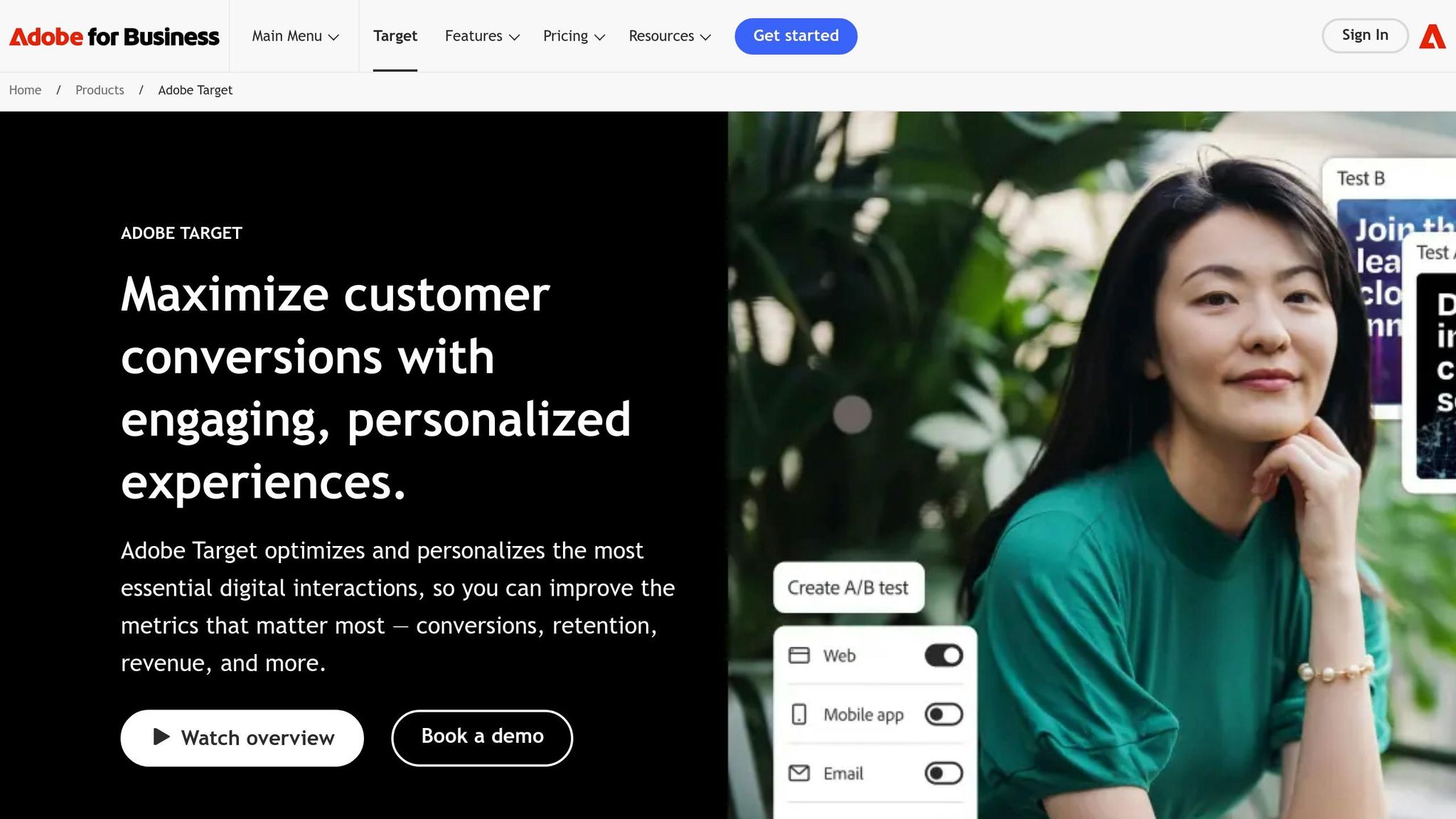
- Adobe Target: Real-time personalization with advanced AI features like Auto-Target and Multi-armed Bandit testing.
- Braze: Predictive modeling and cross-channel messaging for lifecycle marketing.
- Customer.io: Behavior-based workflows and predictive segmentation for SaaS and e-commerce.
- WebEngage: Dynamic segments and predictive RFM for industries like retail and BFSI.
- MoEngage: AI-powered predictions and omnichannel engagement for mobile-first brands.
Quick Comparison:
| Tool | Predictive Features | Real-Time Capabilities | Best For |
|---|---|---|---|
| Insider One | AI recommendations, triggers | Sub-second data processing | E-commerce, retail |
| Adobe Target | Auto-Target, bandit testing | Real-time audience updates | Enterprises |
| Braze | Gradient boosted decision trees | Cross-channel personalization | Lifecycle marketing |
| Customer.io | Event-triggered workflows | Instant message delivery | SaaS, e-commerce |
| WebEngage | Predictive RFM, churn models | Dynamic segments | Retail, BFSI, travel |
| MoEngage | RFM, propensity models | AI-driven engagement | Mobile-first brands |
With 72% of consumers preferring personalized messaging, these tools are essential for businesses aiming to stay competitive. They not only improve customer satisfaction but also drive measurable revenue growth.
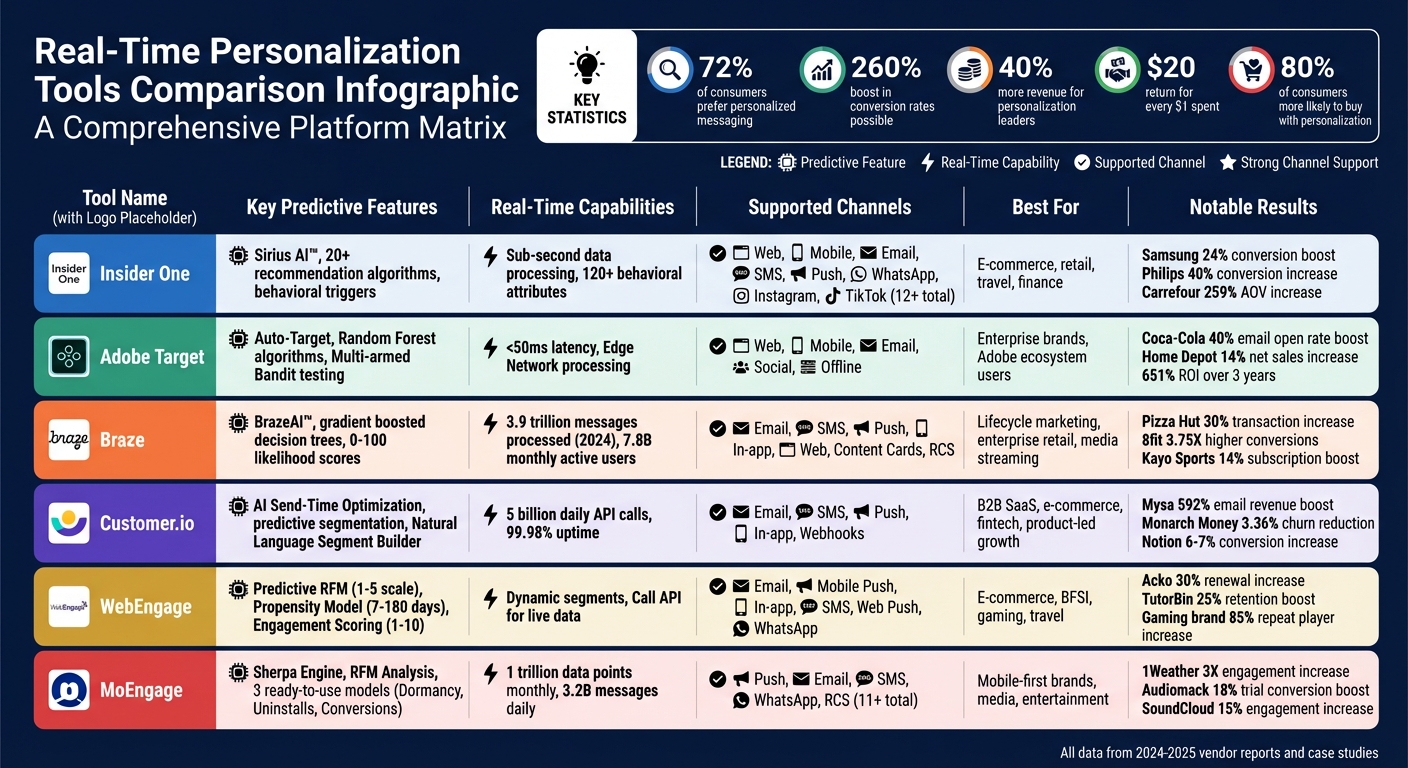
Real-Time Personalization Tools Comparison: Features, Capabilities and Best Use Cases
Providing a more personalized customer experience in real time
What Is Real-Time Personalization with Predictive Algorithms?
Real-time personalization delivers content and offers that are instantly tailored to customers based on their preferences and real-time data inputs. Unlike older methods that depend solely on past purchase history or fixed browsing patterns, this approach reacts to immediate actions - like clicking a link, exploring product categories, or opening an email - and adjusts the experience in milliseconds.
At the heart of this process are predictive algorithms, which use machine learning and AI to analyze incoming data on the fly. These algorithms don’t just react; they anticipate customer needs by determining the next-best-action or offer for each individual. For instance, if someone spends time browsing winter coats but doesn’t add anything to their cart, the system might instantly send a personalized email featuring similar items or a time-sensitive discount. This ability to adapt in real-time transforms the customer experience.
Three key features make this possible:
- Dynamic segmentation: Audience groups update in real time, reflecting the latest customer behaviors.
- Behavioral triggers: Messages are delivered instantly based on user actions.
- AI-driven predictions: Next-best-action recommendations are tailored to the individual.
Traditional methods rely heavily on historical batch data, but real-time systems combine past insights with live signals to understand current intent and adapt within the session. Advanced techniques, such as contextual bandits, further enhance this by dynamically deciding which experience to present based on ongoing performance and the user’s context.
The results of real-time personalization are impressive. Businesses can see a 260% boost in conversion rates, a 20% increase in customer lifetime value, and a 75% rise in average order value. By processing data in milliseconds, these systems create experiences that feel personal and relevant, even at scale.
1. Insider One
Real-time Data Processing and Personalization
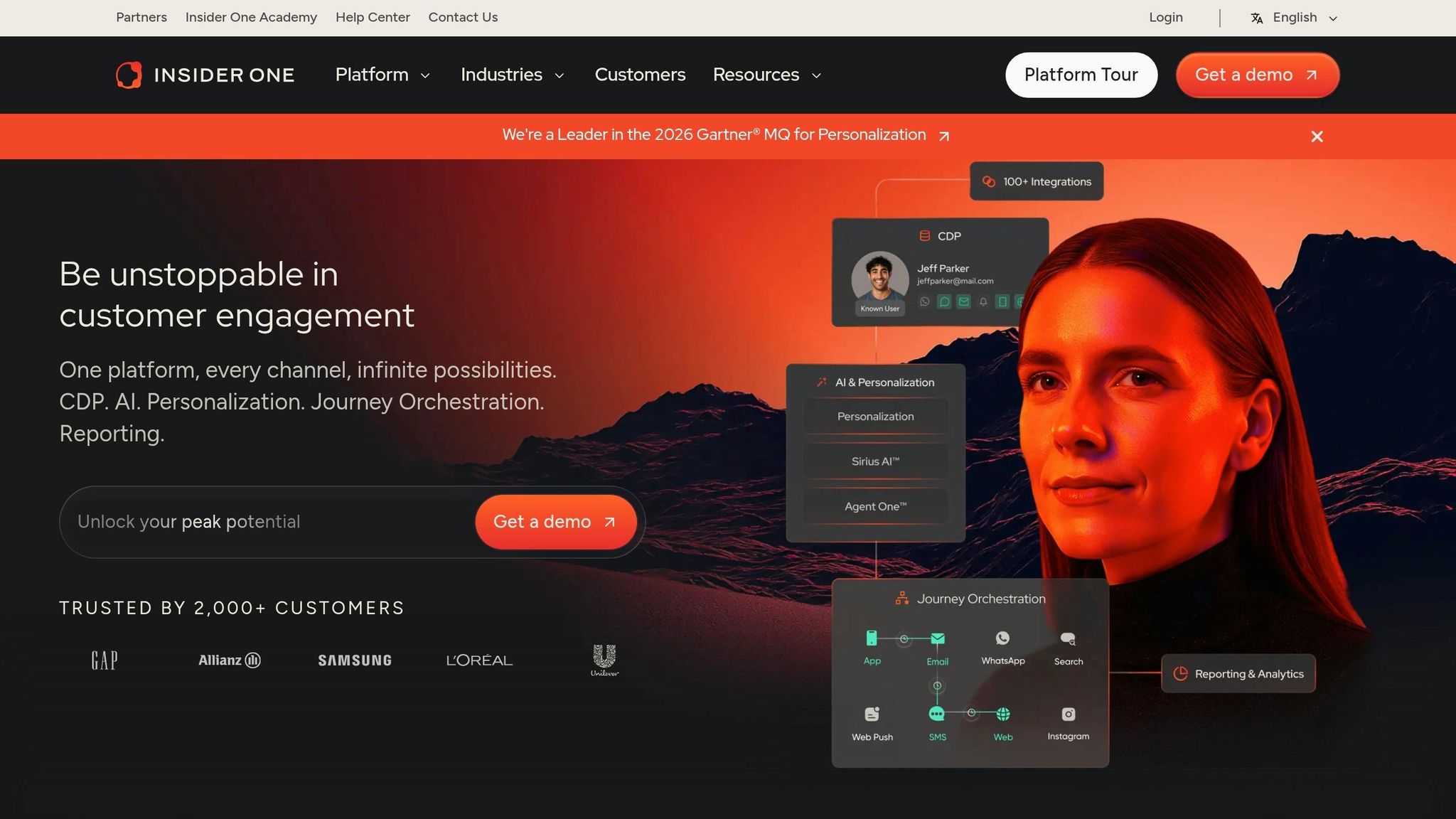
Insider One's actionable CDP processes data from over 100 sources to build comprehensive customer profiles in just milliseconds. By tracking shopper activities - like browsing, cart updates, or checkout abandonment - using more than 120 behavioral attributes, the platform ensures campaigns align with customer actions in real time.
Take Samsung's Galaxy Note launch as an example. Using Insider One's Architect, Samsung identified users interested in competitor devices and sent personalized web push notifications to those who abandoned their carts. This strategy boosted conversion rates by 24%. Similarly, Philips enhanced its homepage with web personalization tools, delivering content tailored to live user behavior. This resulted in a 40% jump in conversion rates and a 35% increase in average order value.
With its rapid data capture, Insider One's sophisticated algorithms take customer insights to the next level.
Predictive Algorithms for Behavioral Insights
At the heart of Insider One is Sirius AI™, a predictive intelligence engine that automates segmentation and decision-making. It forecasts behaviors like purchase intent, churn likelihood, and price sensitivity. The platform also offers over 20 recommendation algorithms - such as "Bought Together", "Trending Now", and "Most Valuable Products" - to fine-tune suggestions and optimize message timing for better engagement.
Carrefour saw impressive results with these tools, generating 18.8% more revenue per user and boosting profitability from returning customers by 42%. This contributed to a staggering 259% increase in average order value.
"What impressed us most is Insider One's AI-powered segmentation capabilities. The platform learns from customer behavior and identifies which products and services would interest each customer most."
- Marketing and Service Design Group Head, Allianz
Cross-Channel Delivery Capabilities
Insider One doesn't stop at insights - it delivers personalized experiences across more than 12 native channels, including WhatsApp, SMS, RCS, mobile apps, web, and social platforms like TikTok and Instagram. Every month, the platform manages over 1 billion user profiles, processes 40 billion push notifications, and sends 1.6 billion emails, ensuring customers receive relevant messages wherever they interact.
Use Case Suitability
By simplifying complex customer journeys, Insider One caters to a variety of industries. Its enterprise-scale design makes it a strong fit for sectors like retail, ecommerce, travel, finance, and entertainment. For instance, Vogacloset, a European fashion retailer, used Insider One's CDP and Architect to achieve a 30× ROI within just 12 weeks. The platform’s high performance is reflected in its G2 rating of 4.8/5.0, earning it the title of #1 Leader across 11 categories.
2. Adobe Target
Real-Time Data Processing and Personalization
Adobe Target leverages the Adobe Experience Platform Edge Network to process customer data in real-time. By evaluating segments and profiles at the datacenter closest to each user, it ensures latency stays below 50 milliseconds for most requests and under 70 milliseconds for 95% of them.
This system uses Incremental Query Processing, meaning only relevant data is re-evaluated with each request. When paired with Adobe Real-Time CDP, the platform analyzes unified profile attributes - drawn from both online and offline data - to deliver "next-hit" personalization. In other words, it personalizes the very next page a visitor interacts with.
Real-world results highlight its power. Coca-Cola unified 98 million customer profiles from over 100 countries, achieving a 40% boost in email open rates and a 63% increase in click-through rates on personalized content. The Home Depot saw personalization delivery speed up by 10x, with a 14% rise in net sales and a 50% boost in marketing efficiency. These capabilities make real-time personalization not just possible, but highly effective.
Predictive Algorithms for Behavioral Insights
Adobe Sensei, the AI engine behind Adobe Target, drives predictive insights through features like Auto-Target and Automated Personalization. These tools rely on Random Forest algorithms, which build multiple decision trees using visitor attributes to predict conversion chances. Key data points include location, device type, and user behavior.
Success stories abound. A major clothing retailer experienced a 29.09% average lift and generated over $1.7 million in revenue lift within just ten days using Auto-Target. TSB Bank in the UK achieved 11x higher incremental revenue than expected while cutting data-to-action latency by 90%. Similarly, HSBC reduced the development time for optimized digital journeys from six months to just weeks.
Adobe Target also employs Multi-armed Bandit testing with Thompson Sampling, which dynamically adjusts traffic to favor winning variations during experiments. Traffic allocations can update as often as every two hours, making it ideal for capturing fleeting trends like Black Friday sales.
Cross-Channel Delivery Capabilities
Adobe Target ensures personalization extends seamlessly across web, mobile, social, and even offline channels by unifying customer profiles. Server-side environments are supported through Node.js and SDKs, enabling consistent experiences no matter where users interact.
Delta Air Lines exemplifies this approach. Alicia Tillman, Chief Marketing Officer, highlights the importance of consistency:
"Delta as a brand is showing up in a similar, consistent way time and time again. It builds trust. It builds loyalty. And Adobe is the foundation that allows us to enable that."
Use Case Suitability
Adobe Target’s AI-driven personalization fits a variety of industries. Ecommerce businesses can optimize product page designs and allocate traffic automatically during peak shopping events. Financial services use real-time data to manage offers, such as suppressing upsells after a customer service complaint. Travel and hospitality brands integrate online and offline data to create smooth, end-to-end guest experiences.
An IDC study reported that Adobe Target delivers a 651% ROI over three years, with businesses earning an average of $25 for every $1 invested. One implementation increased conversions by 38% and engagement by 125%, thanks to the creation of 76 new customer segments. Research also shows that 80% of consumers are more likely to buy from brands offering personalized experiences, and 40% are willing to spend more when those experiences meet their preferences.
3. Braze
Real-Time Data Processing and Personalization
Braze's BrazeAI™ is designed to handle massive amounts of data in real time, making it possible to deliver instant, personalized customer experiences. By integrating first-party data through open APIs and direct connections, Braze processed an astounding 3.9 trillion messages and managed 8.6 trillion API calls in 2024, while supporting 7.8 billion monthly active users as of September 2025. This combination of real-time data processing and predictive modeling enables brands to offer highly personalized interactions at scale.
The platform pulls data from sources like data warehouses, backend systems, and digital properties, which it then uses to create dynamic, real-time messaging. Tools such as Liquid logic, Content Blocks, and Connected Content ensure that messages are populated with up-to-the-minute information. For example, in 2024, Pizza Hut replaced its legacy CRM with Braze. By incorporating machine learning into its email strategies and leveraging real-time data, the company saw a 30% increase in transactions, a 21% boost in revenue, and a 10% rise in profit.
Predictive Algorithms for Behavioral Insights
Braze employs gradient boosted decision trees to analyze historical data and predict future user behavior. Its Predictive Suite assigns users a likelihood score ranging from 0 to 100, divided into Low (0–50), Medium (50–75), and High (75–100) tiers. To keep predictions accurate, the models are retrained every two weeks.
The health and wellness app 8fit used Braze's Predictive Suite to identify users most likely to make a purchase. By adjusting discount offers based on these predictions, they achieved 3.75X higher conversion rates among high-likelihood users while saving 100,000 emails per week by excluding low-likelihood users. Additionally, Braze's reinforcement learning optimizes decisions like timing, channel, and message content in real time, ensuring better outcomes.
Cross-Channel Delivery Capabilities
Braze excels in delivering cohesive experiences across multiple channels, including email, SMS, push notifications, in-app messages, web, Content Cards, and advertising. With Braze Canvas Orchestration, marketers can design and manage complex, multi-step customer journeys that adapt dynamically to real-time user behavior and intent.
For instance, Kayo Sports integrated its "Customer Cortex" engine with Braze, scaling from 300 to an impressive 1.2 million communication variations. By implementing AI-driven messaging across email, SMS, and push notifications, they achieved a 14% increase in subscriptions and a 105% growth in cross-sells during fiscal year 2024. Victoria Mitchell of Pizza Hut highlighted the platform's impact:
"We've been really impressed with how Braze has enabled us to advance our customer communication strategies across email, SMS and mobile channels. The cross-channel integrations and targeting capabilities continue to be crucial."
Use Case Suitability
Braze is particularly well-suited for enterprise brands in industries like retail, ecommerce, media streaming, SaaS, and travel, where real-time data processing and personalization are critical. For example, Panera Bread used Braze's AI decision engine to support a major menu update. By creating over 4,000 unique combinations of personalized offers through Braze Canvas, Panera achieved a 5% improvement in retention among at-risk customers and doubled both loyalty offer redemptions and purchase conversions.
Similarly, New Zealand's property platform OneRoof utilized Braze's Intelligent Timing and Connected Content to personalize property listing emails. By capturing user preferences with a Profile Builder and using Liquid personalization for tailored reports, they saw a 218% increase in total clicks to listings and a 50% year-over-year growth in users.
4. Customer.io
Real-Time Data Processing and Personalization
Customer.io stands out by transforming live data into tailored, immediate customer interactions, much like Insider One, Adobe Target, and Braze. By combining a Customer Data Platform (CDP) with a Marketing Automation Platform (MAP), it processes over 5 billion daily API calls with an impressive 99.98% uptime.
Its real-time personalization hinges on dynamic segments that adapt instantly to user behavior. For instance, smart thermostat company Mysa used Customer.io's Journeys and Data Pipelines to automate actions across their website, app, and Shopify store. This approach led to a 592% revenue boost from email marketing alone.
Customer.io's Liquid feature takes live data, like account balances or product details, and injects it into messages at just the right moment. Marc Messer, Director of Digital Marketing, shared:
"What really makes Customer.io stand out is your focus on data. You make it easy to get the data we need... we can leverage our data to dynamically personalize our segmentation efforts and messaging."
On top of these real-time features, the platform incorporates predictive insights to refine messaging strategies further.
Predictive Algorithms for Behavioral Insights
Customer.io employs AI-powered Send-Time Optimization to analyze user engagement and determine the best time to deliver messages. Its predictive segmentation identifies complex behaviors, such as users likely to churn within 30 days or those ready for an upgrade, using data from product usage, email interactions, and support history.
Monarch Money saw major improvements by shifting from generic time-based drips to behavior-based onboarding. This change led to a 3.36% drop in cancellations, a 4.4% increase in reports page views, and a 200% rise in referrals in just one week. Similarly, Notion localized its onboarding for a global audience (80% outside the U.S.), achieving a 6-7% boost in conversions and open rates of 49-51% for feature adoption campaigns.
The Natural Language Segment Builder simplifies targeting by translating plain-language audience descriptions into actionable criteria. Through its integration with Actable Predictive, Customer.io can assess behavioral data against trained models to forecast outcomes like churn or potential purchases.
These predictive tools not only enhance timing and content but also ensure seamless delivery across multiple channels.
Cross-Channel Delivery Capabilities
Customer.io enables consistent omnichannel experiences via email, SMS, push notifications, and in-app messages. Instead of relying on static rule trees, its AI-guided routing evaluates real-time signals - like sessions, clicks, and purchases - to determine the best channel and timing for delivery. Additionally, it manages messaging frequency as a shared budget across all channels, reducing the risk of over-messaging.
For example, fintech marketplace Bamboo doubled its conversion rates - from 15% to over 30% - and reduced abandoned deposits by 12% using a multi-channel strategy. Similarly, e-commerce brand Suitsupply used personalized email campaigns with ranked content variants for different audience segments, achieving 5-7× higher engagement and 5-10× higher conversion rates compared to generic messaging.
Use Case Suitability
Customer.io is a strong fit for product-led, B2B SaaS, e-commerce, fintech, and marketplace brands due to its ability to scale messaging and adapt to dynamic customer segments. Trusted by over 9,000 brands, the platform processed more than 56 billion messages in 2024. It’s particularly effective for SaaS companies aiming to enhance product-led growth, automate onboarding, and promote feature discovery based on user behavior.
For e-commerce businesses, Customer.io shines in areas like cart abandonment recovery, personalized product recommendations, and syncing audience segments to ad networks for retargeting. Enterprise clients benefit from its scalability, which accommodates hundreds of millions of users, alongside compliance with GDPR, HIPAA, SOC 2 Type II, and ISO 27001 certification. This blend of precision and enterprise-grade infrastructure empowers brands to deliver tailored experiences on a massive scale.
sbb-itb-5174ba0
5. WebEngage
Real-Time Data Processing and Personalization
WebEngage processes customer interactions in real time by leveraging dynamic segments. It analyzes behavioral, demographic, location, and technical data to create segments that adjust instantly as user behavior changes. With its Call API feature, the platform can pull live data - such as current flight prices or wallet balances - from external CRMs, data warehouses, or lead management systems directly into campaigns.
The platform also offers Dynamic Media Personalization, which uses custom event attributes to tailor images, icons, and links across various channels. Trusted by over 850 global brands, WebEngage integrates conditional logic into its campaign builders, allowing marketers to customize content for different user groups. These features set the stage for the platform's advanced predictive tools.
Shoppers Stop utilized these capabilities to streamline customer journeys and reach specific audiences. Shreekant Chetlur, Chief E-commerce Officer, shared:
"WebEngage has been a game-changer, helping us automate tasks, personalize customer journeys, & reach the right audience, leading to higher revenue growth."
Predictive Algorithms for Behavioral Insights
WebEngage builds on its real-time data features with advanced predictive models. Its Predictive RFM Segmentation (Recency, Frequency, Monetary) scores users on a 1–5 scale across these three metrics. This AI-powered model identifies 11 user segments, ranging from high-value "Champions" to low-priority "Lost" users, enabling marketers to focus on the most impactful groups.
The platform also features a Propensity Model, which predicts user actions over a 7- to 180-day timeframe. Additionally, Engagement Scoring evaluates user interactions on a scale of 1–10, tracking up to 10 specific events like "Added to Cart" or "App Installed". WebEngage notes that 71% of consumers expect personalized interactions.
Insurance provider Acko achieved a 30% increase in policy renewals and a 17% improvement in its persistency ratio by using WebEngage’s win-back and policy renewal campaigns. Payal Saxena, Associate Director of Digital Marketing, commented:
"Win-back and policy renewal campaigns have contributed significantly to our overall revenue and resulted in improvement of our North Star Metric i.e. Persistency ratio."
Cross-Channel Delivery Capabilities
WebEngage supports campaigns across multiple channels, including email, mobile push, in-app messages, SMS, web push, and WhatsApp. Its Intelligent Orchestration algorithm evaluates millions of data points to determine the best timing and channel for each message, boosting clicks and conversions.
Ed-tech company TutorBin implemented personalized messaging across various channels and saw a 25% increase in retention rates, according to Co-founder Anup Kumar Singh. Similarly, Airblack achieved a 13% increase in subscription rates using WebEngage’s automation tools. Co-Founder Videt Jaiswal shared:
"The WebEngage team is very consultative and helps us focus on the right things. Today we cannot imagine our life without WebEngage."
Use Case Suitability
WebEngage’s real-time personalization features make it a great fit for industries like e-commerce, BFSI, gaming, and travel. It excels at reducing cart abandonment and delivering hyper-personalized product recommendations based on live user behavior. SaaS and subscription-based businesses can also benefit from its tools for managing renewals, driving feature adoption, and reducing churn through predictive models.
In the gaming industry, one brand increased repeat cash game players by 85% using WebEngage’s Retention Marketing OS. BFSI companies have seen measurable improvements in persistency ratios with automated win-back campaigns and policy renewal reminders. For travel and hospitality brands, the platform’s API integration allows for dynamic data updates - like flight prices or hotel availability - enabling timely, contextual offers.
6. MoEngage
Real-Time Data Processing and Personalization
MoEngage processes an impressive 1 trillion data points monthly, giving brands a comprehensive understanding of user behavior and preferences. Its MoEngage Inform API simplifies transactional messaging by integrating WhatsApp, SMS, email, and push notifications into one system. This streamlined setup has allowed brands to reduce engineering time by 70%. Like other platforms, MoEngage uses real-time signals to deliver personalized experiences quickly.
One standout feature, Conditional UI, enables marketers to visually configure if/else logic for dynamic updates to banners, CTAs, and product recommendations based on user actions. For example, 1Weather used this feature to automate hyperlocal weather alerts, increasing mobile engagement by 3x and driving 25 million additional app opens. Jeff Stone, Senior Engineering Manager, shared:
"MoEngage has proved to be an asset in automating our efforts at scale."
Predictive Algorithms for Behavioral Insights
MoEngage also employs machine learning through its Sherpa Engine, which analyzes historical data to predict user behavior. By assigning propensity scores, it categorizes customers into high, medium, or low likelihood groups. The platform offers three ready-to-use predictive models:
- Dormancy: Identifies users likely to stop visiting within seven days.
- Uninstalls: Flags customers at risk of uninstalling within two weeks.
- Conversions: Predicts purchase likelihood within seven days.
Audiomack combined MoEngage with Mixpanel to create highly personalized listening experiences, which led to an 18% increase in premium trial conversions and a 17.8% rise in sessions per customer. Additionally, MoEngage provides automated RFM Analysis (Recency, Frequency, Monetary) to help brands segment their audience, distinguishing loyal customers from those at risk.
Cross-Channel Delivery Capabilities
MoEngage extends its personalization efforts across 11+ channels, including mobile push, email, SMS, WhatsApp, web push, on-site messages, content cards, and RCS business messaging. Its Intelligent Path Optimizer leverages AI to determine the best sequence of channels and messages for conversions. The platform handles massive volumes, sending 3.2 billion messages daily and processing over 1.4 billion emails per month.
A notable example is SoundCloud, which migrated 200+ multi-geo campaigns to MoEngage in just 12 weeks. With 90+ team members using the platform daily, SoundCloud saw a 15% increase in engagement for music streams across its 100 million+ users. Hope Barrett, Director of Product Management, remarked:
"We consider MoEngage as a true partner... to create, launch and deliver engaging experiences for our fans and artists."
Use Case Suitability
MoEngage caters to a variety of industries, delivering tailored solutions for personalized engagement.
In retail and e-commerce, it specializes in region-specific promotions, personalized product recommendations, and recovering abandoned carts. Cocomelody used MoEngage to unify customer data and create targeted offers, achieving a 27% rise in repurchase rates and a 69% improvement in return on online ad spend (ROAS).
For financial services (BFSI), the platform powers omnichannel campaigns triggered by user actions, such as interactions with a loan calculator. Magenta Telekom saw a 1.5x increase in app adoption and a 140% boost in conversions for tariff change offers through personalized notifications and in-app messages.
In media and entertainment, brands use MoEngage for subscription upgrades and content recommendations based on viewing habits. Meanwhile, travel and hospitality companies can dynamically adjust pages to match users’ destination preferences and budgets.
7. Marketing Analytics Tools Directory
Looking to dive deeper into real-time personalization tools? This directory provides a centralized hub for exploring cutting-edge platforms designed to meet advanced marketing analytics needs.
A Centralized Resource for Real-Time Personalization Tools
The Marketing Analytics Tools Directory (https://topanalyticstools.com) is a one-stop platform for comparing tools that specialize in real-time personalization and predictive analytics. It organizes solutions into categories like Customer Data Platforms (CDPs), AI-powered personalization engines, behavioral data pipelines, and real-time analytics platforms. This structured approach simplifies the process of finding tools tailored to specific business objectives.
For instance, the directory highlights CDPs such as Tealium, which boasts 1,300+ pre-built integrations to unify fragmented data sources, and Meiro, which offers 300+ integrations and has driven a 260% boost in conversion rates for its clients. Users can filter tools by categories like "real-time analytics", "audience insights", or "A/B testing", making it easier to pinpoint solutions that align with their goals. This resource complements the previously discussed tools by providing an up-to-date and user-friendly catalog.
Comparing Predictive Capabilities and Integration Depth
The directory also differentiates between rule-based platforms and those leveraging AI for predictive modeling. Tools like Tealium's Predict ML and BrazeAI utilize machine learning to predict behaviors such as churn risk or purchase likelihood. Meanwhile, platforms like Snowplow excel at processing millions of events per second with sub-second latency.
A great example of these tools in action comes from the Utah Jazz, who used Tealium's real-time visitor stitching between 2021 and 2024. By unifying online and offline data, they achieved a 67% return on ad spend and generated nearly $1 million in additional email ticket sales. Jared Geurts, VP of Analytics and Digital Development, shared:
"Whenever somebody does anything on our site…Tealium – on the fly, dynamically, and in real time – is combining that so we can see that our online and offline visitors are really the same person."
Similarly, the Barceló Hotel Group leveraged Tealium's cross-channel customer data capabilities to drive a 37% revenue increase.
Practical Guidance for Tool Selection
The directory provides actionable advice for businesses evaluating tools. Look for vendor-neutral platforms that offer seamless CRM integration and no-code journey builders. Ensure that the tools can handle sub-second latency to deliver offers within the same session. Additionally, the directory helps businesses compare data governance certifications such as HIPAA, GDPR, ISO 27001, and SOC 2, ensuring compliance with industry standards.
This directory is a practical resource for businesses aiming to enhance their marketing strategies with real-time and predictive analytics solutions.
Comparison Table
This table provides a clear side-by-side look at how different platforms stack up, helping you determine which one aligns with your business priorities. It outlines each platform's predictive features, real-time capabilities, supported channels, and ideal use cases.
| Tool | Key Predictive Features | Real-Time Capabilities | Supported Channels | Ideal Use Case |
|---|---|---|---|---|
| Insider One | AI-powered product recommendations, predictive segments | Real-time behavioral triggers, sub-second data processing | Web, Mobile, Email, SMS, Push, WhatsApp | E-commerce brands seeking omnichannel personalization |
| Adobe Target | Auto-Target, Automated Personalization, AI-driven content selection | Edge delivery for instant experiences, real-time audience updates | Web, Mobile, Email, Apps | Enterprises integrated within the Adobe ecosystem |
| Braze | AI Item Recommendations, Predictive Suite, AI Decisioning | Real-time context ingestion, cross-channel interaction | Email, SMS, Push, In-app, Web | Lifecycle marketing and cross-channel engagement |
| Customer.io | Behavioral segmentation, event-triggered workflows | Real-time event processing, instant message delivery | Email, SMS, Push, In-app, Webhooks | SaaS companies focused on onboarding and retention |
| WebEngage | Predictive churn models, AI-based journey optimization | Real-time user tracking, instant campaign activation | Web, Mobile, Email, SMS, Push, WhatsApp | Retail, travel, and media consumer brands |
| MoEngage | AI-powered send-time optimization, predictive segments | Real-time behavioral analytics, instant personalization | Web, Mobile, Email, SMS, Push, In-app | Mobile-first brands prioritizing app engagement |
| Marketing Analytics Tools Directory | Comparison of predictive tools (e.g., Tealium Predict ML, BrazeAI) | Directory of sub-second latency platforms (e.g., Snowplow, Hightouch) | All channels via listed tools | Businesses comparing and evaluating personalization solutions |
When assessing these tools, think about your specific needs. For instance, do you require deep CRM integration (like Salesforce), API-driven personalization (like Meiro), or no-code solutions for smaller teams (like Personyze)? Real-world results highlight the potential: Meiro users have reported a 260% boost in conversion rates and a 75% increase in average order value thanks to AI-powered personalization.
This breakdown highlights each platform's strengths, paving the way for a closer look at how they can fit into your strategy.
Conclusion
In today’s competitive market, real-time personalization tools have become a must-have. With 72% of consumers engaging only with personalized messaging, businesses that fail to adapt risk falling behind. Traditional methods, which take 4 to 24 hours to react to customer behavior, simply can’t compete with modern tools that deliver the next-best action in under 100 milliseconds. This speed can mean the difference between securing a sale and losing a customer.
The financial payoff is undeniable. Companies that excel in personalization generate 40% more revenue than their peers and can see returns as high as $20 for every $1 spent. These results stem directly from the use of advanced real-time personalization platforms. For instance, Tuft & Needle, guided by Tyler Norris, Head of Email, saw a 181% jump in email revenue within just one year by adopting AI-driven lifecycle journeys. Similarly, Ent Credit Union boosted member engagement by 32% using unified data platforms.
The key to success lies in unifying data sources and selecting tools that align with your business’s growth stage. Whether you’re an e-commerce company looking for seamless omnichannel integration or a SaaS business prioritizing customer retention, the right platform can deliver fast, tailored experiences. Industry leaders agree: personalization at scale not only drives engagement but also enhances automation and conversion rates.
FAQs
What data do I need to start real-time personalization?
To kick off real-time personalization, start by gathering a mix of customer data. This includes real-time behaviors, like clicks, views, and interactions, as well as historical data, such as purchase history and past engagement patterns. By unifying these insights into a single customer profile, businesses can quickly identify customer intent and deliver tailored experiences on the spot.
Key types of data to focus on include:
- Behavioral signals: Actions like clicks, page views, and time spent on specific content.
- Demographic details: Information such as age, location, and other personal attributes.
- Transactional data: Purchase history, order frequency, and spending habits.
When this data is integrated in real time, it helps create more engaging and relevant customer experiences, fostering stronger loyalty and connection.
How do predictive algorithms choose the next-best offer?
Predictive algorithms analyze customer profiles, behavioral data, and purchase history to recommend the most relevant offers. Powered by machine learning, these systems factor in details like product popularity, individual preferences, and recent interactions. As new data comes in, the models adjust in real time, fine-tuning their suggestions to improve both timing and relevance. This approach boosts engagement and conversions across industries such as retail, finance, and e-commerce.
How can I measure ROI from real-time personalization?
To gauge the return on investment (ROI) from real-time personalization, focus on metrics that directly showcase its influence on your business. These might include conversion rates, revenue growth, and customer retention rates. Start by setting clear, measurable goals that align with your business objectives. Use analytics tools or dashboards to track performance as it happens, ensuring you stay informed.
For a more precise assessment, consider using multi-touch attribution models and combining data from multiple channels. This approach provides a clearer picture of how your personalization efforts translate into financial gains, making it easier to showcase their impact.