Product recommendation engines are tools that analyze user behavior to suggest products, services, or content tailored to individual preferences. These systems process implicit data (e.g., clicks, time spent on a page) and explicit data (e.g., ratings, reviews) to predict what users might want next. They are widely used across industries, driving results like 35% of Amazon's sales and 75%-80% of Netflix's viewership. Below are the 10 main types of recommendation engines:
- Collaborative Filtering: Suggests items based on similar users' preferences.
- Content-Based Filtering: Recommends items with similar attributes to what a user has interacted with.
- Demographic-Based: Groups users by traits like age, location, or income to make suggestions. This approach is common when using social media analytics tools to segment audiences.
- Utility-Based: Matches products to user-defined preferences (e.g., price, features).
- Knowledge-Based: Uses expert rules or user input for precise recommendations.
- Hybrid Recommendation: Combines multiple methods for better accuracy.
- Session-Based: Focuses on real-time behavior during a single session.
- Context-Aware: Considers situational factors like time, location, or device.
- Graph-Based: Uses relationships between users, items, and attributes for recommendations.
- Reinforcement Learning-Based: Continuously learns from user actions to improve suggestions.
These systems help businesses increase sales, improve customer engagement, and enhance user experiences. Choosing the right engine depends on your data, goals, and technical resources. For example, collaborative filtering works well for platforms with rich user interaction data, while session-based models are ideal for real-time suggestions.
Quick Comparison:
| Type | Best For | Challenges |
|---|---|---|
| Collaborative Filtering | Platforms with large user bases | Cold start, data sparsity |
| Content-Based Filtering | Niche products, clear item metadata | Limited variety, "filter bubble" |
| Demographic-Based | Broad audience targeting | Generic recommendations |
| Utility-Based | Comparison shopping | Requires explicit user input |
| Knowledge-Based | High-stakes decisions | Complex setup, rule maintenance |
| Hybrid Recommendation | Large-scale platforms | High complexity, costly |
| Session-Based | Real-time suggestions | Lacks long-term context |
| Context-Aware | Location/time-sensitive offers | Data processing, privacy issues |
| Graph-Based | Complex relationships | Needs graph database expertise |
| Reinforcement Learning | Dynamic, evolving preferences | High computational demands |
Each method has unique strengths and limitations, making it crucial to align the choice with your business needs and user behavior patterns.
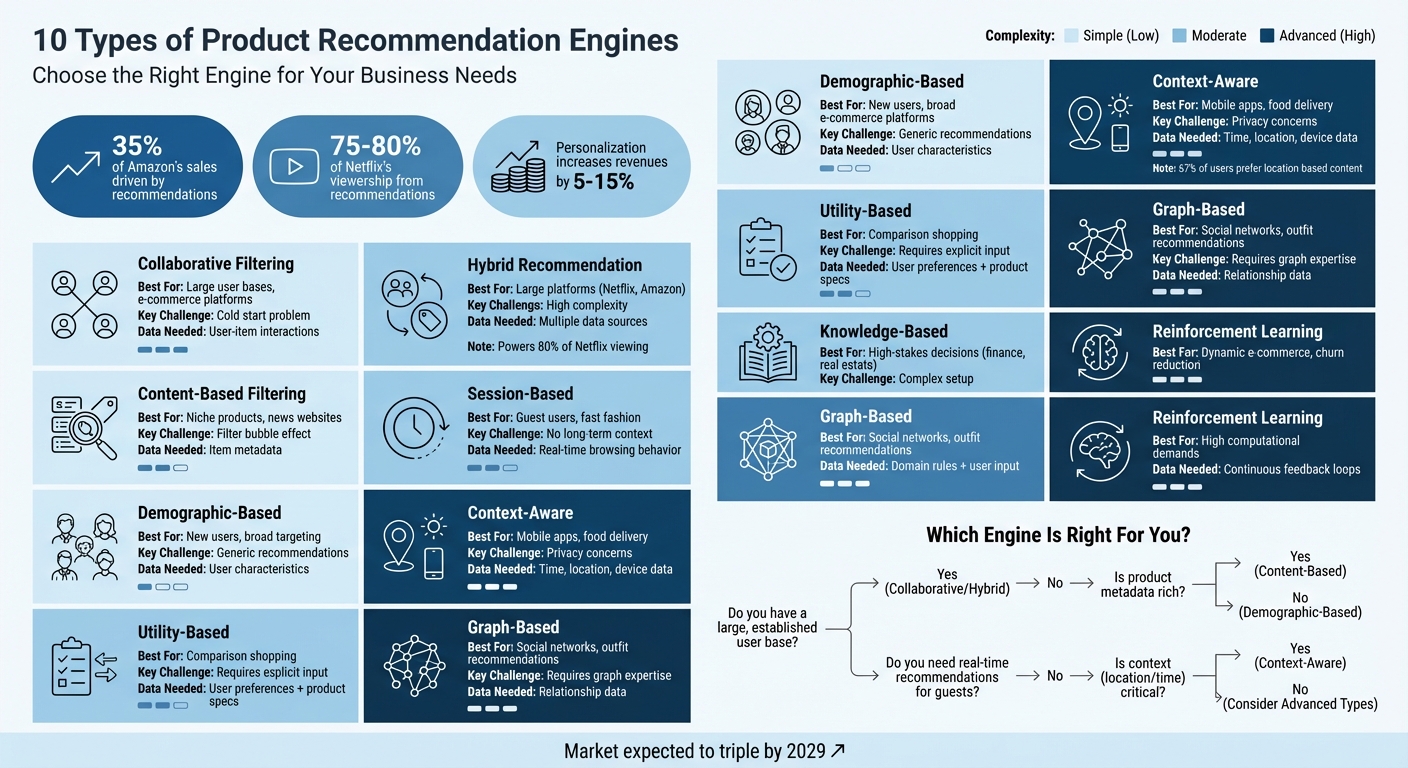
10 Types of Product Recommendation Engines: Quick Comparison Guide
Recommender Systems: Basics, Types, and Design Consideration | Machine Learning | Community Webinar
sbb-itb-5174ba0
1. Collaborative Filtering
Collaborative filtering is all about predicting what a user might like by looking at the preferences of others with similar tastes, often tracked using website analytics tools. The idea is simple: if two people have agreed on certain items in the past, there's a good chance they'll agree on similar items in the future. Instead of focusing on a product's specific features, this method zeroes in on the community of users who have interacted with it, uncovering patterns in their behavior.
At its core, the system relies on a user-item matrix, which tracks explicit feedback (like ratings or reviews) and implicit feedback (like browsing habits or purchases). By analyzing this matrix, the system can predict what a user might enjoy - even if they haven’t interacted with that item yet.
There are two main ways to approach collaborative filtering. Memory-based filtering uses algorithms like k-nearest neighbors (KNN) to find users or items with similar histories. On the other hand, model-based filtering leans on machine learning techniques, such as matrix factorization or singular value decomposition (SVD), to find hidden patterns in the data. Many modern systems also use embeddings, which capture the relationships between users and items, making predictions even more accurate. However, all these methods depend heavily on having a rich history of user interactions, as detailed below.
Data Requirements
Collaborative filtering thrives on historical interaction data. It uses both explicit signals (like ratings, likes, or reviews) and implicit ones (such as time spent on a page, cart additions, or purchases). Since user interactions are often sparse - meaning most users only engage with a small portion of available items - techniques like dimensionality reduction become essential for maintaining prediction accuracy.
Strengths
One of the standout benefits of collaborative filtering is its ability to surprise users with recommendations they might not have found on their own. For example, it can suggest movies, music, or products based purely on behavioral patterns, uncovering subtle preferences that users haven’t explicitly stated. This element of discovery makes it particularly powerful for complex or highly personalized recommendations.
Weaknesses
Despite its strengths, collaborative filtering has its challenges. The cold start problem is a significant hurdle - new users or items with little interaction history are hard to recommend effectively. Additionally, data sparsity, where users engage with only a tiny fraction of available items, can make it difficult to identify reliable patterns. Processing these large, sparse datasets in real time can also demand hefty computational resources, especially for platforms serving millions of users.
Ideal Use Cases
Collaborative filtering shines on platforms with large user bases and extensive interaction histories. For instance, e-commerce sites use it to recommend products based on similar shoppers' behaviors, while streaming services rely on it to suggest shows or songs. To overcome issues like the cold start problem, many platforms combine collaborative filtering with content-based methods, at least until enough interaction data is gathered.
2. Content-Based Filtering
Content-based filtering takes a different approach from collaborative filtering by focusing on the attributes of items rather than relying on user opinions. It evaluates product features - like genre, color, price, material, or keywords - to align recommendations with a user's preferences. For instance, if you've watched several action movies starring a specific actor, the system might suggest other action films or movies featuring that actor. This method zeroes in on the characteristics of items themselves, setting it apart from techniques that depend on group behavior.
At its core, this approach builds two profiles: an item profile, which captures the characteristics of each product, and a user profile, which tracks your interactions, such as likes, clicks, or purchases. These profiles are converted into feature vectors, and their similarity is measured using techniques like Cosine Similarity (measuring the angle between vectors), Euclidean Distance (measuring straight-line distance), or Dot Product (comparing magnitude and direction). As IBM's Jacob Murel Ph.D. explains, it’s "an information retrieval method that uses item features to select and return items relevant to a user's query".
Data Requirements
For content-based filtering to work effectively, it needs detailed metadata for each item. This includes structured data like categories, specifications, and tags, as well as unstructured data like text descriptions or images, which are processed into vectors. The user profile is created using historical interaction data, such as past purchases, ratings, clicks, or preferences provided during account setup. Without comprehensive item attributes, the system’s ability to generate accurate recommendations is limited.
Strengths
One of the standout benefits of content-based filtering is its ability to recommend new products that have yet to receive user interactions, helping to address the cold-start problem for new items. Since it relies on the intrinsic features of items, it can also explain recommendations clearly, such as "because you liked similar genres" or "because this item shares features with products you’ve purchased." This transparency can help build user trust.
Weaknesses
However, this method isn’t without its challenges. A common issue is overspecialization, often referred to as the "filter bubble", where users are only shown items similar to what they’ve already interacted with. This can stifle variety and limit exposure to new or diverse options. Additionally, the system struggles with new users who lack a history of interactions. Its success also hinges on the quality of metadata - poorly tagged items can lead to irrelevant or inaccurate suggestions.
Ideal Use Cases
Content-based filtering is most effective for platforms with well-organized product catalogs and clearly defined item attributes. For example, news websites use it to recommend articles based on topics and keywords, while e-commerce platforms leverage it to suggest products with similar specifications or styles. It’s particularly useful for promoting new inventory that lacks a purchase history. Many platforms enhance its capabilities by combining it with collaborative filtering to balance personalization with discovery.
3. Demographic-Based Recommendation
Demographic-based recommendation engines focus on grouping users by shared traits like age, gender, location, income, education, or profession. Instead of relying on past interactions like clicks or purchases, these systems use user profiles to suggest items popular among people with similar characteristics. For example, a 25-year-old woman living in California might see different recommendations than a 50-year-old man from Texas. When paired with behavior-based methods, this approach adds depth to overall recommendation strategies.
These systems aim to deliver relevant suggestions right away. They often use cluster-based segmentation - grouping users with similar profiles - or rule-based filtering, where predefined rules guide the recommendations (e.g., "if user is female and aged 20-30, recommend X"). However, as Mario Gerard points out, demographic classifications alone can be too broad and are most effective when combined with other recommendation techniques.
Data Requirements
To function, these engines rely on structured user profile data, which can be collected during account setup or sourced from third-party databases. Key data points include personal details (age, gender, ethnicity), socio-economic information (education, profession, income), and geographic data (city, state, country). In content recommendation scenarios, demographic models typically achieve training and validation accuracies in the mid-70% range. Unlike collaborative filtering, this approach doesn't depend on historical interactions, making it particularly useful for instant personalization.
Strengths
One of the biggest advantages of demographic filtering is its ability to tackle the cold start problem. Since it doesn't require prior behavioral data, it can provide meaningful suggestions as soon as a user signs up. It's also relatively simple to implement and needs fewer data points compared to behavior-based models. This makes it a dependable fallback option when other data sources are unavailable. Additionally, it often serves as a foundational layer in hybrid recommendation systems.
Weaknesses
The main limitation of this method is its lack of precision. By assuming that all users within a segment share similar preferences, it often overlooks individual differences. For instance, two 30-year-old software engineers living in Seattle might have completely different tastes, yet the system could treat them the same. This can lead to generic or less engaging recommendations. Moreover, building effective segments requires detailed market research, which can be time-intensive. Despite these challenges, demographic-based recommendations remain valuable in many contexts.
Ideal Use Cases
This approach works well in various scenarios, such as:
- Social media platforms: Suggesting "people you might know" based on shared backgrounds or locations.
- HR and recruitment: Matching job candidates with opportunities on professional networks.
- E-commerce: Highlighting popular products within specific regions or age groups.
- Content aggregation: Recommending news or articles tailored to a user's location.
Often, demographic filtering serves as an initial layer, later refined with behavioral data for better accuracy. On large commercial platforms, it can contribute up to 30% of total revenue.
4. Utility-Based Recommendation
Utility-based recommendation systems take a more calculated, criteria-driven approach compared to collaborative or content-based methods. These systems evaluate the "usefulness" or benefit of a product by assigning it a numerical score based on how well its attributes align with a user’s specific needs. Instead of relying on what others have purchased or product similarities, they focus on matching individual preferences. For instance, if you're shopping for a laptop, the system might weigh factors like price, processor speed, battery life, and brand reputation to help you navigate the options and make an informed decision.
These engines operate by combining user-defined preferences with real-time data. Say you're searching for a camera and prioritize image quality over cost - the system adjusts its utility function to reflect your preference. It also incorporates real-time information, such as stock availability, to ensure recommendations are practical and actionable. Prominent platforms like Facebook, LinkedIn, and Netflix employ utility-based approaches to rank content, match users with job opportunities, and provide tailored streaming suggestions based on user-defined criteria.
Data Requirements
For utility-based systems to deliver accurate recommendations, they need a rich mix of data:
- User Input Data: Includes search queries, preference settings, and explicit ratings that outline what matters most to the user.
- Product Attribute Data: Covers details like price, technical specifications, color, size, and other relevant features.
- Operational Data: Provides real-time updates on stock levels, vendor performance, and availability.
- Behavioral Data: Tracks user activity, such as click history and past purchases, to refine recommendations.
By combining these data types, utility-based engines can create highly personalized, criteria-based suggestions tailored to individual needs.
Strengths
One of the standout benefits of utility-based systems is their ability to simplify complex decision-making. When users are comparing products with multiple variables - like smartphones with different screen sizes, battery capacities, and price points - these engines excel at ranking options based on calculated benefits. They are particularly effective for niche products in large online marketplaces where collaborative data may be limited. Additionally, because they don't rely solely on historical data, they can help users overcome decision fatigue by presenting clear, criteria-driven rankings.
Weaknesses
However, implementing utility-based systems can be challenging. They require the integration of numerous variables into a utility equation, making them more complex to set up and fine-tune compared to other recommendation methods. These systems also rely heavily on users explicitly stating their preferences, which can be less convenient than passive tracking methods. If users fail to clearly define their needs, the recommendations might fall short. Furthermore, maintaining real-time data feeds - such as inventory levels or vendor rankings - requires significant technical resources and ongoing maintenance.
Ideal Use Cases
Utility-based recommendations shine in situations where decisions involve multiple criteria. E-commerce platforms benefit from these systems when suggesting niche or highly specific products, such as specialized hardware or unique items in multi-purpose marketplaces. They are also valuable in service industries, where options need to be compared based on factors like price, availability, and quality. Social media, HR platforms, and streaming services also leverage utility-based approaches to deliver highly tailored experiences.
5. Knowledge-Based Recommendation
Knowledge-based recommendation systems take a different approach compared to those relying on user history or item attributes. Instead of mining past behaviors, these systems interact directly with users to understand their specific needs. By asking targeted questions and applying expert rules, they generate tailored suggestions. These systems typically fall into two categories: constraint-based (using predefined rules to narrow down options) and case-based (employing similarity metrics to match items with user preferences).
What makes knowledge-based systems stand out is their ability to handle complex, high-stakes decisions without needing historical data. For example, when dealing with significant purchases like real estate, financial planning, or enterprise software, these systems can offer precise recommendations right away - even for first-time users. This makes them particularly effective in scenarios where traditional recommendation methods might struggle. As Siemens Energy AG researchers explain:
"Knowledge-based recommender (KBR) systems can be considered as complementary to CF- and CBF-based approaches in terms of avoiding the related cold-start difficulties."
Data Requirements
To function effectively, these systems need three key components:
- Detailed metadata about the items being recommended.
- Explicit user preferences gathered through direct interaction.
- Well-defined business rules that connect user needs with product features.
Strengths
One of the biggest advantages of knowledge-based systems is their ability to bypass the cold-start problem. They don't depend on historical data, making them ideal for first-time users and long-term customers alike. Another strength lies in their transparency - these systems can explain why a particular recommendation was made or why no suitable option is available. This builds trust, especially in complex decision-making processes. Moreover, they are particularly effective for items that are purchased infrequently, where historical data might be sparse or irrelevant.
Weaknesses
However, these systems aren't without challenges. Setting them up requires significant collaboration between domain experts and engineers, which can lead to high costs and lengthy implementation timelines. Additionally, the reliance on static rules can limit the element of surprise in recommendations. Keeping the system updated with new regulations, inventory changes, and market conditions also demands ongoing maintenance.
Ideal Use Cases
Knowledge-based systems shine in scenarios that require detailed, personalized guidance. They are well-suited for high-stakes decisions like selecting investment products, matching real estate options, configuring complex B2B software, or choosing high-end electronics with specific technical needs. In these cases, the combination of expert input and direct user interaction ensures more informed and confident decision-making.
6. Hybrid Recommendation
Hybrid recommendation engines combine multiple techniques - like collaborative filtering and content-based filtering - to deliver more accurate recommendations while addressing the shortcomings of single-method models. By blending data sources and algorithms, these systems can adapt to various scenarios, whether it's a new user with no browsing history or a long-time customer with a wealth of interaction data. Essentially, hybrid systems take the strengths of collaborative and content-based methods and use them to counterbalance each other's weaknesses.
There are several types of hybrid models, including weighted, switching, cascade, and feature augmentation approaches. Weighted hybrids mix scores from different models in fixed ratios, such as 50% collaborative and 50% content-based. Switching hybrids dynamically choose the most appropriate model based on the current situation. Cascade hybrids work in layers, where one model generates initial recommendations that another model refines. Finally, feature augmentation uses the output of one model as an input for another, creating a more layered and detailed recommendation process.
These systems have proven to be game-changers in industries like streaming and e-commerce. For instance, Netflix’s hybrid recommendation engine powers 80% of its viewing time, saving the company over $1 billion annually. Similarly, Amazon generates 35% of its sales through features like "Frequently bought together". Even smaller platforms like Fuzu have seen success, boosting email click-through rates by 30% with hybrid recommendations.
Data Requirements
For a hybrid engine to work effectively, it needs access to diverse data sources. This includes user interaction data (like ratings, clicks, and purchases), detailed item metadata (such as categories, features, and descriptions), and user demographic information. Additionally, these systems require robust computational infrastructure to handle the complexity of processing multiple algorithms and combining varied data inputs.
Strengths
One of the biggest advantages of hybrid systems is their ability to tackle the cold-start problem. By using item features and demographic data, they can generate recommendations for new users or products even when interaction data is limited. Hybrid systems also tend to offer higher predictive accuracy and help reduce the "echo chamber" effect by introducing more variety into recommendations. As data scientist Jeffery Chiang explains:
"Hybrid recommendation systems are one of the most effective way to improve our model. By combining different approaches... we can better customize our model to fit the recommendation condition and dataset requirements."
This makes them a powerful tool for delivering personalized and diverse recommendations.
Weaknesses
However, hybrid systems come with their own set of challenges. They are more complex to build and maintain compared to standalone models, often requiring advanced machine learning expertise and collaboration across teams. Running multiple algorithms in real time can also be resource-intensive, demanding significant computational power. IBM researchers highlight this trade-off:
"A hybrid approach can greatly enhance the performance of a recommendation engine, but it requires advanced architectures and intensive computational power."
Balancing computational efficiency with performance remains a constant struggle for developers.
Ideal Use Cases
Hybrid systems shine in large-scale environments like e-commerce marketplaces and streaming platforms, where personalized recommendations can directly drive revenue. They are particularly effective for marketing campaigns targeting new users or promoting new products, as they can provide tailored suggestions even without historical data. These systems are also well-suited for industries like finance and real estate, where recommendations must balance user preferences with expert insights. Additionally, they are invaluable in cross-channel data integration, ensuring consistent personalization across email, websites, and mobile apps. This versatility makes hybrid recommendation engines a cornerstone of modern personalized marketing strategies.
7. Session-Based Recommendation
Session-based recommendation engines are all about predicting what a user might do next during a single visit. Instead of relying on a user's long-term profile, these systems focus solely on the immediate context and the sequence of actions they take in real time. By analyzing the order of interactions, models like Recurrent Neural Networks (RNNs) or Transformers can determine the most logical next step. This real-time approach has both its perks and challenges, which we’ll dive into below.
One of the biggest advantages of this method is its effectiveness for anonymous users - those who haven’t logged in or signed up. By focusing only on the current session, these models sidestep the cold-start problem, which typically hinders systems that rely on historical data.
The results can be impressive. For instance, when a Fortune 500 fashion retailer teamed up with Grid Dynamics to implement a session-based recommendation system, they achieved a 15% increase in desktop click-through rates and a 3% boost in revenue per visitor. The system used real-time signals - like when a user left a product page or added an item to their cart - to deliver suggestions that matched what the user was looking for at that moment, rather than relying on past behavior.
Data Requirements
Session-based engines thrive on real-time interaction data from the current visit. This includes clicks, product views, add-to-cart actions, and search queries. The timing and sequence of these actions are crucial - something done 30 seconds ago carries more weight than an action from 10 minutes earlier. Additionally, these systems benefit from product metadata like categories, prices, and colors, which help establish relationships between items in the sequence.
Strengths
These systems shine in several areas:
- They effectively tackle the cold-start problem, offering relevant suggestions to new visitors from their very first interaction.
- They adapt quickly to shifting user intent. For example, if a user suddenly switches from browsing electronics to searching for accessories, the recommendations adjust instantly.
- Since they focus only on the current session, they’re privacy-friendly and easier to comply with regulations like GDPR.
Weaknesses
However, there are challenges to consider:
- Developing and maintaining these systems is technically demanding. Advanced models like RNNs or Transformers require specialized expertise and significant computational resources to process vast amounts of behavioral data in milliseconds.
- These engines don’t account for a user’s brand loyalty or past preferences that aren’t evident in the current session.
Ideal Use Cases
Session-based models are a great fit in scenarios where understanding immediate intent is key. They work well alongside collaborative and hybrid filtering approaches. Here are some examples:
- E-commerce platforms: Perfect for guest shoppers or first-time visitors, where real-time relevance matters more than historical data.
- Media streaming services: Great for predicting the next video or song for users who are browsing without logging in.
- Customer support systems: Helpful for suggesting the most relevant help articles or troubleshooting steps based on the current conversation, without relying on past ticket history.
8. Context-Aware Recommendation
Context-aware recommendation engines take personalization to the next level by factoring in real-time situational signals - like time of day, location, device type, or even the user's current workplace. They don't just rely on past behavior; instead, they adapt to the user's present circumstances. Unlike traditional systems that work within a basic User × Item model, these engines introduce a third element: Context. This added layer creates a more dynamic framework, capturing how preferences shift based on the situation.
For example, in 2015, Best Buy introduced a recommendation engine that seamlessly combined online and offline shopping. By using geolocation, it provided users with tailored recommendations and promotions specific to their local store's inventory, helping them find items available for immediate pickup. Similarly, Netflix adjusts its homepage layout depending on the device being used and the time of day, tailoring the experience to match the user's current viewing context. While these systems share similarities with other recommendation methods, they stand out by leveraging real-time situational data for deeper personalization.
Data Requirements
To function effectively, context-aware systems require fast data pipelines capable of processing real-time information. Key data categories include:
- Temporal data: Time of day, day of the week, seasons, and holidays.
- Spatial data: GPS coordinates and proximity to physical locations.
- Technical context: Device type, browser, and network conditions.
- Social context: Whether the user is shopping solo, with family, or for a specific purpose.
Session-based context is also vital, such as tracking which page the user is viewing and how long they've been browsing.
Strengths
These systems excel at delivering dynamic and relevant personalization that static models simply can't achieve. By filtering out irrelevant items in real time, they reduce information overload and boost user engagement. They also adapt to preferences that change with the user's environment or time, making suggestions more relevant. In fact, 67% of smartphone users are more likely to buy from companies that customize content based on their location.
Weaknesses
However, the complexity of these systems is a notable challenge. Adding contextual dimensions creates a multi-dimensional framework, which can lead to data sparsity and make it harder for algorithms to detect patterns. Handling real-time data at scale requires significant computational power and advanced processing capabilities. Privacy concerns are another hurdle - tracking real-time location and situational data demands strict compliance with regulations and transparent data practices.
Ideal Use Cases
Context-aware engines shine in scenarios where the user's immediate situation takes precedence over their long-term history. Here are some prime examples:
- Mobile commerce and travel: Location-based offers and geospatial filtering for food delivery or tourism.
- Streaming services: Adjusting content recommendations based on the time of day or device.
- Brick-and-mortar retail: Personalized offers delivered through entrance terminals or point-of-sale screens when customers scan loyalty cards.
- Telemarketing: Optimizing the timing of customer outreach to improve conversion rates.
These systems are all about making the most of the moment, tailoring experiences to match the here and now.
9. Graph-Based Recommendation
Graph-based recommendation engines organize data into nodes (like users, products, or attributes) and edges (the relationships between them). Think of it as a social network where the system jumps from one node to another to find related items. For instance, it might start with a user’s purchase history (1 hop), identify similar users who bought the same items (2 hops), and then suggest products the user hasn’t seen yet (3 hops). To work effectively, this method relies on a structured and interconnected dataset.
eBay uses Neo4j to power a shopping app that combines natural language understanding and artificial intelligence for tailored recommendations. Similarly, Medium built its personalized content recommendation system using a social graph powered by Neo4j. In 2019, researchers employed a Node-wise Graph Neural Network (NGNN) to recommend clothing outfits by representing product combinations as subgraphs. This method achieved an impressive AUROC score of 0.9722.
Data Requirements
For these engines to work, they need interconnected data stored in a graph database like Neo4j. This includes user profiles, product details, and session data (which can be tracked using top analytics tools). Relationships between nodes - such as "purchased", "viewed", or "follows" - are critical, along with weighted attributes that allow for detailed queries. Additionally, unstructured data like product descriptions and reviews can be integrated using Natural Language Processing (NLP), adding more depth to the recommendations.
Strengths
Graph databases are incredibly fast, capable of traversing millions of relationships in milliseconds. This makes real-time recommendations based on a user’s current session possible, without relying on slower batch processing. They’re particularly effective for managing complex, interconnected data, linking everything from products and customers to inventory and even social sentiment, all without the performance issues of traditional relational databases. Their flexible schema also allows new data types - like weather or location - to be added without needing a complete redesign. Neo4j highlights this advantage:
"The accuracy and the scope of recommendations increase as you add more nodes or data points".
Weaknesses
However, graph-based systems come with challenges. They require expertise in graph databases and query languages, which can be a hurdle for teams used to SQL. Setting up these systems involves mapping out intricate relationships and ensuring high data quality, which can be time-consuming. Also, for simpler recommendation tasks, traditional methods like collaborative filtering might be more efficient.
Ideal Use Cases
These engines are particularly effective in scenarios involving complex product combinations, such as recommending complete outfits in fashion or matching furniture sets in home decor. They’re also well-suited for social networks, where user connections and shared interests drive content recommendations. Beyond retail and social platforms, they’ve found applications in healthcare, HR, and IT, such as linking patients to clinical trials, improving employee retention, or suggesting technical solutions. Sarah Evans, Analytics Practice Manager at Graphable, puts it this way:
"Those that can imagine beyond the traditional recommendation use cases will set themselves up to compete much more effectively by mining their data for value in this unique way".
10. Reinforcement Learning-Based Recommendation
Reinforcement learning (RL) takes recommendation systems to the next level by introducing a dynamic, ever-evolving approach. Unlike static models, RL operates as an agent that learns by earning "rewards." These rewards come from positive user actions - like clicks or purchases - which the system uses to refine future recommendations. Instead of sticking to fixed rules, RL treats recommendations as a sequential decision-making process, constantly adjusting its strategy based on real-time user behavior to boost long-term engagement or sales. Patrick Thompson, Director of Product at Amplitude, sums it up well:
"The goal is to get to the point where you're recommending the right content to the right person at the right time, based off of their previous journey".
Many modern RL systems also leverage deep learning, enabling them to identify key patterns and relationships from raw data like text, images, or metadata. This eliminates the need for manual feature engineering and allows the system to capture more complex user–product interactions.
Data Requirements
For RL-based recommendations to work effectively, they need a steady stream of interaction data - things like clicks, conversions, and time spent on pages - which serve as "rewards" for the system. These engines rely on both historical user-item interaction data and real-time session data, allowing them to adapt quickly as user preferences shift. They also pull from a variety of data sources, including product descriptions and images, to better understand the factors influencing user behavior. This rich, real-time data helps RL systems fine-tune their recommendations continuously.
Strengths
One of the standout features of RL-based systems is their ability to adapt dynamically. They adjust recommendations with every new interaction, eliminating the need for manual updates to rules. These systems are particularly effective at optimizing for long-term outcomes, such as customer lifetime value or total session duration, rather than focusing solely on immediate clicks. They can also address the cold start problem by analyzing product context and user details instead of relying entirely on historical behavior. As AB Tasty puts it:
"The recommendation agent is rewarded for certain interactions and uses this insight to optimize website performance".
Weaknesses
Despite their advantages, RL systems come with challenges. Their complexity can be a major hurdle - they require sophisticated architectures and significant computational resources compared to simpler models. Implementing them demands specialized expertise and robust data pipelines. They can also struggle with new items or users who lack sufficient interaction data. To ensure effectiveness, businesses should A/B test RL algorithms against traditional models before rolling them out fully.
Ideal Use Cases
RL-based recommendation systems thrive in environments where adaptability is key. They excel in dynamic e-commerce settings, such as fashion or fast-moving consumer goods, where trends shift quickly. They're also a great fit for session-based recommendations, predicting the "next best action" or product during a user's browsing session. Platforms like media streaming services or social networks, where the goal is to keep users engaged with a steady flow of relevant content, can benefit significantly. Additionally, RL systems are effective for churn reduction, helping identify offers or content that can re-engage users at risk of leaving.
Comparison Table
Each recommendation engine comes with its own set of strengths, challenges, and data requirements. Choosing the right one depends on your specific goals, available resources, and the type of data you have. The table below provides a quick overview of the key attributes of various recommendation engines, helping you decide which might be the best fit for your needs.
| Recommendation Type | Data | Strength | Weakness | Ideal Case |
|---|---|---|---|---|
| Collaborative Filtering | Historical user-item interactions (e.g., ratings, clicks, purchases) | Identifies hidden patterns without needing item metadata | Struggles with new users or items (cold start issue) | High-traffic platforms like large e-commerce sites (e.g., Amazon) |
| Content-Based Filtering | Detailed item metadata (e.g., keywords, categories) and user profiles | Great for new or niche items; highly personalized | Can create echo chambers with limited diversity | Specialized catalogs like news websites or niche retail |
| Demographic-Based | User characteristics (e.g., age, gender, location) | Useful for anonymous or new users lacking interaction history | Doesn't account for individual behavior | Initial onboarding or broad audience targeting |
| Utility-Based | User-defined preferences and criteria (e.g., price, rating) | Offers transparency and clear comparisons for users | Relies on explicit user input | Ideal for comparison shopping or service-focused platforms |
| Knowledge-Based | Domain-specific rules and structured knowledge bases | Highly accurate for complex, high-stakes decisions | Requires ongoing maintenance of rules and logic | Finance, real estate, and healthcare decisions |
| Hybrid Recommendation | Combines behavioral data with item attributes | Addresses cold start and data sparsity issues effectively | Complex to build and costly to maintain | Enterprise-level platforms like Netflix or Amazon |
| Session-Based | Real-time browsing behavior during a session | Works without historical data; privacy-friendly | Limited to session data; lacks long-term context | Guest checkouts, news websites, or fast-fashion retail |
| Context-Aware | Situational data (e.g., time of day, location, device type) | Delivers highly relevant, immediate suggestions | Requires advanced real-time data processing | Mobile apps, food delivery, or travel services |
| Graph-Based | Relationship data between users, items, and contexts | Captures complex, non-linear connections | Computationally demanding and intricate | Social networks or fashion recommendations (e.g., outfit suggestions) |
| Reinforcement Learning | Feedback loops from user interactions (e.g., clicks, conversions) | Adapts dynamically to changing trends | Needs constant data input and expertise | Dynamic e-commerce or churn reduction campaigns |
This table highlights the variety of recommendation engines available, each suited to different use cases. While no single option is universally perfect, selecting the right engine for your business can significantly influence user engagement and revenue. Strategic implementation is key to achieving the best results.
Conclusion
Product recommendation engines have become a cornerstone of modern marketing analytics, delivering measurable results across various industries. Personalization has shown to increase revenues by 5%–15%, yet 76% of customers report frustration when it’s missing. Major platforms, too, owe a significant portion of their revenue to these recommendation systems.
As discussed earlier, each type of recommendation engine comes with its own strengths and challenges. The key is to align the engine with your business needs. For businesses with limited historical data, content-based or demographic filtering provides quick wins. High-traffic e-commerce platforms, on the other hand, thrive with collaborative filtering, which identifies patterns in user behavior. Specialized industries like finance or real estate often benefit from knowledge-based systems that leverage domain-specific expertise and strict business rules. Meanwhile, context-aware and session-based engines are perfect for real-time interactions, such as mobile apps or guest checkouts, where immediate relevance takes priority over historical data.
Implementing a recommendation engine successfully requires careful planning and precise execution. Testing is crucial - A/B test algorithms to determine which ones drive the highest conversions. Address challenges like the cold start problem by using hybrid systems that combine multiple methods. Also, keep an eye on popularity bias to ensure niche products receive fair visibility alongside bestsellers.
To help navigate the available options, the Marketing Analytics Tools Directory (https://topanalyticstools.com) provides a resource for comparing and selecting the right engine. This tool allows businesses to evaluate solutions based on data maturity, technical needs, and strategic goals.
Ultimately, choosing the right recommendation engine goes beyond technology - it’s about understanding your customers, leveraging your data, and defining your objectives. With the global recommendation engine market expected to triple by 2029, now is the perfect time to refine your approach, enhance engagement, and drive growth.
FAQs
How can I select the best recommendation engine for my business?
To pick the right recommendation engine, start by pinpointing your business objectives. Are you aiming to increase cross-sell revenue, make product discovery easier, encourage repeat purchases, or offer a more tailored customer experience? Once that's clear, take stock of the data you have at hand - things like user interactions (clicks, purchases, ratings), product details (categories, brands, specs), and contextual signals (time, location). The trick is to match your goals and data to the strengths of different recommendation systems.
Think about practical considerations like data volume. This can help you decide between collaborative filtering, which thrives on large datasets, or content-based methods, which work well with detailed product information. If your product catalog is complex and rich in metadata, some engines are better suited to handle that. For highly personalized and scalable recommendations, hybrid or deep-learning models might be the way to go, though they often require more technical resources. On the other hand, if you're working with a smaller team or need a faster, more budget-friendly setup, SaaS solutions could be a smart choice.
By aligning your specific needs with these factors, you can zero in on the best engine for your situation. Collaborative filtering works great in data-heavy environments, content-based models shine with niche products, hybrids offer balanced performance, and deep-learning models excel at advanced personalization. Tools like the Marketing Analytics Tools Directory can help you explore platforms that align with your budget and timeline, especially if you're focused on U.S.-based solutions.
What challenges come with implementing a hybrid recommendation system?
Implementing a hybrid recommendation system comes with its fair share of challenges. One major hurdle is combining various data sources and algorithms. These systems rely on blending collaborative filtering (which uses user behavior data) with content-based methods (focused on product attributes). Achieving smooth coordination between these approaches to produce and rank recommendations accurately can be quite complicated.
Another challenge lies in striking the right balance between different techniques. Deciding how much weight each type of data should carry isn't straightforward - it often involves a lot of testing and adjustments to avoid leaning too heavily on one method while still delivering precise recommendations.
Lastly, scalability and performance pose significant obstacles. Running multiple models at once and re-ranking results can demand a lot of computational power. This makes it tough to maintain real-time performance without driving up costs. These factors make hybrid systems incredibly effective but also technically challenging to implement.
How do context-aware recommendation engines improve the shopping experience?
Context-aware recommendation engines elevate the shopping experience by factoring in real-time elements like a user’s location, device, time of day, or recent activity. By blending this contextual information with insights from traditional user behavior, these systems deliver suggestions that feel more tailored and timely, making users more likely to engage.
Imagine this: someone is browsing on their phone during a weekend sale. A smart recommendation engine might showcase mobile-friendly products or highlight flash discounts available only for a limited time. This strategy doesn’t just improve click-through rates - it also keeps users browsing longer and drives more conversions. Businesses looking to implement such capabilities can tap into platforms specializing in marketing analytics, making their personalization efforts both seamless and data-driven.