If referral credit does not connect to paid accounts, renewals, and expansion revenue, it is not enough for SaaS. I’d look at top analytics tools across 4 paths differently - affiliates, partners, customer referrals, and review sites/marketplaces - because each one needs a different way to assign credit.
Here’s the short version:
- Affiliate programs are the most direct - link click to signup to subscription - but browser limits and last-click rules can skew credit.
- Partner and channel referrals depend more on CRM fields, deal registration, and partner-of-record data than on clicks.
- Customer referral programs work best when referral links or codes feed into account records and rewards trigger from billing events.
- Review sites and marketplaces often shape deals earlier in the buying path, so I’d split sourced revenue from influenced revenue.
Across all 4, the same rules apply:
- Track at the account level, not just the user level
- Match the attribution window to the sales cycle - often 30-90 days for self-serve and 90-180 days for sales-led deals
- Use a mixed setup - tracked links, CRM fields, referral codes, and billing webhooks and automated reporting via Equals
- Judge performance by MRR, ARR, renewals, expansion, churn, CAC, and payback, not just clicks or signups
The main point is simple: the best referral setup is the one that still assigns credit when revenue shows up in billing.
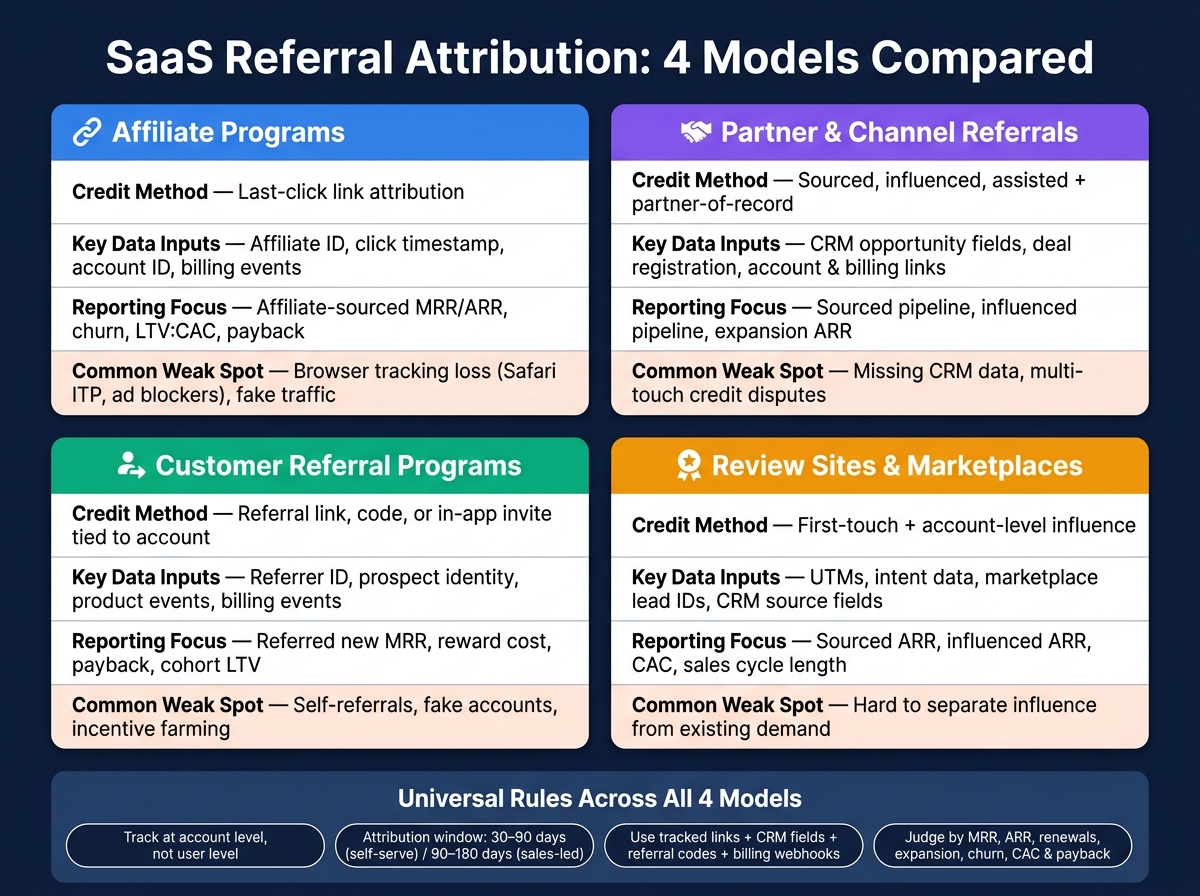
SaaS Referral Attribution: 4 Models Compared
How to Launch a Customer Referral Program for Your SaaS (Using Stripe)
sbb-itb-5174ba0
Quick Comparison
| Referral Type | Main way credit is assigned | Main analytics tools for business data inputs | Main reporting focus | Common weak spot |
|---|---|---|---|---|
| Affiliate programs | Last-click link attribution | Affiliate ID, click time, account ID, subscription and invoice events | Affiliate-sourced MRR/ARR, churn, payback, LTV:CAC | Browser tracking loss, fake traffic |
| Partner & channel referrals | Sourced, influenced, assisted, plus partner-of-record | CRM opportunity fields, deal registration, account and billing links | Sourced pipeline, influenced pipeline, reseller revenue, expansion ARR | Missing CRM data, credit disputes |
| Customer referral programs | Referral link, code, or in-app invite tied to account | Referrer ID, prospect identity, product events, billing events | Referred new MRR, reward cost, payback, referred cohort LTV | Self-referrals, fake accounts, incentive abuse |
| Review sites & marketplaces | First-touch plus account-level influence | UTMs, intent data, marketplace lead IDs, CRM source fields | Sourced ARR, influenced ARR, CAC, sales cycle length | Hard to separate influence from existing demand |
If I were auditing this stack, I’d start with one question: Can I trace each referred account from source to invoice to renewal?
1. Affiliate Programs
Affiliate programs are the cleanest referral model in SaaS: one tracked link, one referrer, and one commission rule. Each affiliate gets a link with an affiliate ID and UTM parameters. When a prospect clicks, the system stores a first-party identifier and tracks the account from trial to first payment and renewal.
Attribution Mechanism
Most SaaS programs use last-click attribution. In that setup, the affiliate whose link was clicked most recently before conversion gets full credit. It’s simple, and it holds up well in partner contracts. The downside is pretty clear: last-click can miss the full path in longer B2B sales cycles, where more than one affiliate may shape the deal over time.
Cookie windows should line up with your sales cycle. A 30-day window is common for self-serve or PLG products with short trial periods. Mid-market deals often need 90-180 days or more [5][6].
Data Requirements
Reliable affiliate attribution depends on storing the affiliate ID at each key milestone: lead creation, trial activation, first invoice, renewal, and upgrade. That ID should pass cleanly from your marketing site analytics into your CRM and then into your billing system. Commission logic should tie to the subscription record, not only the first invoice, so renewals and plan changes stay accurate [7].
The core fields to capture are:
- affiliate ID
- click timestamp
- landing page URL
- contact and account IDs
- opportunity ID
- plan type
- MRR/ARR in USD
- billing frequency
- churn or upgrade events
Revenue Reporting Goals
Clicks and signups are only the start. The metrics that matter for program decisions are affiliate-sourced MRR, LTV:CAC ratio, payback period, net revenue retention (NRR) by affiliate cohort, and churn rate by affiliate. Affiliate revenue tends to cluster among a small group of partners, so reporting should show which ones drive durable MRR, not just traffic or form fills.
Automation Stack
The stack usually includes affiliate software such as FirstPromoter or Rewardful, plus CRM, billing webhooks, and BI.
That clean link model starts to strain when referrals come through partners and channel introductions.
2. Partner and Channel Referrals
SaaS partner attribution is account- and opportunity-based, not click-based. That’s the main shift. Resellers, implementation partners, ISVs, and agencies often introduce the buyer, join sales calls, and help move the deal forward without leaving a neat click trail. In other words, they can affect revenue even when there’s no clean path from first touch to closed deal.
Attribution Mechanism
Track partner revenue across 3 models: sourced, influenced, and assisted. For digital partners, use tracking links. For sales-led deals, use deal registration. For renewals and expansions, use partner-of-record fields. Assign 1 primary partner per deal and use a fixed attribution window that matches the sales cycle for more complex deals.[8][9][10]
Data Requirements
Every opportunity with partner involvement should include the same core fields:
- Partner ID
- Partner type
- Partner tier
- Region
- Contribution type
- Opportunity ID
- Account ID
- Opportunity source
- Created date
- Close date
- Amount in USD
Capture these fields when the opportunity is created in the CRM, not later at close. If the team fills them in after the fact, reporting gets shaky fast.
There’s another piece people often miss: billing and subscription events need to stay tied to both the account and the partner-of-record fields. That includes subscription start, renewal, expansion, and churn. If those links break, ARR attribution stops at the first sale, which leaves out a big part of partner impact.
Revenue Reporting Goals
Report these revenue views separately: partner-sourced pipeline, partner-influenced pipeline, and reseller revenue.
Score each partner using:
- Sourced ARR
- Influenced ARR
- Renewal rate
- Expansion ARR
- Average deal size
- Sales cycle length
Automation Stack
The core stack usually starts with a CRM like Salesforce or HubSpot with custom opportunity fields. Add a PRM platform like PartnerStack or Referral Rock for deal registration and referral intake. Then use a BI layer to roll up sourced versus influenced revenue across partner types and tiers.
Billing and subscription data should feed back into the CRM so renewals and expansions remain tied to the correct partner-of-record account.
This setup fits partner-led deals. Customer referral programs work differently and lean more on referral codes, product events, and billing links.
3. Customer Referral Programs
Customer referral attribution is simpler than partner attribution in one way and stricter in another. The referrer is an existing customer, not a company, so the job is to tie that person to a paid account, not just a signup. Each customer should have a unique referral identifier - a link slug, referral code, or in-app invite token. When a prospect clicks the link and signs up, that referrer ID should be written to the new account record. Rewards should fire from subscription or invoice webhooks, not cookies, so attribution holds even when someone changes devices or runs into browser privacy limits. A hybrid setup works best: use referral links for auto-tracking, then give users a referral code as backup. If someone moves from mobile to desktop before signing up, they can enter the code at registration and keep the referral attached even if cookie-based tracking drops off.[13]
Data Requirements
You need 4 data types: identity, events, relationships, and revenue.
- Identity connects the referrer's account ID, the prospect's user ID and email, and the referral link or code ID across the product, CRM, and billing systems.
- Events cover the full path: invite sent, link clicked, trial started, account activated, subscription created, upgrade, and churn.
- Relationships live in the CRM, usually as a
referrer_idfield on the account object. - Revenue comes from billing - MRR, plan type, and payment status - so only paid, non-refunded subscriptions count.[11][12]
Unlike partner programs, referral attribution starts in the product and finishes in billing. In B2B, use account-level attribution, not user-level attribution.
Revenue Reporting Goals
Focus on referred new MRR, cost per referred acquisition, payback period on referral program costs, and LTV of referred cohorts versus your baseline. Cost per referred acquisition is simple: rewards paid divided by paying referred customers.
This matters because referred customers tend to be worth more over time. They show 16-25% higher lifetime value and 20% lower churn than non-referred customers, so ROI should be based on retention-adjusted revenue, not raw signup volume.[15] Top-quartile B2B SaaS referral programs drive 32% of new customers at 58% lower CAC than paid channels.[4]
Break reporting out by referrer, plan tier, and customer segment. That helps you see which customers bring in the best referrals, not just the most referrals. But none of those metrics mean much if product, CRM, and billing data fall out of sync.
Automation Stack
A common B2B SaaS referral stack starts with a CDP like Segment to standardize event and identity data. A referral platform such as FirstPromoter, Rewardful, Cello, or PartnerStack handles unique identifiers and eligibility rules. Identity data moves from the product into the referral platform, which then connects to the CRM to store referrer-referee relationships. The billing system sends subscription and invoice events back to the referral platform so rewards are based on confirmed revenue, not signups. A BI layer then pulls everything into referral funnel and revenue dashboards.[11][1][14]
Fraud controls should sit in the referral platform layer. At a minimum, block self-referrals, flag same-IP signups, and hold rewards until the referred account has completed at least 1 billing cycle.
Review sites and marketplaces are harder still because the referral path is less direct.
4. Review Sites and Marketplaces
Review sites and marketplaces shape vendor shortlists before a buyer fills out a form. Buyers use places like G2, Capterra, TrustRadius, AppExchange, and AWS Marketplace to research options and compare vendors. G2's 2024 Buyer Behavior Report says review sites were cited by 31% of B2B software buyers during purchasing, up from 13% in 2021.[24] So this channel is less about simple referral credit and more about separating first-touch acquisition from later-stage influence.
Attribution Mechanism
Attribution here is usually weaker at the individual link level and stronger at the account level. Review profile links, comparison badges, and marketplace listings should use consistent UTM parameters - for example, utm_source=g2, utm_medium=review-site, utm_campaign=profile - so this traffic stays separate in your marketing analytics tools.[21][25][28]
What makes this different from plain click tracking is intent data. Platforms like G2 Buyer Intent send signals about which companies are viewing your profile, category, or competitors into your CRM or marketing automation system through native integrations or APIs.[16][19][20][26] Use sourced pipeline when the first touch comes from a review site or marketplace visit. Use influenced pipeline when the channel shows up later in an active opportunity.
Because these signals come from both anonymous research and known accounts, the data model needs to keep both the first-touch source and the account match.
Data Requirements
Keep review-site-sourced leads separate from review-site-influenced opportunities with a dedicated CRM field such as Marketplace Source. Store UTMs, page URL, referrer, and first-touch timestamp in hidden fields, then lock them at first touch so a later channel does not overwrite the original source. For marketplace leads, add the app listing ID or lead ID passed through the API so the marketplace can create or update leads and opportunities on its own. Domain-based account matching also matters because it helps Buyer Intent signals and marketplace leads connect to the right account instead of creating duplicates.[20][26][27][28][29]
Revenue Reporting Goals
Track:
- sourced ARR
- influenced ARR
- CAC by source
- sales cycle length by source
Those metrics show which review site or marketplace is driving faster and lower-cost revenue. They also help you judge whether a paid listing or sponsorship is worth the spend.
Automation Stack
The main additions here are intent feeds, marketplace lead sync, and attribution-platform integration. G2 has native integrations with attribution platforms including Dreamdata, Factors.ai, and HockeyStack, which help teams connect review-site activity to pipeline and closed revenue across the buyer journey.[17][18][22] Teams can also automate the flow of Buyer Intent data into CRM for sales follow-up.[23]
Pros and Cons by Referral Type
The table below sums up the main tradeoffs across the 4 referral types. It’s a quick way to spot which model tends to break first when tracking, CRM, or billing data gets messy.
| Referral Type | Major Advantages | Common Attribution Risks | Best-Fit SaaS Motion |
|---|---|---|---|
| Affiliate Programs | High scalability, predictable CPA, and the ability to test many traffic sources quickly | Cookie loss from Safari ITP and ad blockers; last-click hijacking; fraud from bot or fake traffic | PLG / self-serve |
| Partner & Channel Referrals | Larger deal sizes, multi-year contracts, and strong co-sell alignment | Incomplete CRM data, multi-touch credit disputes, and manual delays in reporting | Sales-led / hybrid |
| Customer Referral Programs | High trust, better conversion rates, and stronger customer loyalty | Self-referrals, fake accounts, incentive farming; limited scale compared with affiliates | PLG / hybrid |
| Review Sites & Marketplaces | High-intent traffic and strong fit for mid-market and enterprise buyers | Incrementality gaps, multi-touch complexity, and overstated impact when visitors were already in pipeline | Sales-led / mid-market and enterprise |
Affiliate programs usually break at the browser level first. The main issue is client-side tracking loss, not the attribution model itself. If you run affiliates, server-side click capture is the safer default because it cuts down exposure to Safari ITP, ad blockers, and other browser-side loss points.[2][3][30][31]
Partner referrals have the opposite profile: bigger revenue, dirtier data. The deal size can look great, but attribution gets shaky fast when CRM fields are missing, partner-sourced flags aren’t filled in, or deal registration never happens. When that happens, sourced vs. influenced revenue turns into a guess instead of a clean number.
Customer referral programs need fraud controls early. Self-referrals, fake accounts, and incentive farming can throw off payout economics fast. If the reward is easy to claim and hard to verify, people will test the edges of the system.[32]
Attribution windows should match the sales cycle. If the window is too short, slower deals get undercounted. If it’s too long, credit can drift or get locked in before the deal actually closes.[5]
Conclusion
Automated referral attribution only matters if it ties credit to revenue. That’s the test across all 4 use cases. Each referral model fits a different SaaS growth motion, but the scorecard stays the same: revenue, retention, and expansion - not just signups.
That comparison falls apart if the data isn’t consistent. Across all 4 models, attribution depends on the same core inputs: social media and first-touch source capture, CRM referral fields, account-level identity, and billing events linked to subscription revenue.
The main question is simple: which referral source brings in customers who renew and expand?
FAQs
How do I choose the right attribution window for my sales cycle?
Match the attribution window to your sales cycle. If the window is too short, you’ll miss part of the story.
A standard 30-day window often undercounts top-of-funnel work in long, complex enterprise deals. When the buying cycle runs 6 to 12 months, extend the lookback window so you can track the full path from first touch to closed deal.
For shorter, simpler buying cycles, a standard window may be enough. Still, don’t set it once and walk away. Review and test your lookback settings on a regular basis so they stay in line with how customers buy and what the business is trying to measure.
What should I track to connect referrals to renewals and expansion?
Track recurring revenue events - upgrades, downgrades, cancellations, and prorations - by connecting your billing system to your attribution tool. That gives you a cleaner view of what each source is driving after the first conversion, not just at signup.
Use account-level measurement, not just user-level tracking. In B2B and subscription businesses, buying decisions often involve more than one person, and revenue sits at the account, not the individual user.
Add server-side tracking for better reliability. Browser-based tracking can miss events, especially when cookies fail or users switch devices.
Also map referral sources to customer IDs in your CRM or analytics platform. That tie between source and customer record makes it much easier to trace revenue changes back to the channels that drove them.
How can I prevent fraud and credit disputes in referral attribution?
Use a layered approach. Start by vetting partners during registration, then catch duplicate commissions by order ID, flag suspicious IP addresses, and block bot traffic.
Before payouts, run rule-based monitoring to spot unusual activity. Audit conversion paths on a regular cadence, and keep a single source of truth so teams can see the same data and verify attributed interactions.