Bad marketing data can cost 15% to 25% of revenue, so the right validation tool should catch issues before they hit reports. If I were picking from this list, I’d sort the tools into 4 groups first: ML monitoring, checks-as-code, dbt and CI/CD testing, and enterprise observability.
Here’s the short version:
- For warehouse-first teams: I’d start with Anomalo, Metaplane, or Bigeye
- For code-first teams: I’d look at Great Expectations, Soda, or Amazon Deequ
- For dbt-heavy teams: I’d use dbt Tests first, then add Datafold or Metaplane
- For large enterprise stacks: I’d compare Monte Carlo and Acceldata
- For budget control: open-source tools start at $0, while paid platforms can run from the low 5 figures to $200,000+ per year
What matters most is not the longest feature list. It’s fit:
- Do you want fixed rules or anomaly detection?
- Do you need CI/CD release gates or live monitoring?
- Do you run mostly in Snowflake, BigQuery, dbt, Spark, or BI tools?
- Can your team maintain checks in code, or do you need lower setup work?
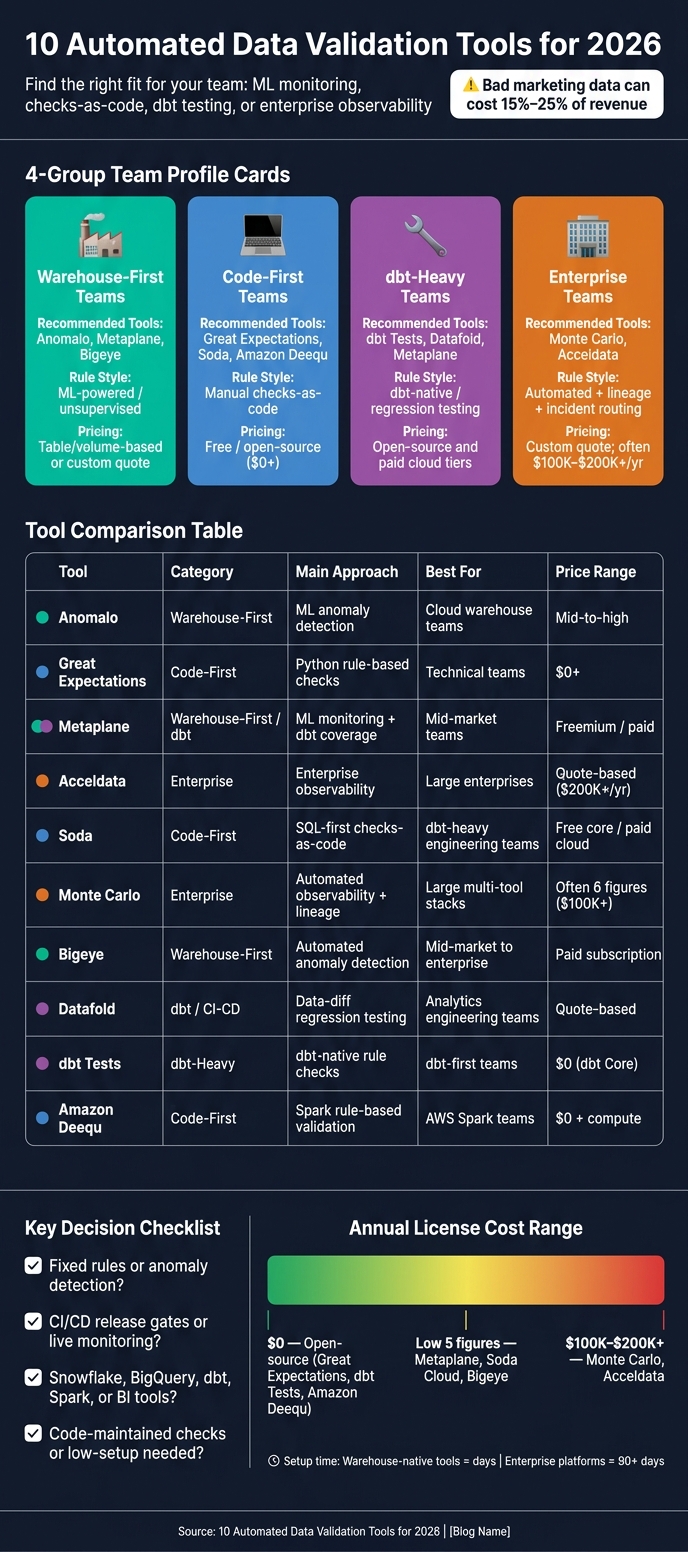
10 Automated Data Validation Tools Compared: Features, Fit & Pricing (2026)
Automate Validation using the Data Validation Tool DVT GSP1047
sbb-itb-5174ba0
Quick Comparison
| Tool | Main Approach | Best Fit | Price Range |
|---|---|---|---|
| Anomalo | ML anomaly detection | Warehouse-first marketing teams | Mid-to-high |
| Great Expectations | Python rule-based checks | Technical teams | $0+ |
| Metaplane | ML monitoring + dbt coverage | Mid-market teams | Freemium / paid |
| Acceldata | Enterprise observability | Large enterprises | Quote-based, often high |
| Soda | SQL-first checks-as-code | dbt-heavy engineering teams | Free core / paid cloud |
| Monte Carlo | Automated observability + lineage | Large multi-tool stacks | Often 6 figures |
| Bigeye | Automated anomaly detection | Mid-market to enterprise | Paid subscription |
| Datafold | Data-diff testing in CI/CD | Analytics engineering teams | Quote-based |
| dbt Tests | dbt-native rule checks | dbt-first teams | $0 for dbt Core |
| Amazon Deequ | Spark rule-based validation | AWS Spark teams | $0 + compute |
My takeaway: if your team wants lower setup, start with Metaplane, Anomalo, or Bigeye. If your team wants tight control in code, use Soda, Great Expectations, dbt Tests, or Deequ. If one data issue can affect many teams and dashboards, move up to Monte Carlo or Acceldata.
The rest of the article breaks down where each tool fits, what tradeoffs come with it, and which stack pattern each one matches.
1. Anomalo
Anomalo is a good fit for warehouse-centric marketing teams that want automated anomaly detection with low setup work. It uses machine learning to learn each dataset's normal pattern and flag deviations without prebuilt rules [2].
Core Functions
Anomalo continuously watches for unexpected shifts in spend, conversions, or attribution feeds. That matters when tracking, attribution, or CRM feeds drift without warning. For marketing teams, it helps catch broken campaign feeds, attribution drift, and CRM anomalies before those issues show up in reporting.
Pipeline Fit
The platform connects directly to Snowflake, BigQuery, Databricks, and Redshift through point-and-click setup. That makes it fairly easy to add to an existing warehouse stack.
The main tradeoff is simple: Anomalo only monitors and alerts. It does not clean or remediate data. If it flags a problem, your team still needs a separate process or tool to fix it.
Pricing
Anomalo uses table-based subscription pricing, so most teams focus monitoring on their highest-value marketing tables [2]. In practice, that usually means the tables tied to spend, attribution, and executive reporting.
Best-Fit Team
Best for marketing teams that run from the warehouse and want automated anomaly detection without much upkeep. Teams that need explicit, rule-based checks should look at Great Expectations next.
2. Great Expectations
Great Expectations is a good fit for teams that want fixed, code-based checks instead of anomaly detection. It works best when the goal is simple and clear: define what "good data" looks like, then test against it.
Core Functions
Great Expectations is built around rules for valid data. You can require campaign IDs to be non-null, or keep spend, conversion rate, and lead volume within a set range. It can also use AI profiling to suggest starter checks based on existing data [2].
Pipeline Fit
Great Expectations connects with Snowflake, BigQuery, Redshift, Databricks, Apache Airflow, and dbt. It is a common open-source option for CI/CD data checks, and teams use it to catch regressions before production [1][3]. That makes sense for marketing ops teams that already manage dbt models or Python-based checks.
The downside is straightforward: this is not plug-and-play. Someone on the team needs to be comfortable with Python, and setup plus upkeep take real engineering time.
Alerting and Pricing
The open-source version does not include built-in alerting. If you want notifications in Slack, PagerDuty, or email, your team has to wire that up by hand. GX Cloud adds a UI, team features, and built-in alerting.
The core framework is free at $0. GX Cloud is the paid managed option. You should also account for engineering time and warehouse compute used during validation scans.
Best-Fit Team
This is best for teams with a dedicated data engineer or a technical ops person who knows Python. Without that support, Great Expectations will likely slow the team down.
Next: Metaplane, which moves from rule writing to pipeline observability.
3. Metaplane
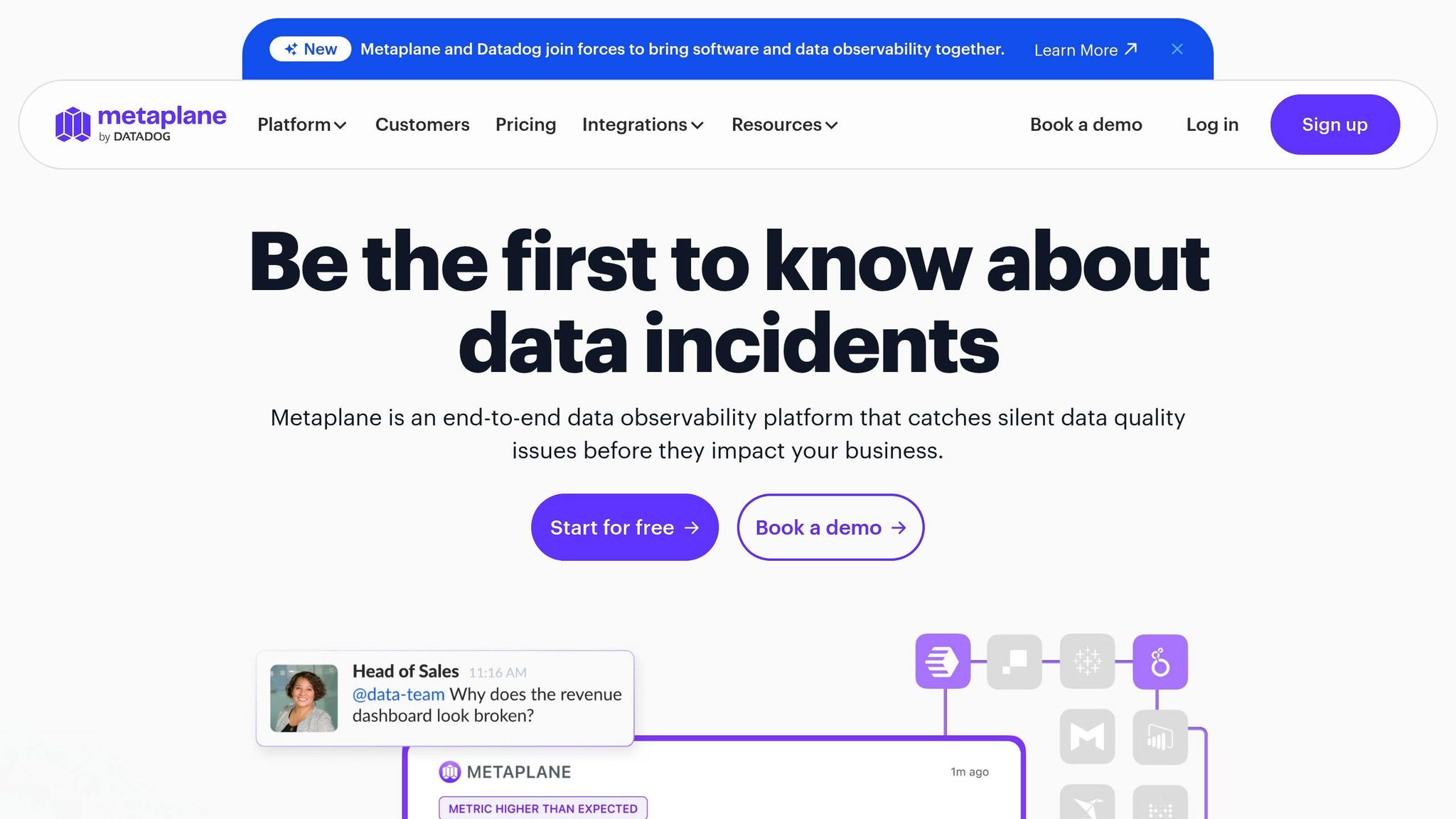
Metaplane is a good fit when you want data monitoring with less manual rule work. It learns normal patterns and flags drift on its own, which helps when campaign feeds, attribution tables, or CRM syncs shift without warning. The main upside is simple: less upkeep than rule-first tools.
Core Functions
Metaplane monitors data from source systems through BI dashboards. It checks freshness, volume, schema changes, and outlier values. It uses ML to handle seasonality and trend changes, so teams don't have to hand-tune every alert. It also includes column-level lineage, which makes root-cause work much easier. If a dashboard breaks, teams can trace the issue back to the upstream source table [1].
Pipeline Fit
Metaplane connects with Snowflake, BigQuery, Databricks, and Redshift. It also has deep dbt integration, including free dbt alerting, inspection, and schema-change tools, plus a Snowflake native app for in-warehouse observability [1]. Users say setup is easier than with older observability platforms [2]. That makes it a solid option for campaign, attribution, and CRM tables that tend to change often.
Alerting and Pricing
Alerts are sent through Slack and email, with targeted notifications meant to cut noise [1]. Metaplane uses a freemium model. The free tier includes core monitoring and data engineering tools. Paid tiers scale based on the number of tables monitored [2].
Best-Fit Team
Metaplane works well for marketing data teams that want automated observability without a heavy engineering lift. It's a practical choice for budget-conscious teams that want baseline pipeline monitoring before moving to a paid plan. Users rate it well for fast setup and faster incident triage. It fits teams that want quick coverage for warehouse and dbt monitoring without a lot of engineering overhead. Teams that need broader platform coverage should compare it with Acceldata next.
4. Acceldata
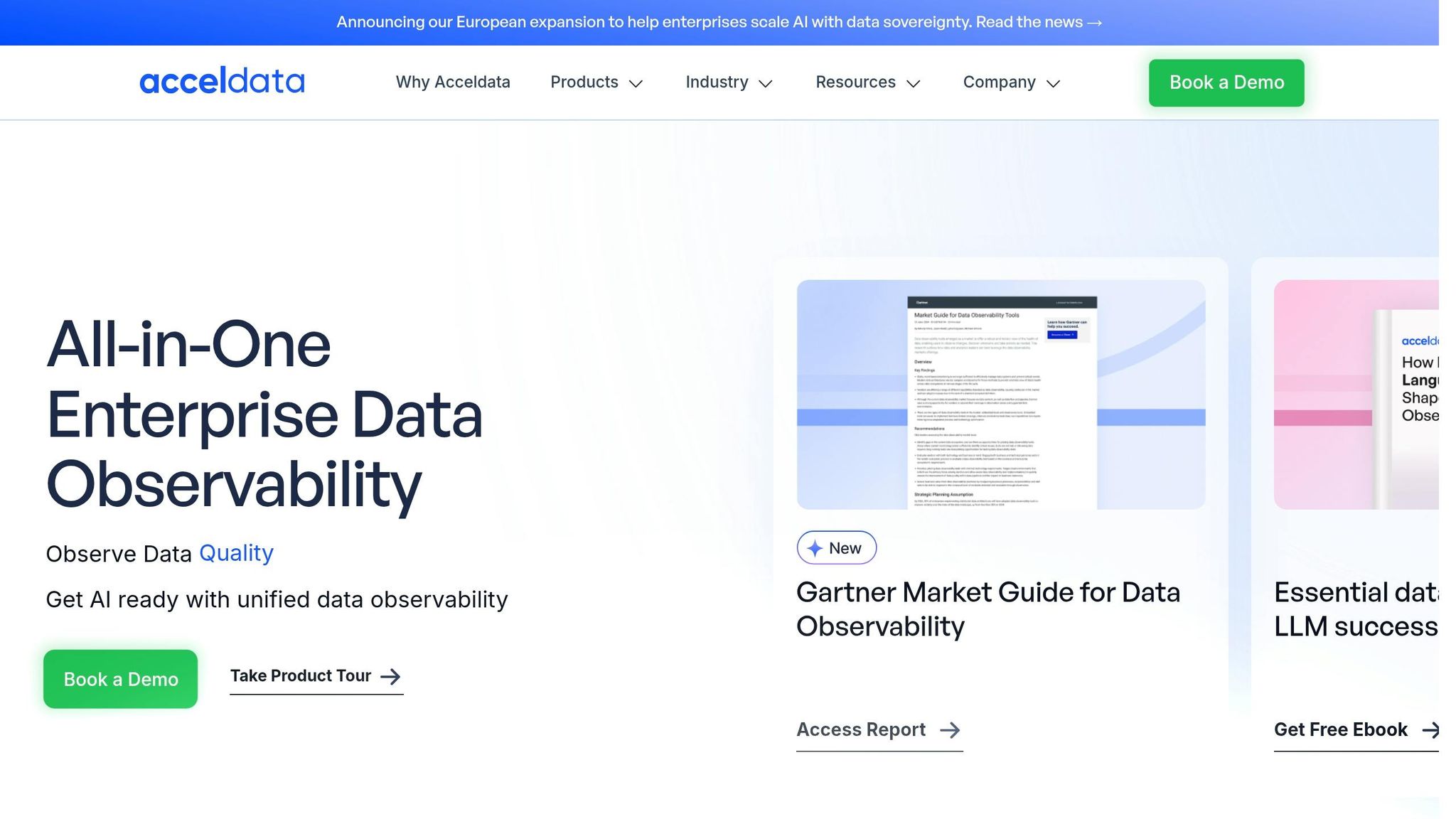
Acceldata is the enterprise pick when you need more than table-level checks. It covers data validation, pipeline health, and cloud cost observability in one platform [3]. It also uses AI-driven automation to detect and route reliability, governance, and performance issues [1]. That broader scope tends to matter most in complex marketing stacks, where one bad upstream job can throw off reporting across multiple teams.
Core Functions
Acceldata monitors freshness, volume, distribution, schema, and lineage [3]. In practice, that means it can flag clickstream drops, 10x swings in average order value, and upstream failures that break campaign dashboards. It also includes cost observability, which helps teams track cloud spend trends and spot expensive queries [3].
Pipeline Fit
Acceldata fits complex hybrid stacks, including cloud warehouses plus Spark, Hadoop, and Kafka [3].
Alerting and Pricing
Acceldata is a paid enterprise platform [1]. Pricing is usually quote-based. Large enterprise deployments can run above $200,000 per year [3].
Best-Fit Team
Best for large enterprise marketing data teams that want validation, pipeline reliability, and cloud cost control in one place [3]. For smaller warehouse-only teams, a narrower validation tool is often the better call.
5. Soda
Soda is the SQL-first, checks-as-code pick for teams that want explicit validation in dbt-heavy pipelines. Where Acceldata moves into platform observability, Soda stays focused on defined validation rules.
Core Functions
SodaCL lets teams write version-controlled checks for freshness, volume, schema, distribution, and custom business rules. That gives teams an early warning on freshness, schema, and volume issues before those problems show up in dashboards or models.[3] If your team wants to decide exactly what gets checked, rather than rely mainly on anomaly alerts, Soda fits that approach well.
Pipeline Fit
Soda connects directly to Snowflake, BigQuery, and Redshift. It also integrates closely with dbt, which makes it a strong fit for SQL-first marketing data stacks built around campaign tables and attribution models.[3]
Alerting and Pricing
Soda Core is the free, open-source CLI built for testing in CI/CD. Soda Cloud adds automated monitoring, alerting, and team collaboration for production use. Pricing follows a freemium model: Soda Core is free, while Soda Cloud adds monitoring, alerting, and collaboration.[3]
Best-Fit Team
Best for engineering-led teams that want version-controlled checks in dbt-centric workflows. Teams looking for more automated anomaly detection should compare it with Monte Carlo next.
6. Monte Carlo

Monte Carlo is built for teams that want broad data coverage without writing a pile of rules upfront.
Core Functions
Monte Carlo tracks 5 pillars of data health: freshness, volume, distribution, schema, and lineage [3]. Its main strength is automatic baseline learning, which means teams do not have to set rules in advance [3][2].
That setup helps flag volume anomalies, distribution shifts, and schema changes before they flow into reporting. In practice, that can mean catching broken spend feeds, attribution drift, and schema changes before they hit dashboards. Teams can still add explicit quality rules for business logic that cannot be left to pattern detection alone [3].
This matters most in larger stacks, where one upstream issue can ripple through reporting, attribution, and dashboards.
Pipeline Fit
Monte Carlo connects with Snowflake, BigQuery, Databricks, Redshift, dbt, Looker, and Tableau [3]. That broad set of integrations helps teams trace warehouse issues into transformation jobs and BI dashboards.
Its field-level lineage shows which downstream tables and dashboards are affected [3]. That makes triage faster when a failure moves across the warehouse and BI layers.
Alerting and Pricing
Alerts go through Slack, PagerDuty, and email, and impact analysis shows which dashboards and tables are affected [3]. Pricing is consumption-based, often tied to the number of tables monitored, with enterprise contracts often reaching 6 figures [3][2].
Best-Fit Team
Best for marketing teams with large warehouse, dbt, and BI stacks that need automated validation without manual rule writing [3][2].
Next: Bigeye, another observability tool built for automated validation at scale.
7. Bigeye
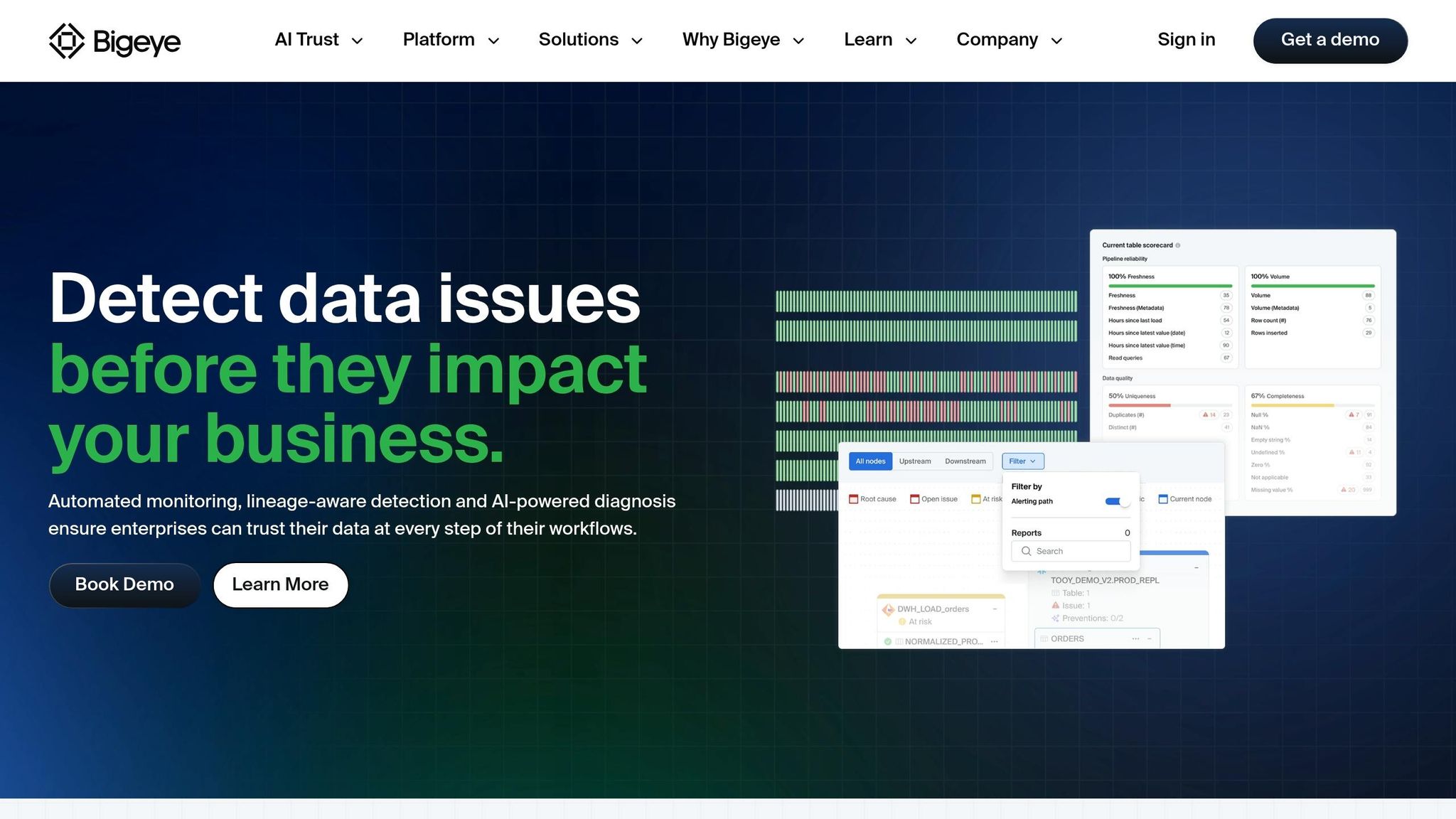
Bigeye is a paid data observability platform built for automated anomaly detection and validation. It follows a path similar to Monte Carlo, but puts more weight on simpler automation for dynamic thresholds.
Core Functions
Bigeye auto-profiles datasets and learns normal patterns, including weekly and seasonal shifts. That means teams don't have to set every threshold by hand. In practice, that helps catch campaign volume spikes, attribution drift, and CRM sync issues without building and maintaining a huge rule library.
Pipeline Fit
It integrates with Snowflake, BigQuery, Redshift, Databricks, and BI tools [3][4].
Alerting and Pricing
Bigeye routes alerts to the right domain owner, which helps cut alert fatigue [3]. It runs on a paid subscription model and sits at a lower price point than Monte Carlo, which often calls for six-figure annual contracts [3][4].
Best-Fit Team
Best for mid-market and enterprise marketing analytics teams that need automated monitoring across multiple owners and want less manual rule writing than checks-as-code tools.
Next: Datafold, which focuses more on data comparisons and regression testing.
8. Datafold
Datafold checks data changes before they go live, while observability tools focus on production data after release.
Core Functions
Its main job is data-diff regression testing. Datafold compares one version of a dataset against another so teams can see what changed before release. It also flags schema changes that can break downstream models or BI [4].
Pipeline Fit
Datafold fits teams already working with Snowflake, BigQuery, dbt, and CI/CD [4]. The main use case is inside CI/CD pipelines, where it runs automated data diffs during continuous integration [1][4]. In practice, that makes it a release gate, not an always-on monitoring tool.
It also helps with complex data migrations by checking whether data stays consistent across environments [1].
For marketing data teams, that means campaign models, attribution logic, and warehouse transformations can be checked before they hit production.
Datafold still sends alerts when diffs or schema changes fail checks.
Alerting and Pricing
Alerts go to the owning team through Slack or PagerDuty [1]. Pricing is quote-based.
Best-Fit Team
Datafold is a strong fit for analytics engineering managers and data engineering leads who own production data reliability [4]. For marketing data teams that work closely with data engineers and already use CI/CD workflows, it adds a practical release gate. Teams without CI/CD ownership should look at observability-first tools first.
9. dbt Tests
dbt tests put data quality rules inside the same version-controlled dbt project as your transformations. In a dbt-first marketing stack, that makes testing part of the release gate, not a separate monitoring setup.
Core Functions
If observability tools watch live pipelines, dbt tests set the rules those pipelines have to meet. They work as rule-based checks: you write the rule, and the test checks whether the data passes. Built-in tests handle the basics - unique and not_null - and you define them in YAML files inside your dbt project [4]. Community packages can add more checks, including freshness, volume, and schema validation.
dbt tests catch the problems you define. They do not spot unknown anomalies on their own. That’s why teams often use them alongside observability tools for runtime monitoring [3][4].
Pipeline Fit
dbt tests fit warehouse-first ELT workflows in Snowflake, BigQuery, and Databricks. They run inside the dbt deployment flow, so failed checks can stop a release before it goes out. For marketing teams, that can mean blocking deployment when campaign IDs are null or when conversion values fall outside an expected range [3].
Alerting and Pricing
dbt tests do not send alerts by themselves. Teams usually wire them into an orchestrator or a monitoring layer.
dbt Core is free and open source.
Best-Fit Team
Best for dbt-centric analytics engineering teams that want code-reviewed quality rules living next to their models [3][4].
Next: Amazon Deequ for Spark-native validation at scale.
10. Amazon Deequ
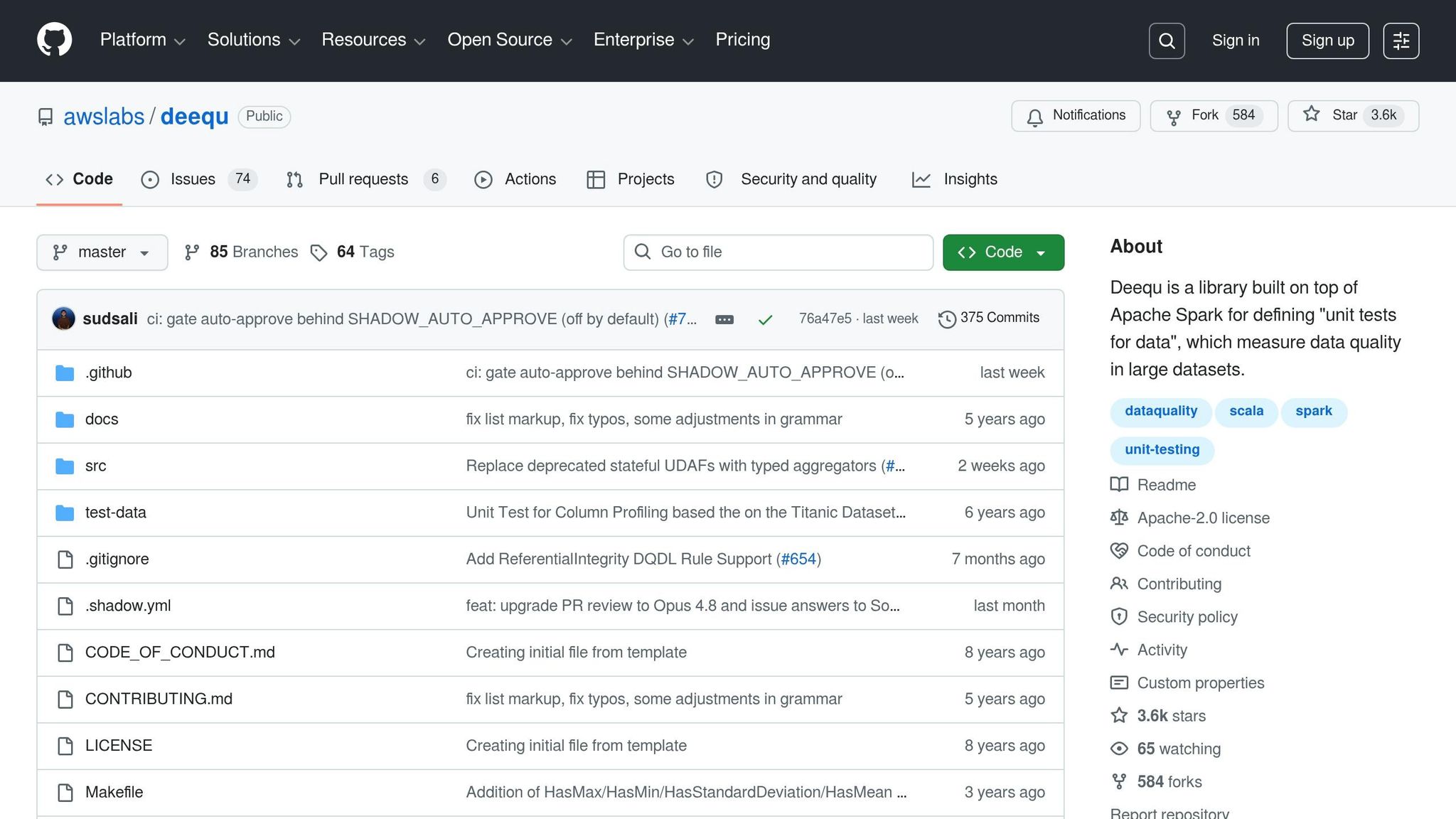
Amazon Deequ is a free, Spark-native library for rule-based data validation. It works best for data teams that want unit-test-style checks on large datasets.
Core Functions
Deequ supports completeness, consistency, and custom column-level rules. In plain terms, you can set rules for what "good" data should look like, then test each dataset against those rules. It does a solid job of catching known issues. What it does not do well is spot unknown anomalies or drift.
Pipeline Fit
For batch-loaded campaign, attribution, or CRM tables, Deequ fits AWS Spark pipelines well. It's especially well suited to Glue and EMR batch jobs, so it's a better choice for batch validation than always-on observability. If your stack doesn't run on Spark, or if you need real-time monitoring, it's a poor fit [2].
Alerting and Pricing
Deequ has no built-in alerting UI. That means failed checks need to route through SNS, CloudWatch, Slack, or a similar tool [2]. The library itself is free, but the full cost picture includes Spark compute and the engineering time needed to write, run, and maintain the rules.
Best-Fit Team
Deequ is best for AWS Spark teams that can write and maintain rules without much hand-holding. If your team wants a lower-setup option, a managed tool will usually make more sense. That Spark-first tradeoff becomes clearer in the comparison below.
Pros and Cons Across the 10 Tools
The big split is code-defined checks versus automated detection. That’s the first decision to make. Do you want tight manual control, or do you need the system to do more of the work for you?
The next split is scope. Anomalo and Bigeye stay focused on data quality inside the warehouse. Monte Carlo and Acceldata go further, covering lineage from ingestion through BI. Acceldata also adds infrastructure signals such as Spark job efficiency and compute costs. If your stack runs across CRM, ERP, and marketing automation - and those systems depend on each other in messy ways - that broader view can justify the added scope.
On pricing, the gap is wide. Open-source tools cost $0 in license fees. Commercial platforms often start in the tens of thousands per year and can climb into six figures [3]. Metaplane stands out here because of its freemium model and solid free tier [1].
The table below sums up the tradeoffs that matter most for marketing data teams and business analytics.
| Tool | Main Advantages | Main Limitations | Best For | Budget Fit |
|---|---|---|---|---|
| Monte Carlo | Fully automated; end-to-end lineage | High cost; consumption-based pricing | Large enterprises | High ($100K+) |
| Anomalo | ML-powered; unsupervised detection | Focuses on detection more than cleaning | Cloud warehouse teams | Mid-to-high |
| Metaplane | Quick setup; strong free tier | Less depth in enterprise governance | Mid-market and startups | Low-to-mid (freemium) |
| Acceldata | Unified observability plus infra and cost monitoring | High complexity for smaller teams | Large enterprises | High |
| Soda Core | Code-defined checks (SodaCL); CI/CD fit | Requires learning a custom DSL | Engineering-led teams | Mid-market |
| Bigeye | Auto-thresholding; SLA tracking | Can be noisy during initial tuning | Mid-market teams | Mid-range |
| Datafold | Data-diff regression testing | Narrower scope than full observability | CI/CD workflows | Professional |
| dbt Tests | dbt-native; easy for dbt users | Limited outside the dbt ecosystem | dbt-centric teams | Low-to-mid |
| Great Expectations | Highly flexible; zero license cost | High engineering overhead | Technical teams | Low ($0+) |
| Amazon Deequ | Open-source; Spark-native | No automated ML detection | AWS/Spark environments | Low ($0) |
The main operating risk is alert fatigue. Most teams need 1 to 3 months of tuning before automated platforms start sending alerts that are worth acting on [4]. The simplest way to keep noise under control is to assign clear dataset owners from day 1 and start with spend and conversion tables [3].
The next section maps these tradeoffs to specific marketing data stack patterns.
Which Validation Tool Fits Your Marketing Data Stack?
Pick based on how your team works: your code habits, your website analytics tools, and who owns day-to-day data quality. The comparison above helps with feature-level tradeoffs. This section is about stack fit.
For small, code-centric teams, Great Expectations and Soda Core are usually the best starting point. They work well when your team is comfortable writing and maintaining checks in code.
If your team is dbt-heavy, start with dbt Tests. Then look at Datafold or Metaplane as your needs grow. Use dbt Tests for release gates and model checks. If you need cross-version diffs, move to Datafold.
For warehouse-first marketing teams running on Snowflake or BigQuery, Anomalo and Metaplane tend to fit best. These tools line up well with teams that want monitoring closer to the warehouse and less hand-built rule writing.
Once a single failure can hit multiple teams and dashboards, basic validation stops being enough. That’s the point where full observability starts to make sense. Enterprise organizations should look at Monte Carlo or Acceldata. These platforms add lineage and owner routing. Enterprise deployments can exceed $200,000 per year [3].
| Team Profile | Best-Fit Tools | Rule Style | Pricing Approach |
|---|---|---|---|
| Small, code-centric | Great Expectations, Soda Core | Manual checks-as-code | Free / open-source |
| dbt-heavy engineering | dbt Tests, Datafold, Metaplane | dbt-native / regression testing | Open-source and paid cloud tiers |
| Warehouse-first marketing | Anomalo, Metaplane, Bigeye | ML-powered / unsupervised | Table/volume-based or custom quote |
| Enterprise | Monte Carlo, Acceldata | Automated + lineage + incident | Custom quote; often six figures |
Speed matters too. Warehouse-native tools can often be up and running in days. Enterprise platforms may take 90+ days to deploy.
FAQs
How do I choose between rule-based checks and anomaly detection?
It depends on the goal. Use rule-based checks when you need to enforce clear requirements, like schema validation or integrity constraints. Use anomaly detection for ongoing monitoring when the job is to catch unknown issues or shifts in behavior.
A lot of teams use both. They run rule-based tests in CI/CD to stop regressions before release, then use anomaly detection in production to flag unexpected changes.
When should I use CI/CD data testing instead of live monitoring?
Use CI/CD data testing when your quality rules are clear and known up front, and you need to stop regressions before code or pipelines go live. Think of it like unit tests for data. You set explicit checks - like not-null fields or unique values - and fail the build when data breaks those rules.
Use live monitoring for broader, automated detection after deployment. It helps you spot anomalies, distribution shifts, and freshness issues you didn't specifically plan for in advance.
Most mature teams use both.
What’s the best starting tool for a small marketing data team?
Start with the tool that gives you the best mix of cost and ease of setup. Metaplane stands out for budget-conscious teams, with a free tier that covers monitoring for up to 10 tables. If your team is comfortable with Python, Great Expectations is a cost-effective open-source option, though it does take more technical setup.
If integrations are your top concern, Stitch Data can work well for small-to-mid-sized teams. Pick the tool based on the main problem you need to solve.