If you need deep backend integration, I’d lean Optimizely. If you need to get web tests live with less setup, I’d lean VWO.
Here’s the short version: this comparison comes down to 6 things - APIs, SDKs, server-side testing, custom events, warehouse sync, and access control. From what I see in the article, VWO is easier to launch, especially for web-first teams using website analytics tools. Optimizely tends to fit complex internal systems better over time, even if setup takes more engineering work at the start.
If I were screening both vendors, I’d focus on:
- API depth - can I push data in and pull data out without extra middleware?
- SDK coverage - does it match my backend languages and mobile stack?
- Server-side reach - can I run decisions inside services, not just in the browser?
- Custom events - can I map experiment data to my internal event schema?
- Warehouse flow - do I get native exports, API-based pipelines, or both?
- Access control - can I map permissions to teams, brands, and environments?
Optimizely vs VWO: Enterprise Integration Comparison
This is what modern experimentation looks like | Optimizely Experience Optimization demo
sbb-itb-5174ba0
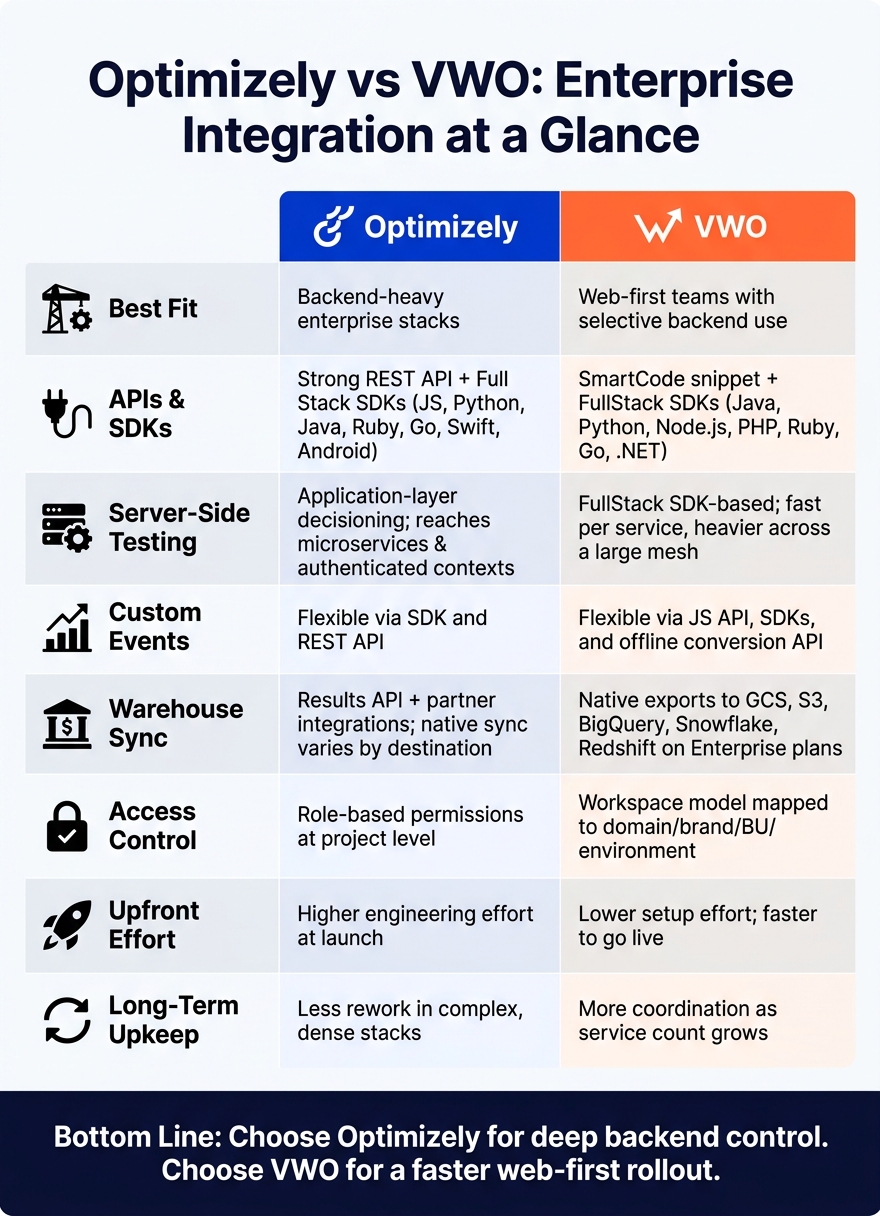
Quick Comparison
| Criteria | Optimizely | VWO |
|---|---|---|
| Best fit | Backend-heavy enterprise stacks | Web-first teams with selective backend use |
| APIs and SDKs | Strong API + SDK set, with app-layer decisioning | Simple web snippet + FullStack SDKs |
| Server-side testing | Better fit for microservices and signed-in user flows | Works well, but gets heavier across many services |
| Custom events | Flexible via SDK and API | Flexible via JS API, SDKs, and offline conversion API |
| Warehouse sync | API and partner-based, may need extra pipeline work | Native exports on Enterprise plans |
| Access control | Project-level roles | Workspace-based roles by brand/domain/environment |
| Upfront work | More engineering at the start | Less setup at launch |
| Long-term upkeep | Often less rework in dense stacks | Often more coordination as service count grows |
My read is simple: choose based on architecture, not just testing features. If your experiment data has to move through internal identity systems, microservices, and a warehouse, the integration model will matter more than the UI.
Below, I’d break the tradeoff down in plain terms so you can judge setup effort, data flow, and team fit before you commit.
Optimizely for proprietary enterprise integration
Optimizely works best in proprietary enterprise setups when it can connect cleanly to internal systems. Its fit comes down to one thing: how much engineering work it takes to wire it into the stack. In practice, that means looking at API depth, SDK coverage, server-side decisioning, the event model, warehouse routing, and analytics tools for business access controls.
APIs, SDKs, and server-side decisioning in Optimizely
The real test here is simple: Can the platform plug into internal systems without a pile of custom plumbing? Optimizely gives teams a REST API for experiment management and results retrieval. Its Full Stack product also includes SDKs for JavaScript, Python, Java, Ruby, Go, Swift, and Android, so teams can handle flag evaluation and event tracking inside application code.
That server-side decisioning layer matters. Instead of running only in the browser, decisioning happens in the application layer. That makes a big difference when experiment logic needs to reach backend services, microservices, or authenticated user contexts that a client-side snippet can't touch. For teams with internal identity systems or their own feature flag setup, this is where Optimizely has the most room to connect.
Custom events, warehouse workflows, and access controls in Optimizely
Optimizely also supports custom event tracking through its SDK and API. Teams can define and send events that match internal data models instead of being boxed into preconfigured metrics. That's useful when the business logic in the product doesn't line up neatly with out-of-the-box event structures.
Centralized experiment and event data can be routed to a warehouse through the Results API or partner integrations. That said, direct native warehouse sync may still need extra pipeline work depending on the destination. So while the path exists, the lift varies by setup.
Access governance is managed through role-based permissions at the project level. That helps separate teams, but some organizations will still need extra controls - especially if they have strict data residency rules or audit requirements. The tighter the internal governance model, the more setup Optimizely tends to need.
The same integration questions apply to VWO, but its workflow and control model differ.
VWO for proprietary enterprise integration
VWO is easier to launch on the web layer than in backend systems. If your use case can stay client-side, setup is simple. If it needs server-side decisioning across proprietary services, the work moves from experiment setup to integration and control.
Compared with Optimizely's application-layer model, VWO is more web-first, with FullStack and Feature Experimentation extending it to server-side systems. Web experiments are easy; backend integration is the real test. The key question is whether your use case can stay client-side or needs SDK-backed backend integration.
APIs, SDKs, and full-stack coverage in VWO
VWO's client-side path is simple: a single asynchronous SmartCode snippet in the <head> tag handles web experiments.[20][3] The server-side path is more involved. VWO FullStack provides SDKs for Java, Python, Node.js, PHP, Ruby, Go, and .NET, which covers many enterprise backend stacks.[1][2][7][9][11][13] In that setup, proprietary services call VWO's decision layer through the SDK at runtime, get a variation assignment, and route application logic based on it.[1][23]
VWO says FullStack SDK setup can take about 15 minutes per service.[2][3] That's fast for one service. It gets heavier as you add more microservices, more languages, and more deployment pipelines. Teams should also plan for SDK version management and environment key synchronization across services, which adds release-management work over time.[5][12][13] If a system can't host an SDK, the REST API can still track offline conversions with experiment, user, goal, and revenue data.[6]
That makes VWO faster to launch on a single service than to manage across a large service mesh.
Event modeling, data exports, and workspace controls in VWO
VWO supports custom conversion and revenue goals on both client-side and server-side.[8] On the web layer, goals can be triggered through VWO's JavaScript API or mapped from dataLayer pushes. In FullStack, SDK methods track goal completion straight from backend code, and the REST API handles offline conversions for flows that happen fully outside the browser.[6][7] Standardize event names and IDs before integration.
On Enterprise plans, VWO exports to GCS, S3, BigQuery, Snowflake, and Redshift, covering Testing, FullStack, and Mobile App Testing campaigns.[14][15][16][17][18][19] That gives teams a path to join internal revenue and operating data to experiment results. FullStack SDKs also expose data-export hooks that let data engineering teams push experiment and event data into internal top analytics tools, CDPs, or custom data lakes without waiting for a scheduled export.[19]
Access control uses a workspace model where each workspace maps to a domain, brand, business unit, or environment.[4][10][21][22] Roles such as Owner, Admin, Publish, Design, and Browse control who can view workspaces and who can design or publish experiments.[10] For multi-brand enterprises, the model works well, but it needs a clear workspace map and an SSO-backed access policy.
Those tradeoffs matter most when VWO has to fit an existing enterprise identity and data-governance stack.
Optimizely vs VWO: Side-by-side comparison by integration requirement
Developer architecture and implementation effort
Optimizely takes less rework in complex stacks. VWO is faster to get live on a standard web setup.
Once you look past feature lists, the main issue is custom work inside your stack.
Optimizely has the cleaner enterprise integration model. It supports deeper application-layer decisioning and gives teams more reach into backend workflows. Its Full Stack SDKs cover JavaScript, Python, Java, Ruby, Go, Swift, and Android. Because server-side decisioning runs inside the application layer, it can reach backend services, microservices, and authenticated user contexts that a client-side snippet can't touch. CDPs such as Segment and RudderStack can also help route identity and event data when proprietary systems need a cleaner flow.
VWO is easier to launch on the client side. One SmartCode snippet can run web experiments with light setup. Its FullStack SDKs cover Java, Python, Node.js, PHP, Ruby, Go, and .NET, which lines up with many enterprise backend stacks. The setup per service is quick. The tradeoff shows up later. As the number of services grows, teams have to manage SDK versions and keep environment keys in sync across a large microservice mesh. That adds release-management work over time.
| Requirement | Optimizely | VWO |
|---|---|---|
| SDK language coverage | JS, Python, Java, Ruby, Go, Swift, Android | Java, Python, Node.js, PHP, Ruby, Go, .NET |
| Server-side decisioning | Application-layer; reaches backend and authenticated contexts | FullStack SDK-based; fast per service, heavier across a mesh |
| CDP / identity routing | Segment, RudderStack integrations | dataLayer and SDK-based event routing |
| Implementation effort at scale | Higher upfront, lower rework across complex stacks | Lower per service, higher as service count grows |
Implementation work is only part of the story. Governance and data routing usually decide whether the setup still works once more teams, brands, and systems get involved.
Data flow, governance, and enterprise readiness
VWO has the more direct warehouse export setup out of the box. Optimizely fits teams that are fine doing more pipeline work.
Optimizely routes experiment and event data through its Results API and partner integrations. Direct native warehouse sync may still need added pipeline work depending on the destination. Its access governance uses role-based permissions at the project level. That setup works for many team structures, but teams with strict data residency or audit rules may need extra controls.
VWO's Enterprise plan exports to GCS, S3, BigQuery, Snowflake, and Redshift across Testing, FullStack, and Mobile App Testing campaigns. Its FullStack SDKs also expose data-export hooks, which lets data engineering teams push experiment and event data into internal analytics platforms, CDPs, or custom data lakes without waiting for a scheduled export. Access control uses a workspace model tied to domains, brands, business units, or environments. Roles - Owner, Admin, Publish, Design, Browse - control who can view, design, or publish experiments. That model fits multi-brand enterprises well, but it depends on a clear workspace map and an SSO-backed access policy.
| Requirement | Optimizely | VWO |
|---|---|---|
| Warehouse destinations | Results API + partner integrations; native sync varies by destination | GCS, S3, BigQuery, Snowflake, Redshift on Enterprise plans |
| Real-time data export | Results API | SDK data-export hooks for direct pipeline push |
| Access control model | Role-based permissions at project level | Workspace model with domain/brand/BU mapping |
| Governance fit | Needs extra setup for strict residency or audit rules | Needs clear workspace map and SSO policy |
Best fit by team and operating model
Pick Optimizely for deeper control across backend systems. Pick VWO for a lighter web-first rollout.
Optimizely is the better fit when proprietary-system integration is the main job. Teams running complex backend environments - microservices, internal identity systems, and strict audit requirements - are more likely to find its application-layer model easier to keep in place.
VWO fits better when most experiments live on the web layer and backend use is more selective. In that setup, teams can move faster with the lighter implementation path and broader warehouse export options available out of the box.
The choice comes down to architecture. If your stack needs deeper enterprise control, Optimizely has the edge. If your team wants a lighter web-first deployment, VWO is the easier path.
Conclusion: Which platform takes less work to connect with internal systems
The short answer is straightforward: VWO takes less work to get live. Optimizely tends to mean less rework later as needs grow.
If your team runs mostly web-first tests, VWO is the easier starting point. It usually asks for less setup work up front, which helps teams get moving without a heavy engineering lift.
Optimizely is the better fit when backend depth and tighter governance matter more. Its server-side setup often needs more engineering time at the start. In return, it tends to fit large, complex enterprise stacks better. That’s the tradeoff - more effort now for stronger control later.
The right pick comes down to a few practical factors: where your experiments run, how many internal systems need to plug in, and how much upkeep your team can handle over time.
Key questions to bring into vendor evaluation
Use this checklist during vendor review:
- API completeness: Does the API handle both data in and data out without extra middleware?
- SDK language support: Do the native SDKs fit your backend stack?
- Event schema flexibility: Can you set up custom events without tight limits?
- Warehouse sync method: Is warehouse sync built in or handled through connectors?
- Permission granularity: How detailed is access control?
- Internal maintenance burden: How much upkeep will the integration need after launch?
FAQs
Which platform scales better for microservices?
It depends on your microservices setup. Between Optimizely and VWO, scalability comes down to API depth, server-side testing, integration reliability, SDK support, and how each platform handles custom events.
Both are leading experimentation tools, but the better fit comes down to one thing: how well each one plugs into your internal enterprise systems.
How much engineering work should I expect after launch?
Post-launch workload varies a lot by integration type. Custom in-house connectors often need 40 to 120 hours of development after launch. Enterprise middleware setups can take 6 to 12 months.
Maintenance is not optional, either. Plan for quarterly audits, API health monitoring, and deprecation management from the start. If you skip that groundwork, the cleanup shows up later in someone’s week.
That matters because marketing analysts can spend up to 40% of their time on manual data transformation. Early governance and automation cut down that drag and make the stack easier to manage over time.
Which option is better for strict governance needs?
For strict governance needs, there isn’t one blanket winner. The better choice comes down to your exact compliance rules and how well the platform fits your internal systems. Start there, not with feature checklists.
Look closely at data protection, audit trails, data retention support, and compliance with rules such as GDPR and CCPA. Those points matter more than broad product claims.
No matter which platform you pick, put clear API governance in place from day one. That means:
- versioning rules
- testing standards
- documentation requirements
It’s also smart to use trial periods to check security controls and integration fit before rolling anything out further.