Cloud data integration simplifies marketing by connecting platforms like Google Ads, CRMs, and social media into a single system. This eliminates scattered data, speeds up decision-making, and improves campaign performance. Here are five ways it transforms marketing:
- Campaign Tracking: Automates data collection for accurate, real-time insights across channels.
- Audience Segmentation: Combines data to create precise customer profiles for tailored messaging.
- Real-Time Analytics: Enables quick adjustments by improving marketing decisions using up-to-date performance data.
- Customer 360 View: Centralizes all customer interactions, improving cross-channel strategies.
- AI-Powered Personalization: Supports predictive tools for better targeting and engagement.
Quick Comparison
| Use Case | Advantages | Challenges |
|---|---|---|
| Campaign Tracking | Simplifies reporting; accurate metrics | API updates may disrupt pipelines |
| Audience Segmentation | Enables tailored messaging; boosts conversions | Data silos and quality issues |
| Real-Time Analytics | Fast response to data changes | Requires strong infrastructure |
| Customer 360 View | Unified customer insights | Complex integration; privacy concerns |
| AI-Powered Personalization | Predicts behavior; improves targeting | High costs; depends on quality data |
Cloud integration reduces manual work, minimizes errors, and enhances marketing efficiency. Choosing the right tools ensures better results and faster decision-making.
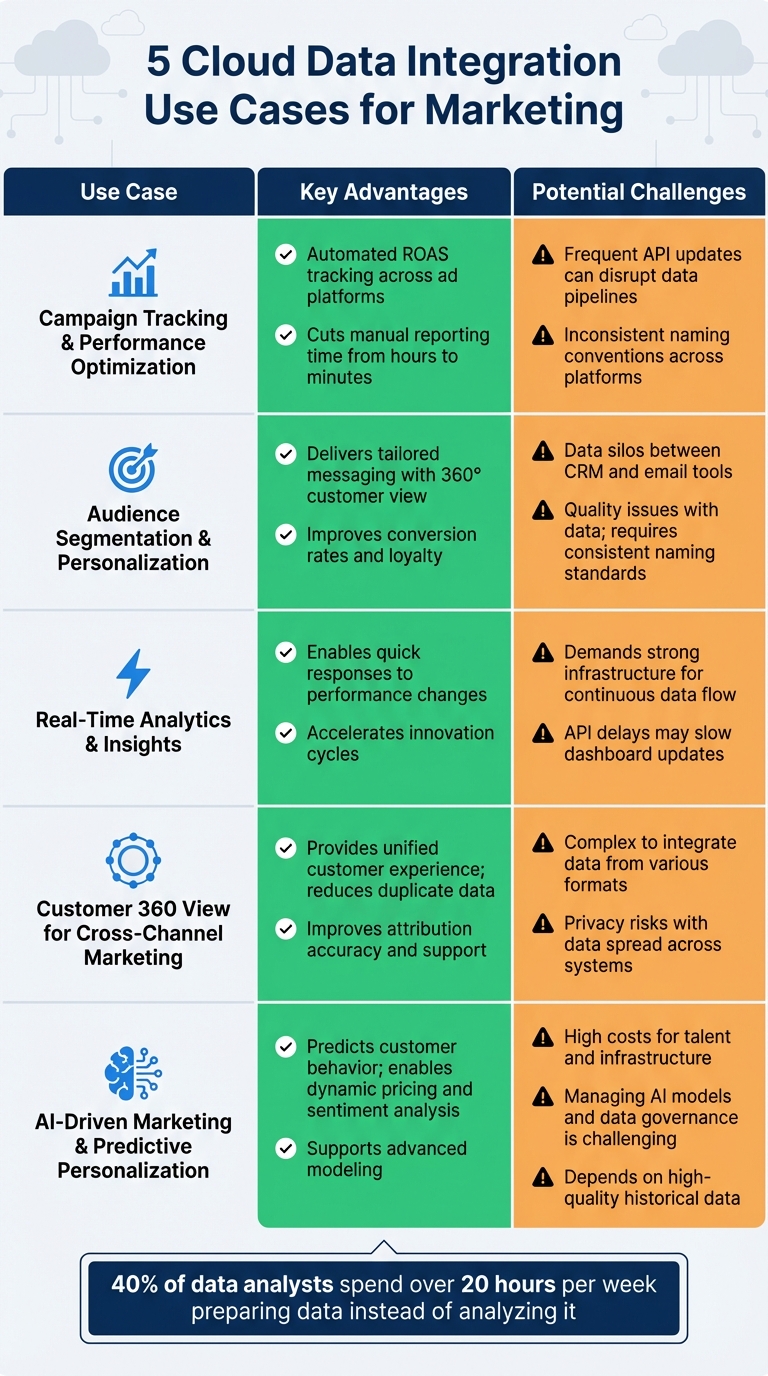
Cloud Data Integration Use Cases for Marketing: Benefits vs Challenges Comparison
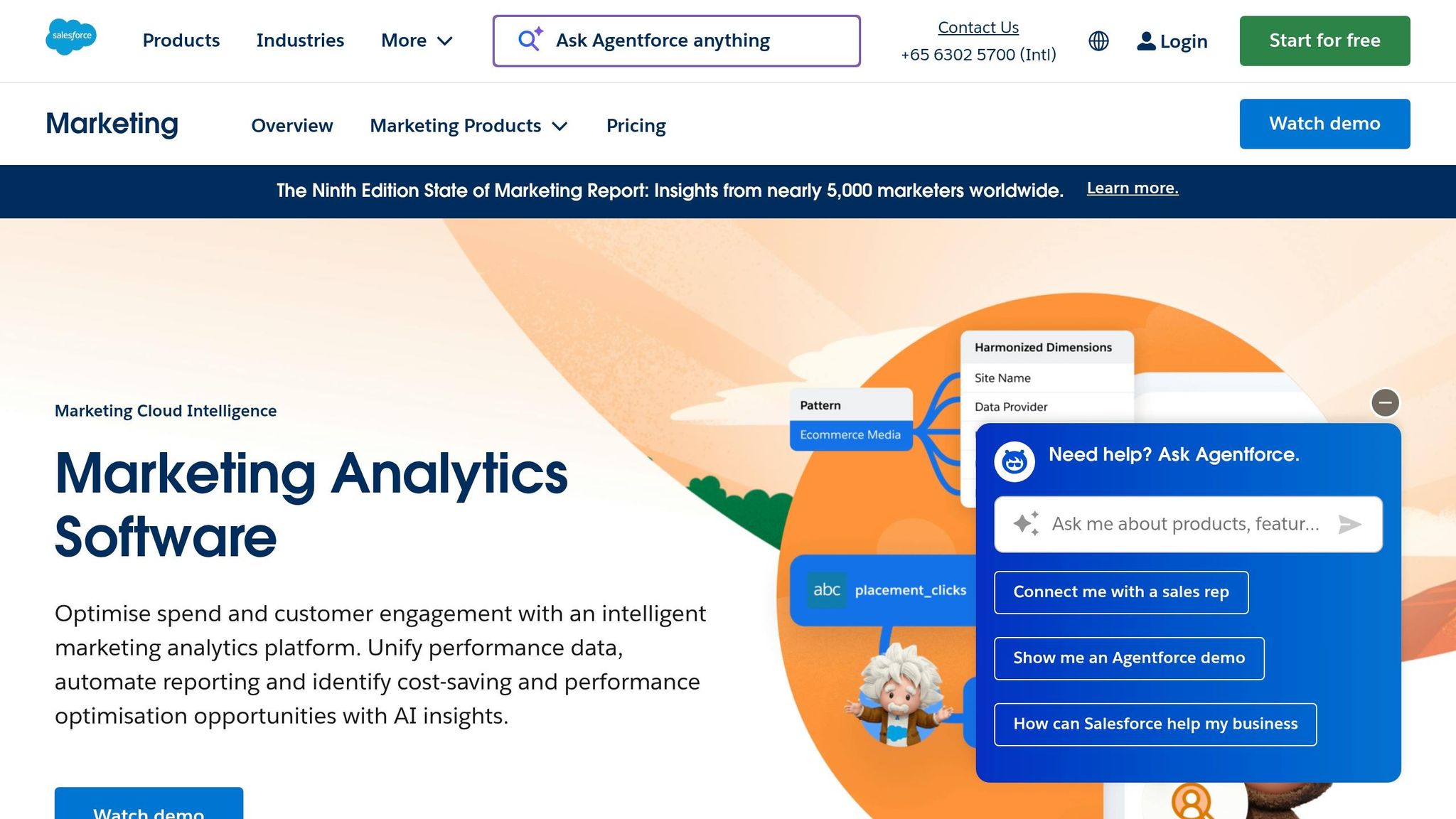
Platform Overview | Marketing Cloud Intelligence
sbb-itb-5174ba0
1. Campaign Tracking and Performance Optimization
Cloud data integration takes the hassle out of juggling multiple dashboards. Instead of manually pulling data from tools like Google Ads, Meta, email platforms, and CRMs, automated connectors bring everything into one system. This unified setup allows you to easily compare spending and returns across all channels using top analytics tools for business, helping you quickly pinpoint which campaigns are delivering results and which ones might need tweaking. With this clarity, tracking becomes more precise as data standardization comes into play.
When everything runs through a single system, tracking accuracy improves significantly. Different platforms often use varying terms for the same metric - Facebook might call it "conversions", while Google Analytics refers to it as "goals." Integration tools handle these discrepancies by standardizing naming conventions, eliminating duplicates, and unifying metrics. This means your reports are not only more accurate but also free from the headaches of manual spreadsheets and human error.
Another game-changer? Real-time data processing. Automated updates keep dashboards fresh, enabling teams to spot trends, address budget inefficiencies, or seize emerging opportunities far faster than manual reporting ever could. If your campaigns are generating massive datasets - think over 500,000 monthly tracking rows - cloud solutions like BigQuery or Snowflake can handle the load effortlessly, avoiding the sluggishness you’d get with spreadsheets.
"By changing the KPI from being about leads to being about opportunity, I'm focusing on what's going to convert and that shift helped the marketing conversion rate go from 33% to 54%" - Nicole Fuselier, Vice President of Corporate & Revenue Marketing
This level of optimization is only achievable when all your marketing data flows seamlessly and is cleanly integrated.
Adding to these improvements, Luke Ambrosetti, Principal Industry Architect at Snowflake, highlights the power of hosting advanced models on your data platform. By leveraging aggregated datasets for real-time decisions, you can dive deep into analysis while making immediate adjustments as needed.
2. Audience Segmentation and Personalization
Cloud-based data integration breaks down barriers between marketing tools by creating a unified customer profile. By combining data from CRM systems, website analytics tools, support tickets, and purchase histories, marketers can segment their audiences with precision. This means distinguishing between free trial users and paid subscribers, identifying VIP customers versus new leads, or even categorizing by company size - all from a single source of truth.
The stats are eye-opening: 82% of marketers say having high-quality audience data is critical, yet only 27% report their marketing data is fully integrated. Over half acknowledge missing key details about their target audience due to fragmented systems. This lack of integration can make it tough to deliver the personalized experiences customers now expect. But when systems are connected, marketers can bridge these gaps and implement personalization strategies effectively.
Take Clockwise, a SaaS productivity tool, as an example. In 2023, they linked their data warehouse to HubSpot using Census, cutting the time needed for segmentation experiments from weeks to just hours. Similarly, Prolific created Customer 360 profiles by syncing product behavior data with their CRM. This allowed their sales team to automatically identify purchase intent signals and tailor their outreach.
"Data silos are one of the biggest hurdles that prevent businesses from delivering personalized, data-driven experiences to their customers."
- Katy Yuan, Writer, HubSpot
From a technical perspective, Luke Ambrosetti of Snowflake suggests a dual-zone approach: host advanced decision-making models on your main data platform while maintaining a "thin profile layer" in your marketing cloud for real-time triggers. This setup balances cost efficiency with immediate access to critical data. Modern tools designed for warehouse-native environments even allow marketers to build dynamic audience segments without needing SQL expertise.
3. Real-Time Analytics and Insights
Cloud data integration speeds up how marketers access and act on data, making it possible to query petabytes of information in just seconds. Tools like BigQuery, with its distributed architecture, allow for quick analysis of massive datasets.
Modern systems take this further with query pushdown - running SQL queries directly on data warehouses. This approach reduces unnecessary data movement and ensures marketers are always working with up-to-date information. As Matt Skinner from Adobe explains:
"In an age where data gravity is real, the ability to access critical datasets, query data where it lives, and activate it seamlessly is a strategic advantage".
This kind of efficiency directly impacts marketing ROI, enabling quick, data-backed decisions and adjustments.
Access to real-time data also prevents wasted spending. Automated refresh schedules keep dashboards current, helping teams identify and address underperforming campaigns before they drain resources. Fran Sánchez, Head of Marketing at Reporting Ninja, highlights:
"Automatic refresh schedules keep dashboards current, allowing teams to spot performance shifts, budget waste, or emerging opportunities long before manual reporting would reveal them".
By merging speed with actionable insights, unified data integration transforms how campaigns are optimized in real time. Integration across platforms like Google Ads, Meta, LinkedIn, and CRMs consolidates fragmented data into a single source of truth. This not only improves customer journey attribution but also enables real-time audience syncing for immediate campaign updates. Some tools even support Change Data Capture (CDC) with delays as short as 60 seconds, making near-instant adjustments possible.
For marketers looking to enhance their real-time analytics capabilities, the Marketing Analytics Tools Directory provides a detailed list of top tools designed to optimize campaign performance and deliver powerful insights.
4. Customer 360 View for Cross-Channel Marketing
Integrating all customer touchpoints into a single, unified profile can significantly amplify cross-channel marketing efforts. By leveraging cloud data integration, businesses can consolidate data from various sources - like social media, email, CRM systems, paid search, and in-store purchases - into one centralized hub. This is particularly important given that 73% of customers engage with multiple touchpoints before making a purchase, yet 88% of enterprise marketing teams struggle with real-time access to cross-channel performance data.
Recognizing customers across different channels makes them 3.5 times more likely to complete a purchase, and it also boosts average order values by 13% when marketing messages adapt to previous interactions. ASUS Global Marketing offers a compelling example. By using cloud integration to standardize data from hundreds of global locations into a BigQuery instance, they transformed their marketing operations. Jeff Lee, Head of Community and Digital Strategy at ASUS, shared:
"Improvado saves us about 90 hours per week and allows us to focus on data analysis rather than routine data aggregation, normalization, and formatting".
This unified view not only improves personalization and targeting but also ensures campaigns are more cohesive and impactful.
Modern integration platforms employ identity resolution to unify digital identifiers, like laptop and mobile IDs, into a single customer profile. This process, which uses both deterministic and probabilistic matching, ensures a seamless experience across digital and physical channels. For example, it prevents situations where a customer receives an online offer that isn’t honored in-store. Companies adopting cross-channel strategies often gain a 3-4x higher Share of Voice compared to those relying on single-channel approaches.
As data volumes grow, cloud-native integration platforms are essential for managing complexity without the slowdowns caused by manual processes. On average, these manual workflows consume 14.5 hours per week for marketing teams. Luke Ambrosetti, Principal Industry Architect at Snowflake, advises a streamlined approach:
"The data stored in the marketing cloud should only be a small subset of the data in your data platform".
This "thin profile layer" approach allows for fast real-time execution while keeping comprehensive historical data in the enterprise platform. It’s a cost-effective way to scale as data needs increase.
For businesses looking to implement such strategies, the Marketing Analytics Tools Directory offers a range of platforms designed to build holistic customer profiles and enhance cross-channel marketing through integrated data solutions.
5. AI-Driven Marketing and Predictive Personalization
AI models can't work their magic without complete and unified data from CRMs, ad platforms, and analytics tools. The lack of integration costs companies an average of $12.9 million annually. With projections showing that 80% of marketing automation will rely on AI by 2026, having an integrated data pipeline isn't just helpful - it's essential. When it comes to campaign tracking and audience segmentation, seamless data integration is the backbone of effective AI-powered marketing personalization.
A bi-directional data flow is what makes AI personalization shine. It allows marketing platforms to use integrated data for predictions while also logging key engagement metrics - like opens, clicks, and purchases. These continuous feedback loops help refine AI models, ensuring they deliver the right message, through the right channel, at the right time. Businesses implementing these AI-driven workflows report 27% higher conversion rates and 42% more content output.
Emerging techniques like "Query Pushdown" are also changing the game. This approach enables marketing clouds to execute SQL queries directly on the data platform, reducing unnecessary data movement and allowing for real-time tweaks. Luke Ambrosetti suggests hosting advanced AI models on the data platform itself, while maintaining a "thin profile layer" in the marketing cloud for instant decision-making.
Platforms that automate data integration are key to making these AI strategies scalable and cost-efficient. These solutions can power AI/ML models that forecast outcomes three times faster. For marketers looking to dive into AI-driven personalization, the Marketing Analytics Tools Directory offers options ranging from entry-level tools at $35/month to enterprise-grade AI optimization platforms. However, as July Cintra from Dataslayer wisely notes:
"You can't skip Layer 1 and expect AI to magically fix reporting problems".
The takeaway? Setting up automated data flows is the first step toward unlocking the full potential of AI in marketing.
Comparison Table
Each cloud data integration use case comes with its own set of perks and hurdles, helping marketing teams craft strategies that fit their needs.
The table below highlights how these five use cases compare. Campaign tracking simplifies reporting with automation but requires close monitoring due to frequent API updates. Audience segmentation boosts conversion rates with personalized messaging but struggles with data quality issues. Real-time analytics empowers teams to act quickly on market changes but demands a strong infrastructure to handle constant data flow.
Customer 360 view offers a thorough understanding of customer interactions by connecting all touchpoints, though implementing it can be tricky due to departmental data silos. AI-driven marketing, while the most complex, unlocks advanced predictive tools like dynamic pricing and sentiment analysis - requiring substantial investments in expertise and resources. The table below outlines these trade-offs, giving marketers a quick way to align their goals with the right integration strategy.
| Use Case | Key Advantages | Potential Challenges |
|---|---|---|
| Campaign Tracking & Performance Optimization | Automated ROAS tracking across ad platforms; cuts manual reporting time from hours to minutes | Frequent API updates can disrupt data pipelines; inconsistent naming conventions across platforms |
| Audience Segmentation & Personalization | Delivers tailored messaging with a 360° customer view; improves conversion rates and loyalty | Data silos between CRM and email tools; quality issues with data; requires consistent naming standards |
| Real-Time Analytics & Insights | Enables quick responses to performance changes; accelerates innovation cycles | Demands strong infrastructure for continuous data flow; API delays may slow dashboard updates |
| Customer 360 View for Cross-Channel Marketing | Provides a unified customer experience; reduces duplicate data; improves attribution accuracy and support | Complex to integrate data from various formats; privacy risks with data spread across systems |
| AI-Driven Marketing & Predictive Personalization | Predicts customer behavior; enables dynamic pricing and sentiment analysis; supports advanced modeling | High costs for talent and infrastructure; managing AI models and data governance is challenging; depends on high-quality historical data |
A striking fact: nearly 40% of data analysts spend over half their workweek - more than 20 hours - preparing data instead of analyzing it. By adopting the right integration strategies, teams can slash this prep time, shifting their efforts from tedious tasks to strategic planning. This shift not only saves time but also amplifies the advantages outlined above, allowing teams to focus on driving results.
Conclusion
Cloud data integration breaks down silos by bringing together information from platforms like social media, CRM systems, email, and web analytics. This process ensures data is consistent, reliable, and ready to use.
The five use cases - from tracking campaigns to AI-driven personalization - highlight how integration shifts the focus from repetitive manual tasks to strategic decision-making. As Christopher Van Mossevelde, Head of Content at Funnel, puts it:
"Automation is not just about speed. It safeguards against data loss, reduces manual cleanup and gives your team more confidence in the numbers."
By moving away from tedious spreadsheet work, marketing operations become more flexible, enabling teams to respond quickly and effectively. This agility translates into faster, data-informed actions.
Real-time access to data also means campaigns can be adjusted instantly, ensuring budgets and messaging are optimized without delay.
Choosing the right integration tools is key to achieving these results. While the process of selecting tools might feel overwhelming, the Marketing Analytics Tools Directory makes it easier by organizing solutions based on their capabilities. Whether you're looking for marketing-specific ETL platforms, real-time analytics dashboards, or AI-powered personalization tools, this resource helps align technical solutions with your business objectives.
FAQs
What marketing data should I integrate first?
Start by focusing on data from your most important channels, like advertising platforms (Google Ads, Facebook Ads), email campaigns, and your CRM. These platforms give you a direct line to performance insights, letting you monitor campaigns, analyze audience behavior, and calculate ROI effectively.
Once you've got these core pieces in place, broaden your scope. Incorporate website analytics, social media metrics, and even offline data to build a richer, more comprehensive view of your marketing efforts.
How do I keep integrated marketing data accurate as APIs change?
To keep your marketing data accurate as APIs evolve, it's crucial to have solid data management strategies in place. Start by setting up flexible data pipelines that can adjust to changes without breaking. Use automated monitoring tools to track performance and set up alerts for failures or schema updates to catch problems as they happen. Regularly test and validate your data flows to spot issues early and maintain consistency. Taking these steps ensures your data stays reliable, even as things shift over time.
Do I need real-time data, or is daily refresh enough?
Daily data updates are ideal for most marketing analytics, offering timely insights that align with the fast pace of dynamic campaigns. If you're working in an environment that demands split-second decisions, real-time data might be a better fit. On the other hand, for understanding broader patterns or long-term trends, less frequent updates are usually enough. The key is to match your data refresh strategy to your campaign's goals and how quickly you need to respond to changes.