If you need to stop fraud in time, run the first decision close to the transaction. In most cases, that means edge for fast scoring and policy action, and cloud for training, graph analysis, and long-term reporting. The article’s core point is simple: when cloud round trips add 80-200 ms and edge checks run closer to 10-40 ms, that time gap can decide whether fraud is blocked or money moves.
If I were explaining this fast, I’d boil it down to this:
- Use edge for the first call - allow, challenge, or block
- Keep cloud for heavier work - model training, global patterns, and case review
- Match the setup to the flow - web, mobile, payments, and identity do not share the same timing limits
- Keep sensitive data local when possible - send tokens, scores, and feature summaries upstream instead of raw PII
- Plan failover from day 1 - edge nodes should keep working during WAN or central service issues
What matters most is not just speed. It is the full design choice: which signals stay local, which models run inline, what fallback rules apply, and how fraud signals feed other systems like CRM, CDP, and website analytics tools for attribution reporting without adding extra data risk.
For most teams, I’d start with onboarding, coupon redemption, and payment pages. Those flows usually give the fastest payback, fit clear latency targets, and help keep both fraud loss and dirty marketing data under control.
Network edge struggles to find sweet spot as AI and trust emerge as key drivers
sbb-itb-5174ba0
Edge Architectures for Web, App, Payment, and Identity Flows
Each fraud surface needs its own edge setup. Web checkout, mobile login, payment terminals, and identity capture do not run on the same signal mix, the same latency budget, or the same response path. In practice, these patterns line up with device, network, and enterprise edge layers.
Web and Mobile App Edge Detection
At the browser and mobile SDK layer, the main job is signal collection. That includes behavioral signals like keystrokes, mouse movement, and touch patterns, along with device and browser profiling, IP reputation, and session event capture. Together, those signals create a lightweight feature set that moves to the next layer for scoring.
CDN edge runtimes can score requests in stateless edge functions. ML inference at this layer usually finishes in 5-20 ms, which is fast enough to filter bot traffic and flag impossible travel before the request hits core systems. Top analytics tools for business often leverage local key-value stores at the edge also help with velocity matching and other ultra-fast pattern checks [3].
The response is simple: Allow, Challenge, or Block. Only high-risk events and decision metadata need to move upstream. That keeps the path lean and sets up the short-window event and latency patterns that matter in the next layer.
Payment Scoring at Terminals, Gateways, and Processor Edge Nodes
Payment flows have the tightest latency budgets. Total authorization time is usually 200-400 ms [2], so edge inference has to stay in the low-millisecond range.
Edge gateway servers handle tokenization at ingress, which means raw Primary Account Numbers (PANs) never enter downstream systems. That can reduce PCI DSS scope from SAQ D to SAQ A under PCI DSS 4.0 [7]. After that, pre-scoring runs against transaction velocity, BIN-to-country mismatches, and merchant attributes [7].
The decision path then splits by risk level:
- Low risk: synchronous Allow and immediate clearance
- Medium risk: Challenge flow, such as 3DS 2.x, OTP, or a biometric prompt
- High risk: Block before the transaction reaches core systems [3][7]
Identity Verification and Customer Risk Checks at Capture Points
Identity flows need a split setup. Onboarding, login, password resets, bank detail changes, and device enrollment all deal with privacy-sensitive data such as document scans, liveness video frames, and biometric templates. Sending all of that to a central cloud adds latency and increases data residency exposure.
A split model works better: edge handles the first pass, while cloud handles the gray-area cases. A small, fast classifier runs at the edge - such as a regional PoP or an on-prem appliance - and makes the first accept or reject call for liveness checks, anti-spoofing heuristics, and document classification. The edge node processes data for a short time, extracts a biometric template, and sends only that irreversible template upstream, never the raw image or video [4]. This local-first setup also helps when connectivity drops and fallback checks have to take over.
| Flow | Primary Edge Layer | Key Signals | Latency Target |
|---|---|---|---|
| Web / Mobile App | Browser / SDK + CDN / API Edge | Behavioral signals, device/browser profiling, IP reputation, session events | <50 ms |
| Payment | Terminal / Gateway | Transaction velocity, BIN-to-country mismatches, merchant attributes | <20 ms (inference) |
| Identity Verification | Capture device / Regional PoPs / On-prem appliances | Document OCR, liveness, biometric templates | <100 ms (initial check) |
At payment and identity edges, build for intermittent connectivity. Edge nodes should cache revocation lists and apply local fallback policies so basic verification can continue during WAN disruptions [4][7].
Event Processing, Latency, and Model Scoring at the Edge
Edge vs Cloud Fraud Detection: Model Types, Latency & Use Cases
Streaming Events and Short-Window Pattern Detection
Once events are captured, the next job is correlation using top analytics tools. The edge has to make sense of the stream fast enough to act. Fraud rarely shows up in a single signal. It shows up in sequences across browser events, payment retries, and liveness checks. On their own, those events may look harmless. Taken together, they can point to abuse. That is why edge nodes enrich live events with local state and check them against short-window patterns instead of waiting on a cloud round trip [7][5].
That only works if the scoring path stays inside the latency budget.
Latency Budgets and Fallback Decision Paths
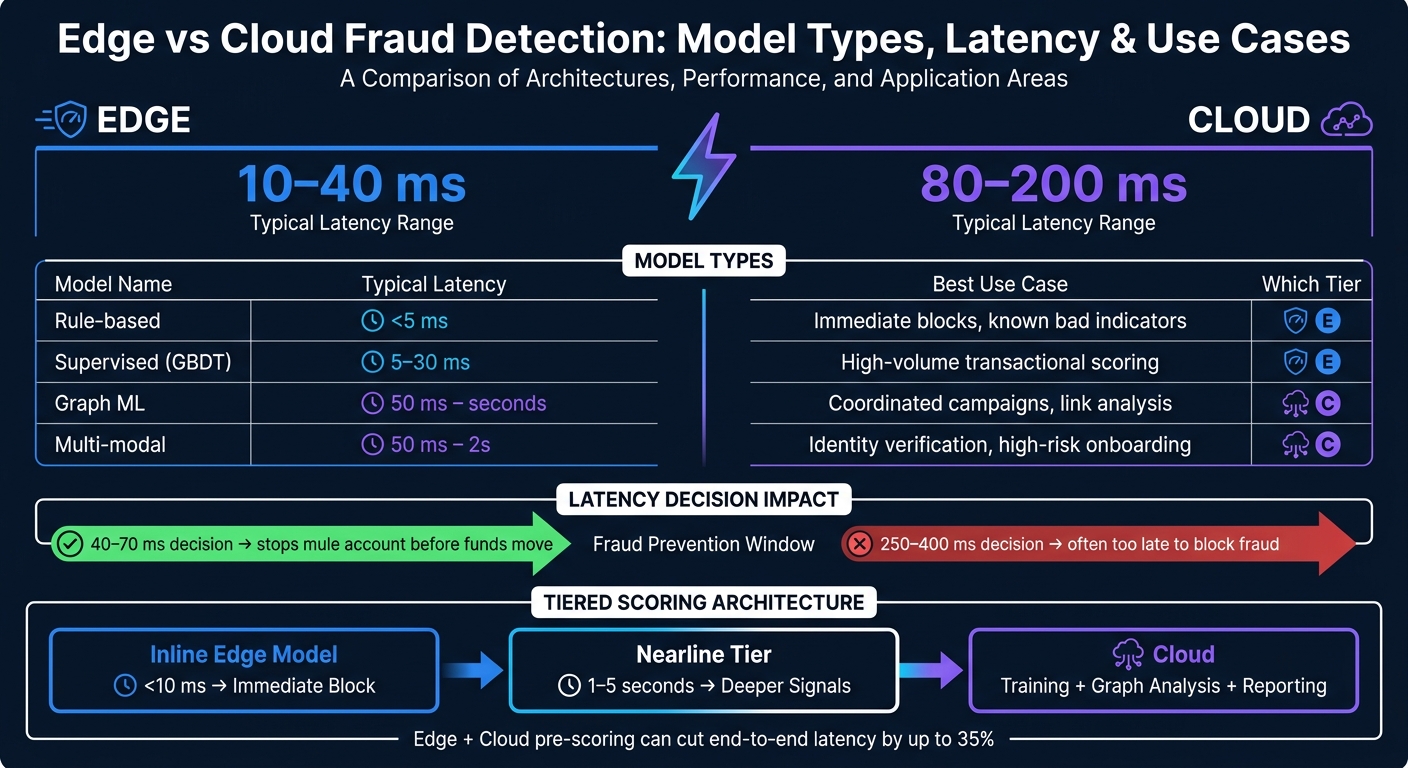
The key issue here is timing. The node has to decide fast enough to stop abuse before the moment passes. A fraud decision made in 40-70 ms can stop a mule account before funds move. A 250-400 ms decision often comes too late [3].
A practical setup is to use a sub-10 ms inline model for immediate blocks, then a 1-5 second nearline tier for deeper signals and nonblocking escalations [6]. In many setups, edge-level pre-scoring plus cloud refinement cuts end-to-end latency by up to 35% [8].
If central systems go down, the edge should not fail open. It should fall back to cached risk scores, local rule sets, or local deny/allow policies based on the risk tolerance of the flow [5][3]. During an active attack, circuit breaker patterns help throttle or isolate suspicious traffic bursts without waiting for a central service to recover [7].
Model Types and Edge-Cloud Scoring Design
Run inference at the edge and training in the cloud [3].
In practice, rules engines and gradient-boosted decision trees (GBDT) handle most edge scoring. They are fast enough for inline use and cheap enough to run at scale. Rule-based checks can finish in under 5 ms, while GBDTs usually score in 5-30 ms [6].
Some model types are better left upstream. For identity verification, multi-modal models can be more accurate, but they often take 50 ms to 2 seconds. That makes them a better fit for regional or nearline processing [6].
Graph neural networks are useful for coordinated fraud campaigns and link analysis, but they can take 50 ms to several seconds and carry high compute cost [6]. In other words, they are good at seeing the bigger web of connections, but not great for the first split-second decision. The edge should handle the fast real-time checks, while the cloud or a nearline tier handles graph-heavy scoring.
| Model Type | Typical Latency | Compute Cost | Best Edge Use Case |
|---|---|---|---|
| Rule-based | <5 ms | Low | Immediate blocks, known bad indicators |
| Supervised (GBDT) | 5-30 ms | Moderate | High-volume transactional scoring |
| Unsupervised | 10-100 ms | Moderate | Zero-day or unknown attack patterns |
| Graph ML | 50 ms - seconds | High | Coordinated campaigns and link analysis |
| Multi-modal | 50 ms - 2s | High | Identity verification, high-risk onboarding |
Edge model rollout should look more like firmware deployment than a one-time model launch. Start with a canary release, then trigger automatic rollback if latency or accuracy slips [3]. Fraud signals lose value fast. A 300 ms delay can weaken device and session signals [3]. That scoring split decides what stays local and what moves upstream, which leads straight to the next design choice: what data stays at the edge and what should move upstream.
Data Routing, Security, and Compliance Design
What to Keep at the Edge and What to Send Upstream
Once the edge makes the fraud decision, the next call is routing: what stays on the node, and what goes upstream. Raw biometrics, device fingerprints, local velocity counters, geo signals, and session heuristics should stay at the edge. Decision metadata, aggregated features, high-risk events, and anonymized metadata can move upstream for global model training and long-term audit [3][4].
This is mostly a trade-off between latency, privacy, and cost. Payment authorizations running on sub-500 ms total budgets do not have room for a cloud round trip on every signal [2]. In payment flows, PANs should be tokenized at the edge so only tokens and derived features leave the node. Non-urgent telemetry should move in batches to cut edge-to-cloud egress cost.
Edge events should also flow into SIEM through backpressure-aware pipelines. For suspicious sessions, keep event order intact so analysts can rebuild what happened, step by step [5].
Use this routing model to balance fraud performance, compliance scope, and ops load.
| Processing Model | Fraud Quality | Compliance Impact | Ops Complexity |
|---|---|---|---|
| Edge-Only Processing | High for velocity and local patterns; lacks global context | Lowest - sensitive data stays within local boundary | Low - stateless, no sync required |
| Edge-to-Cloud Feature Streaming | Best - combines local speed with global signals | Medium - metadata and tokens move upstream | Medium - requires resilient telemetry pipelines |
| Full Event Mirroring | Medium - latency-heavy for real-time decisions | Highest - increases CDE scope and egress costs | High - storage and bandwidth overhead |
This pattern keeps enough context for downstream analytics and investigation without sending too much data upstream. The practical rule is simple: keep sensitive data local, send tokens and feature aggregates upstream, and train global models without expanding compliance scope. Export risk flags and aggregates, not raw PII, so marketing analytics tools like Easy Insight can suppress fraud-heavy journeys without adding more data exposure.
Security Controls for Edge Nodes and Services
If data leaves the edge, the node has to be trusted first. That means secure boot, signed model artifacts, mTLS, field-level encryption, payload signing, and HSM-backed keys [3][7]. Those controls support edge decisions that block, challenge, or allow transactions in real time.
To limit blast radius and lateral movement, use V8 isolates or an NGINX service mesh [7][1]. For cardholder data, deterministic FPE tokenization at the edge helps avoid a central token vault [7].
Each edge fraud decision should send a feature-level explanation and rule-hit summary upstream for auditability [7]. Logs from the edge must redact PANs and authentication secrets before they hit centralized SIEM tools [7]. Model version tracking matters for the same reason. If a team can show exactly which model version scored a transaction, and when that version went live, dispute review and rollback are easier to defend. Under PCI DSS 4.0, edge nodes also need continuous monitoring and automated control validation.
Secure routing keeps the edge fast, audit-ready, and usable for both fraud and analytics teams.
How Edge Fraud Detection Fits with Marketing Analytics
Using Fraud Signals in Marketing Analytics and Lifecycle Journeys
Edge fraud checks protect marketing data as much as they protect transactions. Bot signups, fake accounts, and coupon abuse can pollute CRM records and analytics, so the best move is to block or tag them before they hit downstream systems. Once the edge classifies a session, lead, or transaction, send those signals into marketing systems only when they serve a clear purpose. That keeps fraud noise out of lifecycle triggers and reporting.
Pass risk scores and reason codes through versioned APIs so CDPs can suppress journeys and exclude blocked accounts from CAC reporting.
These signal paths map differently across CDPs, CRM, analytics, and attribution tools:
| Marketing Tool Category | Signal intake | Real-time action | Primary business impact |
|---|---|---|---|
| Customer Data Platforms (CDP) | High (via API/Webhooks) | High (journey suppression) | Direct (LTV and churn accuracy) |
| Web & App Analytics | Medium (custom dimensions) | Low (post-processing/filtering) | Indirect (conversion rate integrity) |
| CRM Systems | High (lead scoring/metadata) | Medium (validation at entry) | Direct (CAC and pipeline quality) |
| Attribution Platforms | Medium (postback/API) | Low (reporting focus) | High (ROAS and spend efficiency) |
CDPs are the best fit when a fraud signal needs to change a journey right away. Attribution platforms get value in a different way: when bot-detected sessions are removed from the denominator, ROAS reflects actual customer behavior instead of inflated traffic.
Track false positives closely. If edge rules block good users, conversion rates drop, and the same controls meant to protect marketing performance start to damage it.
Using a Directory to Evaluate Analytics Integration Options
Use the directory to compare which tools can ingest these signals natively. The Marketing Analytics Tools Directory helps teams compare tools that can ingest fraud signals and support real-time analytics, campaign tracking, and reporting.
Conclusion: What to Implement First
Start with onboarding, coupon redemption, and payment pages. These flows tend to deliver the fastest fraud gains and the cleanest downstream analytics.
Keep the first model deployment simple. Compact models such as gradient-boosted trees or logistic regression work well at the edge, while ambiguous cases can be routed upstream for review.
Plan edge-cloud collaboration from day 1. The edge should handle inference and rule enforcement. The cloud should handle model retraining, graph analysis, and long-term reporting. That setup improves fraud control and keeps marketing metrics trustworthy.
FAQs
When should fraud checks run at the edge instead of in the cloud?
Run fraud checks at the edge when latency is tight - especially for card authorizations, point-of-sale interactions, and real-time payments. In these flows, even millisecond delays can lead to more false declines or more fraud loss.
Edge processing also makes sense for high-volume, sub-second decisions. It can help keep decisions moving during connectivity issues, support local privacy or data residency rules, and handle an initial risk screen before requests hit core systems.
What data should stay local at the edge for fraud detection?
Keep data at the edge when it needs low-latency processing or contains sensitive PII. That usually means device fingerprints, behavioral biometrics, network velocity metrics, geo-proximity data, and local key-value stores that hold hashed identifiers and session patterns.
For privacy and resilience, edge nodes should also handle document scanning, template extraction, fuzzy matching, and short-term storage for transaction buffering, idempotency keys, and deterministic sanity checks during connectivity drops.
How can edge fraud signals improve marketing analytics?
Edge fraud signals make marketing analytics more accurate because they flag bad traffic early, before it pollutes your data.
When you collect signals at the edge, you get real-time context about user behavior and session integrity. That includes behavioral biometrics, device fingerprints, and navigation patterns. With that data, teams can sort real customers from bots much earlier in the session.
The payoff is simple: fraudulent traffic is less likely to distort attribution and performance metrics. That gives you a cleaner read on conversion quality, campaign performance, and audience insights.