Cloud analytics is under constant attack. With cyber threats evolving faster than ever, traditional security measures can no longer keep up. Real-time threat detection, often powered by the best real-time analytics tools, has become the go-to solution to identify and neutralize these risks as they happen.
Key Takeaways:
- Malware damages are projected to hit $10.5 trillion annually by 2025.
- Attackers exploit vulnerabilities faster, often before patches are available.
- 83% of cloud breaches in 2025 stemmed from identity compromises.
- Real-time detection focuses on speed: detect in 5 seconds, triage in 5 minutes, respond in 5 minutes.
- AI and machine learning are leading the charge, improving detection accuracy to 98.6% while reducing response times drastically.
How It Works:
- Behavioral Analytics: Tracks unusual patterns in user and system activities.
- AI Models: Spot threats without relying on static signatures, handling 10,000+ events per second.
- Key Data Sources: Logs from control, data, and management planes help detect issues like API misuse, container escapes, and credential abuse.
Why It Matters:
Traditional tools fail to keep up with the dynamic nature of cloud environments. Real-time systems not only detect threats faster but also reduce the time attackers have to operate undetected - minimizing damage and costs.
If you're managing cloud analytics, this approach is no longer optional. The stakes are too high to rely on outdated methods.
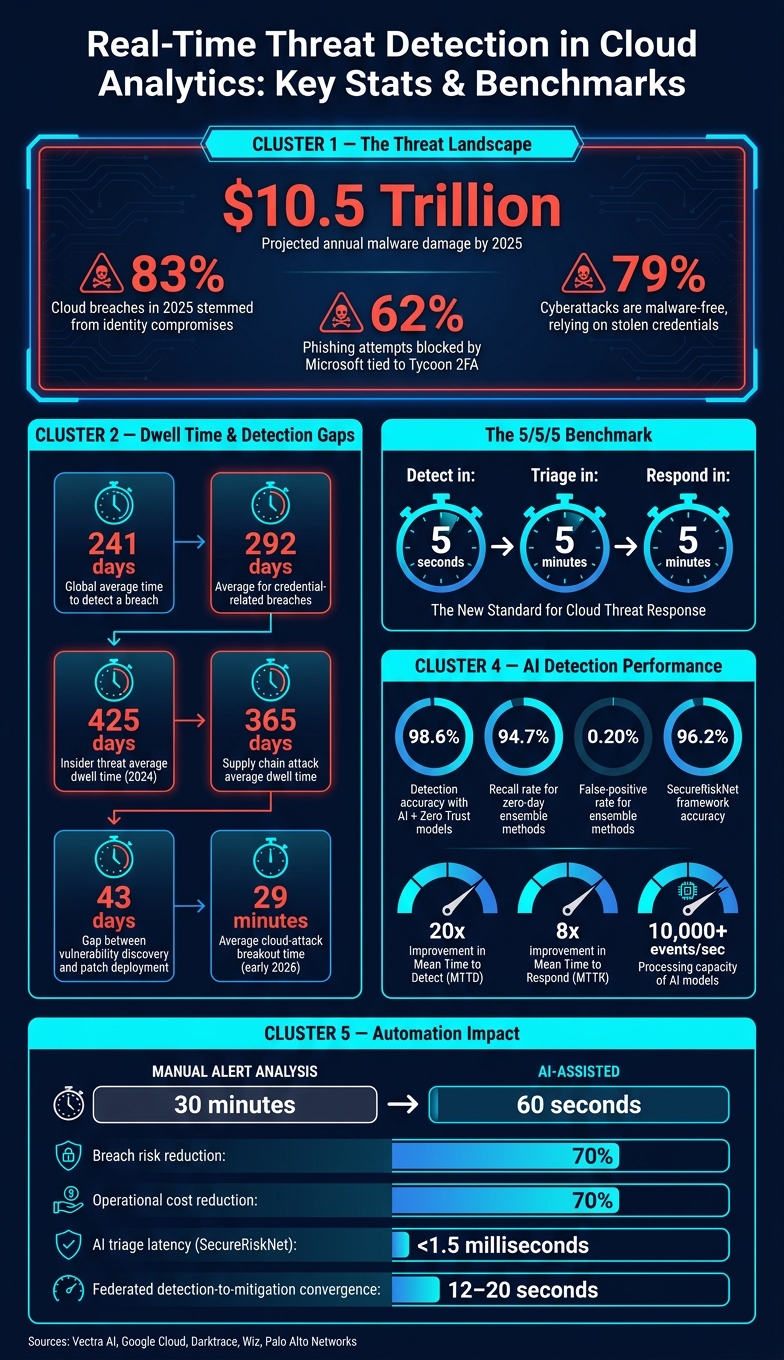
Real-Time Threat Detection in Cloud Analytics: Key Stats & Benchmarks
AI-Powered Threat Hunting in the Cloud: From Reactive Defense to Predictive Security
sbb-itb-5174ba0
Scope and Goals of Real-Time Threat Detection
Real-time threat detection in cloud analytics focuses on identifying and responding to active attacks as they happen. Unlike traditional static tools that depend on recognizing known attack signatures, this approach uses behavioral analytics and AI to uncover threats that might otherwise go unnoticed. The key advantage here is speed - cloud environments demand defenses that can keep up with their dynamic nature.
"Cloud detection and response (CDR) is the runtime discipline that finds and stops active threats inside cloud environments - the layer between posture management and incident response where most modern breaches actually unfold." - Vectra AI
Key Data Sources in Cloud Analytics
The effectiveness of real-time threat detection depends heavily on gathering the right signals. Cloud environments produce telemetry across three main planes, each offering unique insights into potential attacks:
| Plane | Key Data Sources | What It Detects |
|---|---|---|
| Control Plane | AWS CloudTrail, Azure Activity Logs, GCP Audit Logs | Unauthorized API calls, unusual IAM-role assumptions, OIDC trust-policy exploitation |
| Data Plane | Container runtime, eBPF sensors, syscalls, network flows | Container escapes, cryptominer execution, in-memory attacks |
| Management Plane | IAM events, federated-identity logs, billing logs | Federated-token misuse, lateral movement across accounts |
A special focus is placed on identity data. Logs from services like Okta or Microsoft Entra ID have become a top priority because identity compromise was behind 83% of cloud breaches in the second half of 2025. Additionally, network telemetry, including VPC Flow Logs and Cloud DNS logs, is critical for detecting command-and-control communications and unusual lateral movements.
By pulling together signals from these diverse sources, security teams can act quickly and accurately, aligning with the goals of real-time detection.
Core Goals of Real-Time Detection
The overarching aim is clear: reduce the time attackers have to operate undetected. On average, breaches take 241 days to detect globally, with credential-related breaches stretching even longer to around 292 days. Every extra day of undetected activity amplifies the potential damage. Real-time detection also addresses the 43-day gap between discovering vulnerabilities and deploying patches, allowing teams to neutralize threats during this critical period.
Security leaders are now pushing for a "5/5/5 benchmark": detect threats in 5 seconds, triage them in 5 minutes, and respond within another 5 minutes. This approach represents a shift from outdated, manual workflows to a faster, more proactive model designed to outpace attackers.
Research Methods in Real-Time Threat Detection
To improve real-time threat detection, researchers rely on techniques like behavioral analytics, machine learning, and streaming pipelines. These approaches are key to meeting the rapid detection goals discussed earlier.
Behavioral Analytics and Anomaly Detection
Gone are the days of simple rule-based alerts. Advanced frameworks, such as EventADL, now take center stage. EventADL uses two types of patterns: Event Semantic Patterns (ESPs) to identify typical interaction sequences, and Event Frequency Patterns (EFPs) to detect irregular spikes or drops in event timing. A study of 520 real-world incidents revealed that 68% of anomalies involved abnormal event values, while 67% were tied to deviations in event frequency.
These frameworks also help pinpoint the root cause of anomalies. By creating Intervention Graphs, researchers can trace anomalies back to their source - whether it’s a configuration change, resource deletion, or an unexpected API call.
In addition to these techniques, advanced AI tools enhance the precision of threat detection.
Machine Learning and AI-Assisted Detection
Machine learning and AI are essential for achieving the 5/5/5 benchmark in threat detection. Unlike traditional methods that rely on known signatures, machine learning can identify threats based on patterns alone. Hybrid models, such as those combining unsupervised algorithms like Isolation Forest with temporal models like LSTM, are leading the charge. For instance, the SecureRiskNet framework delivers 96.2% accuracy with an inference latency of less than 1.5 milliseconds in fog computing environments.
An example of AI in action comes from Google Security Operations. In June 2026, they deployed a Detection Engineering agent to address gaps revealed by the Axios supply chain attack (UNC1069). This agent automatically created custom YARA-L rules, translated attack tactics into behavioral signals, and simulated the attack chain using synthetic logs. It identified critical blind spots in the initial entry and command-and-control (C2) stages of the attack. Highlighting the importance of this work, Google executives stated:
"The remediation gap represents a critical vulnerability... exploitation frequently occurs even before a patch is officially released." - Jon Ramsey, VP & GM, and Payal Chakravarty, Director of Product Management, Google Cloud
AI-powered triage agents have also significantly reduced manual alert analysis times - from 30 minutes to just 60 seconds. In some workflows, this has led to a 70% reduction in both breach risk and operational costs.
Streaming Data and Predictive Analytics
Real-time threat detection relies on robust data pipelines capable of handling high volumes of information. Tools like Apache Kafka are often used for data ingestion, while Apache Spark or Apache Flink manage scalable stream processing and window-based analytics. Cloud-native audit tools, such as AWS CloudTrail, Azure Event Hub, and Google Cloud Audit, feed structured event data into these pipelines.
On the modeling side, CNN-LSTM hybrids are a popular choice. Convolutional layers extract features from raw telemetry data, while LSTM units monitor how those features evolve over time. However, concept drift - a phenomenon where model accuracy declines by 20%–40% over time - poses a challenge without regular updates. To counter this, modern MLOps pipelines include real-time drift detection engines capable of identifying model degradation in under 500 milliseconds. Enterprise-scale simulations have shown these systems can process over 10,000 events per second.
Key Findings on Detection Performance
Research shows that AI-driven threat detection systems are outperforming traditional methods, particularly in terms of speed, precision, and cost-effectiveness.
Faster Detection and Reduced Dwell Time
Insider threats in 2024 had an average dwell time of 425 days, while supply chain attacks went undetected for around 365 days. These extended windows gave attackers ample opportunity to act undisturbed. However, real-time AI detection systems significantly reduce these undetected periods. AI platforms have been shown to improve Mean Time to Detect (MTTD) by 20× and Mean Time to Respond (MTTR) by 8× compared to older approaches.
For example, during the DaVita ransomware attack in March–April 2025, the InterLock group had unauthorized access for 19 days, impacting 2.6 million patients. Post-incident evaluations suggested that real-time behavioral analytics could have identified unusual data access patterns within that timeframe.
"Real-time threat detection minimizes the window of exposure by identifying and containing threats before they escalate." - Darktrace
Newer federated frameworks are taking this a step further, achieving operational convergence - from detection to hardware-level mitigation - in just 12–20 seconds. These advancements highlight the growing speed of AI detection systems.
Accuracy, False Positives, and Tradeoffs
AI-based anomaly detection paired with Zero Trust models has achieved 98.6% accuracy with minimal false positives in multi-tenant cloud environments. Ensemble methods targeting zero-day threats have shown a recall rate of 94.7%, with a false-positive rate as low as 0.20%.
However, challenges remain. Behavioral AI without contextual understanding - like asset relationships or data sensitivity - can misinterpret benign activity as malicious, creating excessive alert noise and risking analyst fatigue. As one expert explained:
"The difference lies in whether the detection engine understands relationships and intent, not just statistical deviation." - Wiz
Some limitations also emerge in model performance. Against novel attacks, models trained on familiar datasets can lose 12.3% accuracy, according to Leave-One-Experiment-Out (LOEO) validation studies. Federated learning, while preserving privacy, often trails centralized models, achieving only 75.1% accuracy. Balancing these tradeoffs is essential for effective real-time cloud security.
Security Applications in Practice
In May 2024, Darktrace's AI successfully neutralized a Fog ransomware attack - designed to encrypt and exfiltrate data in under two hours - by isolating affected devices and blocking suspicious connections before encryption could occur. Similarly, during the MOVEit supply chain attack, AI-driven anomaly detection systems identified irregular data transfers before traditional tools even updated their indicators of compromise. These examples showcase the speed and accuracy improvements enabled by AI.
"AI handles the heavy lifting in threat detection by sifting through millions of events, finding patterns, and automating responses while humans provide oversight." - Palo Alto Networks
On the organizational front, PROS adopted Wiz Defend to enhance its cloud detection capabilities. By enriching alerts with contextual details - like identity permissions and resource exposure - they significantly reduced their threat response time. This demonstrates how adding context to behavioral analysis can amplify detection and response effectiveness in real-world scenarios.
Use Cases in Cloud Analytics
Real-world examples highlight how real-time threat detection is applied across various cloud scenarios, including monitoring SaaS activity, detecting identity-based threats, and automating incident response.
SaaS Activity Monitoring and System Telemetry
Monitoring SaaS activity effectively requires capturing data across multiple layers - control, data, and management planes. This includes tracking API events, runtime processes, and authentication logs to provide a complete picture of activity within the cloud environment.
One key challenge is the transient nature of cloud containers, with 60% lasting less than a minute. Capturing telemetry from these short-lived workloads is critical. Tools equipped with eBPF-based agents can collect syscall-level data in real time, ensuring evidence is preserved before these ephemeral processes disappear. This is especially important as the average cloud-attack breakout time has now compressed to just 29 minutes (as of early 2026).
"CDR is a runtime discipline, not a product: It detects, investigates, and responds to active threats across the cloud control, data, and management planes." - Vectra AI
The importance of real-time visibility became evident during a March 2026 incident involving the Trivy security scanner. A supply-chain compromise allowed attackers to exfiltrate 91.7 GB of data over a five-day dwell window from EU-based AWS infrastructure. The delay in detection was directly linked to the lack of real-time monitoring for control-plane API anomalies.
This layered approach to visibility also plays a critical role in strengthening identity controls, as discussed next.
Identity-Based Threat Detection
Identity has become the primary target for attackers in cloud environments. 79% of cyberattacks are now malware-free, relying instead on stolen or misused credentials rather than malicious code.
Behavioral analytics is essential for combating these threats. By establishing baselines for normal user and resource behavior, systems can detect when attackers employ "living-off-the-land" techniques, using legitimate credentials in unusual ways. One significant threat in this area is Tycoon 2FA, an Adversary-in-the-Middle (AiTM) phishing kit. This tool bypasses multi-factor authentication by stealing authenticated session tokens in real time. At its height, 62% of phishing attempts blocked by Microsoft were tied to Tycoon 2FA.
Detection efforts extend well beyond monitoring login attempts. High-risk behaviors include rapid bursts of Microsoft Graph API calls - such as 20–30 calls within 60 seconds - targeting role assignments or mailbox settings after a compromise. Another example: in Q1 2026, the threat actor UNC6426 exploited a compromised npm package (QUIETVAULT) to steal GitHub tokens. They then leveraged an overly broad OIDC trust policy to gain AWS administrative access within 72 hours. Key indicators included STS token issuance from a non-CI principal and unauthorized CloudFormation stack creation.
Incident Response and Automation
Building on insights from telemetry and identity monitoring, real-time incident response uses automation to contain threats quickly. The "5/5/5 benchmark" - 5 seconds to detect, 5 minutes to triage, and 5 minutes to respond - has become the standard for addressing automated cloud attacks.
Automation plays a crucial role in speeding up investigation, enrichment, and containment. For example, automated workflows can reduce manual alert analysis from 30 minutes to just 60 seconds. This allows security teams to focus on high-priority decisions instead of repetitive log reviews.
However, the level of automation depends on the risk involved. Low-impact actions, like revoking session tokens or disabling flagged accounts, can be fully automated. For higher-risk actions, such as suspending a production IAM role, human approval is often required to avoid disrupting operations.
What to Consider When Deploying Real-Time Detection
Setting up real-time threat detection isn’t just about flipping a switch - it requires careful planning and smart architectural decisions. These choices directly impact how quickly and accurately threats are identified in cloud analytics environments.
Data Ingestion and Integration
To make real-time detection effective, you need a solid foundation of telemetry from all operational layers. Two key steps here are schema normalization and adopting an event-driven ingestion model. In multi-cloud setups, log formats vary widely between providers. Standardizing these logs into a unified schema - like the Open Cybersecurity Schema Framework (OCSF) or Elastic Common Schema (ECS) - ensures your detection rules work seamlessly, no matter where the event originates.
Brian Davis from Red Canary highlights the risk of neglecting scalability in the pipeline:
"If the processing pipeline isn't built to scale, it will become hopelessly backlogged with data."
Switching from batch processing to event-driven ingestion is non-negotiable. Every API call or configuration change should be treated as a real-time signal. Missing even a single data source can leave exploitable blind spots. With the average breakout time for cloud attacks sitting at just 29 minutes, batch processing simply can’t keep up.
These integration practices lay the groundwork for efficient alert management.
Alert Correlation and Orchestration
Raw alerts by themselves don’t tell the whole story - they need context. Shifting to a story-based correlation model helps connect related events into a single, cohesive narrative. Pairing this with dynamic risk scoring, which assigns severity levels and highlights affected assets, can significantly cut down the time analysts spend on triaging alerts.
AI tools also play a big role here. Automated investigation agents can shrink a 30-minute manual alert review down to just 60 seconds. This gives analysts more time to focus on tasks that require human judgment. The goal is to hit the 5/5/5 benchmark: detecting threats in 5 seconds, triaging them in 5 minutes, and responding within another 5 minutes.
But even the best alert orchestration won’t succeed without full visibility across your cloud environments.
Visibility Across Cloud Environments
Two major blind spots in cloud environments are ephemeral workloads and non-human identities. For instance, 60% of cloud containers have a lifespan of less than a minute. To capture critical syscall evidence from these fleeting workloads, deploying eBPF-based agents is essential. This makes eBPF a top priority for environments heavily reliant on ephemeral resources.
Non-human identities, such as service accounts and CI/CD pipelines, now outnumber human users. Yet, these are often overlooked in monitoring setups. Treating log-tampering events like StopLogging or DeleteTrail as high-confidence attack indicators - rather than harmless misconfigurations - can greatly enhance detection accuracy. Additionally, mapping your detections to the MITRE ATT&CK for Cloud matrix helps prioritize techniques most relevant to your industry.
As Kumar Shantanu from Cy5.io aptly puts it:
"Cloud environments don't get breached in slow motion anymore; they break in real time."
Conclusion
Real-time threat detection has become an essential part of cloud analytics, shifting from a "nice-to-have" to a critical operational tool. Why? Because adversaries are quick to act - research shows that exploitation often begins nearly seven days before an official patch is even released. Relying on batch-processed logs or manual reviews just doesn’t cut it anymore. This urgency has pushed businesses to adopt advanced systems capable of detecting threats in real time and stopping their spread before it’s too late.
Today’s top-tier architectures combine AI-driven behavioral analysis with Zero Trust principles, achieving detection accuracies as high as 98.6% and demonstrating 93.4% resilience against adversarial evasion attacks. Impressive numbers, but they only tell part of the story. Technology alone isn’t enough to secure the entire data lifecycle. For example, securing ETL pipelines - built on platforms like Apache Spark, Airflow, and dbt - requires just as much attention as monitoring user behavior. As highlighted by the ThreatClaw Intelligence Blog:
"Data pipelines are the new frontier for stealth attacks... their transformation logic is a rarely monitored attack surface."
For businesses looking to act on these findings, the next steps are clear: standardize log data across all cloud environments, automate alert correlation to create unified threat narratives, and expand visibility to include ephemeral workloads and non-human identities. These measures not only enhance detection but also streamline incident response, allowing teams to handle hundreds of daily alerts with greater efficiency.
To explore solutions that meet these rigorous demands, check out the Marketing Analytics Tools Directory. It offers a curated selection of tools for real-time analytics, data pipeline monitoring, and cloud-based business intelligence - all designed to align with modern compliance and security needs.
FAQs
What’s the fastest way to start real-time detection in my cloud?
To get real-time threat detection up and running in your cloud environment, turn to AI-powered tools that keep a constant watch over your data. Start by using runtime sensors or security platforms that can monitor activity across your systems. Set up automated responses to handle threats as they arise, reducing reaction time to mere moments. AI can also help identify unusual behavior with anomaly detection capabilities, catching potential issues before they escalate. By integrating these tools into your current security framework, you can achieve fast deployment and strong protection without a complicated setup process.
Which logs are most important for identity-based cloud attacks?
Logs that record control-plane activities - like CloudTrail for AWS, Azure Activity Logs, and GCP Audit Logs - play a crucial role in cloud security. They monitor key actions such as IAM events, token issuance, federation trust updates, and API calls. These details are indispensable for spotting suspicious identity-related behavior in cloud environments.
How do I cut false positives without missing real threats?
To cut down on false positives while still catching real threats, focus on three key strategies: confidence scoring, correlation, and contextual layering.
- Confidence scoring: Assign confidence levels to detections to help filter out unnecessary noise. This ensures your attention is on the most credible alerts.
- Correlation: Combine related alerts into cohesive attack narratives. This not only improves accuracy but also makes it easier to understand the bigger picture of potential threats.
- Contextual layering: Add context, such as asset permissions and sensitivity, to better prioritize threats. This helps you focus on what truly matters.
These approaches work together to reduce false alarms while keeping your detection capabilities sharp.