If you market to people in the EU/EEA, consent is not a banner project - it is a channel-by-channel control system. For most U.S. teams, the rule is simple: email, ad tracking, remarketing, and non-essential analytics usually need opt-in first. Regulators have already issued fines in the tens of millions of euros, including €150 million and €60 million, when users could accept cookies more easily than reject them.
I’d reduce the article to 4 rules:
- Pick the lawful basis by use case - not by team or tool
- Use separate opt-ins for email, analytics, ads, profiling, and tracking
- Keep proof - who consented, when, how, and what they saw
- Make opt-out easy - and push it to every system fast
A few points matter most for marketers:
- Legitimate interests is limited - it does not override ePrivacy rules for cookies or unsolicited marketing email
- Server-side tracking does not remove GDPR duties - if the data is still tied to a person or device, the same rules follow
- One checkbox for “marketing and analytics” is too broad
- A
consent=truefield is not enough for audit proof - Unsubscribe and cookie-setting changes must be simple and must update your CRM, ESP, ad tools, and analytics setup
| Area | What I’d do |
|---|---|
| Separate consent to send from consent to track opens/clicks | |
| Analytics | Block non-essential tags until opt-in |
| Ads | Do not fire remarketing or ad cookies before consent |
| Attribution | Pass consent status into server-side flows and conversion APIs |
| Recordkeeping | Store timestamp, source, notice version, and purpose-level choices |
Bottom line: if your consent flow is bundled, hard to refuse, or hard to withdraw, your measurement setup is exposed. This guide explains how to choose the right basis, collect valid opt-ins, log proof, and stop processing when a user says no.
Choose the right lawful basis for marketing data
Start here: pick the lawful basis by activity, not by department or tool. Under GDPR, there are 6 lawful bases, but for marketing, the answer is usually consent or legitimate interests. You can't apply one basis across all marketing work. Each channel and each purpose needs its own basis, and that basis should be documented against the specific activity.[8][18][19]
When consent is required vs. when legitimate interests may apply
The clearest rule is simple: if the ePrivacy Directive says consent is required for a given action, GDPR does not let you sidestep that with another basis.[10] In practice, that means legitimate interests cannot be used to justify non-essential cookies or unsolicited marketing emails. For those actions, consent comes first.[10][11][16][17][20]
Legitimate interests can still apply in narrower cases, such as aggregated analytics, fraud detection, and intra-group administration. But that only works if you complete and document a Legitimate Interest Assessment (LIA). That assessment needs to cover:
- the specific interest you are pursuing
- why the processing is needed for that interest
- the balancing test showing that the individual's rights are not overridden[5][3][6]
EDPB guidance makes the point clearly: legitimate interests is not a shortcut. The interest must be real and specific. And if you're using tracking tech beyond what is strictly needed to provide the service, consent is the standard you should expect.[12][13][20]
Lawful basis by channel: email, analytics, ads, and attribution
The table below shows the usual basis by channel for U.S. companies marketing to users in the EU/EEA.
| Channel / Use Case | Typical Lawful Basis | Key Condition |
|---|---|---|
| Promotional email to new subscribers | Consent | Opt-in required under ePrivacy[11] |
| Email to existing customers (soft opt-in) | Legitimate interests under GDPR, where national soft-opt-in rules allow it | Easy unsubscribe required[7][11] |
| SMS / messaging app marketing | Consent | Treated similarly to email under ePrivacy[11] |
| Non-essential analytics cookies | Consent | ePrivacy Article 5(3) applies; legitimate interests is not valid for cookie storage[10][16][17][20] |
| Remarketing / retargeting ads | Consent | Advertising cookies must be accepted before they fire[10] |
| Attribution and server-side measurement | Consent | Requires the same consent as the underlying ad or analytics use[8][9][10] |
For a U.S. SaaS company running EU-targeted campaigns, this gets concrete fast. Your newsletter signup needs a clear opt-in checkbox. Your website analytics tools setup needs a consent banner that blocks cookies until the user accepts. Your remarketing pixels cannot fire before opt-in. And server-side conversion APIs do not get you around this. They still process personal data tied to ad measurement, so the consent gathered upstream needs to cover that use.[10]
Build consent flows and CRM mapping around channels and purposes. Your ESP, analytics tools for business, ad network, and attribution tool should each be tied to a specific lawful basis, along with the rule that controls it, whether that's GDPR or ePrivacy.[8][10][11]
Once the basis is set, the next question is whether the consent itself is valid.
sbb-itb-5174ba0
What valid consent looks like under GDPR
The 4 elements of valid consent in marketing
Under GDPR, consent passes only if it is freely given, specific, informed, and unambiguous - and it must come from an active opt-in.[21][22][25][27] That sets a clear bar for forms, banners, and preference centers: each choice has to stand on its own.
Here’s the plain-English version:
- Freely given: people can say no without pressure or a penalty
- Specific: each choice covers one purpose
- Informed: your notice says who you are, what data you collect, why you collect it, and whether automated decision-making is involved
- Unambiguous: the user takes a clear action, like checking an empty box
So no pre-checked boxes. No treating silence as consent. No “if they scroll, they agree.”
For U.S. marketers reaching EU users, this usually means reworking forms, cookie banners, and preference centers. Use unchecked boxes, plain-language labels next to each option, your company name in clear view, and a short note on how someone can withdraw consent.
Granular consent for channels, purposes, and tracking
A single checkbox for “marketing and analytics” is too broad.[22][24][4][26] This is where many consent setups break down.
GDPR expects separate consent for separate purposes. In practice, that means users need separate controls for each channel and each kind of tracking.
A solid preference flow gives people distinct, optional choices for email marketing, SMS marketing, phone calls, analytics cookies, advertising cookies, profiling, and cross-device attribution tracking. Each one should have its own toggle or checkbox, plus a short explanation.
This matters for withdrawals too. Someone might want analytics on but ad personalization off. Your systems need to honor that split all the way through your CRM, analytics stack, and ad platforms.
Granular records are what make that enforcement possible downstream.
Problem areas: bundled consent, consent-or-pay, children, and email pixels
Some patterns draw attention from regulators for a reason.
Bundled consent is one of them. If one checkbox covers unrelated uses like promo emails, analytics, and profiling all at once, it fails the specificity test.[30][31] A single checkbox takes away the user’s ability to choose email without also agreeing to analytics or ads.
Pay-or-consent models are also under pressure. If access to content depends on accepting behavioral advertising, or if the tracking-free option comes with a disproportionate fee, consent may not be freely given. Recent opinions on these models say that, in most cases - especially for large platforms - a binary pay-or-consent choice will not produce freely given consent.[14][23][1][15]
Children’s data needs extra care. GDPR Article 8 sets the default age for digital consent at 16, though EU member states may lower it to between 13 and 16.[2][3] If minors may use your service, use language they can understand, get parental consent where needed, and avoid - or sharply limit - behavioral advertising, detailed profiling, and cross-site tracking.
Email tracking is another weak spot. Regulators are more often treating marketing email tracking the same way they treat web tracking. If your emails use open tracking or click tracking, say so at sign-up and handle it as part of the same consent choice as web tracking.[32][33][29] If a user does not agree to tracking, send plain-text, untracked email instead, or use a privacy-centric platform like Matomo.
Those choices only work if you can log them and undo them later.
How to prove consent and handle withdrawal
What a defensible consent record must include
Under GDPR, you need to prove consent at the time it was given. A simple consent=true flag does not do that.[26][37] The UK ICO is clear about what a record must show: who gave consent, when they gave it, the exact notice, banner, or policy version they saw, how they gave it, and whether and when they later withdrew it.[40][43] If you want withdrawals, audits, and suppression rules to work across your stack, store those fields in a structured record for every consent event.
At a minimum, each record should include:
- User identifier: email address, customer ID, or a hashed user ID tied to the consent event
- Timestamp: MM/DD/YYYY h:mm:ss AM/PM TZ, such as 08/15/2026 2:23:17 PM PDT[26]
- Collection method: web form checkbox, cookie banner, in-app toggle, or POS form, recorded as a clear affirmative action - not silence or a pre-ticked box
- Banner or notice version: a version ID or reference to the exact text or UI the user saw, plus the privacy notice or policy version tied to the record[26][37]
- Purpose-level choices: separate flags for each purpose, such as email newsletters, behavioral advertising, analytics cookies, and third-party sharing, instead of one bundled flag[41][42][44]
Treat these records like legal evidence. They need to be accurate, complete, and traceable.
Retention, audit trails, and suppression records
Keep full consent records only as long as you rely on them and long enough to defend a complaint. GDPR does not set a fixed retention period.[26][37]
Once consent is withdrawn, or the customer relationship ends, cut the record down to what you need to avoid contact by mistake: the person's identifier, a do-not-contact flag, and the opt-out timestamp.[45][28] That is enough to stop accidental re-enrollment without holding more data than needed. The ICO expressly accepts suppression lists as a compliant way to honor opt-outs.[45]
Your campaign logic should exclude suppressed IDs by default. Staff should not be able to remove a suppression flag by hand unless there is documented legal justification.[26][35]
Audit trails should log:
- every consent creation
- every preference change, with before-and-after states
- every withdrawal event
- every time that withdrawal was pushed to a downstream system such as the CRM, email service provider, ad platforms, or analytics tools[26][37]
If a sync fails, log the failure and the fix. You want a record that shows consent management is active and monitored, not a one-time setup.[26][37]
Withdrawal must be as easy as giving consent
This is the operational test: every opt-out has to reach every system. GDPR says withdrawing consent must be as easy as giving it.[34][35][36] So don't bury unsubscribe links, force people through multi-step opt-out forms, or require a login just to change a setting.
For email marketing, each message needs a one-click unsubscribe link that updates consent status without a login or extra fields.[34][35] For web tracking, keep a persistent "Cookie preferences" or "privacy settings" link in the site footer so users can reopen the consent banner and change choices at any time.[21][46][37] For advertising, preference centers should let users turn off personalized ads and cross-site tracking separately from other permissions.[37]
When someone opts out, that update should move across every connected system - CRM, email service provider, ad platforms, and analytics tagging rules - through an automated consent-withdrawal trigger that updates connected systems.[28][26][37] Do not switch to legitimate interests after withdrawal.[28]
Broken unsubscribe links and ignored opt-outs are serious violations.[38][39] CNIL has sanctioned over 200 companies for non-compliant electronic prospecting since 2021.[38] Test opt-out paths on a regular basis, especially after email template changes or platform migrations, because those updates can break the flow without anyone noticing right away.[38][39]
How consent rules apply to analytics, email, ads, and attribution
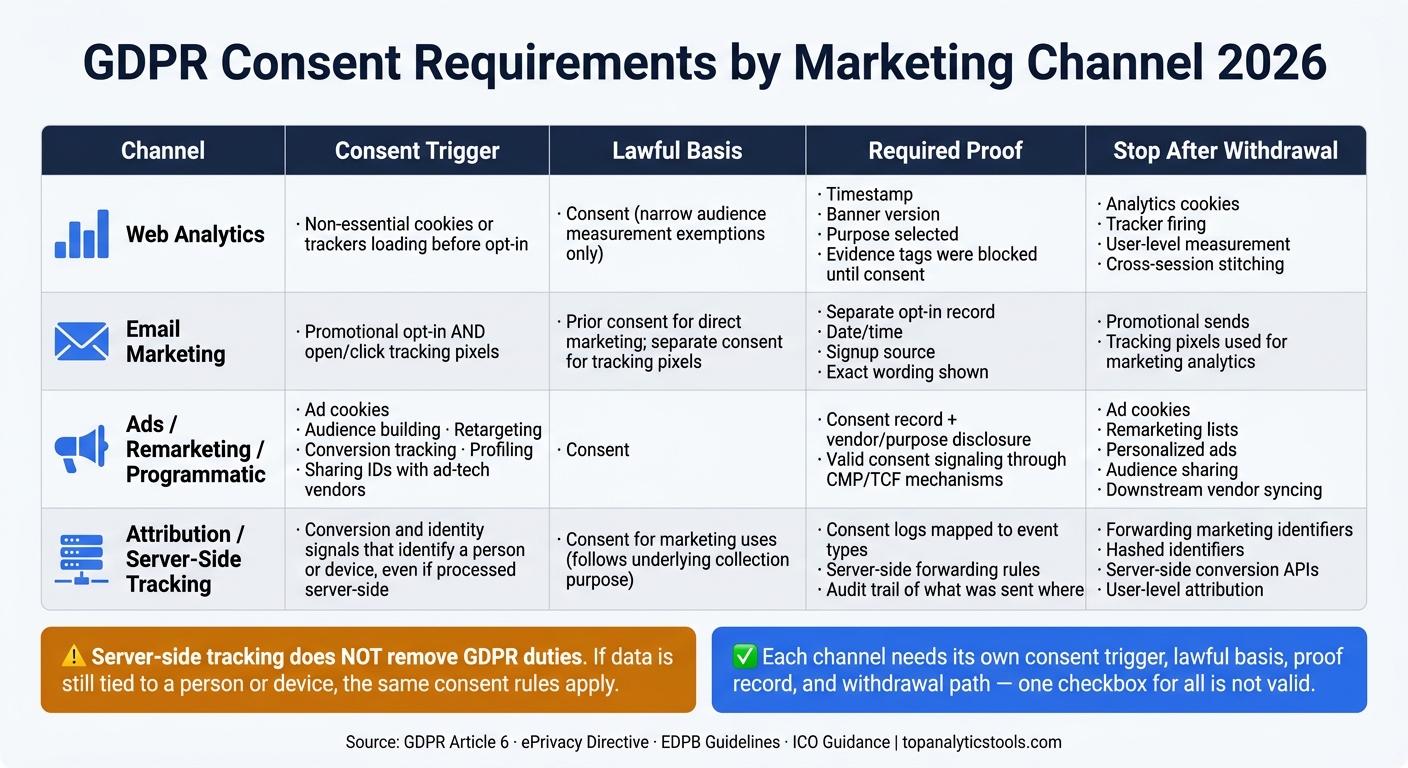
GDPR Consent Requirements by Marketing Channel 2026
Web analytics and measurement
Once consent is recorded, every tool downstream has to read that signal and act on it before any data is processed. If your analytics setup uses non-essential cookies or similar IDs to track sessions, conversion paths, or user behavior, those tags need to stay blocked until the user’s choice is known.
There is a narrow audience-measurement exemption, but the limits are tight. CNIL allows it only when the tool is limited to a single publisher, does not combine data with other sources, truncates IP addresses, and keeps data for no more than 13 months.[47] In plain terms, that carveout fits only a small set of setups.
If users decline consent, or if consent comes late, your reporting will have gaps. Session stitching breaks, conversion events go missing, and funnel data comes in incomplete. This is where teams get tripped up: the dashboard may look clean, but the numbers still undercount in a systematic way. Plan for partial data loss from day 1, and use modeled or aggregated reporting to patch those gaps instead of assuming you’ll get full coverage.[49][50] The same logic carries into email, ads, and attribution: separate consent choices, separate records, separate withdrawal paths.
Email marketing, advertising, and programmatic use cases
Email has 2 consent layers, and teams often blur them together. One is permission to send marketing emails. The other is permission to track engagement through opens and clicks when that tracking uses pixels or other IDs. If someone signs up for your newsletter, that does not automatically mean they agreed to behavioral tracking tied to that program.[51]
Keep those opt-ins separate, and log them separately. Transactional emails are a different case. Those can rely on contract or legal obligation, so they do not need marketing consent.
Ads, remarketing, and programmatic use cases usually face the toughest consent standard. Remarketing often depends on consent because it relies on cross-site tracking and follow-up ads. Audience sharing sends IDs to platforms and DSPs. Programmatic bid requests may include device data, browsing context, and location signals. That kind of processing will usually need consent.[48]
Consent also has to be machine-readable, so ad partners get a valid signal before they process anything.[52][53] That same consent state should also control server-side attribution. If the browser says no, the server should not act like it heard yes.
Attribution, server-side tracking, and tool selection
Server-side tracking does not remove GDPR duties. If hashed emails, device IDs, or conversion signals are still being processed, the same consent rules still apply.[54][55] Server-side changes where processing happens, not whether the activity is regulated.
That means consent state has to move from the browser to the server. Marketing tags and downstream endpoints should get data only when the matching consent was granted. If you do not have consented IDs, multi-touch attribution will undercount conversions. Teams using conversion APIs need to bake that into reporting assumptions and stakeholder updates, or they’ll set the wrong expectations.
When you compare tools, look first at consent logging, per-purpose controls, vendor disclosure, and purpose-level suppression. The Marketing Analytics Tools Directory can help narrow the field.
The table below sums up the trigger, basis, proof, and withdrawal step for each channel:
| Channel | Typical consent trigger | Likely lawful basis | Required proof | Stop after withdrawal |
|---|---|---|---|---|
| Web analytics | Non-essential cookies or trackers loading before opt-in | Consent, with narrow audience measurement exemptions only in limited cases | Timestamp, banner version, purpose selected, consent state, and evidence tags were blocked until consent | Analytics cookies, tracker firing, user-level measurement, and cross-session stitching |
| Email marketing | Promotional opt-in and open/click tracking pixels | Prior consent for direct marketing; separate consent for tracking pixels | Separate opt-in record, date/time, signup source, and exact wording shown | Promotional sends and tracking pixels used for marketing analytics |
| Ads / remarketing / programmatic | Ad cookies, audience building, retargeting, conversion tracking, profiling, and sharing IDs with ad-tech vendors | Consent | Consent record plus vendor/purpose disclosure; for ad ecosystems, valid consent signaling through CMP/TCF-style mechanisms | Ad cookies, remarketing lists, personalized ads, audience sharing, and downstream vendor syncing |
| Attribution / server-side tracking | Collection of conversion and identity signals that still identify a person or device, even if processed server-side | Consent for marketing uses; the lawful basis follows the underlying collection purpose | Consent logs mapped to event types, server-side forwarding rules, and audit trail of what was sent where | Forwarding marketing identifiers, hashed identifiers, server-side conversion APIs, and user-level attribution tied to consented purposes |
Conclusion: the minimum standard for GDPR-safe marketing data in 2026
The bar is simple, and it applies across every channel. In 2026, GDPR-safe marketing data comes down to 4 basics: the right lawful basis, valid consent, defensible records, and easy withdrawal. You need all 4. One does not make up for another.
The ICO expects organizations to name a specific Article 6 basis for each processing activity. Broad or generic justifications do not meet Article 6. When legitimate interest is the right basis, teams should document the balancing test and check whether the prospect would reasonably expect that processing.[56] That standard needs to carry through every channel, since each use case can trigger its own rules and recordkeeping demands, requiring top analytics tools and resources to manage cross-channel tracking effectively.
If users decline consent and that leaves holes in your measurement stack, report those gaps plainly. Don’t paper them over in dashboards created with tools like Easy Insight. Accurate reporting starts with controls that hold up. That is the minimum standard for marketing data in 2026.
FAQs
Do I need separate consent for each marketing channel?
Yes. Under GDPR, consent must be specific to each type of message or use. A single blanket opt-in does not cover different marketing channels or separate activities.
For example, if someone agrees to get a newsletter, that does not automatically mean they agreed to receive promotional emails. If you add new channels, advanced analytics, or extra third parties, you need new, specific consent.
Can server-side tracking work without user consent?
No. Server-side tracking does not bypass GDPR consent rules.
Moving data processing from a user’s browser to your server can give you more control over how data is handled, but the legal standard does not change. If you process personal data, the same privacy rules still apply as they do with client-side tracking.
You still need to capture, store, and honor user consent before processing personal data. If a user says no, tracking must be limited or turned off.
What should a GDPR consent record include?
A GDPR consent record needs to show when consent was given, how it was collected, what the person was asked, and how they responded.
That means recording the timestamp, the specific purpose or request, and the user’s response. You should also keep the exact wording shown at the time. If that wording changes later, retain the older versions too, so you have a clear record of what the user saw when they made their choice.
If someone withdraws consent, record that as well. Their preferences should stay in sync across your CRM and marketing systems.