I recommend starting identity resolution with 1 storefront, 90 days of order data, and a clear reporting goal - not automated targeting. Link customer records, test for incorrect matches, and reconcile revenue with finance before expanding.
In this guide, I explain how to:
- Prepare your data: choose first-party sources, clean identifiers, and keep people, households, and accounts separate.
- Choose matching rules and tools: compare exact and scored matches, build-versus-buy options, costs, and processing times.
- Protect customer data: enforce consent, access, retention, deletion, and opt-out rules across linked records.
- Measure results: track match errors, repeat purchases, acquisition costs, and margin while separating attributed revenue from causal lift.
My launch rule is simple: <u>scale only after matching, privacy, and revenue checks pass and the pilot improves your chosen KPI.</u> More linked records alone do not prove more profit.
Identity Resolution Explained... (Everything You Need to Know)
sbb-itb-5174ba0
Matching Methods and System Setup
Clean inputs are only the starting point. Next, decide how to match identities and govern those links.
Deterministic, Probabilistic, and Hybrid Matching
Use deterministic links as the baseline. Add probabilistic matching only when testing and permitted use support it. Even exact matches can be wrong if identifiers are shared, recycled, or reassigned. Weak matches based on shared signals should never serve as standalone identity links.[4][5]
| Method | Inputs | Precision | Coverage | Explainability | Privacy risk | Best uses |
|---|---|---|---|---|---|---|
| Deterministic | Authenticated customer ID, verified email, loyalty ID, order linkage | High when the key is controlled and current | Low to medium | High | Low to medium | Orders, customer service, loyalty, consented activation |
| Probabilistic | Address, name, phone, device, behavioral or contextual signals | Medium and variable | Medium to high | Moderate to low | Medium to high | Analytics enrichment, exploratory analysis, low-risk audience analysis |
| Hybrid | Deterministic evidence plus scored fallback rules | High to medium, depending on thresholds | High | Moderate to high | Medium | Enterprise customer 360, attribution, lifecycle analytics |
Set auto-link, review, and quarantine thresholds using labeled records, then tune them for each use case. A score ranks matches; it is not a probability. Authenticated ownership should take priority over anonymous cookie associations. Require independent evidence before chaining links across records. Keep household relationships separate, reassess identifiers that may have changed owners, and quarantine conflicting matches. Log merge and unmerge decisions with full lineage, and send reversals downstream.[4]
Carry these rules into the data model and processing layers.
Implementation Steps and Data Architecture
Build from collection to reporting, not from a flattened customer table. Define entities and inventory sources first. Then establish a canonical schema, normalized collection, durable master IDs, and graph links backed by evidence. Across collection, consent, storage, activation, and reporting, carry only the fields needed to enforce permissions, track lineage, and support replay. Create separate permissioned views for service, analytics, activation, and revenue reporting. Map each view to its permitted identity scope.
Make ingestion idempotent and history reproducible. Use durable event IDs so retries do not create duplicate events or links. Quarantine malformed or conflicting records. Process late events through controlled backfills, and version schemas, rules, profiles, and consent decisions.
Restrict identifier access, encrypt data, and log access. Send deletions to graphs and exports. Monitor merge rates, collisions, unmerges, and revenue revisions. Freeze the identity snapshot used for reporting, attribution, and experiments so later evidence cannot change prior analyses. Publish restatements separately, including the affected period and revision amount.
Once the matching model is defined, select a platform that can run it at the required speed with auditable controls.
Platform Selection and Processing Speed
| Approach | Control | Setup effort | Maintenance | Governance | Main cost drivers |
|---|---|---|---|---|---|
| Build | Maximum control over schemas, rules, storage, and deployment | High | High engineering, testing, operations, and on-call burden | Must be designed and enforced internally | Staff, cloud infrastructure, security, observability, support |
| Buy | Faster deployment with packaged connectors, graphs, and workflows | Lower initial effort | Continued configuration and vendor dependency | Shared responsibility; requires vendor due diligence | Subscription, usage, implementation, data egress, premium modules |
| Hybrid | Internal control of canonical data and governance with purchased resolution components | Moderate | Moderate effort and integration complexity | Strong if ownership boundaries are explicit | Platform fees plus engineering and operating costs |
| Processing mode | Typical resolution latency | Complexity | Cost profile | Suitable uses |
|---|---|---|---|---|
| Batch | Hours to days | Lowest | Usually lowest | Daily revenue reporting, finance reconciliation, historical enrichment |
| Near-real-time | Seconds to minutes | Moderate | Moderate | Lifecycle triggers, customer service context, suppression updates |
| Real-time | Milliseconds to seconds | Highest | Highest | Checkout risk decisions, immediate personalization, transaction-time experiences |
Resolution latency and reporting latency are separate SLAs. Define and test both, including retries, outages, consent changes, and late-arriving orders. Before buying, replay representative records to test integrations, match explanations, threshold controls, unmerge support, privacy enforcement, deletion, and exports. Test whether match quality, reversibility, and reporting consistency hold under actual operating load.
Compare total cost, including staffing and continued operations, rather than license fees alone. For broader vendor research, use the Marketing Analytics Tools Directory; verify identity-resolution capabilities separately.
Privacy, Governance, and Quality Controls
Governance rules control which data enters the graph, which links remain, and which audiences can be activated.
Consent, Consumer Rights, and Data Protection
Map every identifier to a lawful purpose, retention rule, and downstream restriction once matching rules are defined.
Start with a dated legal applicability matrix. Counsel should map customer location, business thresholds, processing activity, exemptions, and controller, processor, or service-provider status. Record applicable rights, response deadlines, opt-out signals, and sensitive-data requirements. California rights include access, correction, deletion, sale or sharing opt-outs, sensitive-information limits, and Global Privacy Control where applicable.[7][9] Have counsel classify identity matching and vendor sharing as sale, sharing, targeted advertising, profiling, or another regulated disclosure.
Privacy notices should explain identifier categories, sources, purposes, recipients, retention periods or criteria, and rights channels. Separate operational identity resolution from analytics, personalization, targeted advertising, and data sharing.
Hashed email is not automatically deidentified: it can still link a person across datasets. Document normalization, the hashing method, key access, and vendor matching capabilities. Review processor contracts for permitted uses, security, subprocessors, deletion assistance, incident handling, and limits on unrelated data combination.
Classify sensitive fields before collection. Use them as match keys only when required, documented, and approved, and enforce required consent or other legal restrictions. COPPA generally covers child-directed services and services with actual knowledge of collecting personal information from children under 13. Verifiable parental consent is generally required before covered collection, use, or disclosure.[6][8]
Keep a purpose-specific permission ledger with jurisdiction, scope, evidence, and expiration date. A merge must never expand permissions. Carry applicable restrictions across confidently linked identifiers, and check current suppression before every export.
Rights workflows should verify requesters without excessive collection, find linked records, document exceptions, and confirm downstream completion. Maintain a suppression registry with protected, stable deleted-identifier tokens so reingested files cannot recreate deleted profiles or include them in downstream exports. Limit registry retention and access.
Set separate retention rules for graph links, behavioral history, backups, and vendor copies. These controls determine which records qualify for matching and governance reporting.
Quality Metrics and Team Responsibilities
Measure match performance only on eligible records so consent failures and data exclusions do not distort quality metrics.
Define the eligible population before reporting. State whether the denominator excludes bots, unusable identifiers, or permission-restricted events, and keep those exclusions visible. Segment results by source, device type, geography, acquisition channel, authenticated status, customer status, and event type. Track over-linking, under-linking, and reporting coverage with these metrics; audit restricted-record leakage separately.
| Metric | Definition to document |
|---|---|
| Match rate | Resolved eligible events ÷ all eligible events |
| Unresolved-event rate | Unresolved eligible events ÷ all eligible events; separate missing IDs, restrictions, failures, and low confidence |
| Duplicate-profile rate | Customers represented by multiple active profiles after normalization and survivorship rules ÷ reviewed customers |
| False-merge rate | Sampled links that connect different people ÷ sampled links reviewed |
| Split rate | Sampled customers with multiple profiles ÷ sampled customers reviewed |
| Confidence distribution | Event and revenue counts by deterministic, high-confidence probabilistic, low-confidence probabilistic, and unresolved classes |
| Time to resolution | Elapsed time from event receipt to accepted identity assignment |
Marketing owns measurement; engineering owns pipeline reliability; finance owns financial definitions; legal/privacy approves data use. Assign identity rules and model performance to an identity owner, and access controls to security.
Estimate precision and recall using authenticated records, verified support cases, controlled identities, and sampled reviews - not model scores alone. Disclose incomplete ground truth and sampling limits.
Review high-impact links alongside random samples. Investigate collisions, reversals, suppression failures, and sudden metric changes by rule version. Require documented unmerge procedures, lineage, approval, and rollback evidence. Audit periodically and after material source, vendor, jurisdiction, or rule changes, checking whether restricted records stayed out of destination audiences.
Attribution and Revenue Measurement
Customer Journeys and Attribution Use Cases
Governed identity links let revenue reporting separate credited touchpoints from causal lift.
Build journeys from timestamped events, source system, identity method, consent status, channel, order ID, and transaction status. Link them through a governed person, household, or account key, while keeping deterministic links, probabilistic links, and unresolved activity separate. Keep raw identifiers out of general analytics tables; expose only approved tokens or aggregates.
Deduplicate purchases by order ID, not by device or campaign claim. Define new customers by their first completed purchase in available history. Use that history for acquisition suppression, retention cohorts, and lifetime value.
Alongside revenue, report the attribution model, click/view windows, direct-traffic rules, eligible repeat orders, and unresolved activity. Reserve pipeline reporting for sales-assisted or wholesale orders with linked opportunities, defined stages, and influence rules. Attribution assigns credit; incrementality measures causal lift.[12][14][16]
Use these journey rules to define revenue and KPI reporting using business analytics tools.
Revenue Definitions and KPI Reporting
Keep revenue, costs, and cash measures separate. Track distinct fields for gross merchandise value, discounts and promotions, taxes, shipping and handling, cancellations, refunds and returns, net revenue, variable fulfillment and payment costs, marketing costs, and contribution margin.
Exclude canceled orders from completed conversions. Treat renewals as separate transactions, and specify whether attribution credits first orders or all eligible orders. Apply finance-approved tax and shipping treatment, then reconcile order, payment, refund, and ledger records by transaction ID.
Booked orders, recognized revenue, and collected cash measure different things. Display the reporting date, time zone, order cutoff, refund window, currency, and reconciliation status. Label figures as either unaudited management metrics or finance-approved results.
Public-company disclosures commonly describe revenue net of returns, rebates, incentives, and discounts. E-commerce revenue may be recognized at delivery or when control transfers.[10][13][15] Analytics revenue totals still need reconciliation to finance records.
| Layer and KPI | Formula or definition | Denominator / reporting base | Owner | Cadence | Main limit |
|---|---|---|---|---|---|
| Identity - identity coverage | Customers or orders with an approved persistent key ÷ total customers or orders | Total customers or orders | Data governance | Monthly | Does not prove complete journey observation |
| Attribution - attributed revenue | Revenue assigned to eligible touchpoints under a stated model and window | Orders or net revenue in scope | Marketing analytics | Daily/weekly | Correlational; does not establish incremental impact |
| Attribution - ROAS | Attributed revenue ÷ acquisition media cost | Media cost only, unless otherwise stated | Marketing finance | Weekly/monthly | Must state whether revenue uses gross, net, or contribution-margin figures |
| Financial - CAC | Acquisition costs ÷ new customers acquired | New customers | Finance and growth | Monthly/quarterly | State whether costs include media, creative, agencies, technology, and labor |
| Financial - payback period | Time until cumulative contribution margin covers acquisition cost | Acquisition cohort | Finance/revenue operations | Monthly | Sensitive to margin, refunds, retention, and cash timing |
| Financial - repeat-purchase rate | Customers with a subsequent purchase within a defined period ÷ eligible first-purchase customers | Eligible first-purchase cohort | CRM/analytics | Monthly | Requires a fixed observation window |
| Financial - lifetime value | Historical or forecast customer value, commonly revenue, gross profit, or contribution margin net of specified costs | Customer or acquisition cohort | Finance/analytics | Monthly/quarterly | Forecast assumptions may be uncertain |
| Financial - contribution margin | Net revenue minus variable product, fulfillment, payment, service, and approved marketing costs | Orders, customers, or cohort | Finance | Monthly | Cost scope must be finance-approved |
Incremental Revenue, EBITDA, and Costs
Use randomized holdouts to estimate causal revenue lift:
Incremental revenue = (treatment revenue per eligible unit − control revenue per eligible unit) × eligible treatment units
Measure revenue, contribution margin, new customers, repeat purchases, refunds, and cancellations where relevant. Before the test, define eligibility, assignment, exposure, attribution window, primary outcome, minimum detectable effect, exclusion rules, and confidence or uncertainty reporting.
Identity resolution can bias results. A person assigned to control may later be recognized on another device and exposed to treatment. Household members may share an identity key, or post-assignment matching may move records between groups.
Prevent contamination by freezing assignment IDs, separating treatment and control suppression lists, and monitoring cross-device exposure. Analyze results by original assignment on an intention-to-treat basis, including customers who were not exposed.
When randomization is impractical, use geo tests, matched markets, interrupted time-series designs, or other causal methods. State their assumptions explicitly. Media-mix modeling complements journey attribution through aggregate channel analysis that accounts for seasonality, pricing, promotions, economic conditions, and distribution.[11][14][17]
For mid-market and PE-backed teams, translate validated marketing effects into finance-approved unit economics and margin, not attributed revenue alone. Bridge incremental net revenue to contribution margin, acquisition efficiency, retention, and payback before claiming an EBITDA gain.
Subtract the relevant acquisition costs - including media, agencies, creative, technology, and labor - plus implementation, integration, and recurring identity-platform costs. Count each cost once, using finance-approved definitions.
Separate cash spending from accounting treatment, including capitalized costs, depreciation, and amortization. Incremental contribution is not automatically EBITDA. Show identity coverage, reconciliation variance, and confidence intervals, and use consistent U.S. currency formatting. Higher match rates and larger attributed-revenue totals do not establish incremental profit.
Conclusion: Identity Resolution Launch Checklist
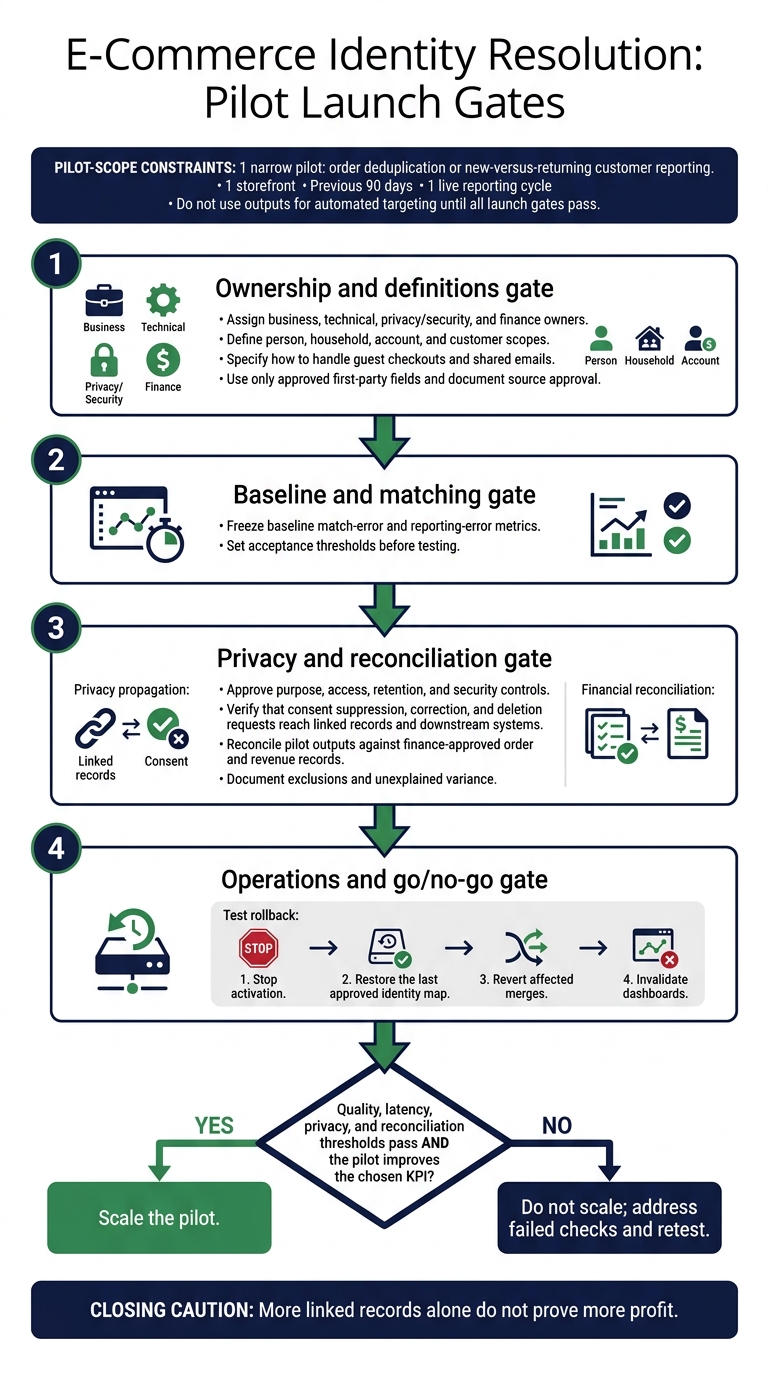
E-Commerce Identity Resolution: Pilot Launch Gates
Launch 1 narrow pilot: order deduplication or new-versus-returning customer reporting with FoxMetrics. Apply the prior definitions, matching rules, and governance controls. Keep the scope to 1 storefront, the previous 90 days, and 1 live reporting cycle. Do not use outputs for automated targeting until all launch gates pass.
- Ownership and definitions gate: Assign business, technical, privacy/security, and finance owners. Define person, household, account, and customer scopes, including how to handle guest checkouts and shared emails. Use only approved first-party fields and document source approval.
- Baseline and matching gate: Freeze baseline match-error and reporting-error metrics. Set acceptance thresholds before testing.
- Privacy and reconciliation gate: Approve purpose, access, retention, and security controls. Verify that consent suppression, correction, and deletion requests reach linked records and downstream systems. Reconcile pilot outputs against finance-approved order and revenue records. Document exclusions and unexplained variance.
- Operations and go/no-go gate: Test rollback: stop activation, restore the last approved identity map, revert affected merges, and invalidate dashboards. Scale only when quality, latency, privacy, and reconciliation thresholds pass and the pilot improves the chosen KPI.
FAQs
How do I match guest shoppers without merging different people?
Start with accurate data and a hybrid approach to identity resolution. Match known users deterministically through unique customer IDs, hashed emails, or logged-in states. For anonymous guests, use probabilistic matching based on browsing habits and usage patterns to fill gaps without incorrectly merging profiles. Validate, clean, and standardize data across systems regularly.
The Marketing Analytics Tools Directory can help you find platforms that support unified profiles.
What match-error rate is acceptable for my store?
There’s no single acceptable error rate for every analytics system. When comparing systems, pageview differences of up to 10% and user or session differences of up to 20% are generally considered acceptable [1].
For overall data quality, target at least 95% completeness and 99% consistency across records [2]. If platform totals differ from backend sales data by more than 15%, investigate the gap for a possible tracking error [3].
How do I isolate identity resolution’s impact on profit?
Calibrate your models against backend data before allocating budget. Compare platform-reported conversions with your CRM or order data to establish a baseline adjustment ratio for discrepancies. Apply that ratio to avoid directing budget based on unadjusted data.
Pair identity resolution with incrementality testing, such as geo-lift holdout tests, to separate correlation from causation. Measure the revenue growth that would not have occurred organically, and check quarterly that credited channels drive new revenue.