Lookalike audiences and predictive audiences are two distinct methods for targeting users in marketing campaigns. While lookalike audiences rely on historical data to find users similar to your existing customers, predictive audiences focus on real-time marketing analytics and behavioral signals to anticipate future actions. Both have strengths, but they serve different purposes depending on your campaign goals.
Key Differences:
- Lookalike Audiences: Use a "seed list" of your best customers to find similar users. Great for broad reach and prospecting.
- Predictive Audiences: Use machine learning to predict user actions based on real-time behavior. Ideal for precision targeting and retention.
Quick Comparison:
| Feature | Lookalike Audiences | Predictive Audiences |
|---|---|---|
| Focus | Past behavior | Future behavior |
| Data Source | Historical seed list | Real-time behavioral signals |
| Update Frequency | Static | Continuous |
| Best For | Broad reach, prospecting | Retention, upselling, churn prevention |
| Privacy | Relies on platform signals | First-party data |
Summary:
- Use lookalike audiences for expanding reach and finding new customers based on your current audience.
- Use predictive audiences for targeting users likely to take specific actions, like making a purchase or canceling a subscription.
- Combining both strategies can enhance results, with predictive data refining the seed list for lookalike models.
The choice depends on your goals and the data available. Predictive audiences are becoming more prominent as privacy regulations and real-time data reshape marketing strategies.
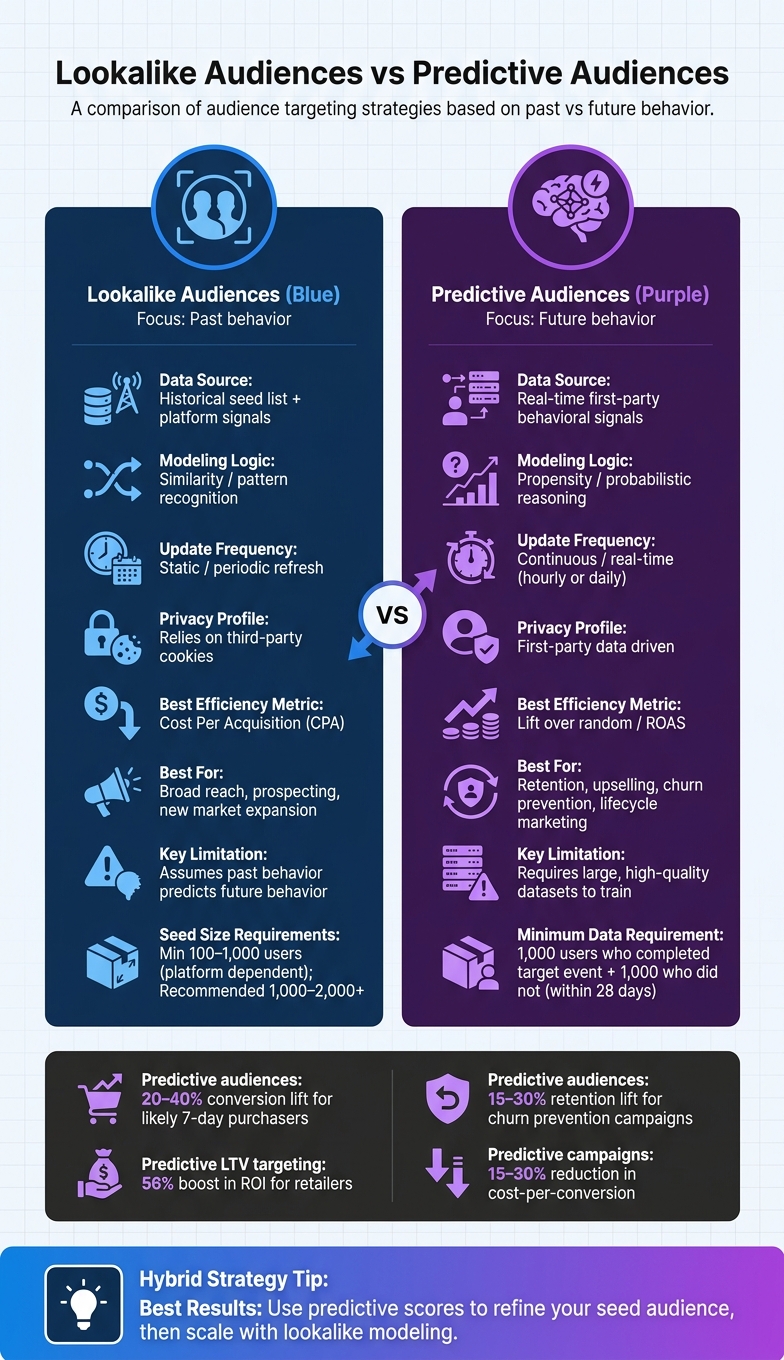
Lookalike Audiences vs Predictive Audiences: Key Differences at a Glance
How Lookalike Audiences Work: Methods and Applications
The Lookalike Audience Modeling Process
Creating a lookalike audience involves four key steps:
- Start by defining a seed audience made up of your best-performing customers.
- Analyze a large database of users to identify profiles that share similar behaviors, demographics, or transaction patterns.
- Assign a similarity score to each user in the database.
- Select a top percentage of users (e.g., 1% for precision or 10% for broader reach) to target in your campaign.
It’s important to note that the lookalike audience itself is the final product - not the model behind it. The quality of this audience depends entirely on the seed data you provide. Unlike predictive audience models, which adjust dynamically in real-time, lookalike audiences remain static.
"A seed of 500 highly consistent, high-value customers will outperform a seed of 5,000 mixed-quality conversions." - LatentView Analytics
"Treating a lookalike audience as a static asset rather than a model-dependent output is one of the most common operational mistakes in audience targeting programs." - LatentView Analytics
Data Requirements and Minimum Audience Sizes
While platforms like Meta, TikTok, and Pinterest allow seed audiences as small as 100 users, practical experience suggests otherwise. Experts recommend a seed size of 1,000 to 2,000 customers for reliable results. For enterprise-level models, such as those built on Oracle Unity, a seed of at least 50,000 customers may be necessary to generate 100,000 lookalikes.
The quality of your seed data is just as critical as its size. Effective models rely on three main types of data:
- Audience membership: Who is included in the seed audience.
- Experience events: Data on interactions like site visits, clicks, and purchases.
- Profile attributes: Details such as age, location, and income.
Providing only an email list limits the algorithm to matching based on the platform’s existing data.
"The algorithm can only use data it has access to... If your seed list contains only email addresses, the algorithm matches on the overlap between those emails and what the platform already knows." - Utku Zihnioglu, CEO, Oneprofile
Here’s a quick look at minimum and recommended seed sizes across major U.S. ad platforms:
| Platform | Minimum Seed Size | Recommended Seed Size |
|---|---|---|
| Meta (Facebook/Instagram) | 100 | 1,000+ |
| Google Ads | 1,000 | 1,000+ |
| TikTok Ads | 100 | N/A |
| Snapchat Ads | 1,000 | N/A |
| Pinterest Ads | 100 | N/A |
| X (Twitter) | 500 | N/A |
| Google DV360 | 100 | N/A |
These guidelines highlight the importance of selecting the right seed size and data type to maximize campaign success.
Common Use Cases
One of the most popular uses for lookalike audiences is prospecting - identifying new customers who haven’t engaged with your brand yet. Beyond this, geographic seed data can help businesses expand into new markets. For instance, a company with a strong customer base in Boston might use that data to find similar buyers in cities like Chicago or Dallas.
In B2B marketing, lookalike modeling can identify new accounts that align with the characteristics of your best clients. This includes factors like company size, industry, technology stack, and revenue range. Another strategic application is suppression modeling, where you create a lookalike audience of less desirable customers - such as those with high churn rates - and exclude them from campaigns. This approach can improve average customer lifetime value without increasing ad spend.
The similarity threshold you choose also plays a big role in your campaign’s performance. A 1% lookalike audience offers the highest similarity, making it ideal for conversion-focused campaigns where ROAS is key. On the other hand, a 10% lookalike audience provides broader reach, making it better suited for top-of-funnel awareness and market expansion efforts.
sbb-itb-5174ba0
How Predictive Audiences Work: Methods and Applications
The Predictive Audience Modeling Process
Predictive audiences stand out from static lookalike lists because they continuously update user scores. This process begins by analyzing first-party behavioral data using website analytics tools - things like scroll depth, session frequency, video completion rates, and purchase history. Using this data, a dynamic propensity score is calculated for each user. This score represents the likelihood that a user will take a specific action within a set time frame, such as making a purchase in the next 7 days or churning within 30 days.
For instance, Google's AI system processes over 70,000 behavioral signals in real time to compute these scores. To activate GA4's built-in predictive models, a property must include at least 1,000 users who completed the target event (e.g., a purchase) and 1,000 who did not, all within a 28-day period. Once the model is trained, it retrains every 24 hours, ensuring the scores stay current as user behavior evolves.
"The strategic shift is from 'who visited my product page' to 'who is likely to buy in the next 7 days.' The audience definition becomes a machine learning output rather than a human-defined rule." - Adnan Agic, Google Ads Strategist
By focusing on behavioral signals that drive conversions, these models provide marketers with insights into the key factors behind audience segmentation. For example, attributes like "Total Pageview Count" or specific content preferences can reveal what drives conversions. This continuous scoring system supports dynamic segmentation and real-time personalization.
Dynamic Segmentation and Personalization
Dynamic segmentation builds on the scoring process to classify audiences in real time. Unlike static lookalike audiences that are created and then deployed, predictive audiences adapt continuously. A system can assign an anonymous visitor to a behavioral category - like "discovery phase" or "brand advocate" - as they interact with content, without waiting for batch processing.
Marketers can fine-tune their targeting by adjusting the decision threshold. For example, focusing only on the top 5% of likely spenders creates a smaller but highly precise audience. On the other hand, lowering the threshold expands the audience reach but with less certainty per user. This flexibility allows predictive audiences to be applied across all stages of the marketing funnel.
Key Marketing Applications
Predictive audience models aim to improve marketing outcomes by adapting to user behavior in real time. These models are especially useful for three core marketing goals: retention, acquisition, and lifecycle optimization.
- Retention: Predictive models can identify users likely to churn and sync them to email or display platforms to trigger automated win-back campaigns. These efforts can reduce user dormancy and improve retention rates by 15%–30%.
- Acquisition: By identifying high lifetime value (LTV) users, predictive models help prioritize budgets more effectively. High-LTV lookalike audiences built on predictive scores have shown to boost paid acquisition ROAS by 20%–40%. Similarly, applying a +30% to +50% bid modifier for "Likely 7-day purchaser" segments in paid search campaigns captures users at their peak intent.
- Lifecycle Marketing: Predictive models can be tailored for different funnel stages, such as identifying anonymous visitors likely to subscribe to an email list or one-time buyers likely to make a repeat purchase.
The table below shows how specific predictive audience templates align with campaign goals:
| Predictive Audience Template | Typical Marketing Application | Impact |
|---|---|---|
| Likely 7-day purchasers | Bid increases in Search/Performance Max | 20–40% conversion lift |
| Likely 7-day churning users | Win-back offers and retention messaging | 15–30% retention lift |
| Predicted 28-day top spenders | Premium creative for high-value customers | Optimized ad spend efficiency |
| Likely first-time purchasers | New customer acquisition "nudge" campaigns | Increased new customer volume |
"The model is not magic. It is pattern matching on signals you already have. If your data is bad, the predictions are bad." - Ryan Whitton, Senior Content Strategist, Tested Media
Lookalike vs. Predictive Audiences: A Direct Comparison
Core Differences in Methodology
At their core, lookalike and predictive audiences differ in how they approach data and time. Lookalike modeling focuses on the past - it studies your previous best customers and seeks out new individuals who share similar traits. Predictive modeling, on the other hand, is forward-looking. It evaluates current user behavior to predict what actions they are likely to take next.
This difference has practical implications. Lookalike audiences rely on historical data, while predictive audiences adapt in real time, updating intent scores based on user interactions like scroll depth, session frequency, or video completions.
Another key distinction lies in the type of data used. Lookalike models depend heavily on third-party cookies and platform signals, whereas predictive models utilize first-party data, supported by methods like federated learning and differential privacy.
"Past behavior alone does not necessarily indicate future behavior... models that rely on historical data alone fall woefully short when compared to predictive audiences." - Sharon Shapiro, Bluecore
The table below highlights the main differences between these two approaches.
Comparison Table: Lookalike vs. Predictive Audiences
| Feature | Lookalike Audiences | Predictive Audiences |
|---|---|---|
| Primary Goal | Broad reach / finding "twins" | Precision targeting / anticipating intent |
| Data Source | Historical seed list + platform signals | Real-time first-party behavioral signals |
| Modeling Logic | Similarity / pattern recognition | Propensity / probabilistic reasoning |
| User Status | Static segments derived from historical traits | Fluid cohorts based on predicted actions |
| Update Frequency | Periodic / manual refresh | Continuous / real-time (hourly or daily) |
| Privacy Profile | High dependency on cookies | First-party data driven |
| Best Efficiency Metric | Cost Per Acquisition (CPA) | Lift over random / ROAS |
| Key Limitation | Assumes past behavior predicts future behavior | Requires large, high-quality datasets to train |
Performance and Efficiency by Marketing Goal
The effectiveness of these approaches depends heavily on the specific marketing objective. Their distinct methodologies shape how well they perform for certain goals.
For top-of-funnel campaigns, lookalike audiences are a solid choice, offering broad reach. However, when it comes to bottom-of-funnel goals, predictive audiences shine. For example, using predicted customer lifetime value (LTV) in paid media strategies has driven a 56% boost in ROI for some retailers. Predictive campaigns can also cut average cost-per-conversion by 15%–30% in AI-enhanced campaigns. The key difference? Predictive audiences focus on targeting intent rather than identity, making them especially valuable when budgets are tight.
"While volume is valuable, conversion is paramount." - AdvertisingUpdates
Predictive modeling also brings a unique edge in suppression strategies. By identifying users likely to unsubscribe or churn, predictive models allow marketers to exclude them from campaigns entirely. This can have a significant financial impact, as each email unsubscribe can cost retailers anywhere from $18 to $36. While lookalike modeling can attempt suppression by creating "worst customer" segments, it lacks the real-time adaptability that makes predictive suppression so effective.
Choosing Between Lookalike and Predictive Audiences
When to Use Lookalike Audiences
Lookalike audiences are perfect when you need to expand your reach quickly, especially if you don't have much behavioral data to work with. They shine in cold prospecting - helping you connect with people who’ve never heard of your brand but share traits with your top customers.
"Lookalike modeling connects cold prospecting and retargeting. It allows you to find new people who have never heard of your brand but are statistically predisposed to want what you are selling." - Perion Staff
If you're entering a new market, start by seeding your lookalike model with high-value customers from an existing market. The better your seed list - focused on high-value customers - the stronger your lookalike model will be.
Now, let’s explore how predictive audiences can take targeting to the next level.
When to Use Predictive Audiences
Predictive audiences are best suited for mid-to-late funnel strategies like retention, upselling, churn prevention, and personalized outreach. They help you get more out of your budget by focusing on customers based on their predicted lifecycle value or likelihood to respond to discounts. As mentioned earlier, these models continuously update based on user behavior, making them ideal for engaging customers at the right moment.
"Predictive audiences are so powerful because they allow you to proactively engage customers in a personalized way using leading indicators that help you predict their future activity." - Sharon Shapiro, Content Marketing Lead, Bluecore
Hybrid Approaches and Tool Selection
A hybrid approach combines the strengths of both models, offering a way to balance precision and scale. By using predictive scores to refine your seed audience, you can improve the performance of your lookalike models. For instance, focusing on the top 10% of users by predicted lifetime value (LTV) ensures your lookalike model identifies high-value prospects at scale.
"The quality of your seed audience determines model performance. Seeding on high-LTV, high-retention customers outperforms conversion-based seeds at scale." - LatentView Analytics
Hybrid strategies also promote consistency across channels. By syncing a refined seed audience from your data warehouse across platforms, you can maintain uniform lookalike profiles. If you're considering tools to help with audience modeling, segmentation, or behavioral analytics, the Marketing Analytics Tools Directory is a great resource to compare solutions tailored to your data needs and campaign goals.
Transitioning from LinkedIn Lookalike to Predictive Audiences: New LinkedIn Ads Targeting
Conclusion: Lookalike vs. Predictive Audiences
Lookalike modeling focuses on answering the question, "Who resembles my best customers?" On the other hand, predictive modeling asks, "Who is most likely to act next?" This fundamental difference influences everything - from the type of data required to the stages of the customer journey where each method provides the most value. Lookalike audiences are perfect for broad reach and scale, making them ideal for targeting new audiences or exploring untapped markets. Predictive audiences, however, shine when precision and timing are critical, such as in retention strategies, reducing churn, or upselling to existing customers. Neither method is inherently better; the right choice depends on where your customers are in their journey and the top analytics tools you have at hand.
Here’s a practical tip: predictive models typically need at least 1,000 unique behavioral identifiers to work effectively. If your first-party data isn’t quite there yet, starting with lookalike modeling can help you grow your database and strengthen your foundation.
As outlined earlier, blending these strategies often yields the best results. For example, you can use predictive scores to fine-tune seed audiences while leveraging lookalike models to scale your reach. This combination ensures you’re maximizing effectiveness across different stages of the funnel.
FAQs
How do I choose a good seed list for a lookalike audience?
The foundation of successful lookalike modeling lies in picking a well-defined, high-quality seed list. Start by focusing on valuable user segments - these could include repeat customers, those with a high average order value, or long-term subscribers. These groups tend to provide the best insights for creating accurate models.
For optimal results, aim for a seed list with at least 1,000 users, as larger samples generally lead to better precision. If you're in the B2B space, shift your attention to accounts or contacts that closely align with your ideal customer profile. This ensures you're targeting businesses or individuals most likely to convert.
To fine-tune your approach, leverage tools designed to clean and enhance your data. This extra step can significantly improve the accuracy of your audience targeting efforts.
How much first-party data is needed to build predictive audiences?
The amount of first-party data you need depends on the platform you're using. For instance, Google Analytics 4 requires at least 1,000 positive events within the past 28 days. On the other hand, LinkedIn needs a minimum of 300 member accounts in your source list. Most third-party tools generally fall in the range of needing 500 to 1,000 data points. To get the best results, make sure your data is both accurate and current.
Can I combine predictive scores with lookalike audiences to improve results?
Combining predictive scores with lookalike audiences can create a powerful strategy for better results. Lookalike audiences are great for expanding your reach, while predictive audiences zero in on precision targeting. By leveraging predictive modeling - such as behavioral propensity scores - you can pinpoint users who not only share similarities with your best customers but also show strong intent to take action. This method strikes a balance between broadening your campaign's reach and improving conversion accuracy, making it easier to hit your marketing targets.