If you use one main CRM and want tight rule control, I’d lean toward Openprise. If you need duplicate fixes to stay aligned across three or more systems, I’d look at Syncari first.
Here’s the short version:
- Openprise is built more around workflow-based cleanup
- Syncari is built more around cross-system sync and shared record state
- Openprise gives more field-level survivorship control
- Syncari is stronger when duplicates exist across multiple apps at once
- Both include audit trails, merge logic, and write-back steps
- Setup can take 4–12 weeks, depending on data model, rules, and stack complexity
- Duplicate cleanup matters because RevOps teams can spend up to 30 hours per week on manual data work, and some teams have seen misalignment rates hit 20%–30%
If I were shortlisting, I’d compare them on:
- Matching logic
- Survivor selection
- Repair flow
- Cross-system write-back
- Reporting
- Governance
- Setup effort
- Team fit
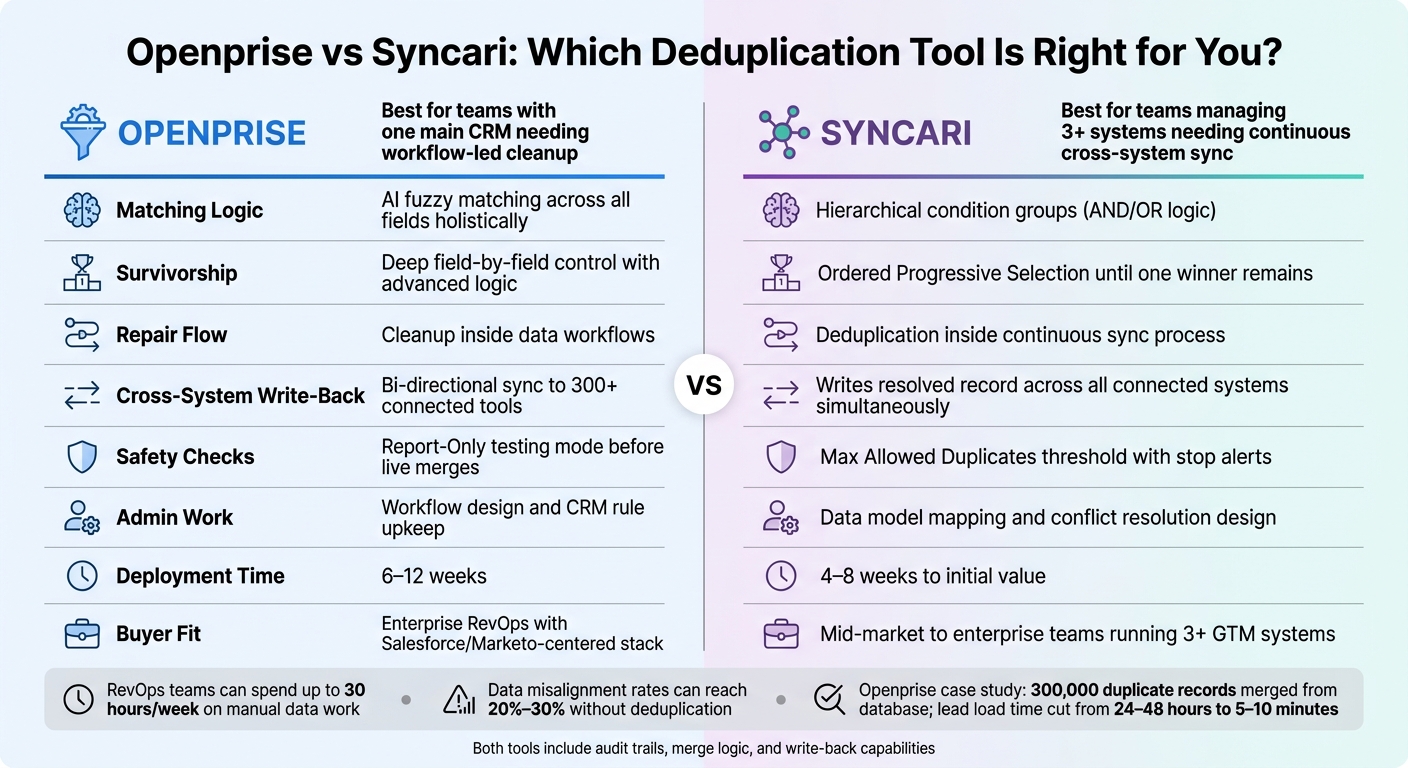
Openprise vs Syncari: Deduplication Tool Comparison
Quick Comparison
| Criteria | Openprise | Syncari |
|---|---|---|
| Best fit | One main CRM with heavy workflow rules | Multi-system stack that must stay aligned |
| Matching style | AI fuzzy matching across many fields | Rule-based matching groups in order |
| Survivorship | Deep field-by-field control | Ordered winner rules plus merge policies |
| Repair flow | Cleanup inside data workflows | Deduplication inside sync process |
| Write-back | Bi-directional sync to connected tools | Writes resolved record across all connected systems |
| Safety checks | Report-only testing before live merges | Duplicate thresholds and stop alerts |
| Admin work | Workflow design and rule upkeep | Data model mapping and conflict rule upkeep |
In short, Openprise is the better pick for workflow-led cleanup, while Syncari fits teams that need one merged record to stay the same across the stack.
That’s the frame I’d use before getting into the full comparison.
sbb-itb-5174ba0
Openprise: Deduplication Approach, Workflow Design, and Controls
Matching Logic and Survivorship in Openprise
Openprise uses AI-driven fuzzy matching to catch record variants like "Cisco" vs. "Cisco Systems" and address shorthand that native CRM rules often miss. Instead of checking one field at a time, it scores records across multiple fields.
It also handles leads, contacts, and accounts together, which helps preserve relationships when a duplicate lead is merged into an existing contact or known account. Survivorship rules are configurable, so teams can decide whether to keep the most recent value, the most complete one, or the value from a preferred source system. At the field level, rules can also sum scores or keep the earliest value.
Workflow Setup, Repair Steps, and Cross-System Write-Back
That matching logic sits inside a larger data pipeline that can standardize, enrich, and write records back to connected systems. Openprise uses a no-code workflow builder to run profiling, standardization, deduplication, enrichment, and write-back in one pipeline.
Corrected data can sync bi-directionally across Salesforce, Marketo, HubSpot, and systems like Snowflake. In practice, that means teams can fix data in one flow instead of patching the same issue in multiple tools. Typical deployment takes 6 to 12 weeks to map data flows, build orchestration rules, and validate output quality [9].
Before anything goes live, teams can use Openprise's "Report Only" mode to test matching logic and review transaction data before merges hit the live CRM [5].
Reporting, Governance, and Buyer Fit
Once merges start touching routing, scoring, and reporting, control becomes a big deal. Openprise logs every record transformation with a full audit trail, so ops teams can review what changed, where it changed, and which rules drove the update. It also gives teams control over rules across objects and source systems.
On the compliance side, Openprise meets GDPR, SOC 2, ISO 27001, and CCPA standards [10].
At scale, the platform has handled large cleanup jobs. A leading enterprise identity provider merged 300,000 duplicate records from a database of more than 6 million and cut lead load time from 24–48 hours to 5–10 minutes [1].
Openprise tends to fit teams that have:
- A dedicated RevOps or Marketing Ops owner
- A Salesforce- or Marketo-centered stack
- Enough record volume to make the deployment worth the effort
Syncari: Global Deduplication, Data Unification, and Observability
Global Deduplication and Cross-System Matching in Syncari
Where Openprise leans on workflow-based cleanup, Syncari is built around continuous sync across systems. It deduplicates data across all connected apps at the same time, so when a merge happens in one system, that change updates the rest of the stack too [6]. After that, Syncari picks the winning record and sends the resolved data back across connected tools.
Syncari includes six fuzzy-match operators: Resembles, Contains Words Like, Sounds Like, Nearly Matches, Loosely Matches, and Is a Variant Of [11]. Teams can also set hierarchical matching rules and apply Skip-When filters to leave certain records out of the process [5].
Two-Way Sync and Data Repair Flow
Syncari runs deduplication through Merge Studio in three steps: find duplicates, select a winner, and merge records [5]. Winner selection follows ordered rules, checking each condition one by one until one record comes out on top. That can be based on rules like Earliest Created or Most Complete [5].
Once Syncari picks a winner, merge policies decide what happens to the data from the losing records. Teams can set a global default, like “fill blank fields,” and then override that rule for individual fields when needed [5]. The sync engine then writes the resolved record back to every connected system, whether that means separate Salesforce orgs or a mix of Marketo and HubSpot [6].
Observability, Governance, and Buyer Fit
Syncari logs every change with a full transaction trail, including the old value and the new value, which gives teams a clear audit record for deduplication activity [8]. It also includes a Max Allowed Duplicates threshold as a safety check. If a merge group goes over that limit, the process stops and sends a notification before anything is written back to connected systems [5].
This setup makes sense for teams that need deduplication running across several systems at once, not just inside a single CRM. It’s a strong fit for mid-size to large teams managing multiple GTM systems, especially during M&A consolidation or when dealing with multiple CRM instances.
Side-by-Side Comparison: Where Openprise and Syncari Differ
After the workflow and sync models, the main decision comes down to orchestration vs. shared-state deduplication.
Deduplication Logic, Automation Style, and Stack Coverage
Openprise handles deduplication inside a workflow. Syncari takes a different path: it keeps a unified state across connected systems. In practice, Openprise runs deduplication through configured workflows and then writes the results back to connected systems [3]. Syncari keeps data unified across those connected systems [6].
Their matching logic also works in very different ways. Openprise uses AI-driven fuzzy matching that looks at all fields together, more like how a person would review a record set [1]. Syncari uses a hierarchical, condition-based setup in Merge Studio, where matching groups are checked in order until one winner is found [5].
So the split is pretty clear: pick Openprise for workflow control; pick Syncari for continuous cross-system consistency.
| Criteria | Openprise | Syncari |
|---|---|---|
| Matching Logic | AI fuzzy matching across all fields holistically [1] | Hierarchical condition groups (AND/OR logic) [5] |
| Survivorship Style | Field-by-field rules; supports advanced logic like summing values [2] | Progressive Selection - ordered condition evaluation until one winner remains [5] |
| Automation Style | Continuous schedule or record-entry triggers [1] | Continuous detection and resolution [12] |
| Cross-System Support | 300+ integrations, including Salesforce, Marketo, Dynamics 365, and Eloqua [3] | Global deduplication across connected CRM, MAP, and ERP systems [6] |
| Data Model | Workflow-led deduplication layer; data processed in transit [3] | Multi-directional sync that keeps records aligned across systems [12][6] |
Reporting, Governance, Deployment Effort, and Team-Size Fit
That same split shows up in reporting and admin work. Openprise leans into data-quality scores and workflow outcomes. Syncari leans into lineage and a full change trail [4][7].
The setup work is different too. Openprise asks you to design workflows. Syncari asks you to map systems to each other and define conflict rules [4][7]. Same goal, different kind of lift.
| Criteria | Openprise | Syncari |
|---|---|---|
| Reporting | Data quality scores and workflow outcomes [4] | Data lineage and cross-system audit trails [7] |
| Governance | Field-level rules via Data Quality Engine [13] | In-flight governance via unified data model [7] |
| Deployment Effort | Workflow design and CRM data expertise required [4] | Data model mapping and conflict resolution design required [7] |
| Ongoing Admin | Maintaining complex no-code workflows [4] | Managing sync logic and conflict resolution [7] |
| Buyer Fit | Enterprise RevOps with complex multi-source orchestration needs [3] | Mid-market to enterprise teams managing three or more systems [7] |
Openprise is a better fit for teams with one main CRM and heavy workflow orchestration needs. Syncari makes more sense for teams running three or more systems and trying to keep records in sync across the stack.
Conclusion and Next Steps for Evaluating Deduplication Tools
Openprise makes the most sense for workflow-heavy Salesforce and Marketo setups. Syncari is a better match for teams that need duplicate resolution to stay aligned across three or more systems. With that line drawn, compare each tool based on stack complexity, governance needs, admin capacity, and duplicate volume.
Key Decision Points Before Shortlisting
Where are duplicates coming from? If duplicates mostly enter through web forms and list imports into a single CRM, Openprise’s workflow-led approach is a good fit [1]. If duplicate records come from conflicting data across systems like Salesforce, HubSpot, and NetSuite, Syncari is built for that job [7][14].
How many systems need to stay in sync? Openprise works best when Salesforce or Dynamics 365 sits at the center. Syncari starts to pull ahead when you need to coordinate three or more systems at the same time [7].
Who will own this day to day? Openprise needs dedicated RevOps skill to manage visual workflows and CRM data architecture. Syncari needs a dedicated owner too, especially for data model mapping and conflict resolution design. In most cases, both platforms take 4–8 weeks to reach initial value [3][7]. Openprise also offers a "Data Mechanic" managed service for teams that don’t have the internal bandwidth [3].
How customized do your survivorship rules need to be? If you need field-by-field logic and custom survivorship rules, Openprise handles that well [2]. If you need one unified record that stays consistent across every connected system, Syncari’s stateful sync is the better choice [14].
"Deduplication is not just a data hygiene project. It's the prerequisite for routing and territory management that actually works." - Openprise [1]
Shortlist Openprise for workflow-led control. Shortlist Syncari for steady cross-system consistency.
FAQs
Which tool is better for a single-CRM setup?
For a single-CRM setup, Openprise is often the better fit. It leans into workflow-based data automation inside CRM platforms, including deduplication, lead routing, normalization, and enrichment.
Syncari makes more sense in complex, multi-system setups, where bi-directional synchronization and fixing inconsistencies across connected systems are the main job.
When does cross-system deduplication become necessary?
Cross-system deduplication becomes necessary when your revenue operations stack grows beyond a single platform and records start living in several connected tools.
Cleaning up duplicates in just one system isn't enough. Duplicates across platforms can split your data, inflate engagement scores, and lead to failed suppression lists. Cross-system deduplication helps keep a unified view in place and prevents one-off cleanup work.
What internal team support is needed after launch?
After launch, teams shift from manual cleanup to day-to-day monitoring and management. The goal is simple: make sure the merge logic is doing what it’s supposed to do.
That means tracking results to confirm survivorship rules still work as expected. For example, teams should check whether the right winner record is being selected and whether activity history is handled the right way after records are merged.
Teams also need to review and update the database on a regular basis. On top of that, they should keep data governance standards in place, train staff, and check from time to time that merges still fit business needs as data requirements or integrations change.