Personalized campaign automation helps businesses deliver tailored content by using AI to analyze customer behavior, such as browsing habits and purchase patterns. This approach improves engagement, saves time, and drives significant ROI. For example, automated emails generate 41% of email orders despite making up just 2% of total sends. Businesses using these tools report an average ROI of $5.44 for every $1 spent.
Here’s a quick overview of the top tools for personalized campaign automation:
- ActiveCampaign: Real-time tracking, AI-powered segmentation, and multi-channel support starting at $15/month.
- HubSpot Marketing Hub: Unified CRM with AI features for $9/month (basic plan).
- Brevo: Affordable multi-channel campaigns starting at $8.08/month.
- Drip: Ecommerce-focused automation with advanced segmentation.
- Klaviyo: Predictive analytics and real-time customer insights starting at $20/month.
- Insider One: Unified data for omnichannel campaigns, free for startups.
- Braze: Enterprise-level real-time personalization, ~$1,000/month.
- GetResponse: Multi-channel automation with AI tools starting at $15.58/month.
- Moosend: Budget-friendly email marketing with AI-driven segmentation, $9/month.
- Gumloop: AI-powered reasoning for data-driven campaigns, starting at $37/month.
Quick Comparison
| Tool | Key Features | Starting Price (USD/mo) |
|---|---|---|
| ActiveCampaign | AI segmentation, multi-channel support | $15.00 |
| HubSpot | CRM integration, AI tools | $9.00 |
| Brevo | Simple automation, predictive AI | $8.08 |
| Drip | Ecommerce-specific workflows | Custom |
| Klaviyo | Predictive analytics, SMS support | $20.00 |
| Insider One | 120+ attributes, omnichannel campaigns | Free for startups |
| Braze | Real-time personalization | ~$1,000.00 |
| GetResponse | AI recommendations, multi-channel | $15.58 |
| Moosend | AI segmentation, budget-friendly | $9.00 |
| Gumloop | AI-driven data insights | $37.00 |
Each tool offers unique strengths, from cost-effective solutions for small businesses to advanced platforms for enterprise needs. Start with one impactful campaign, like an abandoned cart workflow, and scale as you see results.
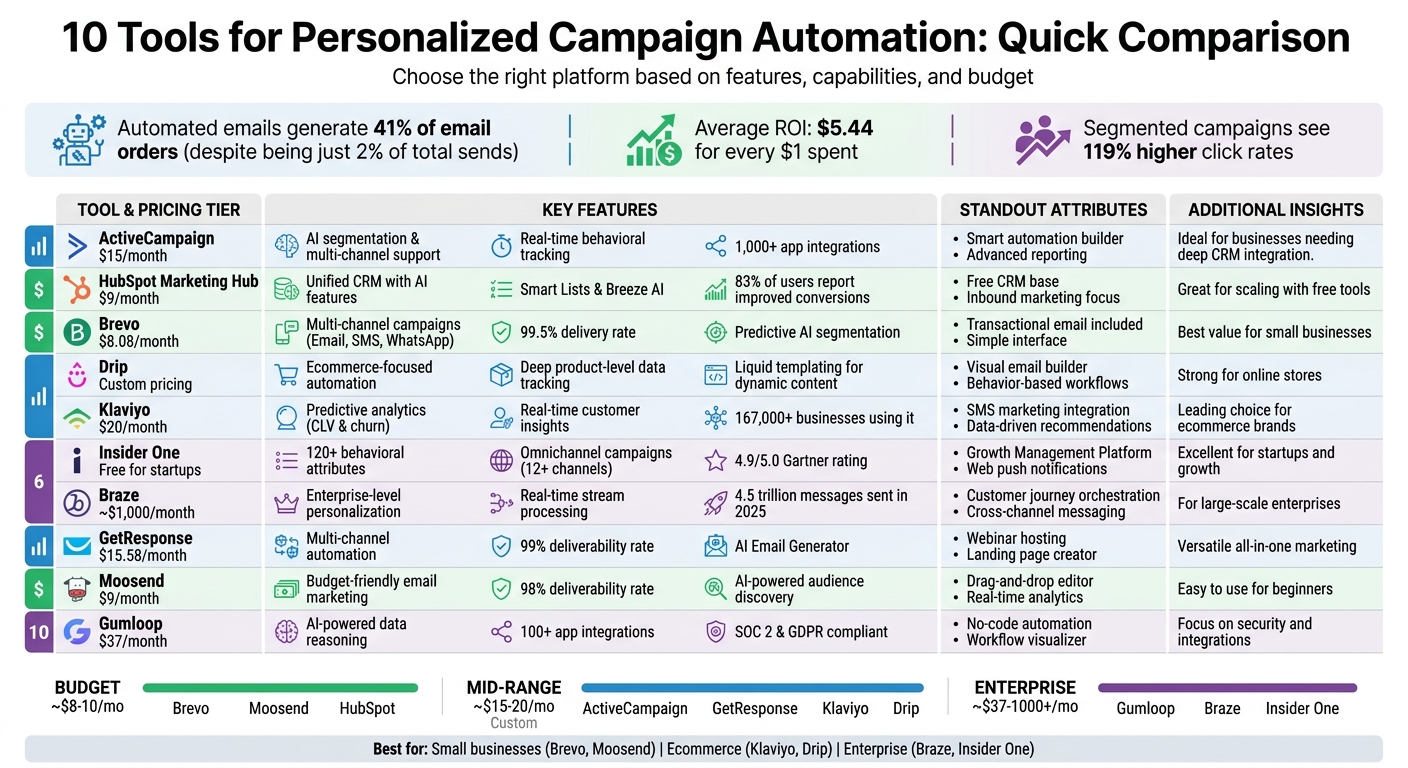
Comparison of Top 10 Personalized Campaign Automation Tools: Features and Pricing
The Best Marketing Automation Tools in 2025
sbb-itb-5174ba0
1. ActiveCampaign
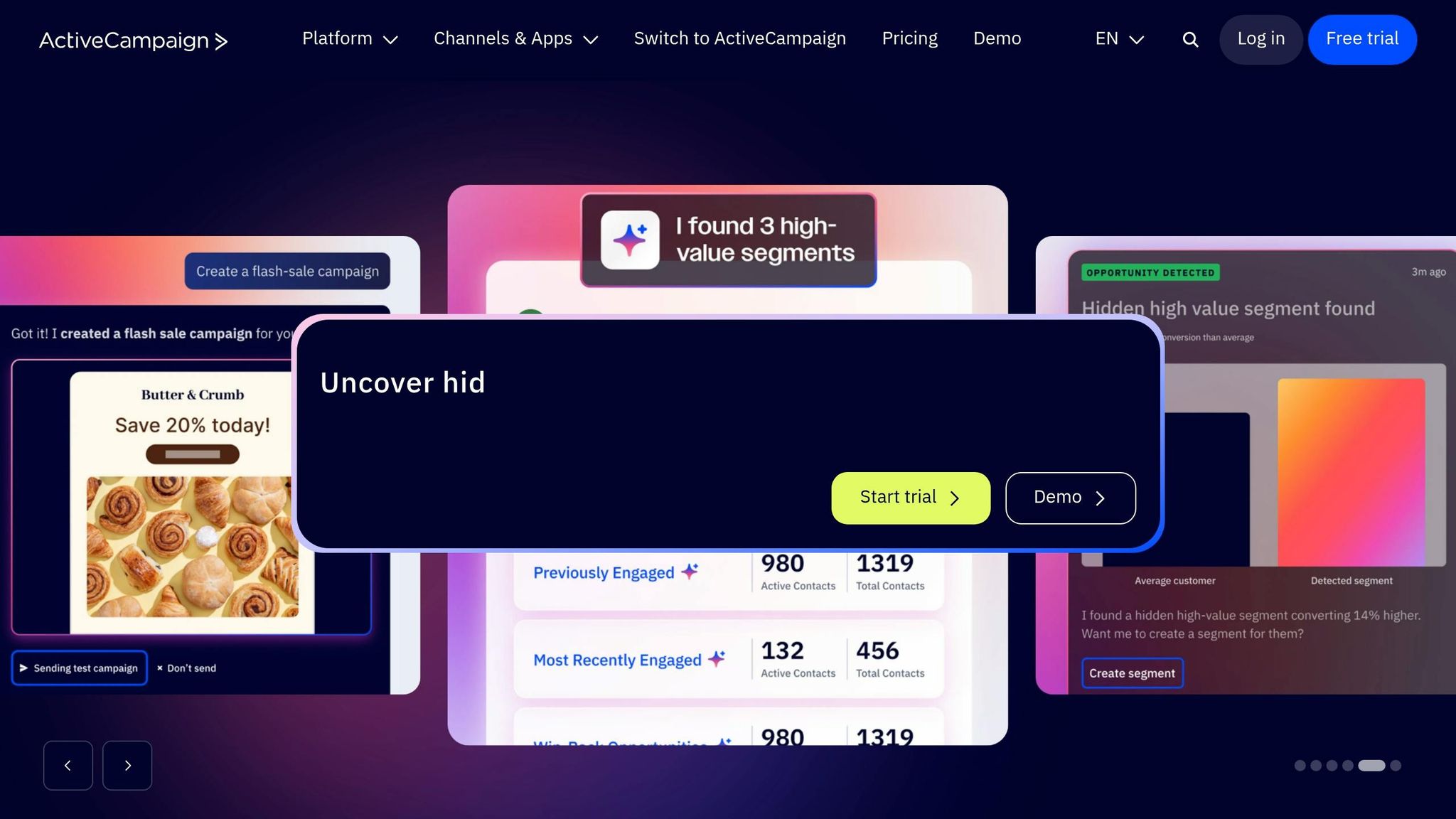
ActiveCampaign blends real-time behavioral tracking with AI-powered automation to help businesses create tailored campaigns across email, SMS, and WhatsApp. Starting at just $15 per month, it offers over 1,000 app integrations - including Salesforce, Shopify, and WooCommerce - making it a great choice for teams aiming to scale their personalization efforts without needing extra staff or technical know-how [7][10].
Audience Segmentation
One of ActiveCampaign's standout features is its ability to automatically update dynamic segments. Using flexible AND/OR logic, it segments audiences by demographics, location, and psychographics, removing the need for manual list updates. Powered by its "Active Intelligence" engine, the platform identifies valuable audience groups, such as repeat buyers or at-risk subscribers [8].
For instance, Ducks Unlimited Canada saw its email click-through rates double within just three months of using these tools. To get started, marketers are encouraged to focus on two or three clear segments, like "new subscribers" or "repeat buyers", and gradually introduce more complexity as they refine their targeted messaging [6]. These insights are then turned into real-time actions through behavioral triggers.
Behavioral Triggers
ActiveCampaign tracks real-time customer actions - such as form submissions, email clicks, website analytics to track visits, abandoned carts, and purchase history - to trigger timely follow-ups [7]. Take Morrow Audio, for example, which achieved a 26% recovery rate for abandoned carts by leveraging these triggers. Additionally, the platform's split and conditional actions ensure that workflows adapt based on engagement levels, delivering messages that align with each contact's behavior [11].
AI-Driven Personalization
ActiveCampaign's AI tools take personalization to the next level. Features like predictive sending optimize delivery times based on past engagement, while sentiment analysis and AI-generated content add further precision [8]. For example, Soundsnap boosted open rates by 20% and tripled its monthly email revenue using predictive sending.
The AI Brand Kit is another handy tool, automatically pulling logos, fonts, and colors from your website to ensure consistent branding across templates. Amy Chinitz, founder of Spark Joy New York, experienced a threefold increase in both sales calls and sales volume by combining automations with ActiveCampaign's AI capabilities. She shared:
"When I combine my existing automations with ActiveCampaign's AI features, I get three times as many sales calls as before" [9][11].
Multi-Channel Support
ActiveCampaign also excels at managing messaging across multiple channels like email, SMS, and WhatsApp, ensuring a unified brand presence [11]. For example, YMCA of Alexandria used the AI Brand Kit to simplify email creation, achieving a 12.8% click-through rate - far above the industry average of 2% - while saving 10 hours of work each week.
The platform’s Model Context Protocol even allows users to integrate external AI tools like ChatGPT or Claude, enabling workflows triggered by natural language commands. A 14-day free trial with complete platform access is available, and all plans include free onboarding and migration services [7].
2. HubSpot Marketing Hub
HubSpot Marketing Hub blends a unified CRM with AI-powered automation tools to create personalized campaigns across email, social media, SMS, and web content. It offers a free plan, with paid options scaling up to $3,600 per month for enterprise-level capabilities. Impressively, 83% of users have reported improved conversion rates after using the platform [14]. By using real-time CRM data as a single source of truth, HubSpot eliminates syncing issues, making it a standout choice for seamless marketing automation.
Audience Segmentation
HubSpot’s Active Lists automatically update as engagement metrics change, ensuring your audience segments always reflect current user behavior [15]. The platform organizes contacts based on lifecycle stages, firmographic data, and behavioral cues - like visits to pricing pages or form submissions.
Why does this matter? Segmented email campaigns generate 30% more opens and 50% more clicks compared to non-segmented ones [15]. HubSpot’s Lookalike Lists feature helps identify high-value prospects by comparing them to your top-performing customers. Additionally, intent-based segmentation targets anonymous site visitors by analyzing their demographics and behavior [14].
Take Crunch Fitness, for example. They manage over 15 million monthly email sends while maintaining a high level of personalization - all thanks to HubSpot’s CRM-driven segmentation [13]. If you’re just getting started, prioritize high-intent segments, such as users who visited your pricing page within the last two weeks [15].
Behavioral Triggers
HubSpot enables marketers to set up triggers based on actions like web visits, email clicks, form submissions, and content downloads [12]. High-value activities - such as viewing a pricing page, abandoning a shopping cart, or downloading an ebook - can trigger personalized follow-ups.
Tim Morse, Digital Marketing Manager at Element Three, shared how he used HubSpot to integrate Facebook Lead Ads with the platform’s automation tools. He explained:
"The combination of Facebook Lead Ads integrated with HubSpot's marketing automation platform make certain that this information is delivered to the right audiences in the most seamless, frictionless way possible" [13].
HubSpot also supports workflows triggered by social media engagement, live chat interactions, and CRM updates like lead score changes or lifecycle stage shifts. To avoid overwhelming contacts, it’s recommended to limit automated emails to 2–3 per week and schedule them during optimal hours.
AI-Driven Personalization
HubSpot’s Breeze AI suite leverages data from over 200 million profiles to identify high-intent leads and create personalized content at scale [17]. The AI Email Writer uses CRM data - such as lifecycle stages and past interactions - to craft tailored email copy, significantly reducing manual effort. Businesses using these tools have seen a 107% increase in leads and a 35% boost in deal closures [17].
HubSpot’s Smart Content feature adjusts website elements like headers, CTAs, and offers based on visitor data. Meanwhile, the Campaign Assistant generates platform-specific copy for over 15 channels, including Google Ads, Facebook, and LinkedIn. Predictive AI also determines the best send times for each contact, enhancing engagement rates [15].
Kipp Bodnar, HubSpot’s CMO, highlighted this approach, saying:
"AI-powered marketing is leading to easier, breezier growth. AI tools and unified tech stacks are a major differentiator in helping marketers connect with their audiences" [13].
Multi-Channel Support
HubSpot ensures that these personalized insights are applied consistently across all communication channels. The platform synchronizes messaging across email, social media, SMS, web content, and live chat, all driven by the same central data [13]. Users have reported a 167% increase in website traffic and a threefold increase in inbound leads within six months of adopting the platform [16].
For added convenience, HubSpot integrates with Salesforce, enabling instant sharing of lead intelligence - like email opens and website activity - with sales teams. While the free plan includes basic email automation and lead capture forms, paid plans unlock advanced features like progressive profiling, which gathers detailed customer information over time without overwhelming them.
3. Brevo
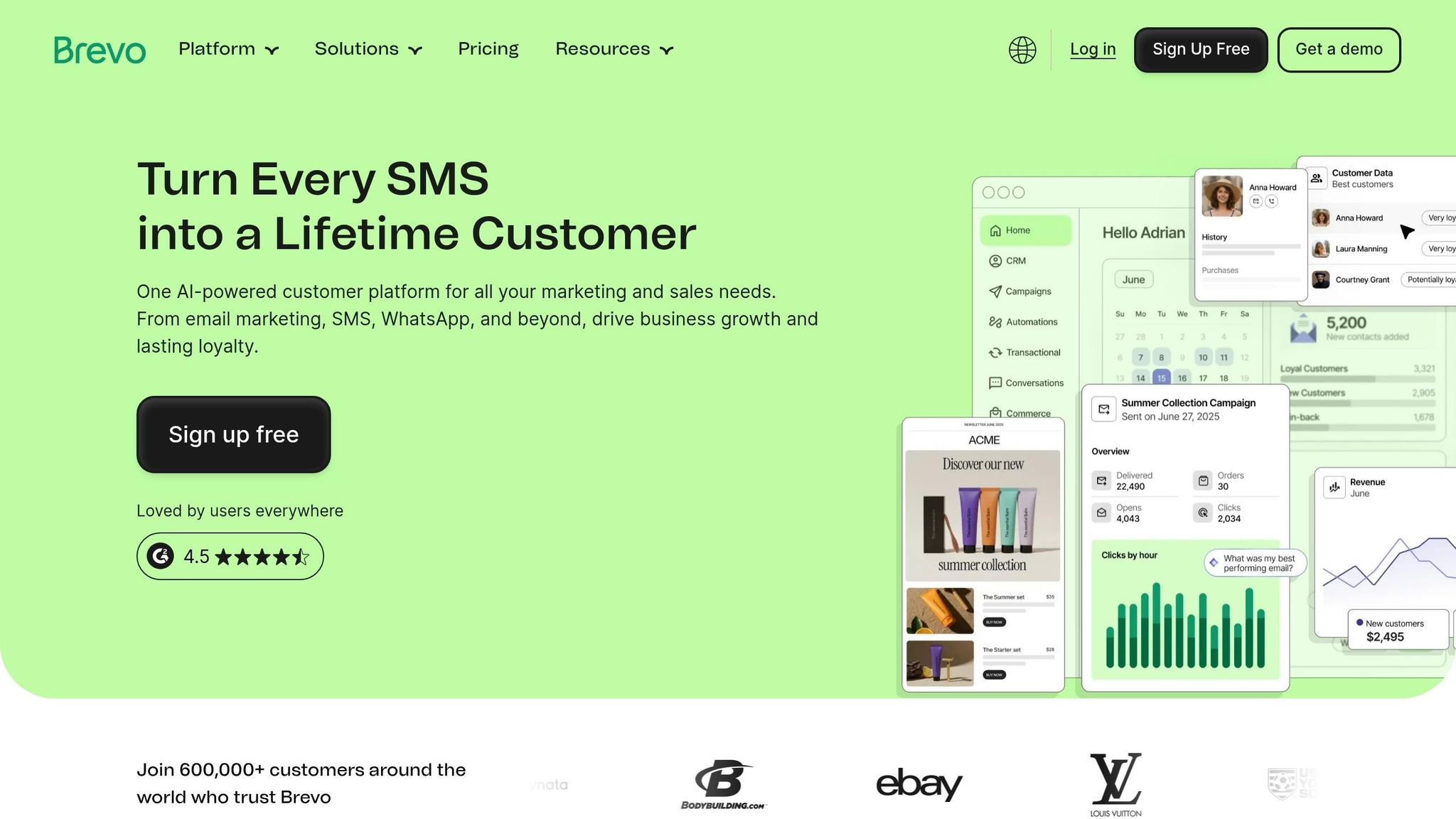
Brevo brings together email, SMS, WhatsApp, and live chat into one dashboard, simplifying personalized campaign automation. Trusted by over 500,000 businesses worldwide, it boasts an impressive 99.5% delivery rate for both marketing and transactional messages. Pricing starts at $0/month for up to 300 daily emails, with full automation features available from $16/month. The platform charges based on email volume instead of contact count, offering flexibility for businesses of all sizes [20].
Audience Segmentation
Brevo’s dynamic segments are designed to automatically update as new data comes in. In January 2025, these replaced the older "dynamic lists" system, offering greater adaptability [18]. Segments can be created using fixed rules like "purchased product X in the last 30 days" or with predictive AI, which groups contacts based on their likelihood to engage [21].
Alltricks, a cycling and outdoor gear retailer, saw firsthand how effective this approach can be. By moving from targeting based on self-declared interests to predictive segmentation - using real browsing and purchase behavior - they achieved a 30–40% boost in campaign engagement. Christelle Grauer, Brevo’s VP of Data, highlighted how this strategy focuses on real-time customer needs:
"Predictive targeting ensures [customers] receive communications that actually reflect their current needs, not outdated assumptions." [21]
The key? Shift to behavioral signals instead of relying on static interests, apply recency decay to stay relevant, and measure success using analytics tools for business to track Customer Lifetime Value (CLV) rather than just open rates [21]. This approach naturally integrates with Brevo’s automated trigger features.
Behavioral Triggers
Brevo supports a variety of automated triggers, including welcome series for new subscribers, abandoned cart reminders, and personalized messages for birthdays or anniversaries. Businesses can also use website activity - like viewing specific pages or downloading content - as triggers for tailored follow-ups. For example, companies implementing abandoned cart emails often see revenue increases of 10–15% [19].
Take Monisnap, a financial services company, as an example. By leveraging Brevo’s automation tools, they boosted customer loyalty by 40% and tripled money transfer transactions through targeted customer journeys [19]. The platform’s omnichannel capabilities allow businesses to create workflows that span multiple channels. For instance, if an email goes unopened for 48 hours, a follow-up SMS can be sent automatically [23]. Starting with workflows like welcome emails and abandoned cart reminders, paired with AI send-time optimization, can significantly improve engagement [34,38].
AI-Driven Personalization
Brevo’s AI tools take personalization to the next level. The platform uses AI to craft subject lines and email content that align with a brand’s tone, while AI-powered segmentation predicts customer behavior to group contacts more effectively [35,36]. Its Aura AI agent handles complex tasks like data analysis and audience segmentation, saving time and reducing manual work [22]. Sarah Mitchell, Marketing Director at TechFlow Solutions, shared her experience:
"Brevo transformed our email marketing. We saw a 47% increase in open rates within the first month." [20]
The AI send-time optimization feature ensures emails are delivered at the best time for each contact, based on their individual engagement patterns. Campaigns using behavior-driven predictive segmentation have shown 30–40% higher engagement rates [39,36].
Multi-Channel Support
Brevo extends its automation capabilities across multiple channels, creating a unified customer experience. The platform integrates eight communication channels - email, SMS, WhatsApp, web push, mobile push, live chat, chatbots, and phone - into one system [23]. It also includes native support for the WhatsApp Business API, enabling marketers to send promotional messages and track read receipts directly from the campaign editor [23]. Kevin Yen, Head of Growth at AI Camp, highlighted the cost savings and functionality Brevo provides:
"Brevo gives us the functionality and flexibility we need to manage our marketing engagement as well as our sales pipeline while saving us $30,000 annually compared to HubSpot." [24]
With email marketing on Brevo delivering an average ROI of $36 for every $1 spent, and its dedicated infrastructure ensuring high delivery rates for transactional emails like order confirmations and password resets, the platform offers a reliable solution for businesses looking to optimize their customer communications [23].
4. Drip
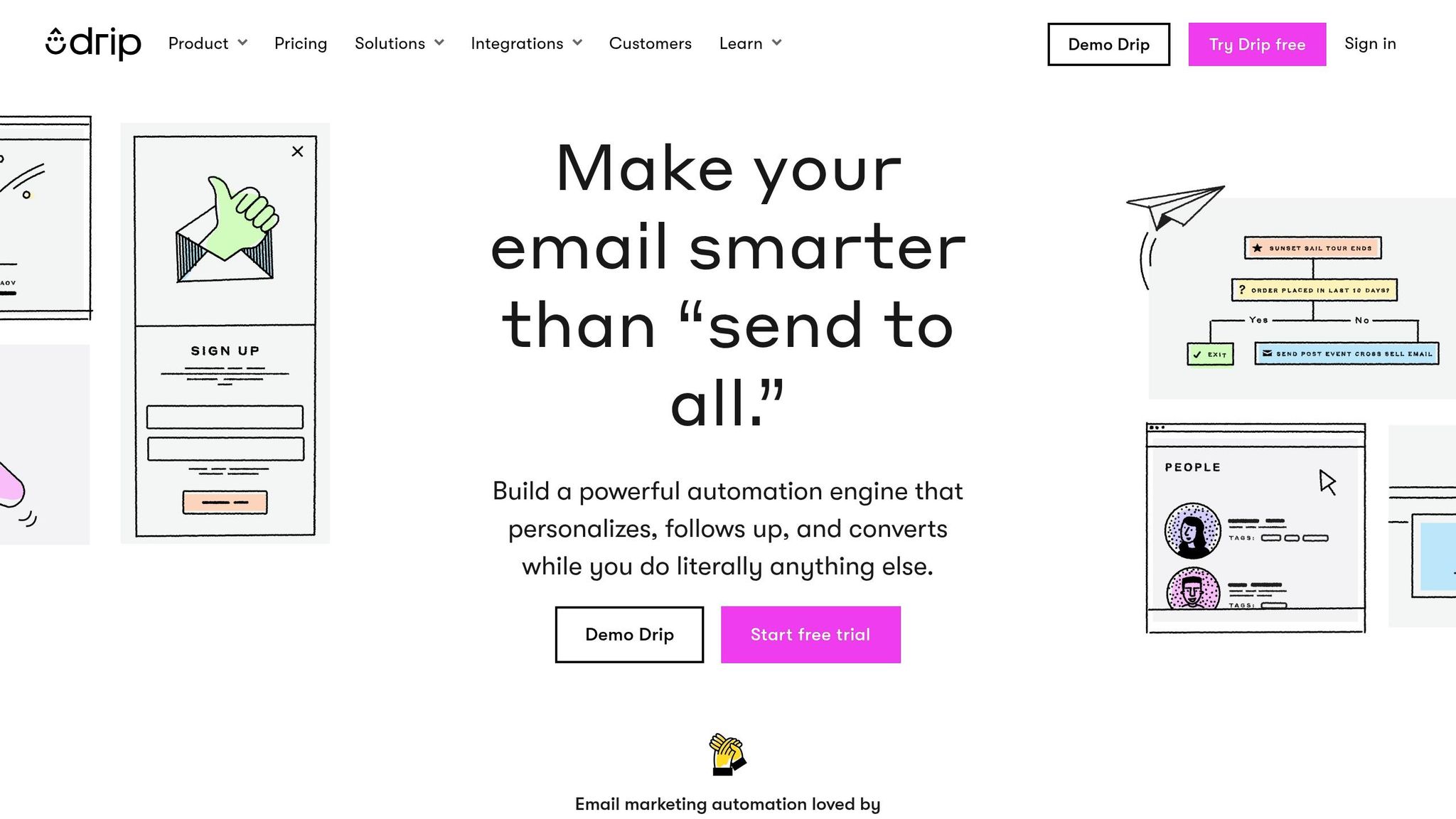
Drip focuses heavily on personalization, offering automation tools specifically designed for ecommerce businesses. Its features integrate effortlessly into multi-channel campaigns, making it a go-to platform for businesses aiming to create tailored customer experiences. One of its standout tools is the visual workflow builder, which simplifies the creation of intricate, multi-step automation processes that adapt to customer behavior in real time. With integrations into platforms like Shopify, WooCommerce, Stripe, and PayPal, Drip uses purchase data, browsing habits, and engagement signals to power its segmentation and automation capabilities [25][27].
Email tool tester Inka Wibowo highlighted Drip's strengths:
"Drip is perhaps the easier of the two to master, and is excellent for ecommerce automations... [it's] been purpose-built for ecommerce." [27]
Audience Segmentation
Drip's dynamic segments adjust automatically as customer data evolves - whether it's a new purchase or a simple page view [26]. The platform supports various segmentation methods, including:
- Behavioral tracking: Tracks actions like page views, cart additions, and email clicks.
- Value-based analysis: Focuses on metrics such as order count, average order value, and lifetime value.
- Predictive AI: Forecasts customer behavior, such as who’s likely to purchase in the next 14 days or who’s at risk of leaving [25][26].
Segmented campaigns deliver impressive results, with 100.95% more clicks and 14.31% more opens compared to non-segmented emails [25].
One of Drip's standout features is Liquid templating, which allows you to customize email content dynamically. For example, you could send a single email that offers "2-day shipping" to new prospects while showing a "loyalty discount" to returning customers - all within the same message [25]. Additionally, Drip supports RFM analysis (Recency, Frequency, Monetary) to identify top customers, at-risk subscribers, and potential leads. These segments can even sync with Facebook Custom Audiences, ensuring consistent targeting across platforms [25][27].
Behavioral Triggers
Drip includes straightforward Rules for creating "if this, then that" triggers [27][25]. It tracks ecommerce-specific actions like product purchases, browsing, and link clicks, as well as website activities such as page visits and form submissions [27]. With Trigger links, you can automatically add tags or kick off workflows whenever a link is clicked, fine-tuning your audience segmentation in real time [25].
Considering that the average cart abandonment rate is 69.23%, Drip's automated recovery workflows can make a big difference in conversions [25]. For example, Hamee, a Drip user, shared how the platform transformed their email sales:
"The #1 thing I absolutely LOVE is their automation, more specifically how easy and user-friendly they make it... I saw a huge spike in our email sales!" [27]
Drip also offers over 40 pre-built templates for ecommerce, including welcome series and win-back campaigns [28]. A smart strategy is to create segments for "at-risk" customers - those with high lifetime value who haven’t purchased in 60 days - and send targeted incentives to bring them back. Even retaining just 5% more customers can boost profits by over 25% [25].
AI-Driven Personalization
Drip leverages predictive AI to anticipate customer behavior. It identifies customers "likely to buy in the next 14 days" or those at risk of leaving, enabling you to launch timely campaigns like flash sales for high-intent buyers while avoiding unnecessary discounts at the bottom of the funnel [26]. This aligns with consumer preferences - 80% of customers are more likely to buy from brands offering personalized experiences, and effective personalization can boost revenue by 5–15% [26].
The platform's visual workflow builder is another highlight, allowing you to create automation journeys tailored to customer preferences without needing any coding skills. To maintain performance, Drip limits accounts to 50 active workflows at a time, but its extensive template library covers most ecommerce needs [27].
5. Klaviyo
Klaviyo stands out by using real-time data and AI-driven tools to power highly customized marketing campaigns, often ranking among the top analytics tools for e-commerce. It’s a go-to platform for over 167,000 businesses, offering a system built on real-time data and predictive insights [33]. With more than 350 pre-built integrations, Klaviyo consolidates customer data - like purchase history and support tickets - into a single, detailed view of each customer [29].
Audience Segmentation
Klaviyo’s audience segmentation adapts in near real-time as customer data evolves, eliminating the hassle of manual updates [46,47]. You can create segments using all historical data, and with its Segments AI feature, defining audiences becomes as simple as typing plain language commands. For instance, you could specify, "customers who opened a support ticket and have a predicted CLV of $500", and the platform will generate the exact segment automatically [46,47].
What sets Klaviyo apart is its use of predictive analytics. Once you have 180 days of order history and 500 customers, the platform can predict churn risk, the expected date of the next order, and forecasted Customer Lifetime Value [46,50]. As Jon Palmer, Klaviyo’s Lead Product Marketing Manager, explains:
"In Klaviyo, you don't need a whole data science team to do it [predictive analytics]. You can use them in segmentation and automation as a dropdown option" [31].
Another standout feature is channel affinity, which predicts whether a customer prefers email, SMS, or push notifications [32]. This allows you to create segments like “email-first” or “SMS-first” for better engagement. Segmented campaigns using Klaviyo have been shown to generate over three times the revenue per recipient compared to unsegmented ones [30]. These segments can also sync with platforms like Facebook, Instagram, and Google Ads to retarget high-value customers or build lookalike audiences [46,50].
Behavioral Triggers
Klaviyo’s automated flows take these precise segments and activate them at the right moment. The platform’s Flows feature responds to customer actions like signing up for newsletters, browsing products, or completing purchases [36]. These real-time triggers deliver messages with what Klaviyo calls "Amazon-level personalization" [33].
With over 160 customizable templates for emails and flows, you can easily set up campaigns for welcome series, abandoned cart recovery, and post-purchase follow-ups [52,53,56]. Conditional splits add another layer of sophistication, allowing you to send follow-ups through alternate channels if the initial message isn’t answered [49,56]. Jarrod Hinvest, Head of Ecommerce at Culture Kings, shares:
"Klaviyo, supercharged by its powerful AI features, enables us to easily and effectively build complex automated flows that deliver the right message to the right customers, in the right region, at the right time" [35].
These flows and segments adjust automatically as customer data updates [46,54]. For example, Every Man Jack, a men’s grooming brand, credits Klaviyo’s predictive segmentation with driving 12.4% of its revenue [34]. Additionally, Klaviyo’s integrations allow you to trigger flows based on detailed data from various sources [46,54].
AI-Driven Personalization
Klaviyo’s AI tools take personalization to the next level. The platform includes K:AI Agents, which handle tasks like creating on-brand campaigns, automated flows, and even resolving customer support issues or recommending products 24/7 [37]. With Flows AI, you can design automated messaging journeys using natural language prompts, eliminating the need for manual setup [57,46,59].
Features like Smart Send Time ensure messages are delivered when subscribers are most likely to engage, while Personalized Campaigns AI selects and sends the most effective version of a campaign to each recipient [57,58]. Automated emails through Klaviyo generate 14x higher revenue per recipient, with an average ROI of 63x [38].
The platform’s predictive analytics also help forecast Customer Lifetime Value, churn risk, and the "next best product" for individual customers [57,51]. Using RFM analysis (Recency, Frequency, Monetary value), you can identify VIP customers or those at risk of leaving and target them with AI-generated offers [51,54]. Chelsea Kinne, Retention Consultant at Tushy, praises the platform:
"Klaviyo is the ESP that I love the most. I have seen unparalleled success from the platform and would recommend it over anything else" [38].
Klaviyo starts at $60 per month, based on active profiles, with a free tier available for testing its features [38]. Its automation and predictive tools make it a powerful choice for marketers aiming to deliver highly personalized campaigns.
6. Insider One
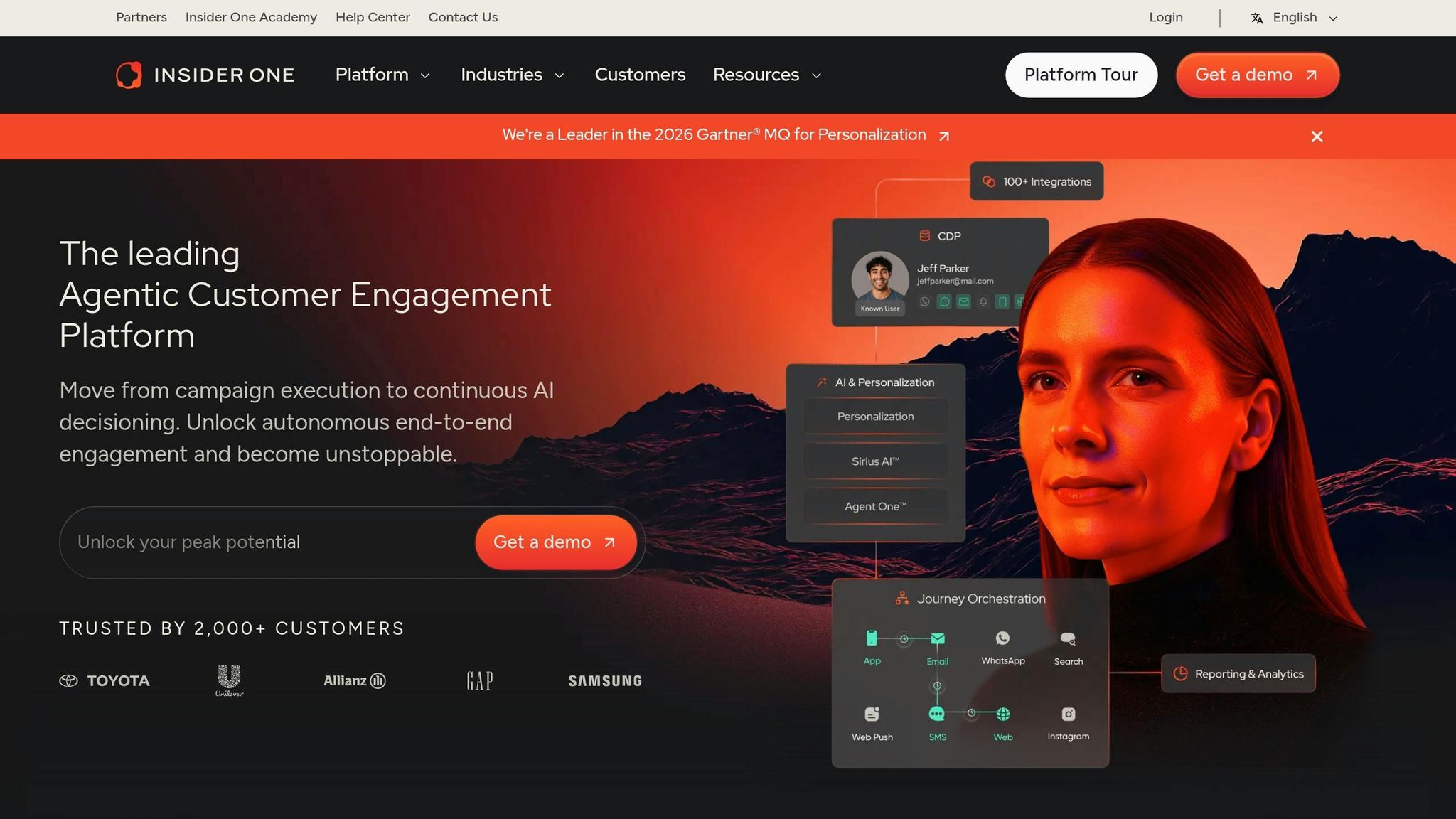
Insider One brings together data from websites, apps, CRM systems, point-of-sale terminals, and contact centers to provide a complete 360° view of every customer across more than 12 channels. These channels include email, SMS, WhatsApp, web push, and in-app messaging, all accessible from a single platform [60,62,63]. This unified approach enables businesses to create highly personalized campaigns. Insider One has earned recognition as a 2026 Gartner Magic Quadrant Leader for Personalization Engines and boasts an impressive 4.9/5.0 rating on Gartner Peer Insights [42].
Audience Segmentation
Insider One leverages its unified data capabilities to deliver precise audience segmentation. With over 120 rules and attributes, it allows marketers to create dynamic segments that update in real time [61,63]. These go beyond basic demographics, incorporating predictive AI to anticipate behaviors like purchase likelihood, churn risk, discount preferences, and potential customer lifetime value [61,63].
A Digital Marketing Manager at a global department store shared their experience:
"What I like best about Insider One is the fact that it allows us to provide an individualized onsite experience for our customers according to their interests." [39]
In early 2026, Slazenger utilized Insider One to target nearly 30 unique customer segments. By combining personalized omnichannel campaigns with gamified on-site experiences, the brand saw a 700% boost in customer acquisition and a 49X ROI in just two months [41]. Additionally, Insider One supports cookieless personalization by using contextual data and real-time behavior to deliver tailored experiences without relying on cookie consent [39].
Behavioral Triggers
Insider One enhances personalization further by tracking micro-interactions such as scrolls, searches, cart updates, and clicks across platforms like web, email, apps, and SMS. These interactions trigger immediate, tailored responses [43]. The platform’s goal-driven logic ensures follow-ups stop once the desired action is completed [43].
For instance, in 2025–2026, global insurer Generali used Insider One's AI-powered lead scoring to prioritize high-intent leads for sales teams while directing lower-priority leads into targeted nurture tracks. This approach shortened their sales cycle by 20% [43]. Similarly, the brand Remix implemented a three-step automated nurture flow using Insider One's Architect tool. By responding to real-time user activity and drop-off points, Remix achieved a 104% increase in first-time purchases [43]. Muharrem, Co-Founder & Chief Product Officer at Insider One, highlighted the benefits:
"With the right automation tool, like Insider One, your system can recognize that the goal has already been hit and move the lead to the next step." [43]
AI-Driven Personalization
Insider One combines predictive and generative AI to optimize customer interactions across the entire journey [39]. The platform offers more than 20 recommendation strategies, including options like "bought together", user-based affinity, and most valuable products, ensuring tailored suggestions for each user [39]. Real-time email personalization adjusts content, such as countdowns and carousels, the moment an email is opened [41].
For example, an international electronics retailer used Insider One's smart recommendations in email campaigns, achieving a 560% increase in conversion rates and an 86% reduction in bounce rates [41]. MAC Cosmetics also saw significant results, reporting a 17X ROI after implementing personalized product recommendations and cross-channel journey orchestration with Insider One's Smart Recommender [40].
The platform claims a 3X faster implementation time for marketing teams, helping them see results more quickly [40]. Its SMS and RCS marketing tools boast open rates as high as 98%, and brands have grown their subscriber bases up to seven times faster using pre-built, compliant opt-in templates [61,67]. These features make Insider One a powerful solution for automating fully personalized campaigns.
7. Braze
Braze operates using a stream-processing architecture that processes customer events, attributes, and purchases as they occur. This allows segments to update instantly with live data, enabling real-time campaign adjustments [44][45]. In 2025, Braze processed an impressive 17.9 billion personalized AI decisions and sent 4.5 trillion messages across multiple channels [47]. By combining user attributes like demographics and location with behavioral data - such as app usage and cart activity - Braze helps marketers create precise audience clusters and execute dynamic, data-driven campaigns [45][46].
Audience Segmentation
Braze’s Predictive Suite uses machine learning models to forecast customer behaviors, such as the likelihood of churn or purchase, eliminating the need for additional data science resources [44][48]. Its visual journey builder, Canvas, integrates these predictive segments to design detailed cross-channel experiences [47][50]. For instance, Eunpa Han, CRM Manager at Job Korea, utilized Braze’s dynamic segments and Braze Liquid to craft personalized recruitment messages. This approach resulted in a 4–5X improvement in average click-through rates. Han shared:
"Braze has allowed me to try different things as a CRM manager... being able to configure personalized messages with Liquid, A/B test with color and creative variations, diversify campaigns, and review performance reports without having to ask the development team has made my job more efficient" [45].
Behavioral Triggers
Braze delivers messages based on customer actions in real time, rather than relying on a fixed schedule [46]. Action-driven push notifications are 480% more likely to be opened compared to traditional ones, while triggered emails boast a 59% higher open rate than their non-triggered counterparts [46]. Additionally, Braze uses "exception events" to automatically remove users from a triggered segment once they complete a desired action - like making a purchase - before a follow-up message is sent [46]. For example, Too Good To Go leveraged Braze Catalogs and behavioral triggers to notify users about nearby availability of "Surprise Bags", leading to a 135% increase in purchases and doubling message conversion rates [45].
AI-Driven Personalization
BrazeAI Decisioning Studio employs reinforcement learning to optimize messaging across channels, timing, and incentives [50][51]. In fiscal year 2024, Kayo Sports expanded its communication variations from 300 to 1.2 million using Braze’s Customer Cortex engine. This resulted in a 14% rise in subscriptions, an 8% increase in average annual occupancy, and a 105% boost in cross-sells [50]. Additionally, Connected Content integrates live data from external APIs - such as weather updates, sports scores, or inventory levels - at the moment a message is sent, ensuring relevance [50]. Pizza Hut’s Victoria Mitchell, Manager of CRM Channel Strategy, reported that Braze’s cross-channel targeting and integrations drove a 21% increase in revenue and a 30% rise in transactions [49].
Multi-Channel Support
Braze supports a wide variety of channels, including email, SMS, in-app messaging, web notifications, WhatsApp, LINE, and digital ads, all managed through its centralized Braze Canvas interface [52]. Its Intelligent Channel feature ensures messages are sent via the customer’s preferred platform to boost engagement [53]. During the pandemic, Canva scaled its weekly email volume from 30 million to 50 million with Braze, using dynamic content and automated localization in over 20 languages. This effort led to a 33% jump in open rates, a 2.5% increase in engagement, and a 99% deliverability rate [50]. Juan Fiore, CRM Automation Manager at Rappi, explained:
"Braze gives us the capability to reach the user at the right time with the right channel, with personalized content to be relevant for the user" [52].
8. GetResponse
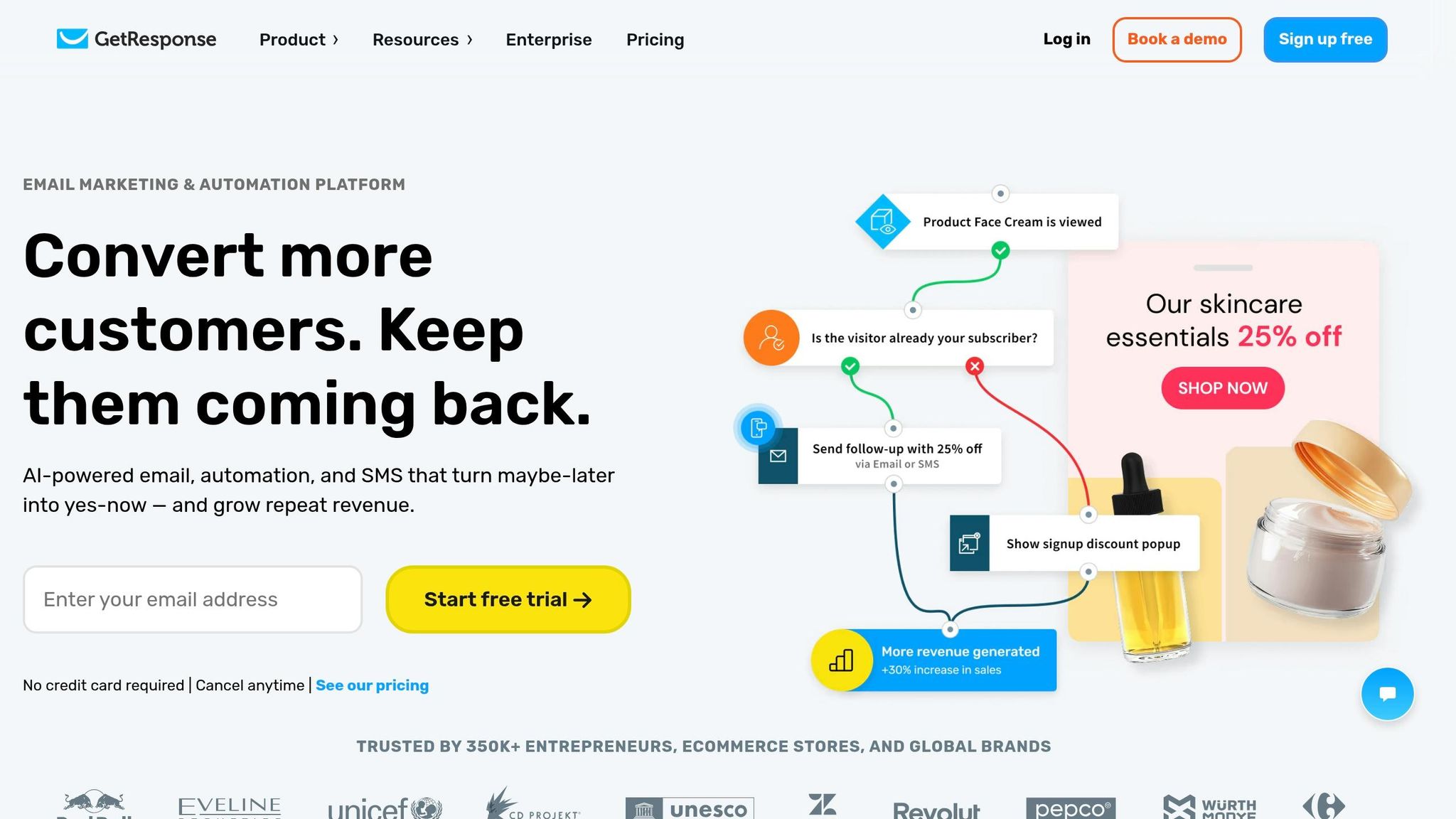
GetResponse stands out in the world of personalized campaign automation with its robust multi-channel capabilities. This platform combines email marketing with SMS, web push notifications, popups, live chats, and even webinars - all within a single interface. With over 350,000 customers across 160 countries and an impressive 99% deliverability rate, it’s a trusted choice for marketers worldwide [55][56]. Its user-friendly drag-and-drop builder makes it easy to design intricate automation workflows, while AI tools offer tailored product recommendations that can increase click-through rates by up to 70% and boost sales by as much as 10% [5].
Audience Segmentation
GetResponse uses dynamic segmentation to keep audience data updated in real-time based on subscriber activity, engagement levels, and custom data points [56][57]. Marketers can assign tags and score leads based on actions like email opens, clicks, or site visits [54][5]. The platform also tracks user behavior across emails, landing pages, and websites via URL tracking, creating detailed customer profiles and enabling highly personalized workflows.
For instance, Med & Beauty, under CEO Szymon Grocholewski, achieved $43,000 in sales within five months using just 10 automated emails. This campaign delivered an ROI of 873%, showcasing how targeted automation can directly impact revenue [55][5]. These dynamic segments integrate seamlessly into workflows triggered by specific user behaviors.
Behavioral Triggers
GetResponse’s automation is powered by behavioral triggers, activating workflows based on actions like newsletter signups, email clicks, abandoned carts, or visits to particular URLs [54][5]. For example, DAAG’s co-owner, Oskar Lipiński, reported generating €16.5K in sales from a single email within two days, contributing to a total revenue of $87,000 over ten months through automation [55][5]. The system also initiates targeted sequences when contacts hit certain lead scores, receive new tags, or update their consent preferences [5]. Steve Forrer, Marketing & Digital Manager at Würth Group, highlighted a 72% increase in turnover achieved through these advanced automation features [55].
AI-Driven Personalization
GetResponse takes personalization to the next level with its AI-powered tools. By analyzing purchase histories and browsing behaviors, its self-learning AI delivers tailored product recommendations in emails and on websites [5]. The platform’s AI Email Generator assists in crafting engaging copy, while its Perfect Timing feature optimizes email delivery for maximum engagement [56][57].
David Jones, CMO at Thundering Herd Marketing, shared his experience:
"I love the GetResponse AI Email Generator. It creates excellent copy and gives me ideas that I can edit and add to my email marketing. It has increased my open rates on the tested emails." [56]
Additionally, Eveline Cosmetics’ Marketing Manager, Dominika Puk, used these advanced tools to generate $13,000 in sales from a single campaign [55].
Multi-Channel Support
GetResponse’s multi-channel approach ties everything together. The platform manages email, SMS, web push notifications, popups, live chats, webinars, and even paid ads on Google and Meta - all from one dashboard [55][57]. It tracks website interactions, such as video views or downloads, to create customized user journeys. For example, it can display discount popups on pricing pages while offering lead magnets on blog posts [5][57].
With over 170 integrations - including Salesforce, HubSpot, and Zendesk - GetResponse ensures seamless data synchronization across your marketing tools. Paid plan users report doubling their email lists within the first 30 days, highlighting the platform’s effectiveness in growing audiences [5][56].
9. Moosend
Moosend supports personalized email marketing for over 100,000 customers, boasting an impressive 98% deliverability rate. Plans start at just $9/month [58][59]. While its primary focus is email marketing, the platform also offers tools for landing pages, subscription forms, and transactional emails. One standout feature is its AI-powered segmentation combined with real-time behavior tracking, which ensures timely and highly targeted messaging.
Audience Segmentation
Moosend allows users to segment their audiences based on demographics, location, and psychographics. These segments are updated in real time using custom fields and tags. The platform's AI-driven "Audience Discovery" tool takes it a step further by identifying customer patterns, understanding where they are in the sales funnel, and predicting their future behavior. This enables the creation of automatic segments without requiring manual input. According to data, campaigns using segmentation see a 100.95% boost in click rates and a 760% increase in email revenue [59].
Alex Melvani, Membership Officer at WWF, shared:
"The most incredible thing is that it's cost efficient."
Another unique feature is its weather-based recommendations, which display products that align with a subscriber's local conditions. This is particularly useful for retailers managing seasonal inventory. Once segmentation is set up, Moosend activates dynamic workflows that respond to user actions in real time.
Behavioral Triggers
Moosend excels at tracking real-time user behaviors, such as website activity, link clicks, and subscription events, to trigger automated workflows. Onsite event tracking enables targeted responses like abandoned cart reminders or re-engagement campaigns, ensuring no opportunity is missed.
Dipak Raghuwansi, Email Marketing Associate at Vogue, explained:
"After going through Mailchimp, and other platforms, we decided to stay with Moosend. From seamless onsite event tracking to amazing support, there's no other tool matching the feature set & price point offered."
The platform also provides pre-designed "automation recipes" for common scenarios, such as welcome emails or repeat purchase campaigns. These workflows integrate seamlessly with Moosend's AI features to deliver personalized content in real time.
AI-Driven Personalization
Moosend's AI Writer takes personalization to the next level by crafting subject lines, email content, landing page copy, and subscription form text tailored to subscriber data. Dynamic content insertion ensures that entire sections of messages are customized for each recipient. The Audience Discovery tool further enhances this by predicting customer behavior and automatically creating more effective audience segments.
George Levetikos, Chief Integration Officer at MullenLowe Group, highlighted:
"Thanks to Moosend our clients are always happy. User–friendly dashboard, amazing support, great tools & automations help our business grow, and our clients deliver outstanding results."
To top it off, Moosend includes tools like a DMARC checker and subject line tester to ensure segmented campaigns consistently land in inboxes. With its robust features, Moosend offers a complete solution for automating personalized email campaigns.
10. Gumloop
Gumloop leverages AI-powered reasoning to turn unstructured data into tailored marketing campaigns. Designed with marketing teams in mind, the platform processes data like PDFs, web content, and natural language queries to create personalized campaigns. With SOC 2 Type II and GDPR compliance, it’s a solid choice for businesses managing sensitive information [62]. Let’s take a closer look at how its segmentation tools, triggers, and AI personalization make it stand out.
Audience Segmentation
Gumloop’s Data Analysis Agents allow marketing teams to query data warehouses - like BigQuery, Snowflake, and ClickHouse - using plain English. For instance, you can ask, “Show me users who visited our pricing page three times but didn’t convert,” to pinpoint specific audience segments. It also integrates seamlessly with CRMs via its Loops MCP (Model Context Protocol) server, enabling teams to manage mailing lists, update contacts, and organize subscriber data directly within automation workflows. This behavioral segmentation helps teams identify where users drop off in their journey, making it easier to target the right audience at the right time.
Behavioral Triggers
Gumloop’s behavioral triggers take segmentation to the next level by enabling real-time, targeted campaigns. Its Workflow Triggers monitor over 100 supported apps for external events. For example, triggers can automatically launch campaigns when a Salesforce lead moves stages, a new Zendesk ticket is created, or a message pops up in Slack or Microsoft Teams. The platform refreshes data every 60 seconds [60].
Additionally, the Parallel Web Monitor uses AI to track changes across the web, such as competitor product launches or pricing updates. You can even build complex triggers that combine data from multiple sources - like firing an action only when a customer has both opened a Zendesk ticket and has an overdue Stripe invoice. With "Loop Mode", these workflows scale to handle large datasets, processing up to 50 company URLs for detailed, individualized insights.
AI-Driven Personalization
Gumloop’s Ask AI reasoning nodes analyze unstructured data from triggers - like email content or web pages - to create personalized responses or summaries. The platform offers three pricing tiers: Standard (2 credits per call), Advanced (20 credits per call), and Expert (30 credits per call) [63]. Free users get 2,000 credits per month, while the Solo Plan starts at $37/month and includes higher credit limits along with Bring Your Own Key (BYOK) support [63]. BYOK allows users to integrate their own OpenAI or Anthropic credentials, reducing AI markup costs to just the base execution credit costs. Monitoring costs 1 credit per polling check, and triggers use 3 credits when activated. If a trigger fails three times in a row, it automatically deactivates [60][61].
Feature Comparison Table
The table below highlights the features of leading personalized campaign automation tools, focusing on audience segmentation, behavioral triggers, AI-driven personalization, multi-channel capabilities, and pricing.
| Tool | Audience Segmentation | Behavioral Triggers | AI Personalization | Multi-Channel Support | Starting Price (USD/mo) |
|---|---|---|---|---|---|
| ActiveCampaign | AI-Suggested Segments | Clicks, purchases, site events | Active Intelligence, AI Agents | Email, SMS, WhatsApp, Social | $15.00 |
| HubSpot Marketing Hub | Smart Lists (CRM-based) | Page visits, deal status | Breeze AI, Predictive Scoring | Email, Ads, Chat, Social | $9.00 |
| Brevo | Basic Tags & Lists | Simple journey steps | Send-time optimization | Email, SMS, WhatsApp | $8.08 |
| Drip | Deep e-commerce data (SKUs, purchase frequency) | Real-time purchase/browsing | Behavioral tracking | Email, SMS | Custom |
| Klaviyo | Predictive Smart Segments | Real-time purchase/browsing | CLV & Churn Predictions | Email, SMS, Mobile Push | $20.00 |
| Insider One | 120+ Behavioral Attributes | Real-time cross-channel signals | Sirius AI, Discount Affinity | Web, App, SMS, WhatsApp | Custom (Free for startups) |
| Braze | Predictive Audiences | Real-time app/web actions | Intelligent Timing & Channel | Push, In-app, Email, SMS | ~$1,000.00 |
| GetResponse | Multi-criteria targeting | Basic behavioral events | Send-time optimization | Email, SMS, Webinars | $15.58 |
For small businesses exploring automation, ActiveCampaign and Brevo stand out with starting prices of $15.00 and $8.08 per month, respectively. On the other hand, Braze caters to enterprise-level, mobile-first brands with pricing around $1,000 per month. Insider offers custom contracts and even provides a free tier for startups, making it an appealing option for emerging businesses [4][5][67].
Klaviyo sets itself apart by offering predictive analytics for customer lifetime value (CLV) and churn risk at all pricing levels, starting at $20 per month. In contrast, HubSpot requires users to upgrade to its Professional tier, priced at $800 per month, to access predictive lead scoring [66].
When it comes to segmentation depth, Insider leads the pack, analyzing over 120 behavioral attributes per user - far surpassing platforms that rely on simpler RFM scoring models [66]. Klaviyo and Drip excel in leveraging detailed e-commerce data, such as SKU-level purchases and abandoned cart behavior, while HubSpot shines in CRM-focused segmentation, using lifecycle stages and industry-specific variables [64][65].
The results speak for themselves: brands using Klaviyo's predictive segments report a 35% increase in revenue per email, while HubSpot users see a 30% boost in sales efficiency thanks to predictive lead scoring [66].
Each platform brings its own strengths to the table, offering tailored solutions for businesses of all sizes to power their personalized campaigns.
Conclusion
AI-powered personalized automation is changing the game by analyzing real-time behavior to deliver tailored messages. The numbers speak for themselves: for every dollar spent, businesses see an average return of $5.44, and click rates have risen by 119% [2][69].
These tools do more than improve performance - they shift priorities. By moving from manual processes to intelligent automation, your team can focus on strategic goals instead of repetitive tasks. As Campaign Monitor aptly states:
"AI tools don't just 'save time.' They reshape what's possible. The real expense isn't the software you buy, but the hours lost to manual tasks, generic messaging, and decisions made without data" [3].
The results are clear - 94% of ActiveCampaign customers report seeing ROI within a year [1].
When choosing a platform, it's essential to align it with your business needs. Small businesses and startups might opt for budget-friendly options like Brevo (starting at $8.08/month) or ActiveCampaign (starting at $15/month). E-commerce brands often find value in Klaviyo, thanks to its predictive analytics and Shopify integration. For enterprise teams managing mobile-first strategies, Braze offers robust cross-channel orchestration. Whether you're looking for affordability or enterprise-grade functionality, these tools are designed to enhance every customer interaction.
To get started, focus on one high-impact journey, like an abandoned cart reminder or a welcome sequence, to see quick results. Make sure the platform integrates seamlessly with your CRM and analytics tools to prevent data silos. With over 75% of consumers expecting relevant content [68], personalization isn't just a nice-to-have - it directly affects your revenue.
Use this guide to evaluate your options, compare features, and choose a platform that supports your current needs and future ambitions. The right automation tool won't just save you time - it will redefine how you engage with your customers.
FAQs
Which tool is best for my business size?
The right tool for you largely depends on your business size and unique needs.
- Small to medium-sized businesses often find value in user-friendly, all-in-one platforms like HubSpot, ActiveCampaign, and Omnisend. These tools are designed to simplify processes while offering automation and AI-driven personalization to enhance customer engagement.
- Larger enterprises, on the other hand, might require more robust and scalable solutions. Tools like Salesforce, Blueshift, or Adobe Express provide advanced customization options to handle complex workflows and larger datasets.
When choosing a tool, consider your business's scale, the complexity of your operations, and your specific automation objectives. The right fit will align with both your current needs and future growth plans.
What data is needed to personalize campaigns?
To create personalized campaigns that truly resonate, you need to gather essential customer data, such as demographics (age, gender, location), browsing habits, purchase history, and engagement trends. This information allows you to segment your audience effectively and craft messages tailored to their specific interests and needs across platforms like email, websites, and social media.
A key player in this process is first-party data - information collected directly from customer interactions. Not only does it align with privacy standards, but it also enables real-time personalization by leveraging past behaviors and preferences. This approach enhances customer engagement and fosters loyalty over time.
How do I start my first automated workflow?
To kick off your first automated workflow, begin by pinpointing the task you want to streamline - think lead nurturing or email follow-ups. Next, select a platform that supports automation and provides ready-made templates to simplify setup. Identify a trigger event, like a visitor landing on your website, and map out the follow-up actions you want to take. Use the platform to link these steps in a logical sequence, run a test to ensure everything works smoothly, and then activate the workflow. This approach helps you manage tasks more effectively and saves time.