If you need sub-second action, use streaming. If you need fast campaign setup, use a packaged CDP. If you want warehouse control, use reverse ETL or a warehouse-first stack.
I’d boil the article down to 4 buying questions: how fast, how much, how much control, and how close to activation you need the data to be. Across the 5 categories in the article - CDPs, streaming pipelines, tag managers, reverse ETL tools, and warehouse-native/composable stacks - the tradeoff is simple: speed vs. control vs. setup lift.
Here’s the short version:
- Streaming pipelines fit sub-10 ms use cases like in-session decisions and real-time ML
- Packaged CDPs fit marketer-led activation with seconds-to-minutes latency
- Tag managers fit event collection and routing, not full identity or profile work
- Reverse ETL fits warehouse-based activation with minutes-to-hours timing
- Warehouse-native stacks fit teams that want data logic in SQL, Python, or dbt, usually with sync-based timing
Quick Comparison
| Category | Latency | Cost pattern | Control | Best fit |
|---|---|---|---|---|
| Packaged CDPs | Seconds to minutes | MTU-based, can climb fast | Low | Cart abandonment, lifecycle marketing |
| Streaming pipelines | Under 10 ms | Event/compute-based | High | In-session personalization, fraud, ML |
| Tag managers | Milliseconds for collection | Low starting cost | Medium | Browser and server-side collection |
| Reverse ETL | Minutes to hours | Lower software cost, more team lift | High | CRM syncs, ad audience refreshes |
| Warehouse-native stacks | About 30 minutes in many setups | Stack cost plus engineer time | High | B2B account scoring, PLG activation |
My take: most teams should not ask, “Which tool is best?” They should ask, “What must happen in under 1 second, what can wait 30 minutes, and who owns the data logic?” That answer usually points to the right category fast.
sbb-itb-5174ba0
1. Customer Data Platforms (CDPs)
CDPs are the fastest path to enrichment plus activation in one system. Tools like Segment and mParticle enrich events as data comes in by validating schemas at ingestion, stitching anonymous users to known identities, and adding metadata such as IP-to-geo lookups and UTM parameters before sending data to downstream tools [1][8]. For marketing-led teams, that usually means less setup work and a shorter path to live campaigns.
Latency
CDPs sit in the middle on latency. Most classic CDPs enrich and route events within seconds [2]. That works well for triggered email, cart abandonment, and similar flows. It is less suited to cases that rely on dedicated streaming systems and tighter timing.
Cost
Cost can swing a lot.
- Segment starts at $120/month for 10,000 MTUs, while enterprise contracts can run into six figures.
- mParticle is enterprise-only, often starts near $60,000/year, and can go past $250,000 at scale.
- MTU-based pricing can get expensive for high-traffic products with many inactive users.
- Implementation often adds $30,000-$150,000, plus 0.5-1 FTE to manage the system [5][6].
Control
Control is one of the main limits. The processing layer is mostly closed, so custom enrichment - like LLM-based signal extraction, Python transforms, or account-level rollups - is hard to add in packaged CDPs [4]. Identity resolution can also be a poor fit for some teams. Many classic CDPs were built around B2C, person-level stitching, not account-level orchestration. In plain terms, they fit person-level marketing better than account-based use cases.
Activation Fit
This is where CDPs shine most. Segment supports 750+ destinations [7], and mParticle covers 300+ [7]. Those prebuilt connectors make it easier to push data into ad platforms, CRMs, and email tools without a lot of custom work. For standard B2C use cases - cart abandonment, churn prediction, and cross-sell - CDPs are hard to top.
The tradeoff is that your data sits in a vendor-hosted system, which can create data residency and governance concerns [8].
Teams that want lower latency, more custom logic, or tighter control often shift toward streaming systems or warehouse-native tools.
2. Streaming Pipelines and Event Streaming Platforms
Streaming pipelines split enrichment from activation. That’s the main difference from packaged CDPs. Tools like Snowplow, RudderStack, and Estuary Flow move enrichment into the stream and leave processing in your hands. The upside is control. The cost is more engineering ownership. For teams that want the warehouse or downstream systems to handle activation, that tradeoff often makes sense.
Latency
This is where streaming platforms pull ahead. Snowplow Signals can stream enriched behavioral attributes at sub-10 ms latency, which fits in-session personalization and real-time marketing decisioning [1].
Cost
Cost is often easier to model here than with MTU-based CDPs. Snowplow's BDP Cloud starts at about $800/month, while self-hosted pipelines are estimated at roughly $1,500/month. Enterprise tiers land near $37,500/year [1]. RudderStack has a free tier for up to 25 million events/month, with paid cloud plans starting at $150/month [9].
For high-traffic products, event-based or compute-based pricing usually scales in a more linear way than MTU pricing. That can make planning less painful as volume grows.
Control
Control is the clearest strength in this group. Snowplow enforces schema validation at collection, so bad events get rejected before they reach warehouse ingest [1].
Activation Fit
Activation is usually the weak spot. These platforms work best as the data layer for warehouse-native activation, and they pair well with reverse ETL tools covered later. If your team is warehouse-first, RudderStack or Snowplow can keep the source of truth in Snowflake or BigQuery [1][9].
Direct activation is less strong here. In practice, most teams add reverse ETL or warehouse-native activation on top. If your main goal is direct campaign activation, expect to need that extra layer.
3. Tag Managers and Data Layer Tools
Tag managers sit at the edge. They collect events in the browser or on the server before CDPs and warehouses do the heavier work. Google Tag Manager (GTM), Tealium, and server-side GTM (sGTM) are common examples [1].
Latency
Tag managers are built for near-instant event capture. That makes them a good fit for high-volume collection. The catch is simple: identity stitching and profile building still happen later, downstream.
Cost
This is the lowest-cost starting point for event collection, especially if you just need to route data to analytics tools and ad platforms. But the cheap part is up front. The bill often shows up later in QA, governance, and cleanup when bad data slips through.
Control
Control is the weak spot. Most tag managers don't enforce a schema at collection time, and auto-captured events often rely on CSS selectors that can break during a frontend redesign [10]. When that happens, broken selectors and malformed payloads keep flowing until something downstream flags them.
Activation Fit
Tag managers work well when the job is routing events to browser-side destinations like analytics platforms, ad pixels, and marketing automation tools. sGTM helps when you want faster, more privacy-aware collection. It improves transport, but it does not solve identity resolution.
If you need more than collection and routing, the next layer is reverse ETL or warehouse-native activation.
4. Reverse ETL and Warehouse-Native Activation Tools
Reverse ETL is built for activation after modeling, not enrichment at the moment of capture. Tools like Hightouch and Census take modeled warehouse data and send it into CRMs, ad platforms, and support systems. In plain terms, they move cleaned-up warehouse data into the tools your team uses day to day.
Latency
Reverse ETL is not the best fit for real-time jobs. Most products run on batch or near-batch schedules. RudderStack's warehouse sync interval, for example, has a minimum of 30 minutes [8]. That puts sub-second personalization out of reach if you're using this setup by itself [8][2]. If your use case can wait a few minutes, though, micro-batch syncs usually do the job [2].
Cost
A warehouse-native stack built around reverse ETL usually lands in the $80,000-$250,000 range in year 1, versus $100,000-$400,000 for packaged CDPs with similar function sets [5]. Hightouch's Pro plan starts at $350/month [7].
The catch is operational overhead. You're often managing 3 to 5 tools instead of 1, and you still need analytics engineers who can write SQL and dbt models to keep things moving [5][9]. Lower software spend can come with more setup and upkeep.
Control
Control is the main reason teams pick this path. Your data stays in your own warehouse - Snowflake, BigQuery, or Databricks - instead of sitting inside a vendor-owned system. The logic for enrichment lives in SQL, Python, or dbt, which gives your team direct control over how the data is shaped.
That matters even more in B2B. Identity resolution can be built account-first, which fits many B2B motions better than CDPs built mostly around person-level profiles [4]. Open table formats like Iceberg and Delta also make it easier to keep data portable if you decide to change tools later [4][5].
Activation Fit
Reverse ETL works best when you need to turn warehouse models into actions inside business systems. Common examples include:
- pushing a churn score into your support platform
- syncing enriched lead fields into Salesforce
- updating ad audiences from warehouse-based segments [2][3]
Kajabi is a good example. The company reported about $100,000 in annual savings after moving from Segment to RudderStack's warehouse-native pipeline, and the migration took days because RudderStack's API is compatible with Segment's SDKs [8].
For teams that need both speed and completeness, a practical setup is to use webhooks for immediate triggers, then pair that with a reverse ETL sync for daily reconciliation [2].
When teams want this warehouse-first model to handle collection, modeling, and activation in one stack, the next category is warehouse-native CDPs.
5. Warehouse-Native CDPs and Composable Stacks
Warehouse-native CDPs and composable stacks put the warehouse at the center. Identity, profiles, and enrichment stay in Snowflake, BigQuery, or Databricks, and activation happens from there. Compared with packaged CDPs, you give up speed and ease of use in exchange for more control. This builds on Section 4: the warehouse is not just the place reverse ETL reads from for activation - it becomes the control point for enrichment, identity, and delivery.
Latency
Latency is the clearest downside. Most warehouse-native setups run on sync intervals rather than continuous streams. That makes session-level personalization hard to pull off. As a result, this category works best for modeled activation, not live-session personalization.
Cost
A composable stack often costs $80,000-$250,000 in year 1, and a lot of that spend shifts from software fees to engineering time. Maintenance usually runs 15%-25% of the initial integration effort each year.
Control
Control is the main reason teams choose this model. Your data stays in your own infrastructure, and identity resolution logic lives in SQL or dbt. That means the logic is auditable and owned by your team.
Activation Fit
Activation usually runs through reverse ETL, with audiences pulled straight from warehouse tables. This setup fits B2B account-level rollups and complex identity stitching well. It is a poor fit for self-serve marketing teams that need immediate audience building or sub-second response times.
Latency, Cost, and Control Tradeoffs
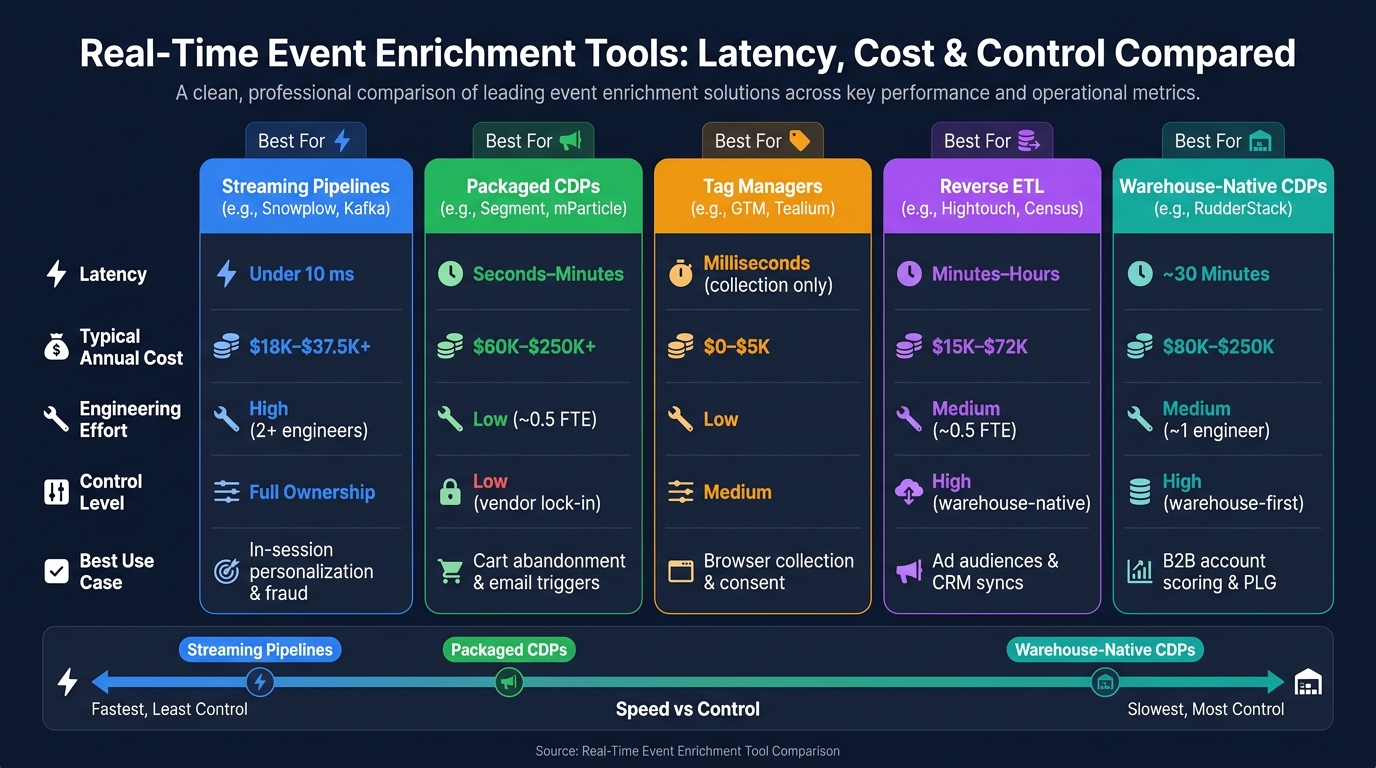
Real-Time Event Enrichment Tools: Latency, Cost & Control Compared
Once you strip away the category-by-category detail, the decision comes down to 3 things: latency, cost, and control. Here’s how the 5 categories stack up across those tradeoffs.
| Tool Category | Typical enrichment/activation latency | Typical spend | Engineering effort | Control | Best Use Case |
|---|---|---|---|---|---|
| Streaming Pipelines | Under 10 ms | ≈$18,000-$37,500+/year, plus compute | High (2+ engineers) | Full ownership | In-session personalization, real-time ML |
| Packaged CDPs | Seconds to minutes | $60,000-$250,000+/year | Low (~0.5 FTE) | Low (vendor lock-in) | Cart abandonment, email triggers |
| Tag Managers | Milliseconds (client-side trigger) | $0-$5,000/year | Low | Medium (client-side) | Browser-side collection, pixel firing, consent handling |
| Reverse ETL | Minutes to hours | $15,000-$72,000/year | Medium (~0.5 FTE) | High (warehouse-native) | Ad audience refreshes, BI workflows |
| Warehouse-Native CDPs | ~30 minutes (sync interval) | $80,000-$250,000 (first-year stack) | Medium (~1 engineer) | High (warehouse-first) | Account scoring, PLG activation |
Latency is the sharpest dividing line. Streaming pipelines can respond in under 10 ms. Packaged CDPs usually land in the seconds-to-minutes range. Reverse ETL and warehouse-native CDPs run on sync intervals, so they fit cases where a delay is fine.
Cost breaks along pricing model. MTU-based CDPs can get expensive fast as volume grows. Warehouse-first setups often move more of that spend into engineering time instead of software fees.
Control is where the tradeoff gets more practical. Packaged CDPs give teams a faster setup, but you give up flexibility. Streaming and warehouse-native tools keep schema ownership inside your stack. That matters when your team needs to own identity resolution logic, enforce custom schemas, or meet data residency rules.
The next section turns this comparison into tool-category pros and cons.
Pros and Cons by Tool Category
Use this table to pick based on how your team works, not how long a feature list looks.
| Tool Category | Pros | Cons | Best-Fit Scenario |
|---|---|---|---|
| Packaged CDPs (e.g., Segment, mParticle) | Fastest setup for marketer-led teams | MTU-based pricing can grow in uneven ways; customer data sits on vendor servers, which can create governance risk | B2C lifecycle marketing; teams where engineering bandwidth is the bottleneck |
| Streaming Pipelines (e.g., Snowplow, Kafka) | Sub-10ms latency; full schema ownership; replay supports recovery after pipeline failures [1] | Needs 2+ dedicated data engineers; high setup and maintenance overhead [1] | Real-time AI agent context; fraud detection; high-volume behavioral telemetry |
| Tag Managers (e.g., Tealium) | Fast client-side or server-side collection; server-side collection helps reduce client-side exposure | Harder to validate changes safely; weaker identity and behavioral modeling than CDPs | Consent-first collection for regulated web and app events |
| Reverse ETL (e.g., Hightouch, Census) | Warehouse stays the source of truth; lower cost | Not built for sub-second triggers; latency depends on warehouse sync intervals [8] | Syncing lead scores to CRM; refreshing ad audiences from modeled warehouse data |
| Warehouse-Native CDPs (e.g., RudderStack) | Warehouse-owned identity and account-level modeling | No visual audience builders; needs SQL or dbt skills | B2B SaaS account-based marketing; product-led growth activation |
The core tradeoff is speed vs. control. Packaged CDPs are the easiest to get live. Streaming pipelines and warehouse-native tools give you more control because the data stays in-house, but they ask more from engineering.
That’s the decision in plain terms:
- Choose packaged CDPs if speed and low lift matter most.
- Choose streaming or warehouse-native tools if warehouse control matters more.
- Choose Reverse ETL if your warehouse already drives activation and you can live with sync-based timing.
The best fit comes down to your operating model - not the tool with the most boxes checked.
Conclusion
Pick the tool based on one thing first: what does the data need to do, and how fast does it need to get there? The decision usually comes down to latency, control, and how much activation your stack needs to support.
In practice, sub-second use cases lean toward streaming pipelines. Marketer-led teams tend to move fastest with packaged CDPs. Warehouse-first teams usually prefer reverse ETL or warehouse-native stacks when control matters more than immediacy. Tag managers are a fit for collection, not full enrichment.
Use the tool that fits your operating model, not the one with the longest feature list.
No single category wins in every case. This is an operating model decision first, and a technology decision second.
FAQs
Which tool type fits my latency needs?
Match the tool to the use case.
- Sub-second: streaming platforms or purpose-built streaming pipelines for high-volume telemetry or real-time personalization.
- Seconds to sub-minute: CDC tools or enterprise replication for database-to-warehouse sync.
- Minutes to hours: standard ELT tools for SaaS analytics, reporting, and operational data.
Avoid over-engineering. Set latency targets by use case, not as a company-wide rule.
When should I choose a CDP over reverse ETL?
Choose a traditional CDP when you want one managed system for event collection, identity resolution, and audience activation - and your team doesn’t have much engineering bandwidth. It’s also a better fit if your team needs self-serve tools and plug-and-play SaaS integrations.
Choose reverse ETL when your data already sits in the warehouse and you want more control, portability, and flexibility from a mature data stack.
Do I need a warehouse-first stack or just a tag manager?
Not necessarily. A warehouse-first stack and a tag manager do different jobs, so the right pick depends on your team’s technical skill and what you’re trying to do.
A tag manager is built for event collection and fast setup. A warehouse-first stack makes more sense for teams that want tighter control of their data for advanced analytics, AI, or more complex activation.
In practice, plenty of teams use both: a collection tool sends data to the warehouse, and then warehouse-native tools handle activation.