When deciding between SOC 2 and ISO 27001 for your analytics tools for business, here's what you need to know:
- SOC 2 is a U.S.-focused attestation framework, assessing control effectiveness based on five Trust Services Criteria: Security, Availability, Processing Integrity, Confidentiality, and Privacy. It results in a detailed report, not a certificate, and is critical for enterprise buyers in North America.
- ISO 27001 is an internationally recognized standard for managing an Information Security Management System (ISMS). It culminates in a formal certificate valid for three years, making it key for vendors operating in Europe, Asia, and other global markets.
- Both frameworks address overlapping security controls but differ in scope, audience, and output. SOC 2 provides detailed control insights, while ISO 27001 focuses on systemic security management.
Quick Comparison
| Dimension | SOC 2 | ISO 27001 |
|---|---|---|
| Output | Attestation Report (40–150 pages) | Certificate (1 page) + SoA |
| Focus | Control effectiveness | ISMS maturity |
| Geographic Strength | North America | Global (Europe, Asia, etc.) |
| Validity Period | Annual | 3 years (with annual checks) |
| Audit Scope | Specific systems/services | Entire ISMS |
Key takeaway: Choose SOC 2 for U.S. enterprise buyers and ISO 27001 for global audiences. Vendors often pursue both to meet diverse client demands.
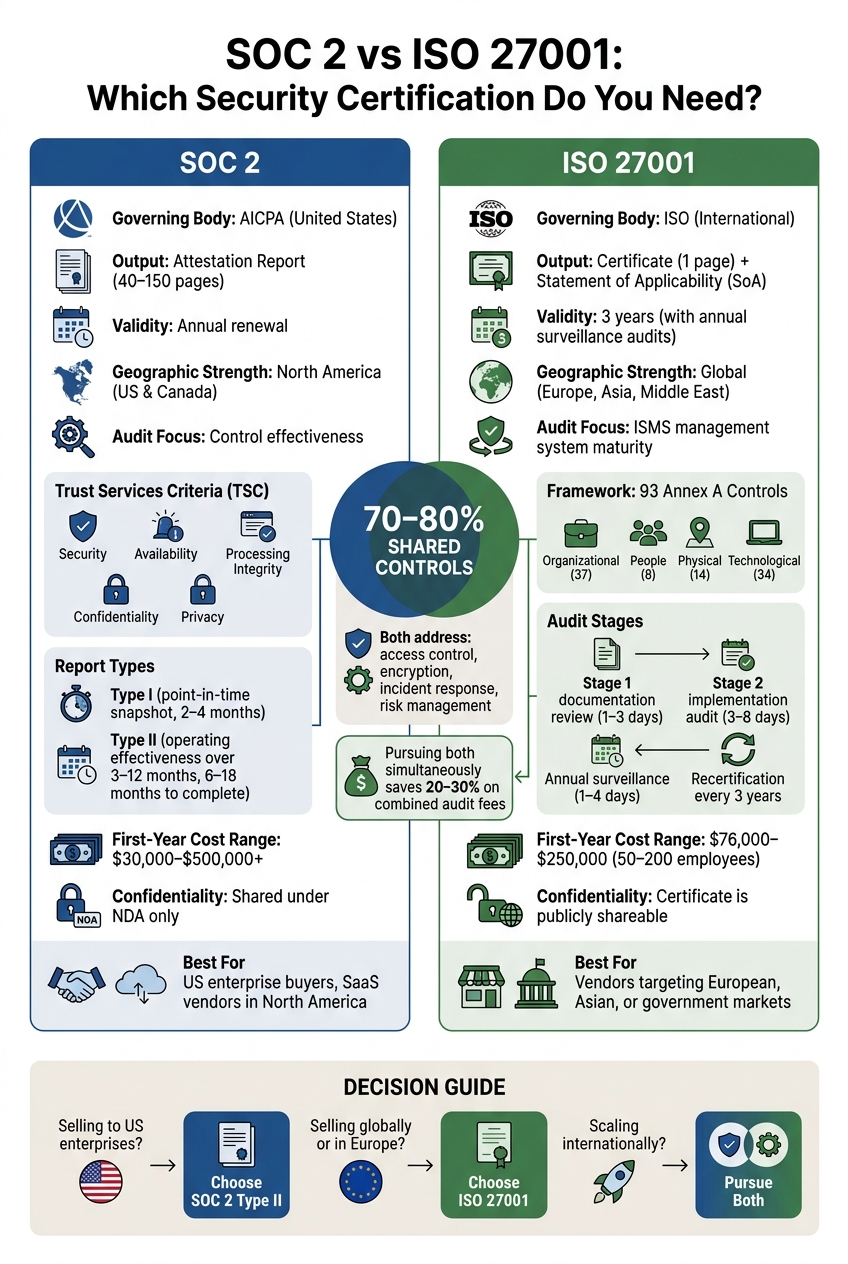
SOC 2 vs ISO 27001: Side-by-Side Security Certification Comparison
Understanding SOC 2 for Cloud Analytics Vendors
What SOC 2 Is and Why It Matters
SOC 2 (System and Organization Controls 2) is an attestation framework created by the American Institute of CPAs (AICPA). Rather than being a certification, it results in a formal report from an independent CPA firm. This report confirms whether a vendor's controls align with the five Trust Services Criteria outlined by the AICPA [9].
"A SOC 2 report is issued by an independent CPA firm after examining whether your organization's controls meet the Trust Services Criteria established by the AICPA." - Petronella Technology Group [9]
The framework revolves around five key criteria: Security (mandatory), Availability, Processing Integrity, Confidentiality, and Privacy. For cloud analytics vendors, Processing Integrity often takes center stage because it assesses whether data transformations, calculations, and automated outputs are accurate, complete, and authorized [9][10]. This is critical for ensuring enterprise website analytics tools deliver reliable results.
SOC 2 engagements have surged by over 50% since 2020, largely due to the rise of cloud services and stricter supply chain security demands [9]. For U.S. enterprise buyers, having a SOC 2 report has shifted from being a differentiator to a baseline requirement [9].
SOC 2 Report Types and How They Are Used
There are two types of SOC 2 reports, each serving a distinct role in the sales process.
| Feature | SOC 2 Type I | SOC 2 Type II |
|---|---|---|
| Focus | Control design at a point in time | Design and operating effectiveness over time |
| Observation Period | None (snapshot) | 3–12 months (6 months is the typical minimum) |
| Timeline | 2–4 months | 6–18 months |
| Best For | Early-stage proof for prospects | Enterprise sales and annual renewals |
| Evidence Required | Policies and configuration screenshots | Logs, access reviews, and change records |
A Type I report is essentially a snapshot that verifies your controls are well-designed at a particular moment. It's a useful tool for early-stage vendors looking to demonstrate their commitment to security quickly. In contrast, a Type II report goes deeper, proving that those controls functioned consistently over a set period. Enterprise buyers almost always require a Type II report [9][10].
SOC 2 reports are confidential documents. Unlike ISO 27001 certificates, they aren’t made publicly available. Vendors typically share these reports with prospects under a non-disclosure agreement (NDA) during procurement discussions [10].
Next, we’ll explore what cloud analytics vendors should anticipate during the SOC 2 implementation process.
What to Expect When Implementing SOC 2
Now that we’ve covered the reports, let’s dive into the implementation process and associated costs.
SOC 2 is principles-based, meaning auditors evaluate whether your implementation meets the intent of each criterion [11]. This flexibility benefits cloud-native vendors but also makes early scoping decisions critical to managing costs and complexity.
For analytics vendors, a common starting point is the "Big Three" criteria: Security, Availability, and Confidentiality. Teams often add Processing Integrity or Privacy later, depending on customer needs [11]. Narrowing the scope - focusing on production environments that handle customer data - can help reduce both audit costs and preparation time [11].
Costs vary widely depending on the auditing firm. Specialist firms typically charge $10,000–$50,000 for a Type I report and $15,000–$70,000 for a Type II. For larger firms like the Big Four, Type II audits can range from $45,000 to $430,000+ [10]. Beyond audit fees, you’ll need to account for internal engineering time (usually 200–500 hours) and compliance software like Vanta or Drata, which costs $7,500–$60,000/year. Altogether, first-year costs can range from $30,000 to $500,000+ [10][11].
To meet enterprise security expectations, vendors should begin the SOC 2 process 6–9 months before any deal discussions. The observation period for a Type II report cannot be shortened, no matter how prepared you are [10].
sbb-itb-5174ba0
Understanding ISO 27001 for Cloud Analytics Vendors
What ISO 27001 Is and Why It Matters
ISO 27001 is a globally recognized security standard that plays a key role for vendors operating in international markets. Published by the International Organization for Standardization (ISO), it provides guidelines for establishing and managing an Information Security Management System (ISMS). Unlike SOC 2, which delivers a detailed attestation report, ISO 27001 culminates in a formal certificate - a concise, single-page document valid for three years - issued by an accredited certification body after a successful audit [2].
For cloud analytics vendors targeting markets outside North America, ISO 27001 acts as a "security passport", particularly in regions like Europe, Asia, and the Middle East. It’s frequently a non-negotiable requirement in government and enterprise procurement processes.
The standard operates on a Plan-Do-Check-Act (PDCA) cycle, emphasizing that security is an ongoing process rather than a one-and-done task. According to the 2022 ISO Survey, over 70,000 valid ISO 27001 certificates were reported across 150 countries, with IT companies, including those using social media analytics tools, making up nearly 20% of the total [13]. This certification not only validates a vendor's security measures but also highlights the critical components involved.
Key Components of ISO 27001 Certification
ISO 27001 is structured into two main parts. The first includes Clauses 4–10, which outline mandatory management system requirements. These cover areas like organizational context, leadership commitment, risk management, operational controls, and continuous improvement. Every organization seeking certification must address these clauses [14][15].
The second part, Annex A, lists security controls. In the 2022 revision, Annex A was reorganized from 114 controls in 14 domains to 93 controls grouped into four categories:
- Organizational: 37 controls
- People: 8 controls
- Physical: 14 controls
- Technological: 34 controls
New additions include controls for cloud services (A.5.23), threat intelligence (A.5.7), and secure coding practices (A.8.28) [12][15].
A critical document in the certification process is the Statement of Applicability (SoA). This document specifies which Annex A controls are relevant to the vendor’s environment, which are excluded, and the reasons for those exclusions. It’s the focal point during ISO 27001 audits.
"The Statement of Applicability (SoA) is the most scrutinized document in an ISO 27001 audit. Auditors will test every included control." - Adeola Okunola, Founder, Invoance [12]
The audit process is divided into stages:
| Audit Stage | Focus Area | Typical Duration |
|---|---|---|
| Stage 1 | Documentation review, ISMS scope, and readiness check | 1–3 days [12][15] |
| Stage 2 | Implementation audit, control testing, interviews | 3–8 days [15][16] |
| Surveillance | Annual check to ensure ISMS effectiveness | 1–4 days [15] |
| Recertification | Full re-audit every three years | Similar to Stage 2 [15] |
These elements provide a foundation for understanding the practical steps, costs, and timelines involved in achieving ISO 27001 certification.
What to Expect When Implementing ISO 27001
ISO 27001 is more detailed and prescriptive compared to other frameworks. It requires documented evidence at every level, from top management to granular operational details like access logs. Auditors often interview senior executives, including the CEO, and lack of leadership commitment can result in audit failure [17].
For organizations with established security practices, certification can take 6–12 months. For those starting from scratch, the process may extend to 12–18 months [12][2]. Notably, about 30% of organizations fail the Stage 1 audit on their first attempt, often due to incomplete or inaccurate Statements of Applicability [16].
The cost of certification varies. For a company with 50–200 employees, a 2026 budget might range from $76,000 to $250,000 in the first year, covering consulting, compliance tools, and audit fees [15]. Surveillance audits, conducted annually, typically cost between $5,000 and $15,000. Narrowing the ISMS scope to focus solely on the production environment that handles customer data can help reduce both costs and timelines [16].
"ISO 27001 is not a check-the-box compliance framework... it promotes a holistic approach to information security." - Anna Fitzgerald, Senior Content Marketing Manager, Secureframe [14]
For vendors pursuing both ISO 27001 and SOC 2 certifications, shared evidence across overlapping controls can streamline the process. This dual approach complements earlier discussions on SOC 2 and helps cloud analytics vendors make informed decisions about their certification strategies.
SOC 2 vs. ISO 27001: Key Differences and Similarities
Core Differences Between SOC 2 and ISO 27001
SOC 2 and ISO 27001 serve different purposes, and their outputs reflect that. SOC 2 results in a detailed attestation report - usually spanning 40 to 150 pages - prepared by a CPA firm. This report outlines tested controls and audit findings in depth. On the other hand, ISO 27001 provides a single-page certificate that confirms the organization has an effective management system in place. Aatish Mandelecha, Founder of Strac, explains it well:
"SOC 2 evaluates controls; ISO 27001 evaluates the system that manages those controls." [1]
Geography also plays a role in their adoption. SOC 2 is more relevant in North America, while ISO 27001 has a stronger global presence, particularly in Europe, Asia, and the Middle East. As Lorikeet Security points out:
"A SOC 2 report carries minimal weight in a German enterprise's vendor assessment. An ISO 27001 certificate doesn't satisfy the security due diligence checklist that a Fortune 500 U.S. company sends." [5]
Here’s a quick comparison of their key attributes:
| Dimension | SOC 2 | ISO 27001 |
|---|---|---|
| Governing Body | AICPA (US) | ISO (International) |
| Primary Output | Attestation Report (40–150 pages) | Certificate (1 page) + SoA |
| Validity Period | Annual | 3 years with annual surveillance |
| Core Framework | Trust Services Criteria (TSC) | ISMS with Annex A Controls |
| Audit Focus | Control effectiveness | Management system maturity |
| Geographic Strength | North America | Global |
Where SOC 2 and ISO 27001 Controls Overlap
Despite their differences, SOC 2 and ISO 27001 share a significant amount of control requirements. In fact, about 70–80% of their controls overlap [1]. This overlap can simplify compliance efforts for vendors. For example, implementing multi-factor authentication (MFA) for SOC 2's CC6.1 criterion can also fulfill ISO 27001's A.8.2 control. By mapping evidence between the two frameworks, vendors can avoid redundant work.
However, ISO 27001 introduces additional formal management requirements that SOC 2 does not emphasize. These include the Statement of Applicability (SoA), internal audits, and mandatory management reviews. These elements highlight ISO 27001's focus on a structured management system rather than just control effectiveness.
Strengths and Limitations for Cloud Analytics Buyers
For buyers evaluating top analytics tools, understanding the strengths and limitations of these frameworks is essential. SOC 2 Type 2 reports are highly transparent, detailing control tests over a 6–12 month period and noting any exceptions. In contrast, ISO 27001 certificates indicate an organization's overall system maturity and commitment to improvement but lack specifics on individual control performance.
Here’s how they compare:
| SOC 2 | ISO 27001 | |
|---|---|---|
| Transparency | High – detailed test results and noted exceptions | Low – pass/fail certificate without detailed control data |
| Geographic Fit | Strong in the US and Canada | Strong globally, especially in Europe and Asia |
| Scope Clarity | Typically limited to a specific system or service | Covers the full ISMS |
| Buyer Actionability | Enables review of specific control failures | Provides systemic assurance without granular detail |
| Privacy Coverage | Optional "Privacy" criteria available | Does not inherently address GDPR or broader data privacy |
For buyers, it’s critical to assess the scope of these certifications. A SOC 2 report might only cover a vendor’s core platform, excluding newer features or third-party integrations. Similarly, ensure an ISO 27001 certificate includes the production environment instead of just the corporate office. These checks can help ensure that the certification aligns with your specific needs [3].
Choosing the Right Certification for Your Cloud Analytics Vendor
Factors That Should Drive Your Certification Decision
Geography plays a big role when selecting the right certification. As Amit Kothari, CEO of Tallyfy, explains:
"US buyers want SOC 2. European buyers want ISO 27001. This framework is a primary compliance factor." [6]
If your vendor's main market is in North America, SOC 2 Type II is practically a must-have. For vendors targeting European, Asian, or Middle Eastern customers, ISO 27001 often holds more importance. Vendors serving a global audience increasingly pursue both certifications. In fact, many B2B SaaS companies with $5M–$10M ARR or more now maintain both [1][2].
The industry also matters. For example, US financial services companies typically demand SOC 2 with additional criteria like Availability and Processing Integrity. In healthcare, SOC 2 combined with HIPAA compliance is common. Meanwhile, international government contracts often call for ISO 27001 [1][7]. Knowing your vendor's target market and industry can help you identify the most relevant certification.
With these considerations in mind, use the checklist below to thoroughly evaluate your vendor’s certifications.
A Practical Checklist for Evaluating Vendor Certifications
A vendor’s certification badge is just the starting point - the details behind it are what really count.
| Item | What to Verify |
|---|---|
| Report Type | Is it SOC 2 Type II (operational effectiveness) or just Type I (design only)? |
| Scope | Does the audit cover the specific analytics product or module you're purchasing? |
| Trust Criteria | Does it address Confidentiality and Processing Integrity, in addition to Security? |
| Exceptions | Look for any qualified opinions or flagged control issues. |
| Sub-processors | Are third-party providers like AWS or GCP included in the audit scope? |
| Recency | Was the report completed within the past 12 months? |
For ISO 27001 certifications, ask for the Statement of Applicability (SoA). This document outlines which of the 93 Annex A controls the vendor chose to implement or exclude, along with their reasoning. A certificate alone doesn’t provide this level of transparency [1][18].
Here’s a tip: if a vendor’s SOC 2 report is over a year old, request a bridge letter. This is a written assurance from the auditor confirming that no major changes have occurred since the last report [3].
By using this checklist, you can narrow down your vendor options to those whose certifications truly meet your needs. This makes the next step - using directories - much more efficient.
How Directories Can Help You Find Certified Vendors
Once you’ve assessed certifications with the checklist, directories can save you time. Shortlisting certified vendors can be tedious, but tools like the Marketing Analytics Tools Directory make it easier. These directories let you filter and compare cloud analytics vendors who already hold active certifications, cutting down on initial research.
This approach is particularly helpful when evaluating niche analytics tools - such as those designed for campaign tracking tools, audience segmentation, or A/B testing. Security documentation for these tools isn’t always front and center on their websites. Starting with a curated directory allows you to skip the guesswork and focus on asking the right questions.
SOC 2 vs ISO 27001: Which Security Framework Fits Your Business?
Conclusion
For cloud analytics vendors, having strong security certifications is essential for protecting client data and earning trust. SOC 2 and ISO 27001, while addressing different aspects of security, work well together. As Aatish Mandelecha, Founder of Strac, explains:
"SOC 2 and ISO 27001 are the two dominant B2B security frameworks. They overlap ~80% on controls." [1]
This overlap highlights how interconnected the two frameworks are. If a vendor is certified in one, they’ve likely already covered much of the groundwork for the other. The remaining 20% typically involves additional documentation and testing, rather than starting from scratch [4].
The primary distinction between these certifications lies in their geographic relevance and audience. SOC 2 Type II is widely recognized in U.S. enterprise procurement processes, whereas ISO 27001 is more influential in regions like Europe, Asia, and the Middle East. Vendors aiming for global reach often choose to pursue both certifications. Completing them simultaneously can also save 20% to 30% on combined audit fees compared to handling them as separate projects [8][19].
FAQs
Which certification do my customers actually expect - SOC 2 or ISO 27001?
Your decision should align with your target audience. If your focus is on U.S.-based customers, SOC 2 is often the go-to standard. It’s frequently required during procurement processes and in responses to RFPs.
On the other hand, for clients in Europe, Asia-Pacific, or other parts of the world, ISO 27001 holds more weight as a globally recognized certification.
Many companies serving international markets start with SOC 2 to address U.S. customer demands and later pursue ISO 27001 to cater to their growing global presence.
Is SOC 2 Type I enough, or do I need Type II?
For enterprise buyers in the U.S., a SOC 2 Type II report is often the go-to standard. While a Type I report shows that your controls are properly designed at a specific moment, it usually doesn’t satisfy procurement requirements. On the other hand, a Type II report proves that those controls functioned effectively over a period of 6–12 months, showcasing consistent performance. If you’re targeting enterprise customers, securing a Type II report can help you sidestep potential sales hurdles.
What should I check to confirm a vendor’s SOC 2 or ISO 27001 scope is relevant?
To confirm a vendor's scope, start by examining their documentation. For SOC 2, focus on the scope section of the report. This will outline the products, services, infrastructure, and sub-processors included. Also, verify that the Trust Services Criteria, such as Confidentiality and Privacy, align with your specific requirements.
For ISO 27001, review the ISMS scope document. This ensures the certification applies to the necessary organizational boundaries, teams, and environments relevant to your needs.