If you cannot share fraud data, lack enough fraud labels, or need faster model work, synthetic data can help - but only if you test utility, privacy, and data quality separately.
I’d boil the article down to this: synthetic data gives fraud teams a way to train, test, and share datasets without passing around raw customer records. That matters because confirmed fraud is rare, privacy rules limit data access, and manual labeling can cost $10-$50+ per hour. Gartner says 75% of businesses will use generative AI for synthetic data by the end of 2026, up from less than 5% in 2023.
Before I’d use it, I’d check 5 things:
- Use case fit - training, sandbox testing, partner sharing, or rare-fraud simulation
- Generation method - copulas, GANs, VAEs, diffusion models, or sequence models
- Data checks - field ranges, linked columns, time patterns, and rare-case coverage
- Privacy checks - membership inference, linkage tests, and ε settings if DP is used
- Model checks - Train on Synthetic, Test on Real and watch precision, recall, ROC-AUC, FPR, and lift
A few lines matter most:
- Synthetic is not the same as masked or sampled data
- It should not replace final testing on governed live data
- Mode collapse, broken field relationships, and weak privacy review can make the dataset unsafe or useless
- Human review from fraud, data, legal, and model risk teams is still part of the release process
If I were making the call, I’d treat synthetic data as a controlled input for pre-production work - not ground truth. The win is faster model development and safer collaboration. The limit is simple: if it does not hold up on TSTR, privacy attack tests, and business-rule checks, I would not use it.
How Synthetic Fraud Data Is Generated
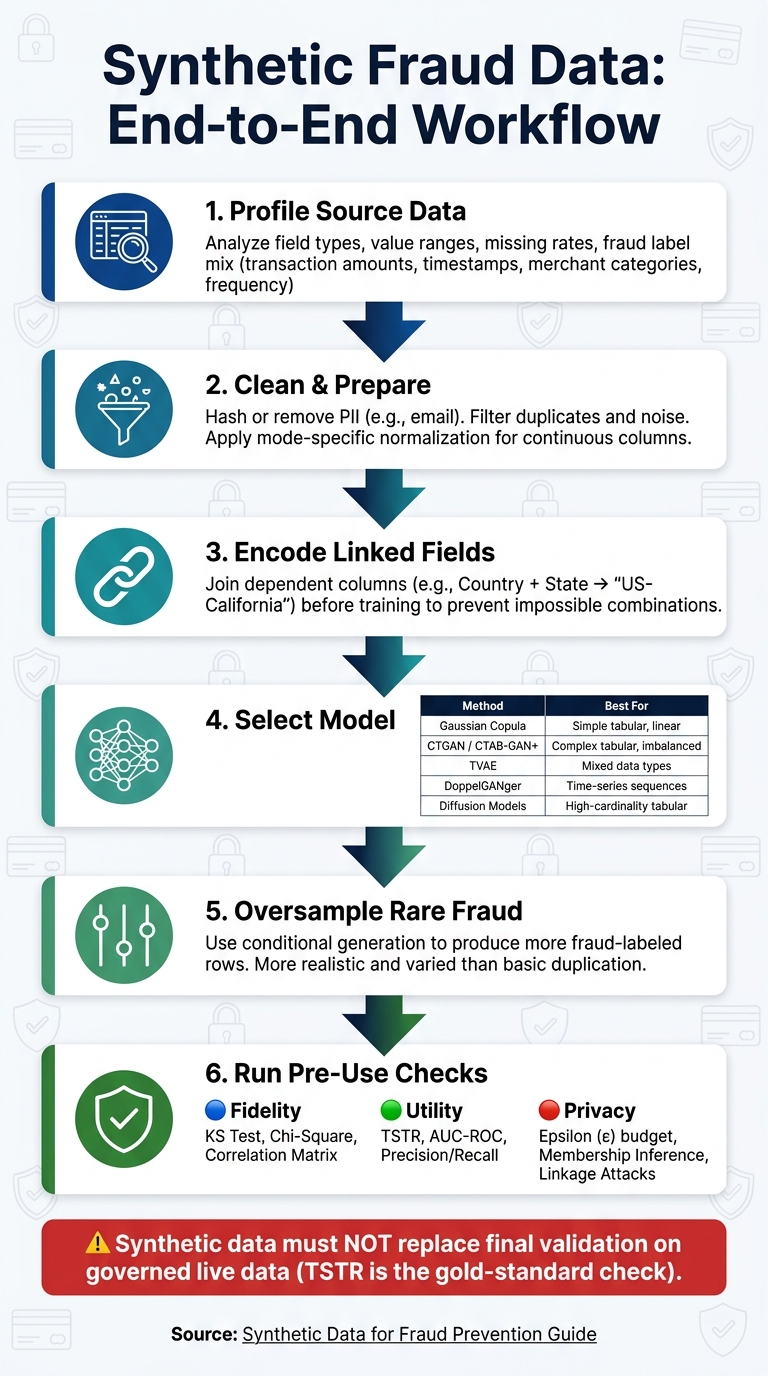
Synthetic Fraud Data: End-to-End Workflow from Source to Validated Dataset
Generation Methods for Tabular Fraud Data
Tabular fraud data usually comes down to a small set of model families. The right pick depends on what matters most: how close the data needs to be to the source, how fast you need results, and how much setup work your team can handle.
Gaussian copulas work for simpler tabular patterns, but they tend to miss more complex dependencies.
CTGAN and CTAB-GAN+ are common picks for harder fraud datasets. CTGAN uses mode-specific normalization for continuous columns and a conditional generator that helps keep categorical frequencies in place. That makes it useful when you need to oversample rare fraud labels. CTAB-GAN+ extends CTGAN with loss functions tuned for imbalanced datasets, which helps it learn the non-linear interactions behind rare events [4].
TVAE works well with mixed data types, though it often loses record-level precision [4].
Diffusion models are a newer option. Recent research suggests they do a better job with multimodal distributions and can reduce mode collapse [4]. For transaction sequences, TimeGAN or DoppelGANger are better fits because they preserve autocorrelation and seasonality [4].
| Generation Method | Best Use Case | Key Limitation |
|---|---|---|
| Gaussian Copula | Simple tabular data, linear relationships | Struggles with non-linear dependencies |
| CTGAN | Complex tabular data with multi-modal distributions | Can suffer from mode collapse |
| TVAE | Mixed-type tabular data (numeric + categorical) | Can produce less precise records |
| DoppelGANger | Time-series transaction sequences | Higher complexity to configure |
| Diffusion Models | Mixed, high-cardinality tabular data | Higher computational cost than GANs |
A Step-by-Step Workflow from Source Data to Synthetic Dataset
The workflow is straightforward: profile the source data, clean it, protect linked fields, generate conditionally, and run checks before anyone uses the output. Fraud data adds pressure in 3 places - rare labels, tied columns, and time-based behavior.
Data profiling comes first. Before choosing a model, teams need a clear read on field types, value ranges, missing rates, and the fraud label mix. In payments and banking, that usually means transaction amounts, timestamps, payment methods, merchant categories, transaction frequency, and purchase history [4][6]. In e-commerce, the field set often expands to order values, product categories, customer segments, shipping regions, and geography such as country and state [4][3].
Feature selection and cleaning come next. PII fields like email addresses should be hashed or removed before the model sees anything [5]. Duplicate and noisy records should be filtered out [5]. For continuous columns, mode-specific normalization is a better fit than basic min-max scaling because min-max can distort multimodal distributions [4].
Field dependencies need protection. If a model learns "Country" and "State" as separate columns, it can spit out impossible combinations - say, a German state tied to a U.S. country code [3]. A simple fix is to join dependent fields into one value, such as US-California, during training, then split them back after generation [3].
Conditional sampling helps with imbalance. After training, teams can ask for more fraud-labeled rows through conditional generation. Since the model learns the full conditional distribution, it can produce fraud cases that are more realistic and more varied than plain duplication or basic oversampling [4].
Run basic integrity checks before use. Non-negative balances and referential integrity should be checked before the dataset moves into any downstream workflow [1].
Where Synthetic Data Fits in Model Development
Synthetic data fits best in a few specific parts of the model lifecycle. It is most useful before production, not as a substitute for final validation.
Prototype training is the clearest fit. If a team is building a fraud model and the labeled set is too small or too skewed, synthetic records can supply enough signal to get training off the ground.
Sandbox and dev/test environments are another strong use case. Developers and QA teams need lifelike data to test pipelines, but raw transaction files usually cannot leave a controlled environment. A synthetic dataset that reflects production complexity gives them room to work without exposing live records.
Stress testing and red-team scenarios use synthetic data in a different way. Here, the goal is not to mirror normal behavior. It is to create rare or missing conditions that historical data does not contain, so teams can test how systems react under pressure [1].
Partner collaboration is often where teams see fast practical payoff. High-fidelity synthetic datasets can be shared across borders or with outside vendors without exposing raw records or triggering rules tied to data-sharing limits such as GDPR or HIPAA [1].
The hard line is production validation. Train on Synthetic, Test on Real (TSTR) is still the gold-standard check. Even if a model performs well on synthetic data, it still needs to be tested on a governed real-world sample before deployment [1].
sbb-itb-5174ba0
Privacy, Compliance, and Risk Controls
Once synthetic data is generated, the next question is simple: is it safe to use? Realistic-looking data isn't enough.
Utility, Fidelity, and Privacy Are Three Separate Tests
Many teams treat synthetic data as safe by default. That's a mistake, and it tends to show up later in model training, testing, and review.
Fidelity, utility, and privacy are not the same thing. In practice, they often pull against each other. A dataset can do well on one test and fail the other two.
Fidelity checks how closely the synthetic data matches the source distribution. Teams usually test this with methods like the Kolmogorov-Smirnov (KS) test for continuous columns and Chi-Square for categorical fields. Utility checks whether the synthetic data helps with the actual job - for example, improving fraud detection on real transaction data. That usually means testing on held-out real data with metrics like AUC-ROC and precision/recall. Privacy checks how hard it would be for an attacker to link a synthetic record back to a real person.
There's a tradeoff here. More privacy noise tends to reduce fidelity. Less noise may keep the data closer to the source, but it also increases re-identification risk. Run all 3 tests on their own before approving any synthetic dataset for training or evaluation.
Fraud data makes this harder. The rare signals that matter most are often the first ones to disappear when privacy noise goes up. So a dataset can look fine in a statistical review and still miss the patterns that separate fraud from normal behavior.
| Dimension | What It Measures | Common Tests |
|---|---|---|
| Fidelity | Statistical similarity to source data | KS Test, Chi-Square, Correlation Matrix |
| Utility | Usefulness for fraud detection tasks | TSTR, AUC-ROC, Precision/Recall gap |
| Privacy | Resistance to re-identification | Epsilon (ε) budget, linkage attack success rate |
Statistical checks alone are not enough. Teams should also run membership inference attacks and linkage attacks to test whether someone could match synthetic records back to real people. These simulations often expose risk that distribution-level testing won't catch.
Privacy-Preserving Approaches and Documentation Requirements
Differential privacy, or DP, is the main math-based framework used to measure re-identification risk. Its key setting is epsilon, written as ε, which defines the privacy budget. Lower ε gives more privacy. Higher ε keeps more of the source data's shape, but weakens protection. There is no standard default. Pick ε based on the sensitivity of the data and the level of risk the organization is willing to accept.
Studies indicate that the identity of 80% of credit card holders can be re-identified from just their last three transactions if traditional anonymization is used instead of robust synthetic generation [2].
For U.S. organizations in regulated settings, documentation matters just as much as testing. At a minimum, keep:
- Model cards that spell out the source data used, the generation method, and the privacy tests performed
- Generation logs and approval records so the dataset can be reproduced and audited later
Without that paper trail, synthetic data can add compliance risk rather than cut it.
Tag synthetic data in internal data lakes so it is never treated as ground truth.
Sign-off for regulated model development typically requires review from fraud analysts, data scientists, a legal or privacy officer, and a model risk management (MRM) team [6][7]. That cross-functional review is the minimum defensible governance gate.
These controls should guide tool selection, approval gates, and how deep validation needs to go in the next step.
Choosing Tools and Validating Results
What to Look for in Synthetic Data Tools and Datasets
After privacy controls are in place, pick tools that keep the parts of fraud data that matter: schema, rare cases, linked fields, and lineage. The goal is simple - the data must still work for fraud use cases, not just look plausible at a glance.
The main requirement is strong support for tabular and relational data, including referential integrity across complex schemas, not just row-by-row realism. Open-source libraries like SDV (Synthetic Data Vault) give you flexible Python APIs and models such as GaussianCopula and CTGAN, but they usually need more hands-on setup. Commercial tools like Gretel add enterprise features such as CI/CD integration and schema-consistent records, while MOSTLY AI adds fairness controls and GPU optimization. Cost matters as well. Open-source tools can give you more control, but commercial platforms may automate heavy work and cut months of manual effort down to days [1][2].
Structure alone is not enough. Look for formal privacy controls, especially differential privacy with a configurable epsilon (ε) budget, usually between 1 and 10 [1][2]. The tool also needs to produce enough rare fraud cases, not just samples from the middle of the distribution. In regulated settings, on-premise deployment, REST APIs, and Python SDKs are all useful options. For documentation, favor tools that support evidence export, case traceability, and record-level confidence scores so human analysts can review what the generator produced [8].
Test every tool against your actual fraud schema before you commit. A polished demo means very little if it breaks on your edge cases.
How to Validate Synthetic Fraud Data Before Use
Once the tool fits the schema, check whether its output holds up on distribution, integrity, and privacy.
Validate synthetic fraud data on 4 axes: distribution, relationships, privacy, and downstream model performance. Privacy attack tests - membership inference and linkage attacks - are required before release [1].
| Validation Check | What It Measures | Common Failure Signs | Rejection Criteria |
|---|---|---|---|
| Distribution & Relationships | Statistical similarity and column dependencies | High D-statistic; lost spend/age correlations | Significant divergence in core transaction ranges or known business drivers |
| TSTR (Utility) | Model performance on real vs. synthetic data | Accuracy/Recall drop > 10% | Synthetic data lacks predictive signal |
| Privacy Attacks | Re-identification risk | High success rate identifying training records | Epsilon budget exceeded; high leakage risk |
| Temporal Realism | Seasonality and autocorrelation | Flat trends; missing holiday spikes | Failure to mimic time-series dependencies |
| Logical Integrity | Adherence to business rules | Impossible values (e.g., State: California, Country: France) | Pre-aggregate columns or apply schema constraints |
Also run a mode collapse review. If the generator covers only part of the real distribution, it will miss the exact edge cases your fraud model needs most. That often shows up as flattened seasonality, broken country/state pairs, or missing rare fraud cases. Those are not small defects. They can undermine the whole training set. Pair automated checks with human fraud analyst review, because statistical tests can miss plausibility issues that an experienced analyst will catch [1].
How to Compare Model Performance Using Synthetic Data
After the dataset passes validation, measure whether it improves fraud detection on held-out real transactions.
The standard benchmark is Train on Synthetic, Test on Real (TSTR). Use it to answer one question: does synthetic data improve fraud detection on real transactions? Track precision, recall, ROC-AUC, false positive rate (FPR), and lift across both baselines.
Single-digit utility gaps are workable. Double-digit gaps point to poor fit, and the synthetic data should not be used for model training without revision [1][2].
Report results in business terms, not just model terms. Show dollars saved, review hours reduced, and legitimate transactions preserved. Lower false positives mean fewer good transactions get blocked, which protects revenue.
Reporting, Limits, and Final Takeaways
What a Strong Reporting Package Looks Like
After validation, the report needs to make the approval decision easy to audit. Once your synthetic fraud data has passed validation and your models have been benchmarked, the next job is simple: show what you did, why you did it, and what the results mean so executives, risk owners, and compliance teams can review it without a long back-and-forth.
A strong report should cover provenance, generation method, validation results, TSTR performance, privacy tests, and business impact. The cleanest way to structure it is around the article's core framework: provenance, fidelity, utility, and privacy. That gives reviewers a clear path from source data to model outcome.
Business impact should be spelled out in terms risk owners care about:
- Fraud loss reduced in dollars
- Lower false positive rates
- Analyst hours saved
That turns the report from a technical write-up into a decision document.
Common Failure Points to Avoid
The report should also call out the failure modes that matter most. The biggest one is treating synthetic data as ground truth rather than a controlled approximation. That sounds harmless on paper, but it can blur the very patterns fraud teams need to catch. Synthetic data can flatten real fraud spikes and hide attack patterns, including specific fraud signatures and sharp distribution peaks that models rely on.
The second major risk is mode collapse. If the generator misses rare fraud categories, it is failing in the part of the distribution that matters most. In plain terms, if your model never sees the edge cases, it will likely miss them in production too. These problems usually trace back to weak fidelity and thin generation coverage.
Privacy testing is just as important. Skipping membership inference or linkage attack tests before release creates privacy risk, not just a paperwork issue. A report that looks polished but leaves out those checks is still incomplete.
Human review from fraud, data, and compliance teams is still required before release.
Conclusion: When Synthetic Data Is Worth Using
Use synthetic data only when the privacy and utility tradeoffs are documented, tested, and acceptable. It makes sense when rules such as GDPR and CCPA limit access to real transaction records, when data access bottlenecks slow model development, or when extreme class imbalance leaves rare fraud scenarios underrepresented in training sets.
Success comes down to 3 things:
- A documented generation workflow
- Recorded privacy tests
- TSTR results strong enough for production use
Judge the outcome with both model metrics and business results: fraud loss reduction in dollars, false positive rates, and analyst hours recovered.
Used the right way, synthetic data is not a shortcut. It is a controlled method for building better fraud models when real data is off-limits, incomplete, or too imbalanced to train on alone.
FAQs
When should fraud teams use synthetic data?
Use synthetic data when fraud teams need to train, test, or validate fraud models without exposing sensitive live data. It’s a practical option when privacy rules get tighter, when teams need to model rare fraud patterns, or when development has to start before confidential data is available.
Treat it with the same discipline you’d use for live data. Check statistical similarity, test utility, and review edge cases with care, because relationships between fields may not hold up the same way.
How is synthetic data different from masked data?
Masked data protects real records by anonymizing, hashing, or encrypting sensitive values while keeping the original structure.
Synthetic data is generated from scratch by models. It mirrors the statistical patterns and behavior of real data, but it does not contain any original records. Put simply, masking hides who the real people are, while synthetic data creates entirely new ones.
What makes synthetic fraud data safe to use?
Synthetic fraud data is safe only when you prove it is. That means it contains no real people’s records, applies enforced privacy controls like differential privacy with a set epsilon budget, and gets checked for both privacy risk and model use.
In practice, that means running tests for re-identification, membership, and linkage attacks. It also means checking whether models trained on the synthetic data perform close to real-data baselines. The point is simple: control privacy risk with evidence, not assumptions.