62% of data breaches are linked to third-party vendors. If you’re using tools like analytics platforms, email services, or customer data platforms, you’re expanding your risk. On average, businesses share sensitive data with 583 vendors, and 82% of organizations have experienced at least one third-party breach in the past two years. Addressing these breaches costs an average of $7.5 million.
Here’s how to secure your marketing tools and reduce risk:
- Inventory your tools: Document every tool, its users, data access, and integration points using curated analytics resources to ensure no platform is overlooked.
- Classify by risk: Group tools into tiers (Critical, High, Medium, Low) based on data sensitivity and potential impact.
- Conduct security checks: Use questionnaires, verify certifications (SOC 2, ISO 27001), and ensure compliance with GDPR or CCPA.
- Evaluate controls: Check encryption standards, access management, and incident response plans.
- Monitor continuously: Use cyber risk ratings and reassess vendors after major changes or breaches.
- Document risks: Maintain a risk register and scorecards for transparency and accountability.
Your security depends on managing third-party risks effectively. Start with these steps to protect your data and reputation.
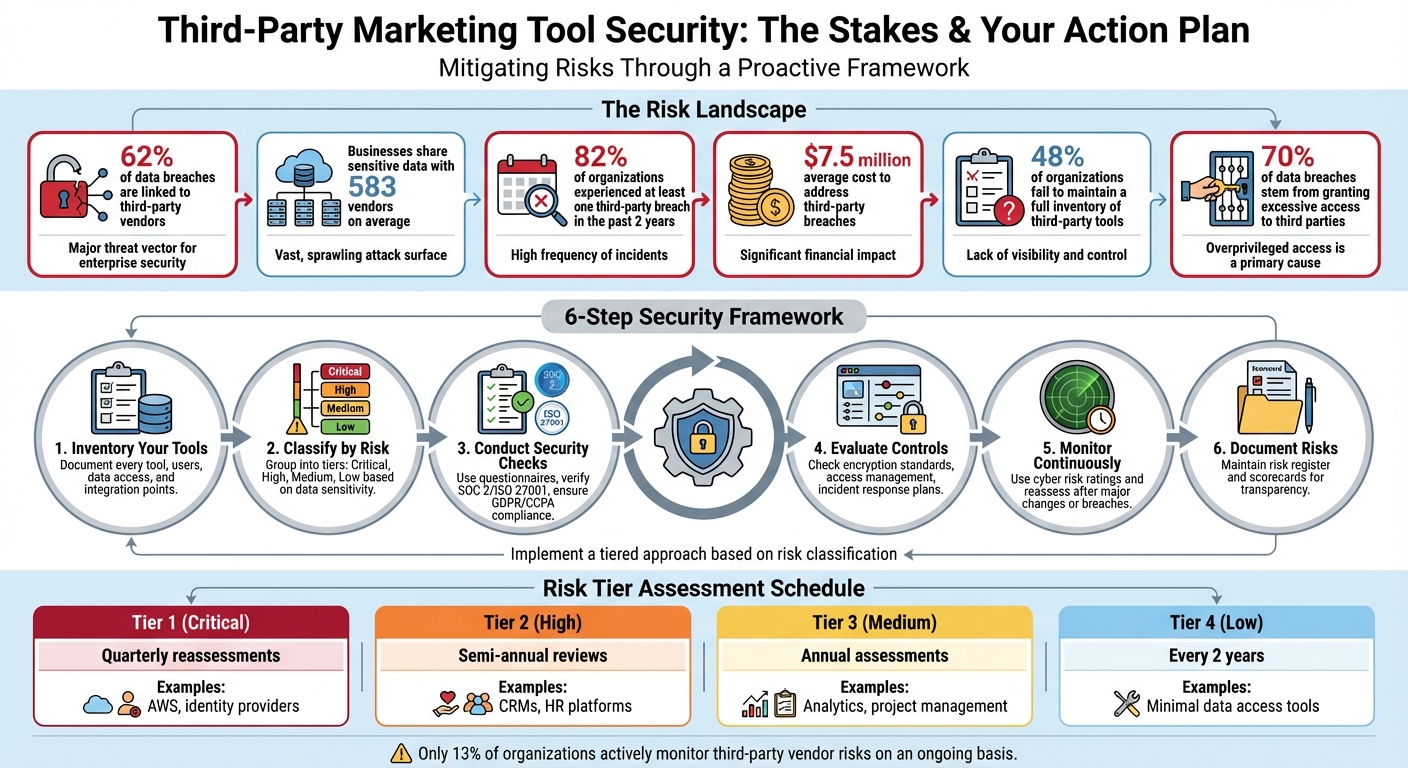
Third-Party Marketing Tool Security: Key Statistics and Risk Assessment Framework
Identifying and Categorizing Your Marketing Tools
Creating a Complete Tool Inventory
Start by documenting every marketing tool your organization uses. This step is critical because 48% of organizations fail to maintain a full inventory of their third-party tools. Without this visibility, businesses leave themselves vulnerable - especially since 70% of data breaches stem from granting excessive access to third parties.
Build a master inventory that includes the following for each tool: name, owner, active users, cost, core features, data types it handles (especially PII), integration points, and renewal dates. Don’t just rely on team input - dig deeper to uncover "Shadow IT." Check SaaS management tools, company credit card statements for recurring subscriptions, SSO logs like Okta, browser bookmarks in shared folders, and even old email confirmations for free trials that may still have access to company data. On average, marketers have access to 90 tools, but 70% of these go unused, leading to wasted resources - up to $8.5 million annually for billion-dollar enterprises.
Additionally, map how data flows between systems, such as Website → Tag Manager → Analytics → CRM. This helps identify security gaps and assess whether integrations are functioning as intended. Establish a primary "system of record" (usually a CRM or CDP) that serves as the foundation for data governance, ensuring all tools align with it.
Once you’ve created a thorough inventory, the next step is to classify these tools based on their risk level.
Classifying Tools by Risk and Data Sensitivity
Using your complete inventory, categorize tools by their risk level to focus security efforts where they matter most. Tools with limited access pose less risk compared to those handling sensitive data.
Adopt a four-tier system to organize tools by risk:
- Tier 1 (Critical): Mission-critical tools like AWS or identity providers that access sensitive data. These require quarterly reassessments.
- Tier 2 (High): Tools with high business importance, such as CRMs or HR platforms, which should be reviewed semi-annually.
- Tier 3 (Medium): Tools with limited or non-sensitive data access, like analytics tools for business or project management platforms, assessed annually.
- Tier 4 (Low): Tools with minimal data access and low operational impact, reviewed every two years.
When categorizing, consider whether a tool accesses sensitive data like Personally Identifiable Information (PII), Protected Health Information (PHI), payment card data (PCI), or behavioral data. Evaluate the "blast radius" - the potential impact on core business functions if the tool is compromised. Also, examine how the tool integrates with your systems. For instance, API integrations, direct database access, file transfers, or VPN connections each carry different levels of risk. Tools with "write" access to your CRM or those managing regulated data under GDPR or CCPA should be prioritized for frequent security reviews.
sbb-itb-5174ba0
Conducting Security Assessments for Marketing Tools
Using Security Questionnaires and Checklists
Once you’ve categorized marketing tools by their risk level, the next step is to conduct formal security assessments. Using standardized questionnaires can simplify this process and provide a consistent way to evaluate a vendor’s security practices.
For lower-risk website analytics tools like HubSpot or Mixpanel, frameworks like SIG Lite - a concise 126-question assessment - can be a good starting point. For cloud-based tools requiring more scrutiny, the CAIQ (Consensus Assessments Initiative Questionnaire) offers 261 questions that focus specifically on SaaS and cloud security. These tools save time while ensuring key security areas are covered.
However, generic questionnaires often miss risks unique to marketing tools. Consider asking questions tailored to your needs, such as: Can you share logs that prove when and how consumer consent was captured? This is crucial for compliance with regulations like GDPR and CCPA. Also, ask for a list of subprocessors and whether your data is being used to train AI models, with the ability to opt out.
Here are some essential questions to include in your assessment:
- What certifications do you hold (e.g., SOC 2 Type II, ISO 27001)?
- Is data encrypted using AES-256 at rest and TLS 1.2 or 1.3 in transit?
- Do you support MFA and SSO, and conduct quarterly access reviews?
- What is your documented timeline for breach notifications (e.g., within 72 hours)?
Be wary of vague or unsupported answers - these could signal weak security practices. Considering that over 60% of data breaches involve third-party vendors, and nearly half of IT and business leaders report breaches tied to vendors after partnerships began, thorough assessments are critical.
These evaluations not only help identify risks but also ensure compliance with your organization’s risk management policies. To verify a vendor’s claims, look for recognized industry certifications and adherence to compliance standards.
Checking for Industry Certifications and Compliance
Certifications provide independent proof that a vendor has strong security controls in place. For SaaS marketing tools, SOC 2 Type II is widely regarded as the most comprehensive standard. It evaluates aspects like security, availability, and privacy over a 6–12 month period, rather than a single point in time. When reviewing a SOC 2 report, check that it applies to the systems and regions relevant to your business, is less than a year old, and includes tested controls - not just "Design Only" controls.
Another key certification is ISO 27001:2022, which confirms that a vendor has implemented a robust information security management system (ISMS). This certification includes 93 detailed controls covering technical, organizational, and physical security measures. Make sure the certificate is issued by an accredited body and that its scope fully applies to the services you’re using.
For tools that handle sensitive data, additional compliance measures may be necessary:
- PCI DSS: Required for tools managing payment data.
- HIPAA: A signed Business Associate Agreement (BAA) is needed if Protected Health Information (PHI) is involved.
- GDPR and CCPA: Look for Data Processing Agreements (DPAs) that outline data handling, subprocessor management, and audit rights, as required under GDPR Article 28.
"Your organization is only as secure as its weakest third-party vendor." - SecurityPal
Finally, make sure your contracts include audit rights to verify compliance annually. This is especially important, given that vendor-related breaches cost companies an average of $4.52 million in detection, response, and recovery expenses.
Evaluating Critical Security Controls
Encryption and Access Management
After reviewing certifications, the next step is to dive into the specific technical security measures vendors have in place to safeguard your data. Start with encryption standards, which form the backbone of data protection. Any marketing tool should use TLS 1.2 or higher (preferably TLS 1.3) for securing data in transit, while older protocols like TLS 1.0 and 1.1 should be disabled. For data at rest - whether in CRMs, marketing platforms, or analytics databases like FoxMetrics - ensure the vendor employs AES-256 encryption. Passwords must never be stored in plaintext or with reversible encryption. Instead, modern, salted hashing algorithms like bcrypt, Argon2, or scrypt should be used.
Encryption is only as strong as its key management. Vendors should have robust measures in place, including secure key storage, regular key rotation, and separate encryption keys for different clients to minimize the impact of any potential breach. If JavaScript tags from third-party vendors are embedded on your site, confirm they support Subresource Integrity (SRI) to ensure the code running in browsers hasn’t been tampered with.
Encryption alone isn’t enough; access management plays an equally important role. Vendors should support Multi-Factor Authentication (MFA) for all admin accounts, Role-Based Access Control (RBAC) to restrict permissions based on job roles, and the Principle of Least Privilege (PoLP) to limit access to only what’s necessary. Implementing Just-in-Time (JIT) access is another key safeguard, granting temporary permissions only when needed and automatically revoking them afterward. This approach eliminates the risks associated with standing access, especially if credentials are compromised.
"Your security is only as strong as your weakest vendor." - OWASP Top 10:2025 Security Guide for Digital Marketers
The numbers don’t lie: 94% of tested applications reveal vulnerabilities in broken access control, and 74% of breaches involve privileged account misuse or human error. Even more concerning, 17% of users will leave a website if it triggers a "Not Secure" warning in their browser due to missing HTTPS. These statistics highlight why encryption and access management are not just technical requirements - they’re critical for protecting your data and maintaining customer trust.
After addressing encryption and access controls, ensure your vendors are equipped to detect and respond to threats quickly and effectively.
Vulnerability Scanning and Incident Response
Even the most secure tools can be compromised if vulnerabilities go unaddressed. Confirm that vendors conduct third-party penetration tests annually and request a summary of their latest test results - not just a vague acknowledgment that testing occurred. Vendors with a bug bounty program - through platforms like HackerOne or Bugcrowd - demonstrate a proactive approach to identifying and fixing vulnerabilities.
Evaluate their patching process. Vendors should have a clear policy for applying updates, with defined timeframes such as addressing critical patches within 30 days. You can also use external scanning tools to monitor their security posture. For instance, expired SSL certificates or open ports can signal weak internal practices. If the vendor’s tools rely on JavaScript tags, use tools like RetireJS to check for outdated libraries with known vulnerabilities.
A solid Incident Response Plan (IRP) is just as important. Vendors should have a formal plan that details their commitment to notifying your organization of breaches within a specific timeframe - typically 24 to 72 hours. Include these notification SLAs in your contract, specifying that critical incidents must be reported within 1 to 24 hours. Alarmingly, only 34% of organizations feel confident that a vendor would notify them of a breach, making these contractual obligations non-negotiable.
| Security Control | Verification Method | Red Flags |
|---|---|---|
| Vulnerability Management | Review patching policy and scan frequency. | No formal policy; critical patches take >30 days. |
| Penetration Testing | Request a summary of the latest third-party test. | Tests older than 12 months; refusal to share results. |
| Incident Response | Review the IRP and notification SLAs in contracts. | No breach notification commitment; unclear roles. |
| External Hygiene | Use tools like BitSight or SecurityScorecard. | Expired SSL certificates; poor patching grades. |
Supply chain breaches take an average of 26 days longer to identify and contain compared to other types of breaches. The financial impact is equally alarming: 82% of organizations have faced at least one third-party-related breach in the last two years, with an average remediation cost of $7.5 million. These statistics underline the importance of proactive vulnerability management and having a rapid incident response plan in place for any marketing tool you adopt.
Third-Party Risk Management 101: Assess, Monitor, and Mitigate: The Core Components of TPRM
Implementing Continuous Monitoring and Reassessment
Once you've established strong encryption and access controls, keeping vendor security up to date requires constant attention. An initial security assessment is just the beginning. Vendors' security postures can shift due to new vulnerabilities, leadership changes, or the involvement of additional subcontractors. Relying solely on annual reviews creates gaps that attackers can exploit. Shockingly, only 13% of organizations actively monitor third-party vendor risks on an ongoing basis, leaving most exposed to threats that emerge after initial approval.
Using Cyber Risk Ratings and Alerts
Think of cyber risk ratings as the cybersecurity equivalent of credit scores. These ratings offer an objective way to measure a vendor's security performance based on external data, giving you a clear, outside-in perspective without constant back-and-forth with the vendor. Services like SecurityScorecard and Bitsight scan for vulnerabilities like misconfigured cloud storage, leaked credentials, or chatter on the dark web. The stakes are high: 98% of organizations reported a third-party breach in the past year, and breaches tied to third-party software vulnerabilities can add over $90,000 to costs.
To make monitoring seamless, integrate risk alerts into your existing tools, such as SIEMs, GRC platforms, or ticketing systems. This approach allows for immediate action when a vendor's security rating drops or a critical vulnerability is detected. Organizations with structured, business-aligned cyber risk programs are 4.5 times more likely to monitor all vendor relationships continuously. Set up automated alerts for key changes, like sudden security score drops or newly identified vulnerabilities. When an alert is triggered, have clear protocols in place - for example, suspending vendor access until they provide proof of remediation.
"Third-party risk management is no longer a checklist - it's a continuous process of visibility, validation, and vigilance." - Bitsight
This type of monitoring naturally feeds into a schedule of risk-based reassessments.
Reassessing Security on a Regular Basis
Not all tools demand the same level of attention. Implement a risk-based schedule: review high-risk tools handling sensitive customer data quarterly or annually, while lower-risk tools might only need a check every two or three years. Critical vendors should be under constant monitoring with real-time alerts, while medium-risk tools can be assessed monthly or quarterly using automated screenings.
Beyond scheduled reviews, conduct targeted reassessments after significant events like breaches, zero-day vulnerabilities, or changes to vendor contracts. Regularly check in with internal teams - such as marketing - to confirm whether social media analytics tools or other platforms' roles have changed or if it now processes more sensitive data than originally intended. It's worth noting that third-party vendors are five times more likely to have weak security compared to the organizations they serve, and containing a supply chain breach can take an average of 26 days longer than other types of breaches. These figures highlight why ongoing diligence is critical to safeguarding your organization and customer data. This consistent vigilance is the final piece of the puzzle in securing third-party marketing tools.
Documenting Risks and Decision-Making Processes
Keeping a detailed record of risks and decisions based on continuous monitoring builds accountability and informs smarter risk management. A risk register is an excellent tool for this purpose. It centralizes all findings, risk levels, and mitigation efforts, making the process transparent for both auditors and executives. Considering the average company shares sensitive data with around 583 third-party vendors, it’s crucial to track who has access to what.
A well-maintained risk register should include key details like the vendor’s name, the services they provide, the type of data shared (e.g., personal information or credentials), the vendor’s importance to your business, your internal point of contact, and contract timelines. To take it further, classify risks using a risk matrix, which evaluates them by likelihood and impact. For residual risks, document their acceptance, assign owners, and set remediation deadlines. Companies with structured third-party risk management systems can onboard vendors 4–6 times faster than those relying on manual processes.
To ensure consistency, align your risk register with earlier security assessments, creating a unified framework for managing third-party risks.
Creating Vendor Risk Scorecards
Standardized scorecards bring consistency to vendor evaluations. A 100-point scoring system divided across critical areas - like Certifications (25 points), Security Practices (25 points), Access Control (20 points), Business Continuity (15 points), and Financial Health (15 points) - helps prioritize what matters most. For instance, when assessing marketing tools that handle customer data, cybersecurity might weigh more heavily than financial stability.
The scoring process involves multiplying the likelihood of a risk by its potential impact. For example, a vendor without multi-factor authentication (MFA) for admin access presents both a high likelihood and significant impact risk. Vendors offering vague responses like “we follow industry standards” without evidence should raise red flags. Always require documentation, such as SOC 2 reports, ISO certifications, or penetration testing results, to back up claims. Storing all these assessment artifacts in one place can cut audit prep time by up to 40%.
| Score Range | Risk Level | Decision Action |
|---|---|---|
| 90–100 | Minimal | Approved; standard annual monitoring |
| 75–89 | Low | Approved; minor gaps to address |
| 60–74 | Medium | Conditional approval; remediation plan required |
| Below 60 | High | Rejected or intensive monitoring recommended |
These scorecards guide decisions on whether to approve, request remediation, or reject a vendor outright.
Approving, Remediating, or Rejecting Vendors
Clear score thresholds make approval or remediation decisions straightforward. For example, vendors scoring 75 or above could be approved, while those scoring between 60 and 74 might need to submit a Corrective Action Plan (CAP) before receiving conditional approval. CAPs should include assigned owners, deadlines, and follow-up steps. Vendors scoring below 60 are often rejected unless senior leadership deems them critical and formally accepts the residual risk.
Every decision should be backed by evidence. If a vendor fails to meet requirements, document the specific gaps and any compensating controls that could mitigate risks. Including “right to audit” clauses in contracts allows for deeper verification of claims, whether through physical inspections or technical assessments. Additionally, establish escalation paths to ensure high-risk findings involving critical vendors reach senior management or the board.
Third-party vendors are five times more likely to have weak security than the organizations they serve. And the cost of addressing a third-party breach averages $7.5 million. Proper documentation creates an accountability framework to manage these risks when problems arise.
Conclusion
Protecting your business from third-party risks demands more than a one-time evaluation. With 62% of data breaches linked to third-party vendors and an average remediation cost of $7.5 million, a thorough and ongoing approach is crucial. Start by creating a detailed inventory of your marketing tools, categorizing them based on data sensitivity and their role in your operations.
Once your inventory is in place, move toward a robust assessment process. This should include reviewing security questionnaires, verifying SOC 2 or ISO 27001 certifications, and ensuring compliance with GDPR or CCPA standards. But don’t stop there - 46% of organizations report breaches occurring after partnerships have begun. This highlights the importance of continuous monitoring for breach alerts, leaked credentials, and potential misconfigurations.
To streamline security decisions, document risks using registries and scorecards. These tools promote accountability and enable faster responses when issues arise. As CM Alliance aptly noted:
"In 2026, your security posture becomes the weighted average of the companies you rely on".
Third-party vendors are also five times more likely to have weaker security than your own organization, making it essential to view vendor security as an extension of your internal safeguards.
Beyond monitoring, strengthen your security framework with firm contract clauses and reliable offboarding protocols. Contracts should include security requirements, right-to-audit clauses, and breach notification timelines. Remember to account for fourth-party risks - your vendors’ subcontractors can also compromise your data. Wrapping up the lifecycle, ensure access is revoked and data deletion is verified when partnerships end. This comprehensive approach not only safeguards your data but also protects your reputation and financial stability.
For more tips on securing marketing tools and staying informed about best practices, check out the Marketing Analytics Tools Directory (https://topanalyticstools.com).
FAQs
What data should I avoid sharing with marketing tools?
When using marketing tools, it's crucial to avoid sharing personal or sensitive data. This includes customer information, login credentials, and proprietary business strategies. Specifically, never share personally identifiable information (PII), OAuth tokens, or any confidential business data. Doing so could result in data breaches, account takeovers, or even regulatory penalties.
To stay secure, ensure the tools you use meet established security standards. Only provide the data that's absolutely necessary for the tool's purpose, and avoid sharing unencrypted or irrelevant sensitive information.
Which contract terms matter most for vendor security?
When it comes to vendor security, certain contract terms deserve extra attention. These include data protection, compliance obligations, and breach response procedures.
Key clauses should cover critical areas like encryption protocols, access control measures, and timely breach notifications. It’s also essential that vendors comply with regulations such as GDPR or CCPA.
Make sure any data processing agreements (DPAs) clearly outline the required security measures, assign liability for potential breaches, and grant audit rights. These elements help maintain oversight and ensure the vendor’s security practices remain up to standard.
How do I monitor vendors after they’re approved?
To keep an eye on approved vendors, it's essential to perform regular risk assessments tailored to their specific risk levels. Automated tools can be a big help in tracking their security posture over time. Create a monitoring plan with clear, measurable KPIs - think security ratings or compliance coverage - that provide insight into their performance.
Make it a habit to review certifications, conduct audits, and monitor key metrics frequently. This ensures that vendors maintain compliance and security standards throughout the duration of your relationship with them.