Want your ads to perform better? The key lies in understanding your audience. Audience segmentation divides your customers into smaller, specific groups based on shared traits like demographics, behaviors, or interests. This allows you to deliver personalized messages that resonate, leading to higher engagement, better conversions, and smarter budget use.
Key Takeaways:
- What It Is: Audience segmentation is grouping customers by traits like age, location, behavior, or values.
- Why It Works: Tailored ads feel relevant, boosting click-through rates and ROI.
- How to Do It: Use data from CRMs, website analytics, and social media to identify patterns. Then, test and refine your segments.
- Types of Segmentation: Focus on demographics, geography, behavior, intent, and psychographics for a complete view.
- Tools Matter: Platforms with AI, real-time analytics, and automation simplify the process.
Audience Segments 2025: Step By Step Google Ads Tutorial
Types of Audience Segmentation
Understanding different types of audience segmentation is key to choosing the best approach for your marketing efforts. Often, combining multiple methods yields the most effective results. Let’s explore how traditional factors like demographics and location set the stage for more precise targeting.
Demographic and Geographic Segmentation
Demographic segmentation sorts audiences based on measurable traits like age, gender, income, education, and family status. These details help paint a picture of your customer base and their spending habits. For instance, high-income professionals might be drawn to ads emphasizing premium quality, while students or budget-conscious shoppers respond better to messages highlighting affordability. Similarly, a 45-year-old parent browsing parenting blogs will connect with messaging that’s vastly different from what appeals to a 22-year-old gamer on YouTube.
Geographic segmentation zeroes in on location-based factors such as country, region, city, or even climate. This allows marketers to adapt their messaging based on local preferences and needs. For example, a clothing retailer might promote winter coats in colder areas while showcasing swimwear to customers in warmer climates.
By tapping into these demographic and geographic insights, you can create messaging that feels personal and relevant. When your audience feels understood, your ads are less likely to come across as intrusive and more likely to spark engagement.
But understanding your audience doesn’t stop at static details. Real-time actions can provide even deeper insights for targeting.
Behavioral and Intent-Based Segmentation
Behavioral segmentation focuses on what people do rather than who they are. It tracks actions like purchase history, website visits, and campaign engagement. For example, if someone frequently browses a particular product category, your ads can reflect that interest immediately. Tailoring messages to past behavior often leads to higher engagement.
First-time buyers might respond well to introductory discounts, while loyal customers could be rewarded with exclusive perks. On the other hand, new leads might need educational content to familiarize them with your brand.
Intent-based segmentation takes things further by identifying customers or accounts that are ready for specific marketing actions based on their intent to purchase. Marketers can detect intent signals through behaviors like pages visited, time spent on-site, downloaded content, or even search queries. For B2B marketers, this approach helps determine whether an account is ready for brand awareness campaigns, product education, or demand generation efforts. Spotting intent signals early allows you to focus on prospects most likely to convert, boosting your return on investment. In fact, research shows that using AI in segmentation can improve conversion rates by nearly 10% among high-value customers.
Psychographic and Lifestyle Segmentation
Psychographic segmentation digs deeper into customer values, interests, beliefs, attitudes, and lifestyle choices. It acknowledges that people with similar demographics can have vastly different motivations. For instance, two 35-year-old professionals might prioritize completely different things - one may lean toward eco-friendly, sustainable products, while the other might seek luxury and status symbols. Crafting messages that align with these values makes customers feel understood, increasing the likelihood of brand loyalty.
Lifestyle segmentation looks at how people spend their time, the activities they enjoy, and what matters most in their day-to-day lives. These insights can shape your content and partnerships. For instance, a soft drink company might discover that one of their audience segments is particularly interested in handball and podcasts. This opens up opportunities to partner with relevant influencers or platforms, creating fresh ways to connect with that audience.
Artificial intelligence enhances segmentation by identifying micro-segments in real time. AI can uncover patterns that might go unnoticed through manual analysis, making outreach more precise and relevant. It also helps marketers avoid overloading audiences with too many messages or sending irrelevant content, both of which can drive disengagement. By leveraging AI, you can focus on the segments most likely to convert, improving overall efficiency and effectiveness.
How to Build a Segmentation Framework
Creating a segmentation framework is all about turning scattered customer data into focused audience groups that improve ad performance. It’s a step-by-step process that involves gathering data, setting clear boundaries, and putting your segments to work across your marketing channels.
Gather and Combine Your Data
The first step in building a segmentation framework is pulling together data from every point where customers interact with your brand. Your CRM system is a goldmine for purchase history and customer interactions. Website analytics can show how users navigate your site and what content grabs their attention. Social media insights reveal interests, demographics, and engagement patterns, while email platforms track who’s opening your emails and clicking through. Platforms like Facebook and Google Ads also offer detailed audience data and conversion metrics.
The goal? A single, unified customer profile that combines all these touchpoints. For example, say your CRM shows a customer has purchased running shoes three times this year. Combine that with website data showing they browse marathon training content and social media activity indicating they follow professional runners. Together, this paints a picture of a serious runner who might respond well to ads for high-performance gear.
Consolidating your data also reduces duplicate records, which can save you from wasting ad spend or sending mixed messages. When your CRM, email platform, and ad platforms aren’t synced, the same person might get bombarded with conflicting offers or see the same ad repeatedly. A unified profile ensures your segments are accurate and your messaging stays consistent.
Define Clear Segmentation Criteria
Once you’ve got your data in one place, the next step is to set clear rules for turning raw data into actionable audience segments. These criteria should align with your business goals and work seamlessly across your marketing platforms.
Here are some common segmentation criteria:
- Demographics: Age ranges (e.g., 25–34), income levels (e.g., $75,000–$100,000), education levels, or family status (e.g., parents with young kids).
- Geographics: Zip codes, cities, states, or even climate zones - especially useful if your products vary by region.
- Behavioral data: Actions like spending over $500 in the last year, visiting your site 10+ times a month, or abandoning a cart in the past week.
- Intent signals: For example, someone who downloads multiple product comparison guides and visits your pricing page repeatedly shows stronger purchase intent than someone who just reads a blog post.
- Psychographics: Lifestyle choices and values, such as customers who prioritize sustainability based on their interest in eco-friendly products or content.
Be as specific as possible. Instead of vaguely labeling a group as “engaged users,” define them as “users who opened at least three emails and clicked twice in the past 30 days.” This level of detail helps you identify high-potential segments and focus on those most likely to convert. Document your criteria so your entire team - marketing, sales, and advertising - can apply them consistently.
Activate Segments Across Channels
Defining your segments is only half the battle. The real magic happens when you use those segments effectively across all your marketing channels. Each segment should receive tailored messaging that aligns with their specific needs and behaviors.
Start by mapping your segments to the targeting options available on each platform. For instance, platforms like Facebook and Google let you upload custom audiences based on your segmentation criteria. Email marketing systems can run campaigns for specific groups, and your CRM or automation platform should serve as the central hub to keep everything in sync. Use consistent naming conventions across platforms - if a segment is labeled “High-Intent B2B Prospects” in your CRM, use the same name in your ad campaigns and email lists.
Here’s an example: First-time buyers might receive welcome offers and brand education across email, social media, and display ads. Meanwhile, loyal customers could see exclusive perks and early access to new products. When a customer moves from the “prospect” segment to the “customer” segment after their first purchase, their messaging should update automatically across all channels.
To make this seamless, set up workflows that update segments in real time. For instance, if a customer’s spending increases enough to move them from “occasional buyer” to “frequent customer,” they should immediately start receiving messaging tailored to their new status - no manual updates required. This keeps your campaigns relevant and avoids overloading customers with irrelevant ads.
If you’re looking for tools to simplify this process, the Marketing Analytics Tools Directory offers a range of options. From enterprise-level customer data platforms to more specialized solutions, these tools can help you manage real-time updates, cross-channel coordination, and automation workflows within your existing marketing stack.
sbb-itb-5174ba0
Testing and Measuring Segmentation Performance
Once your segmentation framework is in place, the next step is to test and monitor its performance. Skipping this step could lead to inefficient use of your ad budget.
A/B Testing Ad Creatives and Segments
A/B testing is a powerful way to figure out what works best for different audience segments. By testing one variable at a time - like your ad creative, tone of messaging, call-to-action, or offer type - you can pinpoint what resonates with each group. For instance, a skincare brand might test whether teenagers respond better to educational content or promotional offers, while separately exploring which messaging style appeals most to older customers. The key is to define clear baseline metrics and set a specific test duration. This disciplined, data-driven approach ensures your budget is spent wisely and highlights the variations that deliver the best results.
Tracking Key Performance Indicators
To measure how well your segmentation strategy is working, focus on tracking key performance indicators (KPIs). Click-through rates (CTR) reveal how effectively your ads grab attention, while conversion rates show the percentage of users taking the desired action. Return on ad spend (ROAS) helps you assess whether your campaigns are generating a profit, and engagement rates provide insights into how audiences interact with your content beyond just clicking. Additionally, tracking cost per acquisition (CPA) by segment can highlight areas where costs are higher than expected, prompting further investigation. For B2B marketers, it’s also useful to monitor how accounts move through the funnel - from brand awareness to product education or demand generation - to better allocate resources.
Refining Segments Based on Data
Once you’ve analyzed test results and KPIs, use the insights to fine-tune your audience segments. Segmentation isn’t static; it should adapt as audience behavior and market conditions shift. Start by examining conversion rate differences between groups. If one segment consistently underperforms, it could mean your current definitions don’t align with actual behavior. Similarly, if there’s significant variation in conversion rates within a single segment, this might suggest the need for micro-segmentation to target distinct subgroups more effectively.
A rising CPA, despite consistent messaging, might indicate diluted targeting that needs adjustment. Behavioral data can also uncover new opportunities. For example, if users who repeatedly visit your pricing page convert at higher rates, you might create a high-intent segment based on that behavior.
Leveraging AI tools can help analyze real-time data and identify promising subgroups to target.
If a segment isn’t performing as expected, investigate whether the issue lies in targeting, messaging, or the offer itself. Document every adjustment and share these findings with your team to build collective knowledge. Since audience behavior evolves over time, make it a habit to regularly review segment performance and reassess key assumptions about messaging, channels, and offer strategies. This ensures your approach stays relevant and effective in a changing market.
Tools for Audience Segmentation and Analytics
Choosing the right tools can make all the difference in how effective and efficient your audience segmentation strategy is. Without automation, segmentation can become a tedious, manual process. Modern platforms simplify this by automating data collection, uncovering hidden trends, and enabling real-time adjustments to campaigns.
Key Features in Segmentation Tools
The best segmentation tools come equipped with several essential features that streamline the process and enhance results:
- CRM integration: This feature pulls together data from emails, website activity, purchase history, social media interactions, and customer support into one centralized platform. A unified view ensures that no valuable insights are lost in scattered systems.
- Real-time analytics: Modern tools stand out by offering real-time dashboards that provide instant insights into metrics like engagement rates, click-through rates, and conversions. This allows you to quickly spot underperforming segments and make immediate adjustments to your messaging or budget.
- Automation capabilities: These tools sync audience segments directly to platforms like email, social media, and display networks. This ensures consistent messaging across all customer touchpoints and streamlines campaign execution.
- AI-powered insights: Artificial intelligence can identify micro-segments and detect subtle audience patterns that might otherwise go unnoticed, enabling more precise targeting.
- Integrated A/B testing: Simplified testing features allow you to experiment with different messages or offers. Built-in tools help you create test variations, track performance, and scale successful campaigns - all within the same platform.
- Detailed reporting dashboards: These dashboards provide a clear view of key performance indicators (KPIs) like conversion rates, engagement levels, customer acquisition costs, and return on ad spend (ROAS). Monitoring these metrics ensures you can make informed, data-driven decisions.
These features are the backbone of any modern segmentation toolset. For a deeper dive into available options, the Marketing Analytics Tools Directory is a great resource.
Using the Marketing Analytics Tools Directory
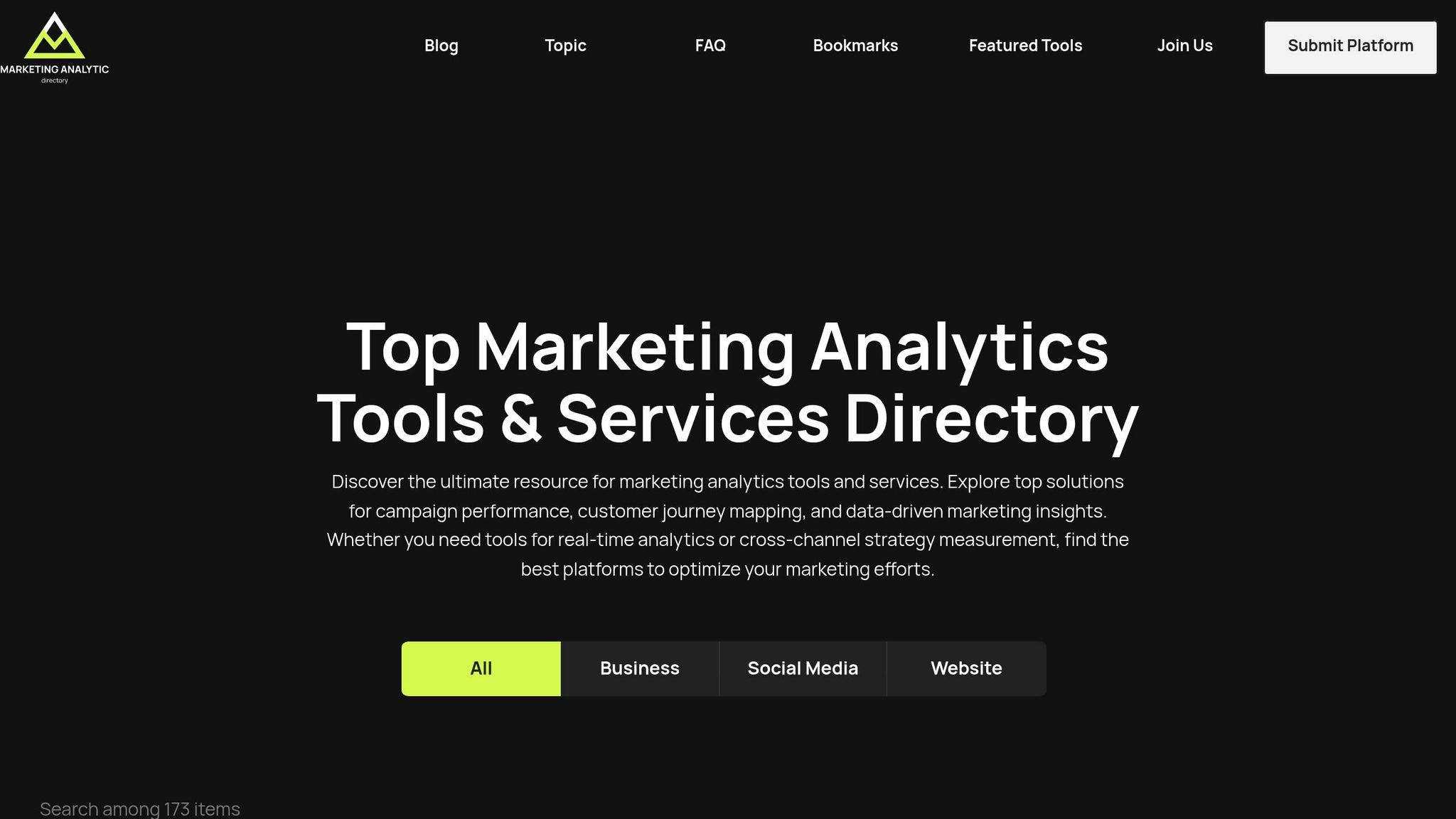
To help you navigate the wide range of tools available, the Marketing Analytics Tools Directory offers a user-friendly way to compare solutions tailored to audience segmentation and campaign performance needs. Tools are categorized by use case - such as real-time analytics, audience insights, A/B testing, and business intelligence - making it easier to find one that aligns with your goals.
Before diving in, evaluate your current data systems and identify the platforms you already use. Look for tools that integrate easily with your existing tech stack to avoid unnecessary costs or complications. Also, consider your team's technical expertise. Some tools require advanced setup and customization, while others are designed with intuitive interfaces for marketers who may not have technical backgrounds.
Pricing structures can vary widely. Some tools charge based on the number of contacts, others by user, and some follow a tiered pricing model based on features. For smaller businesses, cloud-based solutions often deliver better value, while larger organizations may prefer customizable platforms. The directory helps you compare pricing models to find one that fits your budget.
Before committing to a tool, take advantage of demos or free trials. Focus on how well the tool handles your data volume and segmentation needs. Test how easily you can create and modify segments, how quickly it processes data, and whether its reporting dashboards provide the insights you need. Additionally, prioritize tools that support various segmentation types - such as demographic, geographic, behavioral, intent-based, psychographic, and lifestyle - so you can build well-rounded audience profiles.
Conclusion
Audience segmentation plays a critical role in today’s fast-paced digital marketplace. By delivering tailored messaging, businesses can significantly enhance ad performance while fostering meaningful customer relationships. These outcomes stem from using precise segmentation frameworks, integrating robust data, and continuously testing performance strategies, as outlined earlier.
Why Segmentation Matters
Using tailored segmentation boosts conversion rates by delivering messages that resonate with specific audiences. It’s also a smarter way to manage your budget. Instead of casting a wide net and wasting resources, segmentation allows for strategic allocation toward high-potential groups, ensuring every dollar works harder. This approach reduces unnecessary spending and maximizes ROI - a key advantage in competitive markets.
Segmentation also elevates customer satisfaction and loyalty. When customers feel that a product or service aligns with their unique needs, they’re more likely to stick around and even advocate for your brand. For smaller businesses, segmentation can level the playing field. By focusing on niche markets and delivering highly specialized products or messaging, they can outshine larger competitors who might overlook these opportunities. This targeted approach also accelerates product development and optimizes resource use.
With these benefits in mind, here’s how you can refine and execute your segmentation strategy.
Steps to Strengthen Your Segmentation Strategy
To fully harness the power of segmentation, start by auditing your current practices. Define clear criteria such as demographics, behaviors, and interests to build detailed audience profiles. Combine data from various sources - like purchase history, browsing behavior, and psychographics - to create a comprehensive view of your audience. Then, map your audience into distinct groups and evaluate whether each segment receives personalized messaging or generic communication. Comparing engagement and conversion rates between these approaches will help you measure the impact of your efforts.
Ensure your marketing platforms are equipped to handle advanced segmentation. Tools powered by AI can uncover micro-segments and patterns that might otherwise go unnoticed. For a detailed overview of available solutions, check out the Marketing Analytics Tools Directory, which offers a range of options tailored to your needs.
Focus on high-value customer segments first to maximize ROI. Use A/B testing to see how different segments respond to personalized messaging versus generic approaches. Remember, segmentation isn’t a one-and-done task - it’s an ongoing process that requires regular monitoring, testing, and adjustments based on real-world results.
Finally, maintain consistency across all marketing channels, from email and social media to display ads and content marketing. A unified approach ensures that your audience experiences coherent messaging no matter where they engage with your brand. As customer preferences and market trends shift, your segmentation strategy should evolve too, creating a cycle of continuous improvement that strengthens relationships and drives success.
FAQs
What’s the best way to combine audience segmentation strategies to boost ad performance?
To make your ad campaigns more effective, try combining different audience segmentation methods. Focus on demographic, geographic, behavioral, and psychographic data to craft ads that truly connect with specific groups.
For instance, you could target users by age and location (demographic and geographic data) while also factoring in their online habits and personal interests (behavioral and psychographic data). This layered approach helps ensure your ads feel relevant and engaging, which can boost performance and drive higher conversion rates.
Leverage marketing analytics tools to uncover these audience insights and monitor how well your segmentation strategies are working. These tools can also help you fine-tune your campaigns for even better results.
How does artificial intelligence enhance audience segmentation and improve ad targeting?
Artificial intelligence (AI) has transformed the way marketers approach audience segmentation. By sifting through massive datasets, AI uncovers patterns, behaviors, and preferences across various demographics, allowing businesses to craft ad campaigns that feel tailored to specific groups.
With AI-driven tools, marketers can analyze real-time data, anticipate customer actions, and automate segmentation based on criteria like age, location, interests, and buying habits. These insights help businesses fine-tune their advertising strategies, boost engagement, and get more value from their marketing investments.
How can I evaluate the effectiveness of my audience segmentation strategy and make improvements?
To gauge how well your audience segmentation strategy is performing, focus on tracking key performance indicators (KPIs) like click-through rates (CTR), conversion rates, and engagement metrics such as time spent on a page or bounce rates. These numbers give you a clear picture of how effectively your customized ads are connecting with different audience groups.
Incorporate A/B testing to see how various segmentation strategies stack up against each other. This helps pinpoint which approach yields better outcomes. You can also tap into marketing analytics tools to dig deeper into audience behavior and preferences. Make it a habit to review your data regularly, adjusting your strategy as needed to improve results for underperforming segments or fine-tune targeting for stronger engagement.