Marketers spend nearly 40% of their time transforming raw data into usable formats. With data scattered across platforms like Google Ads, Meta, and CRMs - each using different terminologies - manual processes can be tedious and error-prone. Data transformation tools simplify this by automating tasks like merging fields, handling API updates, and preparing data for business analytics tools.
Here’s what you need to know:
- Fivetran: Automates data movement with 700+ connectors and adapts to API changes. Best for low-maintenance automation.
- Stitch Data: A lightweight tool for extracting and loading data, ideal for small to mid-sized teams.
- Airbyte: Open-source platform with 600+ connectors, offering flexibility for technical teams.
- Matillion: Visual interface for building workflows, suited for cloud warehouses like Snowflake.
- Talend: Enterprise-grade tool for complex governance and hybrid environments.
- dbt: SQL-based tool for technical users focused on post-load transformations.
- Hevo Data: No-code platform for real-time pipelines and schema mapping. This capability is essential as real-time data improves marketing decisions by enabling faster campaign adjustments.
These tools reduce time spent on manual data prep, improve accuracy, and help marketers focus on analysis. Choose one based on your team's technical skills, data needs, and budget.
Quick Comparison:
| Tool | Connectors | Pricing | Best For |
|---|---|---|---|
| Fivetran | 700+ | Usage-based (MAR) | Enterprise automation |
| Stitch Data | 140+ | $100+/month | Small to mid-sized teams |
| Airbyte | 600+ | Free/$2.50 per credit | Flexible, technical teams |
| Matillion | Limited | Credit-based | Cloud-native workflows |
| Talend | Deep | $100,000+ annually | Enterprises with hybrid systems |
| dbt | None | Free/$100+ per seat | SQL-heavy post-load transformations |
| Hevo Data | 150+ | $239+/month | No-code, real-time integration |
For more details, focus on tools that match your platform compatibility, team expertise, and cost considerations.
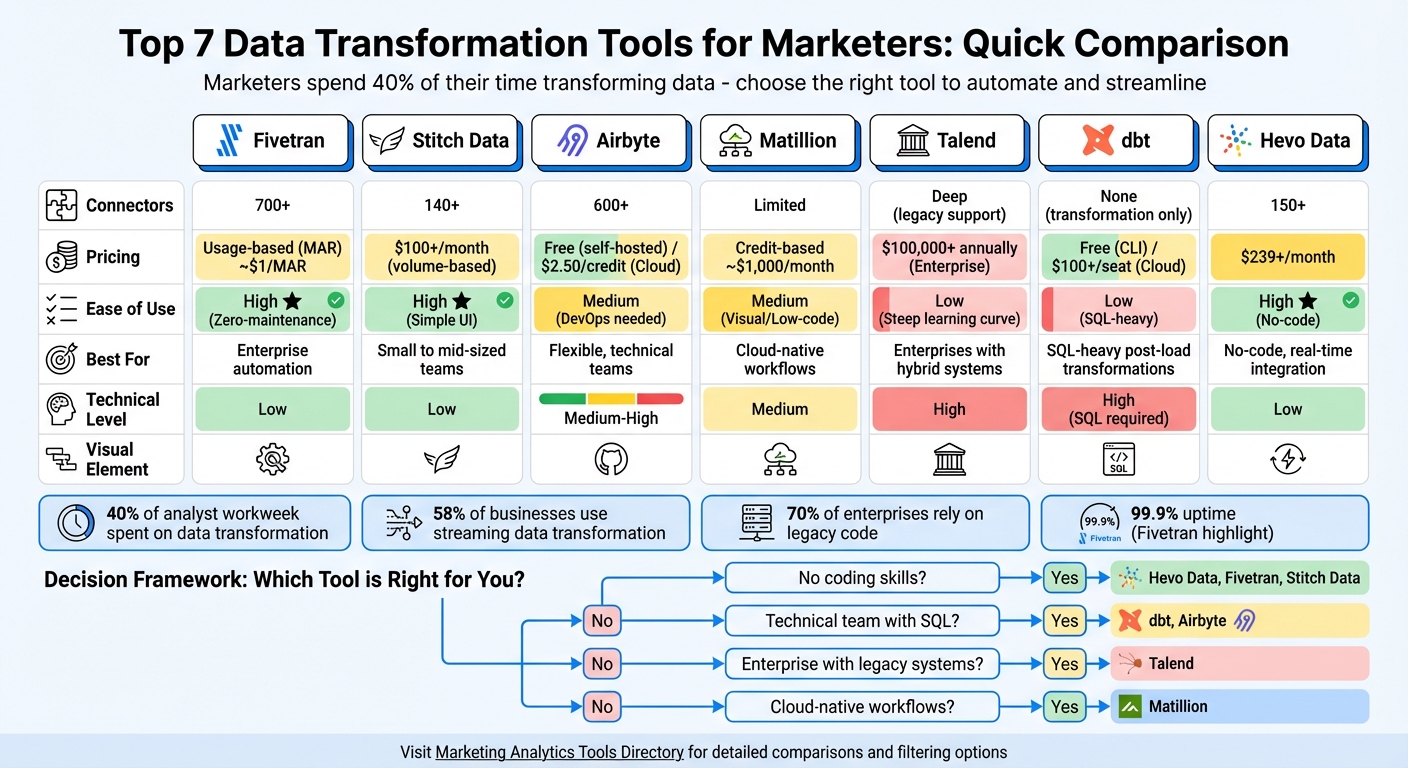
Data Transformation Tools Comparison: Features, Pricing, and Best Use Cases for Marketers
✅ What is an ETL Tool? (Simply Explained for Marketers)
sbb-itb-5174ba0
Why Marketers Need Data Transformation Tools
Marketers often face the challenge of dealing with disorganized data spread across various platforms, each using its own terminology. For instance, Facebook calls ad spend "Amount Spent", Google Ads uses "Cost", while your CRM might label it "Marketing Expense." Without tools to transform this data, comparing campaign performance across platforms turns into a tedious process of merging spreadsheets and crafting complicated formulas. This creates isolated data silos that make it nearly impossible to get a complete view of marketing efforts. The result? Hours wasted on manual tasks that transformation tools are specifically built to eliminate.
In fact, transforming data can take up to 40% of an analyst's work week. Christopher Van Mossevelde, Head of Content at Funnel, highlights the issue:
"Marketing data isn't just scattered, it's unstable. APIs change without warning, schemas shift frequently and most platforms only retain data for a limited time".
Legacy systems make this problem even worse. While modern platforms come with their own challenges, older systems further complicate the process of consolidating data. Over 70% of enterprises still rely on legacy code for critical operations, and maintaining these systems can eat up as much as 80% of IT budgets. Transformation tools help bridge this gap by exposing data from legacy systems via modern APIs and syncing it with cloud solutions like Snowflake or BigQuery. This enables marketers to combine historical customer data with real-time campaign metrics in one unified analytics environment.
Accurate, structured data is crucial for making sound decisions. Transformation tools take care of tasks like currency conversion, deduplication, and data validation to ensure dashboards display reliable information. Without these automated processes, teams risk making errors like double-counting conversions or mismatching currencies. Considering that 80% of digital organizations are predicted to fail due to poor data governance, maintaining data accuracy is non-negotiable. Clean data empowers marketers to make decisions they can trust and act on with confidence.
The demand for real-time insights makes these tools even more critical. With 58% of businesses now utilizing streaming data transformation and global digital transformation spending projected to hit $3.9 trillion by 2027, marketers need platforms that can handle frequent API updates and schema changes automatically. Modern transformation tools create a single source of truth, ensuring everyone in the organization works with consistent, reliable data - eliminating the discrepancies caused by manual preparation.
Top Data Transformation Tools for Marketers
Having the right tool can save you countless hours each month, especially when it comes to transforming messy marketing data into something clean and usable. Below, we’ll explore several platforms that tackle this challenge in unique ways - no engineering team required.
Fivetran
Fivetran focuses on automating data movement, boasting over 700 pre-built connectors to sync data from marketing platforms, databases, and SaaS tools directly into your data warehouse. With an impressive 99.9% uptime, it automatically adjusts to schema changes - processing an average of 33.5 million schema changes monthly.
This platform eliminates the hassle of manual updates when APIs from platforms like Facebook or Google change. It can sync historical data at speeds of over 500 GB per hour and runs 102.9 million transformation models every month.
Companies like Westwing and ClickUp have seen tangible benefits. Westwing saved 40 hours of engineering time per week in 2025 by automating its data processes with Fivetran, while ClickUp reduced customer acquisition costs by 50% by activating LTV models.
"Fivetran has been a core part of allowing us to scale and a force multiplier in our data-driven processes across the organization." - Andrew Wahl, Director of Marketing Analytics and Operations, Paylocity
Fivetran’s pricing is usage-based, billed by Monthly Active Rows (MAR). It offers a 14-day free trial and a free tier for low-volume users.
| Feature | Details |
|---|---|
| Connectors | 700+ automated connectors for SaaS and databases |
| Uptime | 99.9% reliability |
| Sync Speed | 500+ GB/hr historical throughput |
| Transformation | SQL-based via dbt integration |
| Best For | Enterprise teams needing low-maintenance automation |
Stitch Data
Stitch Data simplifies and speeds up the process of moving data from over 140 SaaS and database sources into your warehouse. It’s a lightweight EL (Extract and Load) solution, leaving transformations to tools like dbt after the data is loaded.
This platform is ideal for startups or mid-sized teams looking to quickly ingest data from platforms like Google Ads, Facebook Ads, and Salesforce without writing code. Pricing starts at $100 per month for the Standard plan, with Advanced and Premium plans at $1,250 and $2,500 per month, respectively.
| Plan | Monthly Cost | Best For |
|---|---|---|
| Standard | $100 | Small teams with basic needs |
| Advanced | $1,250 | Growing teams with higher data volumes |
| Premium | $2,500 | Teams requiring advanced features |
Airbyte
Airbyte is an open-source platform offering over 600 connectors, along with a Connector SDK for building custom integrations. Its open-source version is free, making it appealing for teams with technical resources. For those who prefer a managed service, Airbyte Cloud offers capacity-based pricing.
With its flexibility, Airbyte is a strong option for teams that rely on SQL for post-load transformations. It also works well alongside dbt for creating a cost-efficient data stack.
| Version | Cost | Technical Level | Connector Count |
|---|---|---|---|
| Open Source | Free | Medium to High | 600+ |
| Cloud | Capacity-based | Medium | 600+ |
Matillion
Matillion takes a visual approach with its cloud-native ETL platform. Its drag-and-drop interface makes building transformation workflows accessible, even for non-technical marketers. Using pushdown optimization, transformations run directly in cloud warehouses like Snowflake and BigQuery, leveraging their compute power.
This platform is particularly useful for tasks like joining campaign data with CRM records or aggregating spend across channels. Pricing is based on credit consumption, where credits are used as workflows run. However, costs can rise with frequent, large-scale jobs.
| Feature | Details |
|---|---|
| Interface | Visual drag-and-drop |
| Optimization | Pushdown to warehouse |
| Technical Level | Low to Medium |
| Pricing | Credit-based consumption |
Talend
Talend is tailored for enterprises dealing with complex governance and hybrid environments (cloud and on-premises). Talend Studio, its visual designer, allows users to build transformation logic without writing code.
While it’s a great fit for large teams, Talend’s pricing is quote-based, often exceeding $100,000 annually. The free "Open Studio" version was retired in January 2024, removing an entry point for smaller teams.
| Aspect | Details |
|---|---|
| Best For | Enterprise teams with complex needs |
| Environment | Hybrid (cloud + on-premises) |
| Pricing | Quote-based, $100,000+ annually |
| Free Version | Retired January 2024 |
dbt (data build tool)
dbt is widely used for post-load transformations, enabling technical teams to use SQL for cleaning and modeling data. Features like version control and automated testing ensure consistent and reproducible results, which are critical for tracking attribution models and campaign metrics over time.
"dbt is a command-line data transformation tool designed for technical experts who are proficient in programming languages like SQL and Python." - Jim Kutz, Data Analytics Expert
dbt offers a free open-source version for those comfortable with command-line workflows and a managed dbt Cloud service with per-seat pricing.
| Version | Cost | Technical Level | Best For |
|---|---|---|---|
| Open Source | Free | Medium (SQL) | Teams needing version control |
| Cloud | Per-seat | Medium (SQL) | Teams wanting a managed service |
Hevo Data
Hevo Data emphasizes no-code, real-time data pipelines from over 150 sources, with automated schema mapping to simplify setup. This feature is especially helpful for teams looking for quick, maintenance-free integration.
| Feature | Details |
|---|---|
| Pipelines | Real-time, no-code integration |
| Mapping | Automated schema mapping |
| Best For | Teams seeking hassle-free integration |
The table above highlights the strengths of each platform, helping you determine which one aligns best with your marketing data needs.
Comparison Table of Data Transformation Tools
When choosing a data transformation tool, factors like legacy system compatibility, pricing, ease of use, marketing-specific capabilities, and scalability are important to consider. The table below compares popular platforms based on these criteria.
| Tool | Legacy Compatibility | Pricing Model | Ease of Use | Marketing-Specific Features | Scalability |
|---|---|---|---|---|---|
| Fivetran | Moderate (SQL, Oracle databases) | Monthly Active Rows (MAR) – ~$1 per MAR | High (Zero-maintenance) | Basic auto-normalization only | High (Auto-scaling) |
| Stitch Data | Moderate (General databases) | Volume-based – $100/month for 5M rows | High (Simple UI) | None – raw replication | Medium |
| Airbyte | Limited – community-driven | Free (Self-hosted) / $2.50 per credit (Cloud) | Medium (DevOps needed) | None (Community-driven) | High (Extensible) |
| Matillion | Limited (Enterprise databases) | Credit-based – ~$1,000/month | Medium (Visual/Low-code) | None (Requires custom logic) | High (Cloud-native) |
| Talend | Deep (Mainframes, COBOL, on-premise) | Custom (Enterprise) – $100,000+ annually | Low (Steep learning curve) | Data quality & MDM | Very High |
| dbt | None (Transformation only) | Free (CLI) / $100+ per seat (Cloud) | Low (SQL-heavy) | None (Requires custom code) | High (Warehouse-native) |
| Hevo Data | Limited (Modern SaaS focus) | $239/month and up | High (No-code) | None (Requires custom work) | High (Managed) |
Talend stands out for its ability to handle older systems like mainframes and COBOL, making it a strong choice for those dealing with complex legacy environments. Tools such as Fivetran and Matillion are better suited for slightly older databases like SQL Server and Oracle but lack support for older application code.
A surprising challenge for marketing analysts is the amount of time spent on data transformation - about 40% of their workweek, according to research. Most ETL tools process marketing data as raw JSON, leaving users to handle normalization manually. This can significantly impact efficiency.
To manage costs effectively, consider setting billing alerts at 80% of your budget for usage-based tools. Also, stick to daily syncs for analytics needs, as higher-frequency syncs can increase costs by up to 12 times. This comparison highlights the trade-offs between legacy support and cost-efficiency, helping you narrow down the best tool for your specific needs. It underscores the importance of streamlined data transformation in addressing scattered data challenges.
How Marketing Analytics Tools Directory Can Help
The Marketing Analytics Tools Directory simplifies the process of finding the right data transformation tools by focusing on marketing-specific needs. It lets users filter tools based on priorities like connector coverage for platforms such as Google Ads, Meta, and LinkedIn, while also assessing how well these tools work with older systems.
To address the data challenges discussed earlier, the directory provides filters tailored to marketing workflows. It separates tools into categories like code-first frameworks (e.g., dbt) for engineering teams and no-code platforms (e.g., Improvado and Whatagraph) for smaller marketing teams. Centralized comparison tables make it easy to evaluate features, target audiences, and pricing models, helping users make informed decisions. It also highlights tools with built-in marketing data models that automatically standardize UTMs, campaign naming, and attribution touchpoints - ensuring your data is clean and ready to use. This structured approach helps solve both modern and legacy integration problems.
The directory goes further by evaluating the total cost of ownership. This includes not just licensing fees but also the engineering time needed for maintaining connectors and the potential risks tied to data quality issues. For example, building a custom connector in-house can take anywhere from 40 to 120 hours of engineering time. By categorizing tools based on whether their transformation logic operates "upstream" (at the extraction layer), the directory helps users choose tools that prevent errors from spreading through their data warehouse.
If your business offers data transformation tools or analytics services, you can submit your tool for inclusion in the directory to connect with marketing teams more effectively.
Choosing the Right Data Transformation Tool
Picking the best data transformation tool comes down to three key considerations: connector coverage, team expertise, and total cost of ownership.
First, make sure the tool supports your marketing stack - whether you rely on platforms like Google Ads, Meta, TikTok, or HubSpot - and that it can automatically adapt to API changes. Marketing-focused tools often come with over 500 pre-built connectors, while more general ETL platforms typically offer 100–200. This step helps ensure the tool aligns with your specific needs.
Next, think about your team's technical skills. If your team is lean or lacks programming expertise, a no-code or low-code platform with built-in marketing logic (like metric normalization or attribution modeling) is a better fit. On the other hand, if your team is technically skilled and needs flexibility, a code-first framework like dbt might be the way to go - but keep in mind, it requires solid SQL knowledge. Choosing a tool that doesn’t match your team’s capabilities can lead to unnecessary challenges.
Cost is another critical factor. Look beyond just the licensing fees and consider the broader picture: the engineering time needed for maintaining connectors, the expense of cloud warehouse compute credits, and even the potential financial risks of poor data quality. For instance, in late 2024, a Fortune 500 retailer using Improvado's governance engine caught a $2.4 million Google Ads budget overrun just 18 hours before the month closed. This allowed them to pause campaigns and avoid a costly financial restatement.
Additionally, focus on tools that handle transformations upstream, at the extraction layer. This prevents inconsistent raw data from reaching your warehouse. Take advantage of free trials or connector assessments to test whether the tool can tackle specific challenges, such as mapping platform naming differences (e.g., Facebook's "Amount Spent" versus Google's "Cost").
For a deeper dive into connector options, pricing structures, and marketing-specific features, check out the Marketing Analytics Tools Directory. The directory’s filters can help you compare tools based on your exact needs.
FAQs
Do I need ETL or ELT for marketing data?
When deciding between ETL (Extract, Transform, Load) and ELT (Extract, Load, Transform), it all comes down to how you handle and process your data.
- ETL transforms the data before loading it into the destination system. This method works best when you need clean, structured data right from the start.
- ELT, on the other hand, loads raw data first and transforms it afterward. This approach is well-suited for managing large, unstructured datasets and offers more flexibility.
The right choice depends on factors like the complexity of your data, the infrastructure you have in place, and your specific analytical objectives.
Which tool works best with legacy systems?
Informatica stands out as a trusted enterprise platform for data transformation in marketing. Known for its strong integration capabilities, it works seamlessly with legacy systems, making it a dependable option for businesses relying on older infrastructures.
How can I predict total cost, not just price?
To estimate the total cost, it’s essential to account for all variables - like taxes, fees, and shipping - alongside the base price. Using data transformation tools can make this process easier by organizing and combining information from various sources, giving you a complete picture of the cost breakdown. With this organized data, advanced analytics tools can step in to model these factors, helping marketers predict total costs with greater precision. This is particularly useful for complex campaigns where expenses can fluctuate.