Weather-based marketing uses local weather data to create timely, relevant campaigns that align with consumer behavior. Whether it's promoting iced drinks during a heatwave or winter tires before snowfall, this strategy can boost engagement and sales across industries like retail, travel, and automotive. Here are the top tools that enable weather-driven campaigns:
- WeatherAds: Automates ad activation and optimization based on real-time and forecasted weather data. Integrates with Google Ads and Meta.
- Planalytics: Focuses on weather-driven sales analytics to predict demand and optimize campaigns.
- Weather Unlocked WeatherTrigger: Offers precise weather triggers for PPC campaigns, integrating with Google Ads.
- Simpli.fi: A programmatic platform that requires custom integrations for weather-based triggers.
- The Weather Company Advertising Solutions: Powered by IBM, provides hyperlocal data and weather-triggered ad activation across multiple channels.
- Tomorrow.io: Delivers hyperlocal weather insights with advanced triggers for real-time and forecast-based campaigns.
- Cropink Weather Based Ads: Dynamically adjusts ad creatives and product feeds based on weather conditions.
These tools help businesses align campaigns with local weather conditions, improving relevance and ROI while complying with privacy regulations.
Quick Comparison
| Tool | Key Features | Integration | Best For |
|---|---|---|---|
| WeatherAds | Real-time automation, forecast triggers | Google Ads, Meta | Retailers, automotive, restaurants |
| Planalytics | Demand analytics, sales forecasting | Custom integrations | Retail, consumer goods |
| WeatherTrigger | PPC triggers, precise targeting by ZIP code | Google Ads, APIs | Local campaigns, PPC advertisers |
| Simpli.fi | Programmatic campaigns, audience targeting | Requires custom weather setup | Broad programmatic campaigns |
| The Weather Company | Hyperlocal data, multi-channel triggers | Google Ads, Meta, CRM | Large-scale campaigns, travel |
| Tomorrow.io | Advanced triggers, hyperlocal forecasts | APIs, Google Ads, DSPs | Real-time campaigns, QSRs, retail |
| Cropink | Dynamic product feeds, creative automation | Shopify, Meta, Google Shopping | E-commerce, regional campaigns |
These tools simplify weather-based marketing by automating triggers, integrating with ad platforms, and offering actionable insights. Choose one based on your industry, campaign needs, and preferred integrations.
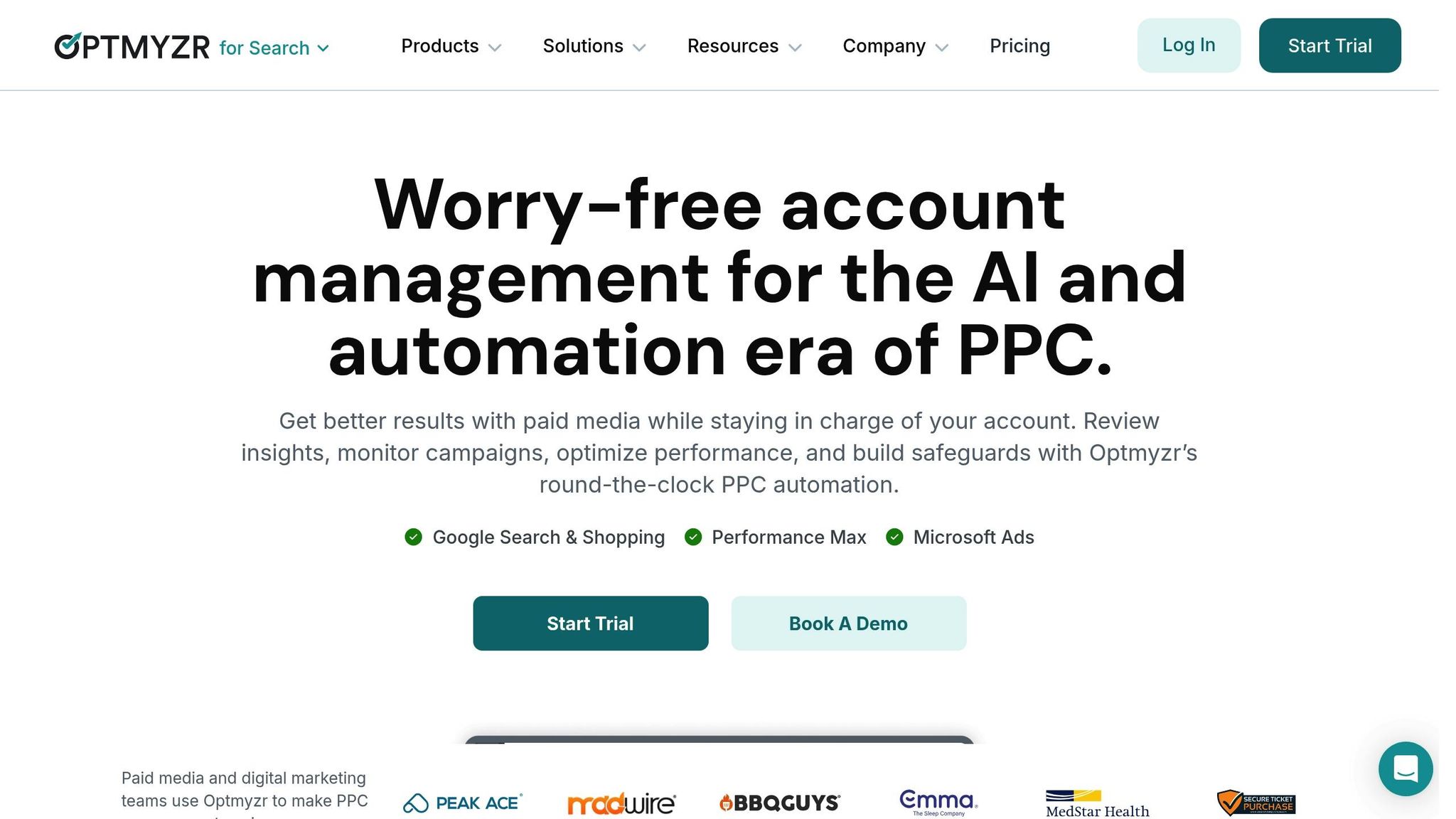
Manage Your Google Ads Campaigns Based on Weather Conditions | Optmyzr
How to Choose Weather-Based Marketing Tools
Picking the right weather-based marketing tool starts with understanding which features truly deliver results. The most effective platforms combine precise, real-time weather data with marketing automation that integrates smoothly with your ad channels and customer systems. The goal is to use actionable weather insights to drive measurable outcomes.
Prioritize Hyperlocal and Comprehensive Weather Data
A solid weather marketing tool should provide hyperlocal updates, ideally down to the ZIP code level. For campaigns in the U.S., ensure the platform supports Fahrenheit measurements, such as 32°F for freezing, 50–60°F for jacket weather, or 90°F+ for heat advisories.
In addition to temperature, look for tools that track other key variables like precipitation, humidity, UV index, wind speed, air quality, and pollen counts. These factors can significantly impact consumer behavior. For example, a skincare brand might promote anti-frizz products when humidity exceeds 80%, while an outdoor retailer could push rain gear when precipitation chances hit 60%. Platforms like The Weather Company's WeatherFX combine user location, historical weather data, and sales trends to create predictive models that trigger ads during specific weather conditions.
Automate Responses with Weather Triggers
Automation is what sets advanced weather marketing tools apart. Look for platforms with rule-based systems that are easy to set up without requiring coding skills. For instance, you could create a rule like: "IF temperature drops below 40°F AND precipitation probability > 60%, THEN increase bids by 30% and switch to snow tire ads."
Effective platforms should offer three types of triggers:
- Real-time triggers: React to current weather conditions.
- Forecast triggers: Activate 24–48 hours in advance.
- Post-event triggers: Focus on recovery actions after adverse weather.
These triggers should seamlessly adjust bids, budgets, ad schedules, and creative content. For example, AdWords Robot offers weather-based PPC management with packages starting at $499 per month, capable of handling millions of Google Ads keywords with dynamic creatives.
Integrate Weather Data with Sales Analytics
To maximize effectiveness, connect weather data with your sales analytics. Import historical transaction data from your POS systems, e-commerce platforms, or CRMs to identify patterns. For example, ice melt sales might spike in the Midwest when temperatures hover between 20–32°F with snow in the forecast, or storm-related hardware sales could surge in the Southeast during hurricane season. These insights help create demand curves and refine trigger thresholds, ensuring ads are activated only when conditions align with consumer behavior.
Seamless Integration Across Platforms
Your chosen tool should integrate effortlessly with your existing marketing ecosystem. Ensure it supports native or API connections to platforms like Google Ads, Meta (Facebook and Instagram), programmatic DSPs, email marketing systems, and e-commerce platforms. For example, WeatherAds offers over 70 contextual triggers that work across multiple channels while adhering to cookieless standards.
If you’re a retailer with both physical and online operations, prioritize tools that connect to CRMs, customer data platforms, and marketing automation systems. This allows for weather-driven emails, push notifications, or SMS alerts. For e-commerce, ensure the tool integrates with product feeds (like Google Shopping) or platforms like Shopify to automatically feature relevant products when weather rules are activated.
Enhance Audience Targeting with Weather Data
Combine weather data with audience segmentation for more precise targeting. Instead of broad campaigns like "everyone experiencing a heat wave", focus on specific groups, such as "past buyers of allergy medication within 20 miles of Houston during high pollen counts and poor air quality." Many platforms offer prebuilt weather segments like "cold snap" or "rainy commute", which can be layered with demographic and behavioral data to fine-tune your audience. This approach also supports retargeting and lookalike strategies, helping your ads reach the most likely buyers.
Account for Regional and Seasonal Variations
Weather patterns vary widely across the U.S., so your tool should allow regional customization. For instance, cold winters in the Midwest and Northeast might call for snow tire campaigns, while the Gulf Coast might focus on flood-preparation ads during hurricane season. Additionally, align weather triggers with calendar events, such as Memorial Day grilling promotions during warm weather or back-to-school campaigns amid heat waves.
Tailor Features for Physical Stores vs. E-Commerce
The needs of brick-and-mortar stores differ from those of e-commerce businesses. Physical stores benefit from tools that tie weather data to foot traffic or local sales trends. On the other hand, e-commerce platforms may prioritize features like inventory tracking, shipping alerts, and website personalization based on real-time weather.
Look for User-Friendly Interfaces and Reporting
Ease of use is critical. Opt for platforms with intuitive dashboards, visual rule builders, A/B testing capabilities, and straightforward reporting on return on ad spend (ROAS). These features should make it easy to set up campaigns and analyze performance without requiring advanced data science skills.
Consider Forecast Accuracy and Update Frequency
The tool’s forecast horizon and update frequency should align with your marketing needs. For real-time bidding campaigns, hourly updates covering 48–72 hours are ideal. For seasonal planning, look for 10–15 day forecasts. AI-driven systems like IBM Weather Company AI and Tomorrow.io offer hyperlocal predictions, down to 90 meters, improving trigger precision and reducing wasted ad spend.
Benchmark Performance with Case Studies
Evaluate potential tools by reviewing performance benchmarks. For example:
- Burton Menswear used weather-driven site personalization to adapt homepage content during cold snaps, boosting conversions by 11.6%.
- Pure360’s sunny-day campaigns achieved a 500% increase in open rates, with click-through rates rising from 12% to 27%.
- Cropink reported up to an 89% improvement in ad performance with well-aligned weather-based campaigns.
These examples highlight the potential impact of choosing the right tool for your needs.
1. WeatherAds
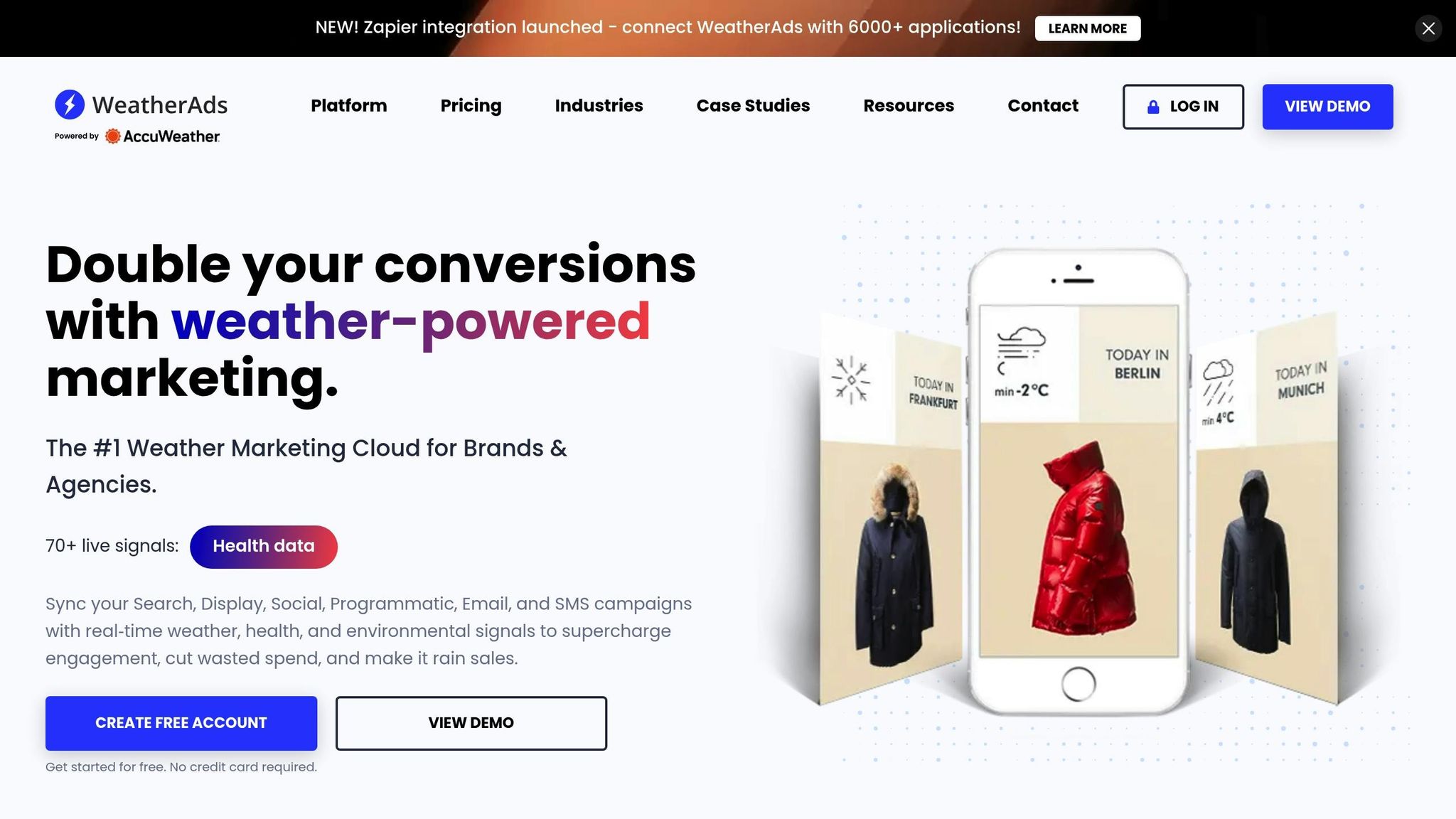
WeatherAds markets itself as the top Weather Marketing Cloud for brands, providing a platform that directly connects live and forecast weather data to your ad accounts. The tool automates the process of turning campaigns, ad sets, and creatives on or off based on real-time or predicted weather conditions in specific ZIP codes or DMAs across the U.S.. This ensures your marketing spend is focused on areas and times where weather-related demand is highest, rather than running ads uniformly without considering local conditions.
The platform integrates seamlessly with your existing ad setup, so there’s no need to migrate campaigns. Marketers in the U.S. can set up and manage weather rules directly within their current Google Ads or Meta (Facebook and Instagram) accounts, making it easy to incorporate into existing workflows.
Real-Time and Forecast Weather Data Integration
WeatherAds pulls in global data on weather, health, travel, leisure, and environmental factors to drive its targeting capabilities. For U.S. campaigns, this means hyperlocal data down to the ZIP code level, with measurements in Fahrenheit. It reacts to both current conditions and forecasted trends - like activating "cooling" ads when temperatures rise above 86°F in Phoenix or promoting umbrellas a day before rain is expected in Seattle.
The platform doesn’t stop at basic weather metrics like temperature and precipitation. It also tracks over 70 additional factors, including UV index, humidity, wind speed, air quality, and pollen levels. For instance, a skincare brand could advertise sunscreen during high UV days in Miami, while an allergy medication company might target regions with elevated pollen counts in the spring. This level of detail allows brands to align their messaging with specific environmental factors that influence consumer needs.
Importantly, WeatherAds is cookieless and privacy-compliant, relying on environmental data rather than individual tracking. This makes it a privacy-conscious choice as third-party cookies are phased out by major browsers. Its precise data feeds power dynamic weather triggers, which are explained further below.
Weather Triggers for Ad Activation and Optimization
WeatherAds allows marketers to set specific triggers based on factors like temperature thresholds, sudden temperature shifts, rain, snow, humidity, UV index, wind speed, air quality, and pollen levels. For example, a clothing brand might activate winter coat ads when temperatures drop below 40°F and snow is forecast, while pausing those ads when temperatures rise above 55°F.
Case studies show that weather-triggered campaigns can deliver impressive results. Some have reported engagement increases of up to 320% for home improvement brands and sales jumps as high as 600% when PPC ads are aligned with local weather conditions. Industry data suggests that syncing ad messaging with changing weather can boost sales by 17–28%.
Triggers can also be customized for different stages of the sales funnel. For awareness campaigns, broader conditions like "sunny and above 70°F" might be used to run high-reach video or display ads. For consideration-stage campaigns, more specific combinations - such as "rain AND temperature below 50°F" - can highlight product benefits when consumer needs are more immediate. Conversion-focused campaigns often rely on tight, high-intent triggers, like forecasted rain within 24 hours or a prolonged heatwave, to capture ready-to-buy customers with strong offers and retargeting.
To maximize results, avoid overly broad triggers that could lead to unnecessary ad spending. Instead, start with historical data to identify demand spikes, experiment with different temperature ranges (e.g., 80–85°F versus 86–90°F), and combine weather signals with audience data for better targeting.
Sales and Demand Analytics Tied to Weather Patterns
WeatherAds goes beyond setting triggers by integrating sales analytics to align campaigns with proven demand trends. Brands can analyze past sales or campaign performance against weather data to identify the conditions that drive demand spikes. For example, if demand for a product peaks between 86°F and 95°F, marketers can use that temperature range as a trigger for future campaigns in regions where heat waves are common. This process of analyzing, applying, and refining triggers helps businesses optimize their campaigns over time and focus budgets on weather conditions that historically boost sales.
For businesses with operations across different parts of the U.S., WeatherAds enables hyperlocal campaign customization. Marketers can adjust messaging and promotions based on the unique weather patterns and seasonal changes in each region.
For those comparing WeatherAds with other weather-based marketing tools, resources like the Marketing Analytics Tools Directory can help evaluate features such as real-time weather integration, cross-channel activation, audience insights, and reporting capabilities. This ensures marketers understand how WeatherAds fits into their broader ad tech stack, especially when considering real-time performance tracking and integration depth.
2. Planalytics

Planalytics provides another way for marketers to use weather data to fine-tune their campaigns. It focuses on utilizing weather insights to optimize campaign timing and target specific geographic areas.
However, specific details about how Planalytics operates, its integration options, or its performance metrics are not readily available.
For a broader view of weather-based marketing tools, marketers can explore the Marketing Analytics Tools Directory, which offers comparisons across various solutions.
3. Weather Unlocked WeatherTrigger
Weather Unlocked WeatherTrigger integrates real-time and forecasted weather data directly into your advertising platforms, enabling campaigns to adapt automatically to local weather conditions. Powered by the Weather Unlocked API, this tool provides highly detailed weather information, pinpointed to specific ZIP codes or latitude/longitude coordinates across the United States.
For marketers in the U.S., this means campaigns can be tailored by city, designated market area (DMA), or even a radius around specific store locations. You can set weather-based rules targeting conditions like temperature (in °F), rain, wind, or snow over specific timeframes - whether the next 24 hours or the next three days - allowing for precise, localized campaign adjustments.
Weather Triggers for Ad Activation and Optimization
WeatherTrigger enables pay-per-click (PPC) triggers that activate when specific weather conditions are met. These triggers can pause or activate ad groups, adjust bids, or swap ad creatives based on factors like temperature thresholds, precipitation levels, wind speed, or combinations such as "snow and temperatures below 32°F".
For example, an HVAC company in Chicago could automatically increase bids on "furnace repair" keywords and run emergency-service ads whenever the temperature drops below 25°F. Once the weather warms up, the platform would automatically scale back these adjustments. This approach ensures ad spend is concentrated on high-value weather-driven opportunities instead of running continuously.
Integration with Marketing Platforms (Google Ads, Meta, CRM)
WeatherTrigger seamlessly integrates with Google Ads, allowing weather conditions to directly influence campaigns via API connections or scripts. Marketers can link their Google Ads accounts to WeatherTrigger, define weather rules, and authorize the platform to adjust bids, enable or disable campaigns, or change ad creatives in near real time.
The platform also supports advanced customization, enabling brands to incorporate weather logic into their ad tech, reporting, or CRM workflows. For instance, you can use historical sales data to create highly specific trigger rules. If cold beverages sell best in temperatures above 90°F with high humidity, you can set these precise conditions and limit activation to areas with significant weather variability. Adding timing logic - like triggering ads 12 to 24 hours before rain for umbrella promotions - can further refine your strategy and reduce wasted impressions.
To get the most out of WeatherTrigger, start with a few high-impact products and simple triggers, then refine based on performance. Align ad creatives and landing pages with the weather scenario - using snowy imagery and urgency-driven messaging during snowstorms, for example. Be cautious of common mistakes, such as using overly broad conditions (e.g., "cold weather nationwide"), ignoring regional climate differences, or failing to sync weather-based segments with CRM or remarketing audiences, which can dilute personalization and lower ROI.
Sales and Demand Analytics Tied to Weather Patterns
WeatherTrigger also offers analytics capabilities that link weather data to sales performance, helping marketers identify which conditions drive demand for specific products or services. For instance, an apparel brand might discover that raincoat sales spike when rainfall exceeds a certain level and temperatures fall between 45°F and 60°F. These insights can inform targeted campaigns for paid search and display ads.
Marketers can analyze performance metrics like conversion rates, cost per acquisition, and ROI during weather-triggered campaigns to measure efficiency gains. Controlled tests can also be run by applying WeatherTrigger rules in some regions while leaving others unchanged, isolating the impact of weather-based activation. Some case studies have shown that weather-triggered ads can reduce wasted impressions by up to one-third while boosting sales.
To evaluate WeatherTrigger’s effectiveness, marketers can compare its features - such as real-time triggers, Google Ads integration, API access, and weather-sales analytics - against other marketing tools. Resources like the Marketing Analytics Tools Directory can help assess whether WeatherTrigger should be a standalone solution or part of a broader tech stack that includes attribution, business intelligence, and CRM analytics.
WeatherTrigger is positioned as a global solution, offering coverage for multi-region and national campaigns in the U.S. Its ability to target at the city or ZIP-code level makes it ideal for localized marketing efforts. Pricing is custom and based on usage, such as impressions, API calls, or the number of campaigns, with quotes available upon request. This flexibility allows WeatherTrigger to scale seamlessly with your campaign needs, making it a powerful addition to any weather-based marketing strategy.
4. Simpli.fi Weather Targeting

Simpli.fi is a programmatic advertising platform that allows marketers to run omnichannel campaigns across various formats, including display, video, connected TV (CTV), and mobile. It stands out for its ability to leverage diverse, unstructured data sources for advanced audience targeting. However, it’s important to note that Simpli.fi does not offer built-in weather targeting capabilities. This sets it apart from platforms specifically designed for weather-based marketing.
While Simpli.fi excels in using geographic, demographic, behavioral, and contextual data to fine-tune campaigns, integrating weather-related triggers would require custom partnerships or additional tools. The platform doesn’t include native weather-based triggers, which could be a drawback for marketers focusing on weather-driven strategies.
If your marketing efforts rely heavily on weather-based triggers, you may need to explore other platforms or resources. The Marketing Analytics Tools Directory can help you find tools better suited for weather-focused campaigns, ensuring your strategies align with your specific goals.
sbb-itb-5174ba0
5. The Weather Company Advertising Solutions
After exploring WeatherAds, Planalytics, and Weather Unlocked, The Weather Company’s offerings stand out for their seamless integration of weather data into marketing strategies. As part of IBM, The Weather Company provides tools like WeatherFX and watsonx Advertising, which harness real-time and forecast data to power ad campaigns. These solutions work across various channels, including display, mobile, video, connected TV (CTV), and digital out-of-home (DOOH), allowing marketers to tailor campaigns to local weather conditions.
What sets The Weather Company apart is its extensive data network. By pulling information from hundreds of thousands of weather stations, radars, satellites, aircraft, and IoT sensors, IBM delivers highly localized forecasts. This capability enables marketers to target audiences at the ZIP code level, offering precision that can significantly enhance campaign relevance.
The platform’s reach is impressive, with about 55 million unique U.S. visitors per month via The Weather Channel’s website and apps. Advertisers can leverage this large-scale audience for weather-triggered campaigns while also extending their efforts through programmatic platforms, social media, and video placements.
Real-Time and Forecast Weather Data Integration
WeatherFX combines a mix of real-time conditions, short- and long-range forecasts, and historical data with user location to create weather-based audience segments and activation triggers. By analyzing hyperlocal data - like temperature, precipitation, UV index, and humidity - alongside medium-range forecasts, the platform optimizes ad timing and placement. This ZIP code-level targeting allows marketers to align messaging with specific events, such as heatwaves, snowstorms, or pollen surges, improving both relevance and efficiency.
Additionally, the platform incorporates factors like "feels like" temperature, pollen counts, and UV index to connect weather patterns with consumer behavior. For instance, it can identify when sunscreen or allergy medication sales are likely to spike. These detailed forecasts enable automated weather triggers that adjust campaigns in real time.
Weather Triggers for Ad Activation and Optimization
The Weather Company’s tools allow marketers to set up automated triggers that adapt campaigns based on changing conditions. These triggers can activate or pause campaigns, adjust bids, or swap creative assets depending on criteria like temperature thresholds (e.g., above 85°F or below 32°F), precipitation types, or other environmental factors. For example:
- Launching lawn-care ads when no rain is forecast for 48 hours.
- Increasing bids for HVAC services when the heat index surpasses 95°F.
- Switching to snow-tire messaging when snowfall is expected within 24 hours.
For U.S. campaigns, combining short-term weather triggers (like “today’s high above 85°F”) with forecast insights (such as an upcoming hot weekend) allows advertisers to prepare creatives and adjust bids ahead of time. Research shows that weather influences 30–40% of consumer decisions in industries like apparel, quick-service restaurants, home improvement, and travel. This automation, paired with sales analytics, further enhances campaign performance.
Sales and Demand Analytics Tied to Weather Patterns
IBM’s tools go beyond weather data by integrating AI and machine learning (Watson) to link weather conditions with business outcomes, such as sales, web traffic, and store visits. By analyzing historical sales data alongside weather trends, businesses can uncover patterns - like a 40% increase in ice cream sales when temperatures exceed 80°F with low humidity. These insights help refine demand forecasts, optimize inventory, and create targeted trigger rules for future campaigns. Case studies show that weather-triggered campaigns using WeatherFX have driven double-digit improvements in sales, click-through rates (CTR), and engagement.
Integration with Marketing Platforms
The Weather Company’s tools integrate seamlessly with major advertising platforms, making it easier for marketers to manage weather-responsive campaigns. Platforms like Google Ads, Meta, and CRM/ESP systems can sync with WeatherFX, enabling campaigns to adapt automatically to weather changes without requiring custom setups for each channel. For instance, a retailer might use Meta Ads Manager to deliver different creatives during heatwaves versus cold snaps, while simultaneously triggering a CRM to send matching email campaigns.
Marketers can also integrate weather data with demand-side platforms (DSPs) and other buying tools, adding weather context to their existing setups without overhauling their technology stack. Industries such as retail, consumer packaged goods (CPG), automotive, travel, quick-service restaurants, and pharmaceuticals use these solutions to align offers with local weather conditions - like promoting snow shovels during a storm or cold beverages during a heatwave.
When evaluating The Weather Company Advertising Solutions against other weather-based tools, factors like data accuracy, granularity (ZIP code versus city-level targeting), forecast range, and ease of integration with platforms like Google Ads, Meta, and CRM systems should be considered. Resources like the Marketing Analytics Tools Directory can help teams compare features like real-time analytics, campaign tracking, and reporting dashboards, ensuring they choose solutions that best meet their needs.
6. Tomorrow.io for Marketing and Ads
Tomorrow.io offers a powerful combination of hyperlocal weather insights and predictive analytics. By gathering data from satellites, radars, ground sensors, and connected devices, the platform delivers minute-by-minute forecasts with street-level accuracy. This level of precision enables marketers to tailor campaigns to specific neighborhoods - an invaluable tool for areas where weather can shift quickly.
But Tomorrow.io doesn’t stop at basic weather data. Marketers gain access to detailed metrics like air quality, pollen levels, wind speed, humidity, and even "feels like" temperatures. This allows for highly specific, context-driven campaigns. For instance, a quick-service restaurant could trigger ads promoting hot coffee when the wind chill dips below 25°F, while a home services company might promote air conditioning repairs as the heat index soars past 100°F. These insights integrate seamlessly into existing marketing workflows, making weather-triggered campaigns easier to implement.
Real-Time and Forecast Weather Data Integration
Tomorrow.io’s API delivers weather data in formats that fit directly into marketing workflows. With nowcasting (0–6 hours), short-range (up to 5 days), and medium-range (up to 15 days) forecasts, marketers can plan both immediate actions and longer-term seasonal strategies. The data refreshes every few minutes, ensuring campaigns respond to current conditions rather than outdated information.
This hyperlocal precision is particularly useful in cities where weather varies block by block. Take a retailer in a city like San Francisco or Seattle: one store might face foggy conditions downtown, while another enjoys sunshine in the suburbs, and yet another deals with rain by the waterfront. Tomorrow.io enables marketers to craft tailored messages for each area, reducing wasted ad spend and ensuring weather-triggered ads reach the right audience.
Marketers can also layer multiple weather factors to create advanced targeting rules. For example, instead of simply running ads when it rains, a campaign could activate only during moderate to heavy rain (over 0.2 inches per hour), with temperatures between 40°F and 60°F, and wind speeds below 15 mph. This level of customization ensures campaigns align with the most relevant weather conditions.
Weather Triggers for Ad Activation and Optimization
Tomorrow.io’s trigger system lets marketers automate campaigns based on specific weather thresholds. With its advanced conditional logic, teams can set up rules like: "Launch a campaign when temperatures exceed 90°F for four consecutive hours between 11:00 AM and 7:00 PM." This ensures that messaging aligns perfectly with moments when weather impacts consumer behavior.
The platform also supports incremental bid adjustments tied to weather changes. For instance, bids could increase by 20% when temperatures hit 85°F, and by an additional 30% at 95°F. This dynamic approach optimizes budget use while keeping campaigns active across varying conditions.
For businesses with physical locations, combining geofencing with weather data opens up powerful local targeting opportunities. A coffee chain, for example, could increase mobile ad bids within a half-mile radius of stores during chilly mornings when temperatures fall below 35°F, driving foot traffic during the commute. Similarly, a car wash service might pause ads in areas expecting rain within the next three hours while boosting them in neighborhoods with clear skies. These triggers integrate smoothly with major marketing platforms, making them easy to implement.
Integration with Marketing Platforms
Tomorrow.io aligns weather data with marketing efforts through seamless API integration with leading advertising platforms, CRMs, and email marketing tools. It works with demand-side platforms (DSPs), customer data platforms (CDPs), and marketing clouds, ensuring weather-triggered campaigns fit into existing workflows. For example, Google Ads users can set up weather-based rules to adjust bids or swap creative assets, while Meta campaigns can use weather segments for more refined audience targeting.
Consider a home improvement retailer: they could send email promotions for generators when severe weather is predicted while simultaneously running display ads and updating their website homepage to feature storm preparation products. This unified approach ensures consistent messaging across all channels, whether customers see it in their inbox, on social media, or on the website.
A centralized dashboard enhances efficiency by offering a regional overview of weather conditions and campaign performance. Marketers can quickly identify areas affected by weather events and make adjustments at scale, rather than managing each location individually. This is particularly valuable for national brands juggling hundreds of localized campaigns.
When evaluating Tomorrow.io against other weather-based marketing platforms, key factors to consider include the accuracy of hyperlocal forecasts, the speed of API responses for real-time triggers, the variety of weather parameters available, and how easily the platform integrates with existing marketing tools. Resources like the Marketing Analytics Tools Directory can help teams compare these features alongside others, such as real-time analytics, campaign tracking, and reporting, to ensure the platform meets their business needs.
7. Cropink Weather Based Ads
Cropink Weather Based Ads brings together creative automation and product feed management to align ad content with weather conditions. The tool automatically adjusts creatives and product selections when specific weather criteria are met. This allows marketers to prepare multiple ad variations tailored to different weather scenarios - whether it’s sunny, rainy, cold, or hot - and lets the system decide which version to display based on real-time or forecasted conditions. Essentially, it automates weather-responsive ad management.
This platform is especially effective for e-commerce brands using Shopify or XML product feeds. For instance, during a cold spell in the Northeast, Cropink can automatically spotlight winter coats and heaters in Google Shopping and Meta ads. On the flip side, if Phoenix experiences temperatures over 85°F, the system can shift to promoting cooling products, summer clothing, or iced beverages. This automation removes the need for manual updates every time the weather changes.
Real-Time and Forecast Weather Data Integration
Cropink integrates a range of weather signals - like temperature (in °F), UV index, precipitation probability, rain intensity, snow presence, humidity, wind speed, and air quality - into its system. Marketers can define specific weather thresholds at the ZIP code or city level and map them to customized ads. For example, you could set a rule to activate ads for umbrellas and raincoats when rain probability exceeds 70% and temperatures range between 40°F and 65°F.
Using weather APIs, the platform continuously tracks variables that influence consumer behavior. A retailer might create separate ad variations for high UV days (promoting sunscreen and sunglasses), moderate UV conditions (highlighting outdoor furniture), and cloudy days (featuring cozy indoor products). These rules operate automatically, ensuring campaigns adapt to changing weather conditions without manual effort.
This level of geographic granularity is especially useful for brands targeting diverse climates across the U.S. For example, coastal storms on the East Coast, wildfire smoke on the West Coast, or winter blizzards in the Midwest all drive different consumer needs. Cropink’s location-specific rules allow for tailored messaging that resonates with local audiences, avoiding the pitfalls of generic national campaigns.
Weather Triggers for Ad Activation and Optimization
Cropink uses weather-based triggers to automatically activate, pause, or adjust campaigns. These triggers control everything from creative assets to bid adjustments and budget allocation. For instance, the system can pause lawn-care ads during extended rain forecasts or boost them in areas with sunny skies.
When weather conditions shift, the platform seamlessly rotates ad sets or templates - for example, switching between rain-focused ads, sun-themed creatives, or allergy-season messaging - without requiring manual updates.
This approach has delivered impressive results in practice. For example, Pure360’s sunny-day holiday email campaign used weather triggers to send travel offers only during sunny forecasts, achieving 500% higher open rates and click-through rates that jumped from 12% to 27%. While this example relates to email, Cropink applies the same principles to Meta and Google Shopping ads, ensuring consistent weather-based messaging across platforms.
Sales and Demand Analytics Tied to Weather Patterns
To make the most of weather-triggered campaigns, brands can analyze historical sales data alongside weather trends. For example, a retailer might find that umbrella sales increase by 25% on rainy days or that sunscreen sales spike by 40% during high-UV weekends. These insights help fine-tune weather-based triggers, ensuring campaigns are activated when they’re most likely to perform.
Cropink supports this data-driven approach by allowing marketers to set precise weather thresholds where sales are strongest. Live performance dashboards then compare the effectiveness of weather-triggered campaigns versus non-weather-triggered ones, helping brands allocate budgets more effectively.
This analysis also aids in demand forecasting and inventory planning. For instance, understanding how hurricane season affects sales in the Southeast or how winter storms impact the Midwest can help brands prepare promotions and stock levels in advance. Aligning inventory with weather-triggered campaigns ensures you’re not promoting products that are out of stock, avoiding customer frustration.
Integration with Marketing Platforms
Cropink integrates seamlessly with major marketing platforms, ensuring consistent, context-aware campaigns. Unlike tools that simply activate campaigns based on weather, Cropink synchronizes product feeds with live weather data to automatically update creative assets.
For Google Shopping, the platform connects with product feeds to dynamically feature items - like swapping out winter jackets for T-shirts - without requiring manual creative changes. Meta campaigns operate similarly, with ad sets switching automatically when specific weather conditions are met.
Beyond paid ads, Cropink also supports weather-triggered email campaigns through CRM integrations. For example, it can send sunny-weekend travel offers or storm-preparedness checklists based on subscriber location and forecast data. This omnichannel approach ensures consistent messaging across platforms. Imagine a heatwave in Los Angeles: Cropink can switch Meta and Google ads to promote cold drinks, update digital out-of-home screens with “Cool down now” messaging near convenience stores, and send SMS offers for refreshing beverages to loyalty members in affected areas.
CRM integration also enables detailed performance tracking. By linking leads, purchases, and customer lifetime value to specific weather-triggered campaigns, marketers can refine their strategies over time and demonstrate ROI. This feature is particularly useful for brands managing multiple regional campaigns, where weather impacts vary significantly by location.
When comparing Cropink to other weather-based marketing tools, consider how its creative automation and product feed capabilities align with your broader analytics needs. Resources like the Marketing Analytics Tools Directory can help you evaluate its weather-targeting features alongside essentials like real-time analytics, campaign tracking, A/B testing, and enterprise dashboards to ensure it fits your organization’s goals.
How Marketing Analytics Tools Directory Helps You Compare Weather-Based Marketing Tools
Selecting the right weather-based marketing platform requires careful consideration of factors like triggers, analytics, integrations, pricing, and geographic reach. The Marketing Analytics Tools Directory simplifies this process by bringing together a variety of weather-based and analytics tools in one searchable catalog. Instead of jumping between multiple websites, you can focus on tools that meet the specific needs of your campaigns. This streamlined approach helps align your weather-based strategies with broader marketing analytics.
Filtering by Weather Triggers and Conditions
Each tool in the directory is tagged based on the weather conditions it supports - like UV index, pollen count, humidity, and wind speed - and how it activates campaigns (real-time or forecast-based). This lets you quickly find tools that fit your marketing goals. For instance, if you're promoting allergy relief products, you can filter for tools that use pollen-count triggers. Selling sunscreen? Look for platforms that monitor UV index and temperature thresholds in Fahrenheit.
You can also assess timing granularity. Some tools activate campaigns during specific weather events, such as rain, while others trigger ads in advance - like a day before a forecasted storm. A retailer selling rain gear might prefer forecast-based triggers to reach customers as they plan their day. On the other hand, a digital billboard advertiser may need real-time activation for campaigns tied to heatwaves exceeding 95°F.
Comparing Analytics and Measurement Features
Weather triggers are just the starting point - you also need tools with strong analytics to track performance and prove ROI. Key features to compare include weather-and-sales correlation analysis, attribution reporting, predictive demand modeling, and A/B testing. These metrics help you determine which platforms can deliver measurable results.
For example, Planalytics specializes in analyzing historical sales data to predict demand based on weather patterns. Other tools focus on real-time dashboards that display metrics like impressions, clicks, conversions, and revenue alongside current weather data. The directory highlights these differences, so you can choose tools that fit your analytics workflow. If proving ROI is a priority, look for platforms that can quantify incremental lift, such as demonstrating a 26% sales increase and $1.23 ROI per dollar spent.
Evaluating Platform Integrations and Connectivity
To execute campaigns effectively, weather-based tools must integrate seamlessly with your existing systems like ad platforms, CRMs, and marketing automation software. The directory identifies platforms that support Google Ads, Meta (Facebook and Instagram), programmatic DSPs, email systems, SMS providers, and e-commerce tools like Shopify.
Integration badges help you confirm compatibility with your current stack - whether that’s Google Ads, Meta, or your CRM - enabling cohesive weather-responsive campaigns across channels. For teams with advanced needs, the directory flags API availability, allowing you to connect weather-triggered data to custom dashboards or combine it with other contextual signals. This ensures you can tailor a marketing stack that aligns with your organization’s goals.
Shortlisting Tools by Budget, Coverage, and Service Model
U.S.-based marketers can filter tools by pricing, geographic coverage, and service model. Pricing transparency varies - some platforms, like AdParlor, offer monthly rates between $99 and $400, while enterprise solutions like Ad-Pure, AdShift, and Planalytics provide custom quotes. The directory displays these pricing tiers upfront, helping you focus on tools within your budget before diving deeper into features.
Service models are another key consideration. Self-service platforms provide full control and faster implementation, ideal for in-house teams with technical expertise. Managed solutions, like AdWords Robot (around €499/month, approximately $540 USD), include hands-on support and campaign setup, which can be helpful for smaller teams or those new to weather-based marketing. The directory categorizes tools by their service models to help you find one that matches your team’s capabilities.
Geographic coverage is equally important. The directory filters tools based on their U.S. performance, ensuring your campaigns can respond to local conditions - like wildfire smoke on the West Coast, coastal storms in the Southeast, or Midwest blizzards.
Leveraging Case Studies and Performance Benchmarks
The directory includes case studies and performance metrics to help you evaluate tools based on proven outcomes. For instance, Burton, a UK menswear retailer, used localized weather personalization to achieve an 11.6% increase in conversion rates. BMW UK ran weather-specific Facebook ads during snowstorms, boosting engagement by 30% and improving ROI. Similarly, Pure360 saw a 500% increase in email open rates and a jump in click-through rates from 12% to 27% with a sunny-weather holiday campaign.
These real-world examples provide benchmarks for what weather-based marketing can achieve. If you’re in e-commerce, seeing another retailer achieve double-digit conversion lifts can justify investing in similar tools. For programmatic or social campaigns, knowing weather-triggered ads can triple engagement sets a clear performance target.
The directory also highlights industry-specific use cases - like ice cream, apparel, automotive, or outdoor gear - helping you prioritize tools with a track record in your sector.
Integrating Weather Tools with Broader Analytics Workflows
Weather-based marketing works best when it’s part of a larger analytics ecosystem. The directory helps you compare weather platforms alongside real-time analytics tools, attribution solutions, and reporting dashboards. This ensures your chosen tool integrates smoothly with your existing setup, enabling holistic performance tracking.
For instance, while a weather tool might handle triggers and localized activation, you may need additional platforms like Google Analytics or Tableau for deeper analysis. By viewing weather tools in the context of your entire marketing stack, you can treat weather-triggered campaigns as a consistent data signal across media planning, budgeting, and personalization.
Navigating Privacy, Compliance, and Targeting Methods
As digital advertising moves away from cookies, weather-based marketing offers a privacy-friendly alternative. The directory flags tools that emphasize cookieless targeting - like WeatherAds - helping you comply with privacy regulations while delivering personalized experiences.
This approach is especially relevant for U.S. brands navigating state-level privacy laws and preparing for a cookieless future. By focusing on contextual signals like weather, location, and time of day instead of individual tracking, these tools ensure your campaigns remain effective and compliant. Integrating privacy-compliant data also extends the value of weather insights across your entire marketing strategy.
Conclusion
Weather-based marketing tools help you tailor your messaging to match real-world conditions that influence consumer behavior. Think of weather as nature’s predictive algorithm - it shapes purchasing decisions in ways that static campaigns simply can’t replicate. By syncing your ads, offers, and creative content with local weather - like promoting iced drinks during a heat wave above 85°F or advertising raincoats ahead of a storm - you create messaging that feels relevant and drives stronger engagement.
The impact of weather-triggered campaigns speaks for itself. These campaigns have shown engagement increases of up to 320% and sales boosts ranging from 17% to 28% when triggers and creative are well-coordinated [2,6]. For example, Pure360’s sunny-weather email campaign saw open rates soar by 500%, with click-through rates jumping from 12% to 27%.
To make the most of these tools, it’s essential to align them with your specific marketing channels. Start by identifying your primary platforms, whether it’s Google Ads, Meta, programmatic advertising, email, or digital out-of-home. Then, determine the level of U.S. coverage you need - state, city, or ZIP code - and choose weather triggers that fit your goals, such as temperature in °F, precipitation, pollen counts, or air quality. Decide whether real-time activation or forecast-based triggers work best for your strategy, and ensure the tools integrate seamlessly with your current ad platforms, CRM, and analytics systems.
For a streamlined comparison of options, the Marketing Analytics Tools Directory is invaluable. This platform brings together a variety of marketing analytics and data tools, letting you evaluate weather-based solutions alongside real-time analytics platforms, reporting dashboards, and attribution tools. Whether you’re a small business looking for self-service options or an enterprise team in need of managed services and custom integrations, the directory organizes tools by features, integrations, and pricing tiers (in USD).
As highlighted earlier, adopting a test-and-learn mindset is critical for success. Treat weather-triggered campaigns as an ongoing optimization strategy rather than a one-time effort. Use automations to adjust creative, bids, and offers as conditions shift, and refine your triggers based on performance insights. Experiment with timing windows to pinpoint the best conversion periods. Segment your campaigns by U.S. climate zones to keep messaging relevant - whether you’re targeting Northeast snow, Southeast humidity, or Southwest heat waves. By continuously analyzing past data, applying insights, executing campaigns, and reviewing results, you can make weather a central force in driving campaign performance and customer engagement.
FAQs
How do weather-based marketing tools work with platforms like Google Ads and Meta to improve campaigns?
Weather-based marketing tools work hand-in-hand with platforms like Google Ads and Meta by leveraging real-time weather data to fine-tune campaign targeting and delivery. Imagine promoting iced coffees during a heatwave or advertising cozy winter jackets when snow is in the forecast - these tools make such precise adjustments possible.
They achieve this through APIs or direct integrations, enabling smooth communication with ad platforms. This automation ensures that weather-driven changes, like tweaking ad content, adjusting bids, or refining audience targeting, happen effortlessly. The result? Businesses can serve highly relevant ads, boost engagement, and get the most out of their ad spend by syncing campaigns with local weather conditions.
What should businesses look for when selecting a weather-based marketing tool for their industry?
When selecting a weather-based marketing tool, it's important to weigh a few critical factors to ensure it aligns with your business goals. Start by assessing the tool's ability to deliver precise, localized weather data that's relevant to your audience. For instance, tools offering real-time updates and region-specific forecasts can empower you to craft campaigns that hit the mark at just the right time.
Another key consideration is the tool's integration capabilities with your existing marketing stack. Whether it's your CRM, email marketing software, or ad platforms, smooth integration can simplify workflows and boost efficiency. Features like predictive analytics and consumer behavior insights are also worth prioritizing, as they can help you anticipate customer actions based on weather trends.
Lastly, choose a tool that's easy to use and comes with strong support options, such as detailed tutorials or responsive customer service. These elements ensure your team can quickly adapt and make the most of the tool's features, helping you create campaigns that truly resonate with your audience.
How can businesses ensure their weather-based marketing campaigns comply with evolving data privacy regulations?
To keep weather-based marketing campaigns aligned with privacy standards, businesses need to focus on transparency and follow data protection laws like the CCPA and GDPR. Always secure clear, informed consent from users before collecting or using their location or weather-related data. Wherever possible, anonymize the data to protect individual identities.
It's also crucial to use reliable analytics tools that come with strong privacy features and regularly update their practices to meet evolving regulations. Staying up-to-date on changes in privacy laws and working with legal or compliance professionals can help ensure your campaigns respect consumer privacy while still delivering results.